USA
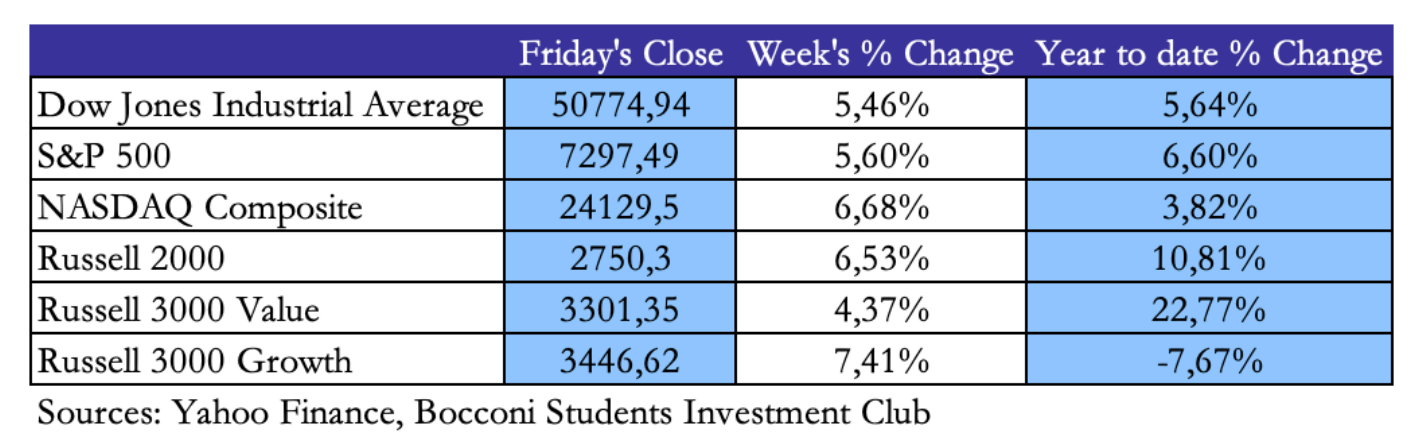
US equities staged their strongest week since April 2025 as the AI trade snapped back from the previous week’s rout. The S&P 500 rose 5.60% to 7,297.49, the Nasdaq Composite 6.68% to 24,129.50, the Dow 5.46% to 50,774.94 (its best week since October 2022) and the Russell 2000 6.53% to 2,750.30, while the VIX fell 33.7% to 23.81. The S&P 500 is still 6.7% below its 6 October record of 7,818.93, but is back to +6.6% for the year and the Nasdaq to +3.8%. Cyclical and tech-linked sectors led: materials gained about 7.9%, technology and communication services about 7.5%, while energy (+1.9%), utilities (+2.4%) and staples (+2.5%) lagged. The path was uneven: Monday’s 4.72% jump in the S&P 500 was followed by a pullback on Tuesday and Wednesday, before a thin, shortened Friday session in which AI names rebounded.
The whole week turned on Nvidia. On Monday its board reinstated Jensen Huang as President, CEO and director, reversing the position it took after its earnings the week before; the stock rose 31% on the day, and the board said it had received input from senior US government levels that his return poses no national-security risk. The rally faded quickly, with Nvidia sliding on Tuesday and Wednesday as several banks cut price targets for memory stocks on fears of a supply glut and S&P placed Nvidia’s AA rating on CreditWatch Negative. It finished the week 19.9% higher at $150.49, its best week since May 2023, and the Philadelphia Semiconductor ETF (SOXX) gained about 8.7%. Anthropic (ANT) ended at $91.88, up 3.3% on the week and about 10.7% above its $83 IPO price. Elsewhere, CrowdStrike agreed on Monday to buy Zscaler for about $43.9bn in stock, and Dell and Workday both fell after results, Dell despite a beat-and-raise quarter. Huang is due to testify before the Senate Banking Committee next week.
The data were firm, which kept the Fed’s December hike in view. October core PCE rose 0.3% m/m, in line, but the annual rate accelerated to 3.3% from 3.1% against 3.2% expected, with headline PCE at 3.8% y/y. The second estimate of Q3 GDP was revised up to 4.3% against 3.5% expected, initial jobless claims fell to 189k (200k expected) and new home sales rose 14.2% to 701k, while durable goods orders (+0.2%) and personal spending (+0.3%) were softer than forecast. CME FedWatch implied roughly 24bp of tightening for 9 December on Wednesday, so a 25bp hike is essentially priced, and about 55bp by March. Reports that the administration is preparing higher tariffs on China, the EU and others added to the noise.
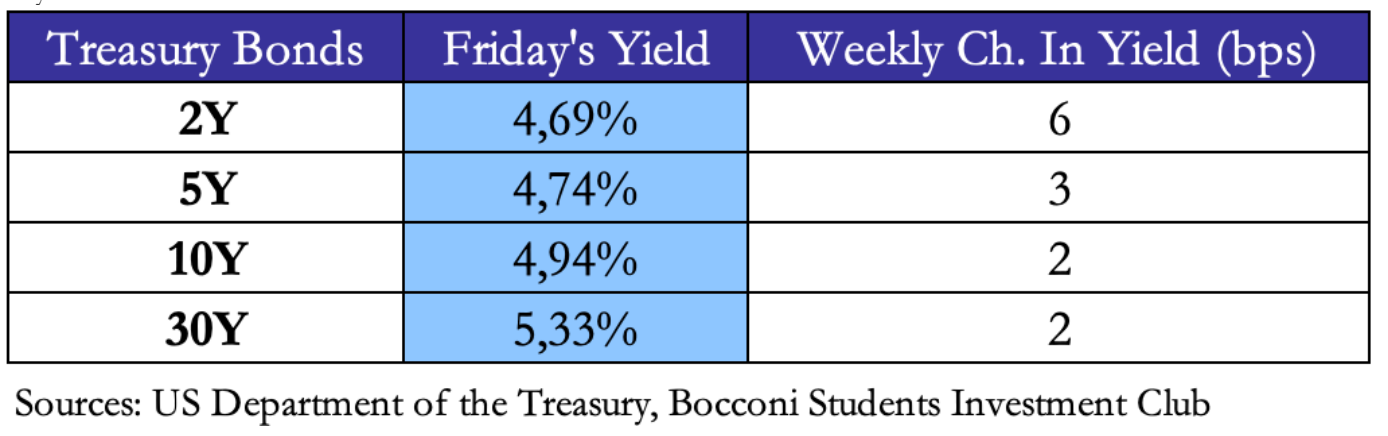
Treasuries rallied midweek and gave it back by Friday. Yields fell across the curve on Tuesday and Wednesday as equities sold off, with the 10-year at about 4.85% on Wednesday, and a $44bn 7-year auction tailed by 1bp, the largest tail since May 2024. As risk appetite returned and oil rose, the move reversed: on the Treasury par curve, the 2-year ended the week 6bp higher at 4.69%, the 5-year 3bp higher at 4.74%, and the 10- and 30-year each 2bp higher at 4.94% and 5.33%. The 2s10s curve flattened to about 25bp from 29bp. With a December hike all but priced, next week’s payrolls (consensus +90k, unemployment 4.1%) matter mainly for the pace of tightening beyond December.
Europe and UK
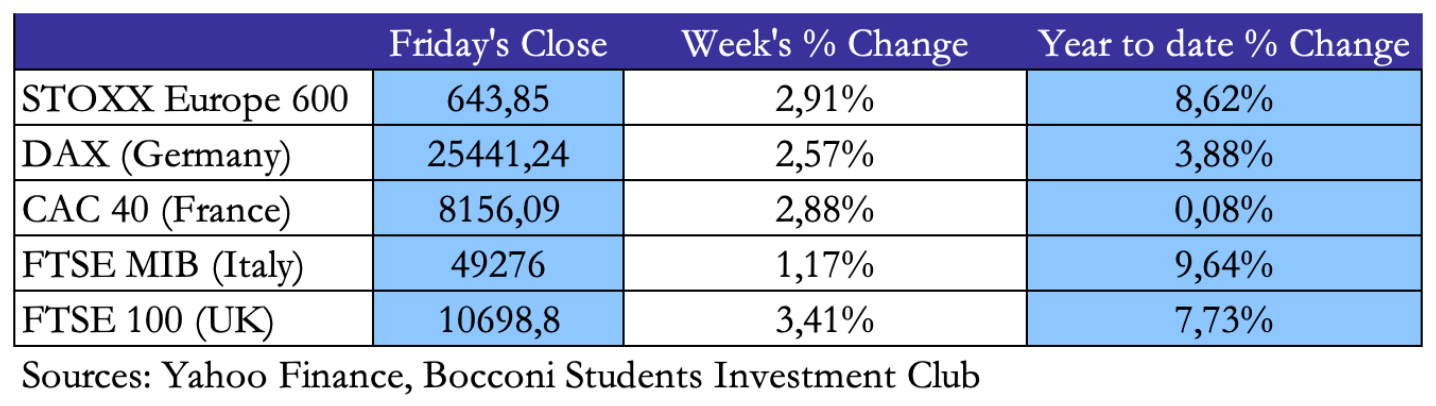
European equities had their best week since May, recovering part of the previous week’s losses as US tech steadied. The STOXX 600 rose 2.91% to 643.85 and is up 8.6% for the year. The DAX gained 2.57% to 25,441.24, the CAC 40 2.88% to 8,156.09, Italy’s FTSE MIB 1.17% to 49,276 and the FTSE 100 3.41% to 10,698.80, its best week since late March, helped by miners as copper had its strongest daily gain in ten months on Friday. The week was choppy: the STOXX 600 rose 1.8% on Monday, fell 0.7% and 1.1% on Tuesday and Wednesday as the US tech wobble returned, then rose 1.8% and 1.1% on Thursday and Friday while US markets were shut. Chips diverged, with ASML up 2.6% but ASM International down 3.3% and Infineon down 4.3%, and Rheinmetall rose 14.1%.
The flash PMIs were mixed. Germany’s composite rose to 55.0 against 53.3 expected, but France’s fell to 46.2 against 48.1 and the euro-area composite was 51.7 against 51.9. In the UK, the composite eased to 52.3 from 52.9 (51.9 expected), with services slowing to 52.0 from 52.8. French Q3 GDP was revised down to −0.2% q/q from −0.1%, while November CPI slowed to 2.9% from 3.4%, below the 3.2% consensus. After the close on Friday, S&P affirmed France at A+ but cut the outlook to negative from stable, citing larger deficits, weak growth and political polarisation, and expects a deficit of about 5.3% of GDP in 2027 without further measures. Moody’s and Fitch also have negative outlooks on France.
The ECB’s tone stayed hawkish. Bundesbank President Nagel said that the ECB “may have to do more” in December and expects inflation durably above 3% in 2027, while ECB’s Dolenc said the two hikes so far are not enough. Euro-area consumers’ inflation expectations rose to 3.5% from 3.1%, with October HICP at 4.0%. Germany’s Bundestag approved the 2027 budget, and the BoE’s Bailey said the peak for UK inflation will be lower if current energy prices hold.
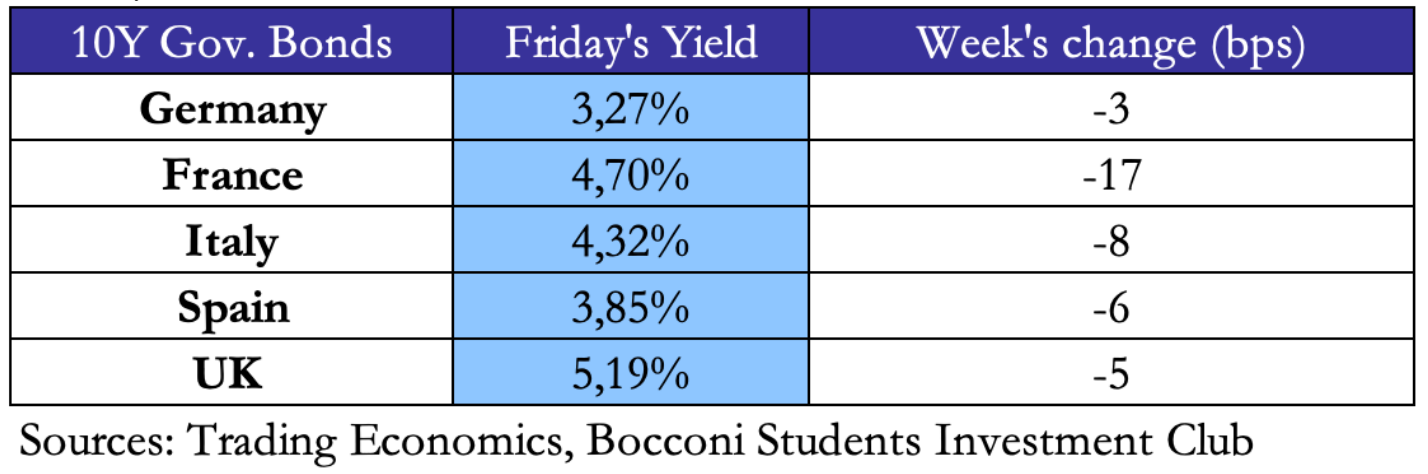
Government bonds were calmer than equities, with France the standout. The 10-year OAT yield fell 17bp to 4.70%, narrowing the OAT–Bund spread to about 143bp from about 157bp, in a move that coincided with cooler inflation data and came before S&P’s review. The Bund yield fell 3bp to 3.27% despite hawkish ECB comments, the BTP fell 8bp to 4.32% (spread about 105bp), the Spanish 10-year fell 6bp to 3.85% and the gilt fell 5bp to 5.19%. Bonds sold off on Friday as oil rose and risk sentiment improved, so most of the weekly rally came on Tuesday and Wednesday.
Rest of the World
Asian equities rebounded, but with violent daily swings. Japan’s Nikkei 225 rose 4.03% to 58,711.11 (Tokyo was closed on Monday for a holiday). The Kospi gained just 0.94% to 4,915.68 after moves of −3.3%, +6.3%, −6.2%, +0.3% and +4.3% across the five sessions, and the Kosdaq jumped about 6.7% in Friday’s session. Taiwan’s Taiex rose 9.1% to 39,308.08 after losing 17.5% the week before. Tokyo core CPI rose to 2.9% y/y in November, a 16-month high but just below the 3.0% forecast, and markets price roughly a 75% chance of a BoJ hike to 1.5% on 17–18 December, and the BoJ’s Tamura said a 50bp move may be needed if inflation risks materialise. The Bank of Korea raised its rate by 25bp to 3.25% on Thursday, its third hike this year, with two board members dissenting, and lifted its 2027 growth forecast to 4.1% from 2.9% on the chip boom.
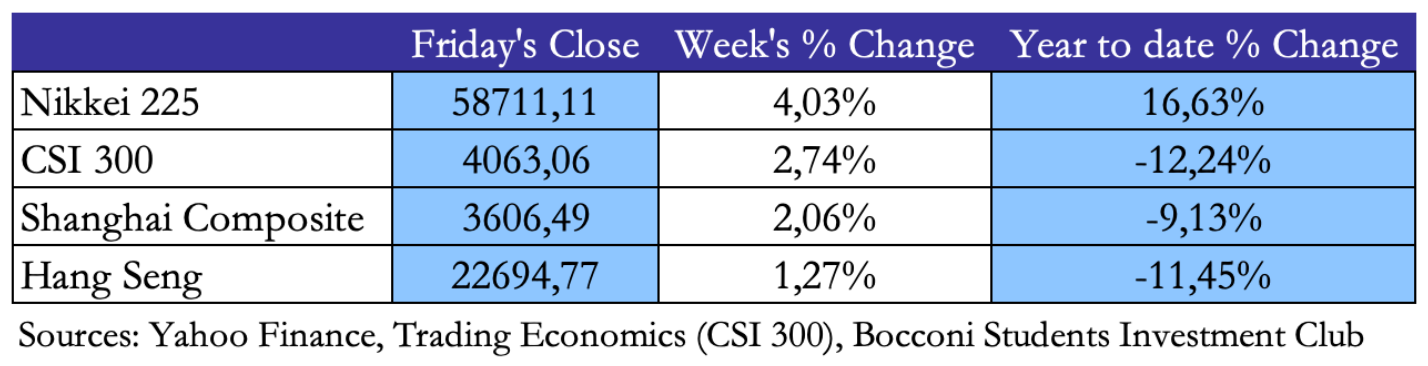
China’s markets gained after the State Council promised new capital-market support, including a bigger role for the “national team”, more dividends and buybacks and tighter defences against imported risks, though it gave no size or timing. October industrial profits rose 20.1% y/y, up from 14.4%, driven by electronics. The CSI 300 rose 2.74% to 4,063.06, the Shanghai Composite 2.06% to 3,606.49 and the Hang Seng 1.27% to 22,694.77, still down 11.5% for the year. In Australia, the ASX 200 gained 2.80% to 8,833.60 after the jobless rate hit 4.9% and a hotter-than-expected CPI print; the RBA meets on 8 December.
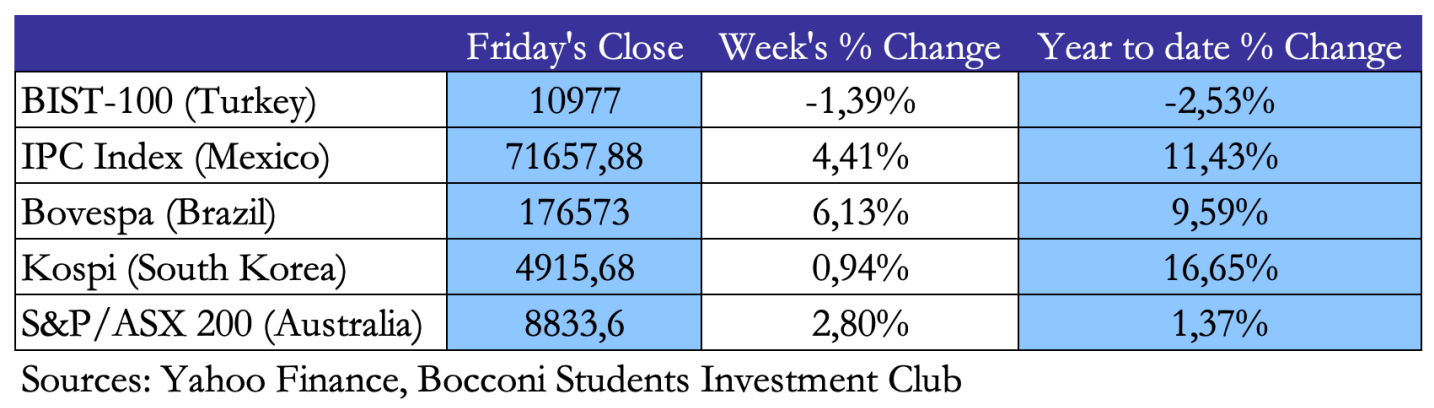
Brazil led emerging markets. The Ibovespa rose 6.13% to 176,573 over the week (the week’s base is Thursday 19 November, as B3 was closed on the 20th). It jumped 6.1% on Thursday, its biggest one-day gain since the first round of the presidential election, after President Lula named Bradesco chairman Luiz Carlos Trabuco as Finance Minister, which markets welcomed after fiscal concerns had weighed since Lula’s re-election. It slipped 0.1% on Friday as the initial euphoria cooled. Mexico’s IPC rose 4.41% to 71,657.88, while Turkey’s BIST-100 fell 1.39% to 10,977, the only decliner among the main indices.
FX and Commodities
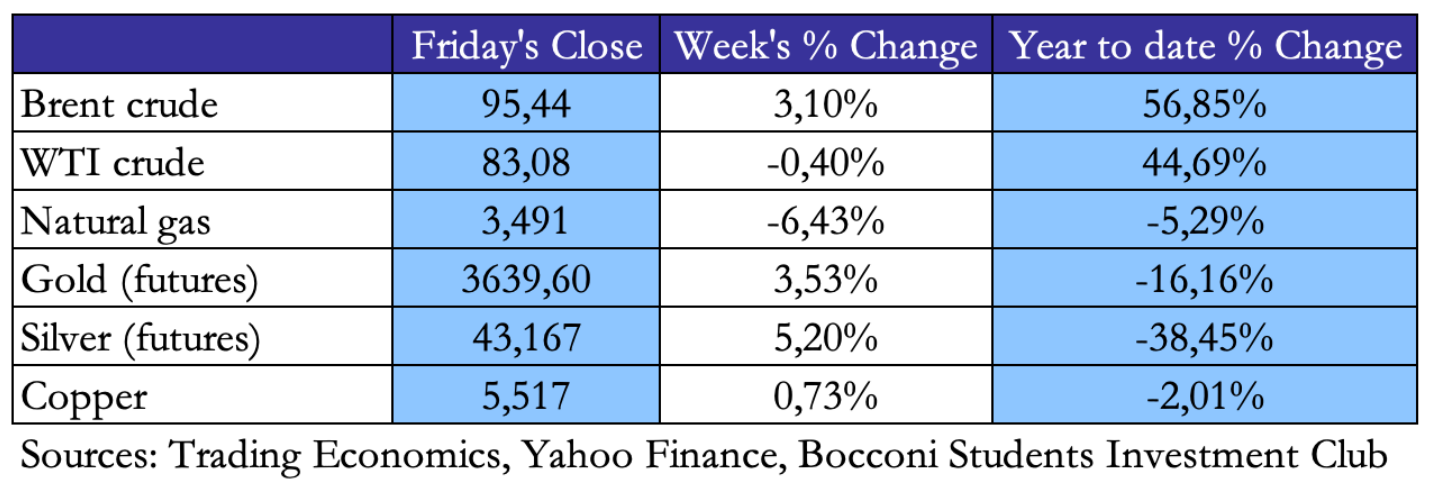
Oil snapped a three-week losing streak as Gulf supply risks returned. Brent settled at $95.44 on Friday, up 3.10% on the week, while WTI at $83.08 was down 0.40% on a like-for-like basis (the December contract expired last week, so the rolled January contract distorts the raw weekly change). Prices were driven by Houthi strikes on Saudi Arabia’s Ras Tanura refinery, an attack on the Jazan refinery, a projectile near a tanker off Dubai, a reported drone attack on Kuwait that Iran denied, and Trump’s description of a US naval blockade of Iranian ports, with Hormuz oil flows at about half of pre-war levels, according to Kpler. Trump also said he favours resuming military action against Iran after the New Year if there is no agreement. A smaller-than-expected 1.11m-barrel build in US crude stocks (2.0m expected) added support, and OPEC+ meets on Sunday, with sources expecting current output targets to be kept through Q1 2027.
Precious metals recovered much of their previous losses. Spot gold fell to $3,426 on Wednesday before rebounding above $3,650 on Friday, and gold futures ended the week 3.53% higher at $3,639.60, still 16.2% down for the year. Silver futures rose 5.20% to $43.17 and copper 0.73% to $5.52. US natural gas fell 6.43% on a like-for-like basis to $3.49 per mmBtu as the front month rolled to January.
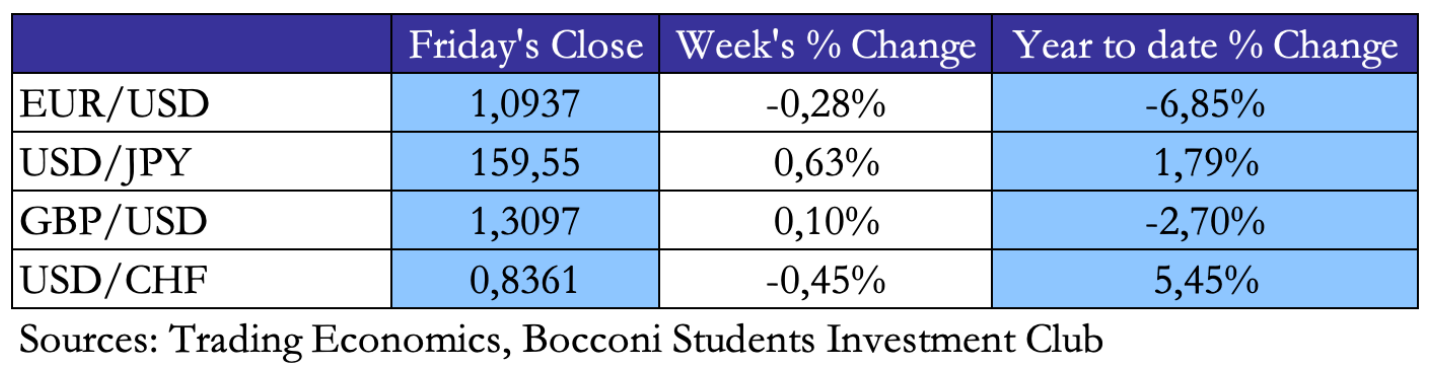
The dollar rose for a fifth straight week. The DXY gained 0.20% to 104.01, extending last week’s multi-month high as US growth data and Fed pricing outweighed the improvement in risk sentiment. EURUSD fell 0.28% to 1.0937, USDJPY rose 0.63% to 159.55, just below the 160 level that capped it last week, and GBPUSD edged up 0.10% to 1.3097. USDCHF fell 0.45% to 0.8361, although the franc lagged on Friday as haven demand faded. Bitcoin ended near $59,900, still below $60,000.
Next Week Main Events
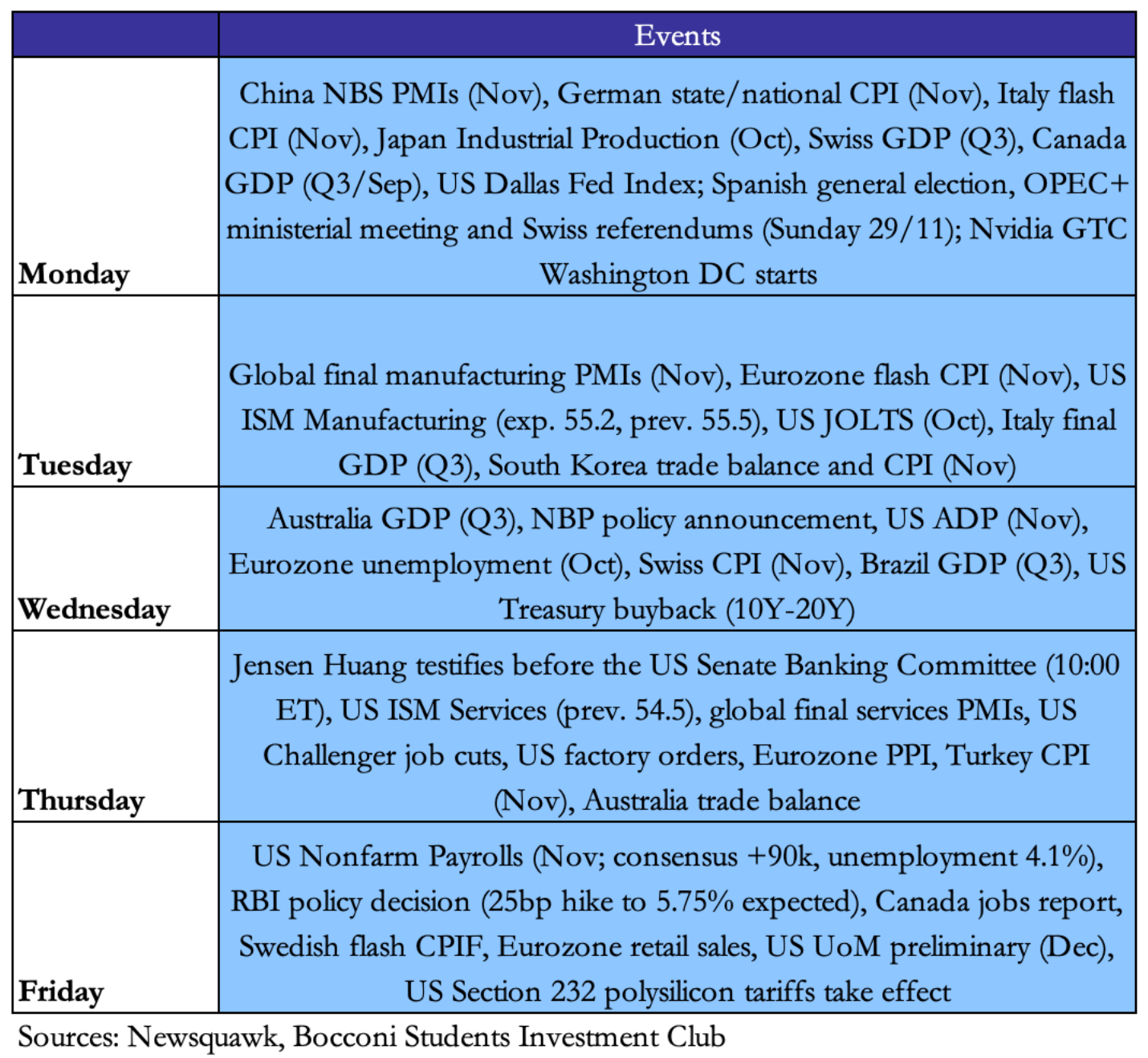
The week opens with the Spanish general election and the OPEC+ ministerial meeting on Sunday, with polls pointing to a PP–Vox majority and sources expecting output targets to be held. On Monday, the China PMIs (manufacturing expected at 49.4) and German and Italian CPI come first. Tuesday brings the euro-area flash CPI, with October at 4.0% against the ECB’s expectation of a peak around there, and the US ISM manufacturing index (expected 55.2). The Fed decides on 9 December. Thursday’s testimony by Nvidia’s Huang before the Senate Banking Committee is the main stock-specific event, alongside Marvell, Salesforce and Snowflake earnings during the week. Friday’s US payrolls (+90k expected) and the RBI decision (a 25bp hike to 5.75% expected) close the week, while the RBA meets on 8 December and the BoJ on 17–18 December.
Brain Teaser #24
You have three boxes labelled “Apples”, “Oranges” and “Apples and Oranges”. Every label is wrong. You may take one fruit out of one box without looking inside. How do you fix all the labels?
Brain Teaser #25
You have two ropes, each of which burns for exactly one hour but burns unevenly along its length, and a lighter. How do you measure exactly 45 minutes?


0 Comments