Thesis: Alternative managers are no longer constrained by investor appetite but by access to liabilities. An insurance balance sheet never redeems, replenishes itself through premiums and carries roughly ten times the equity committed to it.
Introduction
Every closed-end fund is born with an expiry date. Capital is called, deployed, harvested and handed back, at which point the manager returns to the same pension funds and asks them to commit again. Fee income decays on a schedule written into the partnership agreement. An annuity liability does the opposite. The policyholder hands over a premium, receives a promise stretching across decades, and cannot withdraw at will without surrendering value.
Apollo [NYSE: APO] shows what follows when a manager builds around that distinction. At the end of 2025 it oversaw ~$938bn of assets, of which the private equity business that made its name was only a small part. Its largest single client is Athene, the annuity platform Apollo helped found in 2009 and absorbed in 2022. Apollo did not buy an insurer to diversify earnings but bought one as a funding vehicle. KKR [NYSE: KKR] followed the same logic with Global Atlantic, whose assets grew from $72bn in 2020 to $158bn by the time it took full ownership in January 2024.
Higher rates have made guaranteed products attractive again, and those liabilities are an ideal home for private credit, because an insurer facing little redemption risk can hold loans a mutual fund cannot. Europe is now receiving the same treatment, with Athora closing its £5.7bn purchase of Pension Insurance Corporation in March 2026 and Brookfield taking Just Group at £2.4bn five days later. Whether this deserves applause or alarm depends on what the spread represents: capital that can finally bear illiquidity, or risk held at charges that understate it. Regulators spent years debating that question and, in 2026, began acting on it.
The Mechanics of the Model
The model rests on two features of an insurance balance sheet. First, its liabilities are long-dated. A traditional fund must realise its assets and return capital within ~7-10 years. By contrast, when an investor buys an annuity, the premium joins the insurer’s balance sheet and remains there for years. Deferred annuities typically carry surrender charges for the first few years, disincentivising early withdrawals. This enables insurers to make a ten-year private loan and hold it to maturity, in the absence of pressure to sell. Traditionally, the funding is also cheap, because an insurer only needs its investments to yield more than what it credits to policyholders. The second feature is a highly leveraged balance sheet. Regulators require insurers to hold their own capital against what they owe to policyholders. These capital requirements are risk-based, with buffers varying by region. On a balance sheet basis, however, the equity cushion remains thin, at roughly a tenth of assets. The manager charges fees on all those assets, while the insurer earns the spread between portfolio returns and credits to policyholders.
This model feeds itself, with higher-yielding private assets allowing insurers to offer policyholders better rates, gaining market share and bringing more premiums to invest. For example, Athene, which Apollo took control of in 2022, has been one of the largest sellers of annuities in the U.S. in recent years. Illiquid holdings without stable market prices make up a growing share of Athene’s total assets, and although Apollo argues that its incentives are aligned with policyholders’, regulators are starting to scrutinise this trend.
Accountants sort assets into three levels by how they are valued, with Level 1 assets having quoted prices in active markets, Level 2 assets being priced based on observable market inputs, and Level 3 assets having no observable price. In this context, Level 3 assets typically include privately placed investment-grade loans and asset-backed finance, the type of assets these managers originate and that the float is built to hold. At Athene, Level 3 assets rose from 12% of total assets at the start of 2021 to 36% by Q3 2025. At Global Atlantic, the share tripled from 10% to 30%, as shown below. 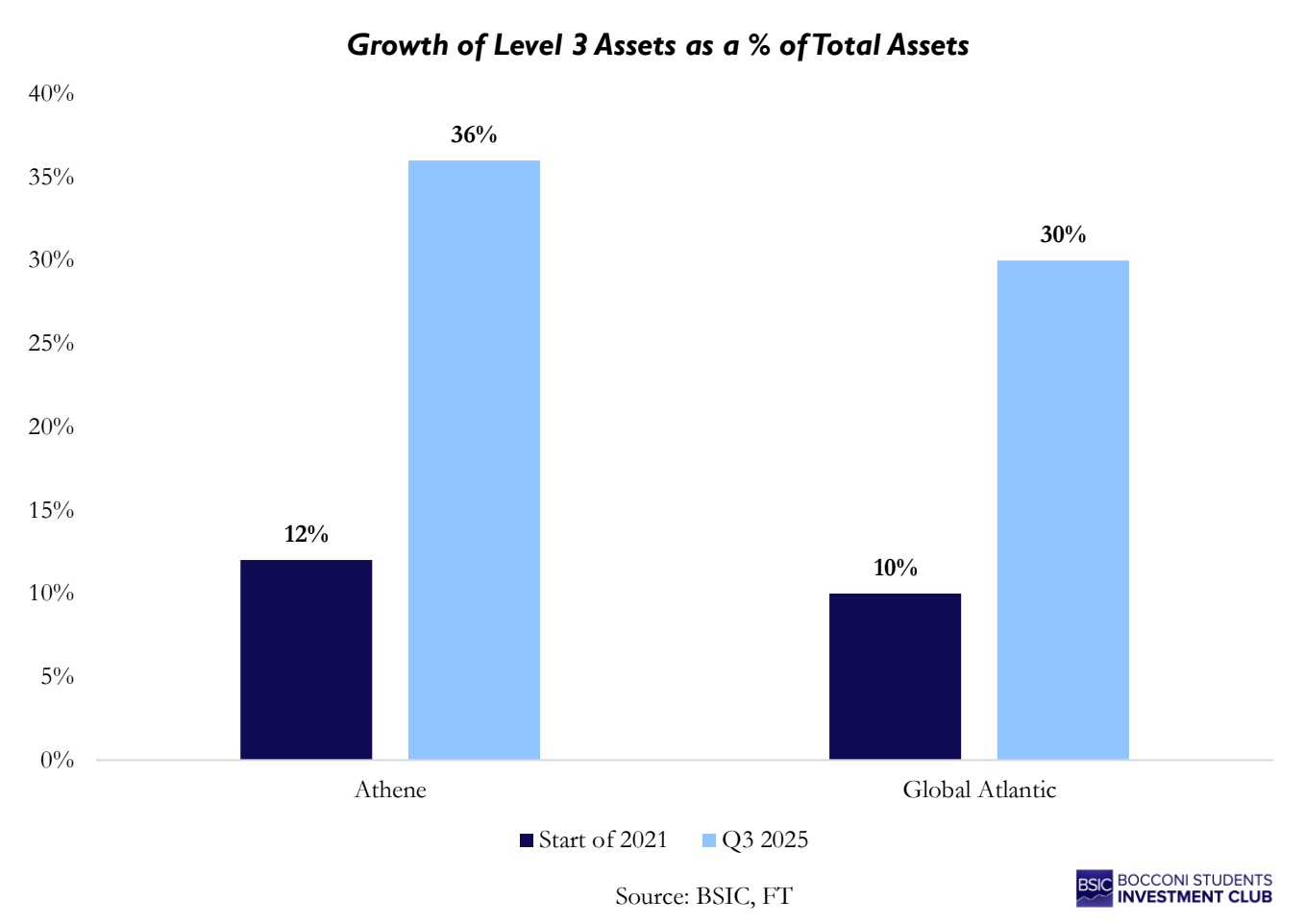
If growth is limited by access to liabilities rather than capital, a way to earn more is increasing earnings from each dollar of liabilities, by widening the spread on the assets behind it. Private, illiquid loans typically pay more than public bonds, and the managers can originate them in-house, while earning an origination fee. The rising share of Level 3 assets as shown above is the footprint of this incentive.
Buy the Insurer, or Rent the Float
The industry is split into two broad structures, with a third route between them. Firms such as Apollo, KKR and Brookfield take full ownership, purchasing insurers and consolidating them onto their own balance sheet. Other companies such as Blackstone and Ares choose to stay asset-light. Blackstone acquired a 9.9% equity stake in AIG’s Life and Retirement business, enough to win a long-term mandate to manage much of its portfolio and receive fees through an investment management agreement, without taking on the burden of its liabilities. Ares seeded its own annuity company Aspida, funding its growth largely from outside equity and chose to manage the assets itself. Between these two structures sits funded reinsurance, in which a manager-backed reinsurer takes on a block of annuities along with the assets backing them, receiving the float without acquiring the company.
The key differentiator is who carries the balance sheet. An outright owner receives both income streams, fees on assets and the spread, but as a trade-off, takes on the capital, interest rate risk and regulatory scrutiny. The minority investor receives fees while leaving the underwriting risk with the insurer’s shareholders, thus practically renting the liabilities. So far, the market seems to have preferred renting. An HBS working paper suggests that managers with insurance-heavy models earn lower returns on equity and trade at lower multiples than asset-light peers. Several factors may explain this discount, the first being an asset-light manager earns fees with less risk of using its own capital, improving their return on equity. A consolidated insurer or conglomerate brings solvency rules and may attract a conglomerate discount. Additionally, asset-heavy models face increased sensitivity to yields due to their large fixed-income portfolios.
KKR demonstrates how the full-ownership model compounds by acquiring a 60% stake in Global Atlantic in early 2021, where it took over management of the insurer’s portfolio and began feeding its loans from its own origination platform. The insurer did not grow through simply raising capital, but by taking on more liabilities, through the reinsurance mechanism discussed above, purchasing blocks of other insurers’ annuities. KKR purchased another 37% of shares for ~$2.7bn in November 2023, before taking full ownership in January 2024. By the time the deal closed, Global Atlantic’s AUM had more than doubled to $158bn, increasing KKR’s fees, while full ownership gave it the investment spread as well.
The playbook is spreading, with managers becoming less dependent on committed capital from investors, and the focus shifting to securing long-dated liabilities. As the U.S. market has become crowded, firms have looked for the next large pool in Britain.
The 2026 European Wave
If the constraint is access to liabilities, and the U.S. market is increasingly crowded, the next step is to seek liabilities abroad. In the space of just a few months, three buyers did exactly that through different structures, yet seeking the same long-dated pool of pension liabilities.
In March 2026, Apollo-backed Athora completed its £5.7bn acquisition of Pension Insurance Corporation (PIC), one of the UK’s largest specialist insurers of defined benefit pension schemes, from a consortium including CVC Capital and Reinet Investments. To fund it, Athora raised €3.5bn of new equity to take over PIC’s £55bn assets and a large pool of pensioners who cannot withdraw for years to come. The combined group has ~€139bn of assets under management and administration and is planning to relocate its headquarters to London by late 2027. A crucial aspect of this deal is that its structure sits in between the two models discussed above. Apollo neither owns the insurer outright, nor simply manages its money. Together with Athene, Apollo owns around a quarter of Athora, so PIC’s liabilities sit with Athora’s shareholders rather than on Apollo’s balance sheet. Yet Apollo holds board seats and helps manage Athora’s assets. PIC will now gain access to Apollo’s origination, such as in private investment grade credit, and for Apollo, they now have access to a sterling-denominated home for the loans it originates, securing them with a fraction of capital compared to outright owning them.
Just a few days later, Brookfield chose the opposite route, completing a £2.4bn takeover of Just Group, a retirement income and pension buyout specialist, with over 700,000 customers and managing £30bn of pension savings. With Brookfield’s support, Just is well positioned to capture growth in the UK pension risk transfer market, and increases Brookfield’s insurance AUM to $180bn. Brookfield told investors that Just can now bid on larger pension schemes with Brookfield’s balance sheet behind it. Thus, this acquisition didn’t only buy the book of liabilities but also opened the door to bigger blocks in the future.
Shortly before these, just before Christmas 2025, JAB Insurance agreed to buy Utmost Group’s UK life and pensions business, with the unit holding just over £5bn of assets. It provides JAB with a regulated UK insurer that competes for UK pension buyouts. Taken together, the three deals point to the fact each bought liabilities which do not redeem, pensions that will be paid for decades and cannot be withdrawn. The question is why all three chose Britain specifically.
Why Britain, and Who Is Next
The clustering of these deals in London is not an accident of timing. When the UK rewrote Solvency II as Solvency UK, it did two things that matter to an owner whose business is origination. It cut the risk margin for long-term life business by roughly two-thirds, and it loosened the matching adjustment, the rule that lets an insurer discount its liabilities using the illiquidity spread earned on assets it holds to maturity. Since June 2024, assets with “highly predictable” rather than strictly fixed cashflows can qualify (up to 10% of the M&A benefit), the old cap on sub-investment-grade assets is gone.
The effect is that the regulation pays for exactly what these managers produce. Every extra basis point of spread on a matched private loan lowers reported liabilities and frees capital. An infrastructure loan originated directly at gilts plus 180bp, against 140bp for a comparable bond in the secondary market, is 40bp that flows straight into the MA benefit. Just as important is what the MA leaves out: equities, CLOs and unrated offshore assets remain largely ineligible. The UK version of the model therefore rewards origination, not structured-product engineering.
The second draw is how liabilities arrive. In the U.S., annuities are sold one policy at a time through brokers and banks. In the UK, pension risk transfer delivers them wholesale, where a single trustee decision hands an insurer an entire population of pensioners. Insurers wrote a record 370 buy-ins worth £38.2bn in 2025, and WTW expects around £70bn of risk transfer in 2026, longevity swaps included. The supply is structural: UK defined benefit schemes held an aggregate surplus of about £206bn in March 2026, with 54% funded at or above buyout, and LCP puts the next decade at £350–550bn. Pensions in payment carry no surrender option, making them a cleaner match for illiquid assets than a US fixed indexed annuity. For a manager whose constraint is liabilities rather than capital, one jumbo buy-in replaces years of retail distribution.
The third point is price. Brookfield paid around 1.1 times own funds for Just, a 75% premium to the undisturbed share price. Public investors value a UK annuity writer on dividends and capital generation, with a discount for balance sheets they cannot see into. A private capital owner values the same book as a funding base for its origination platform, earning the spread and a management fee on top. As long as that gap persists, it tends to close through takeovers, which is why the three deals of the past nine months look like the start of a trend rather than a set of one-offs.
The likely next moves follow from that logic. Managers without a UK platform, among them Blackstone, KKR and Ares, now have to decide whether to buy one or to rent one. The remaining mid-sized annuity writers and closed-book consolidators are the obvious targets. The largest listed players are too big to acquire outright, so they are more likely to be approached with funded reinsurance and asset management partnerships of the kind described above. The one brake is the PRA. It tightened its approach to funded reinsurance in 2025 and published a life insurance stress test that November. London welcomes this capital, but it is watching it. In Washington, that scrutiny has become open confrontation.
The Regulatory Reckoning
The U.S. debate went from quiet to loud within five months. On 7 May 2026, Treasury Secretary Scott Bessent called state insurance commissioners and the NAIC to the Treasury to discuss private credit, offshore reserves and private letter ratings. Over the summer, two insurers linked to Guggenheim’s Mark Walter disclosed more than $20bn of loans that had been classified as non-affiliated when they were not. The DOJ and SEC are now investigating, although Walter himself has not been accused of wrongdoing. On 10 September, Senator Elizabeth Warren wrote to the NAIC asking whether “enhanced federal or state guardrails” were needed. The NAIC replied on 25 September that its evolving toolkit “does not reflect an insurance regulatory vacuum”. Even Apollo’s Marc Rowan has criticised Delaware’s regulators for missing the misclassification.
The scale explains the attention. According to Warren’s letter, life insurers’ private credit holdings rose from $386bn in 2014 to $849bn in 2024 and are now close to $1tn, out of roughly $5.6tn of total life assets. Around $2tn of liabilities has been ceded to offshore and captive reinsurers, including more than $1.1tn to Bermuda. Bermuda’s defence is liquidity: under the BMA’s 1-in-200 stress test, its life insurers show a median liquidity coverage ratio of 471% against a 105% minimum, and a prudent person principle took effect in January 2026. Critics, however, are less worried about a run than about valuation and capital. Research from Columbia finds that privately rated securities are about twice as likely to be impaired as publicly rated ones yet less likely to be downgraded, which implies a gap of two to three rating notches. The capital effect is large: an insured senior tranche rated A can carry under 1% capital, against around 30% for holding the underlying fund directly.
Three measures begin to bite with the filings due on 31 December 2026. The first is a new set of CLO capital factors, which will also cover middle-market CLOs. They cut the charge on AAA tranches from 0.158% to 0.036% and raise it on BB+ tranches from 3.2% to 15.1%, rewarding senior exposure and penalising the mezzanine risk that managers often keep. The second is the next round of AG 55 testing, which requires cedents to show that assets backing large, reinsured blocks hold up under moderately adverse scenarios, making offshore cessions less of a black box. The third follows a July 2026 NAIC review of multi-asset securitisations, which named Apollo’s AMAPS, held by Athene, and KKR’s Thunderbird and Lightning vehicles, held by Global Atlantic. The review flagged a risk of “circular ownership” and is weighing look-through disclosure. Apollo points to diversified, highly rated collateral and low leverage, but a separate sample found that about a quarter of life insurers that own private fund stakes also lend to the same funds, typically $2 of debt for every $1 of equity.
None of these measures bans the model; they reprice it. The test is whether the capital relief matches the reduction in risk. If a structure removes 90% of the economic risk and earns 90% capital relief, it is doing its job. If it removes 40% and earns 97%, it is arbitrage. The answer divides the model in two. Returns built on origination spread should survive the year-end rules largely intact. Returns built on rating and structuring advantages will start to shrink. Britain’s matching adjustment already pays for the first and largely excludes the second.
Conclusion
Both readings hold, but not equally. The asset and liability match is real economics, and an insurer that can hold a thirty year loan to maturity should earn more than one forced to sell it. That survives any tightening of the rules. What does not survive is the part of the spread earned from where risk is booked rather than what it is, and on the evidence of affiliated lending and the gap between private and public rating performance, that part is not small. The model has also stopped being opportunistic. Roughly $1tn of private credit now sits inside $6tn of life assets, with about $2tn of liabilities ceded offshore. A structure that size cannot be unwound by a disapproving regulator without causing the instability the regulator is trying to prevent. The constraint on further growth is therefore regulatory rather than commercial.
Three things will settle the argument. The first is 31 December 2026, when Actuarial Guideline 55 and the revised CLO charges take effect and the industry learns how much of its reported spread survives the new arithmetic. The second is the next British bid, which will show whether three takeovers in four months began a repricing of the listed life sector or closed a short window. The third is affiliated lending, the cleanest indicator of whether these groups manage insurance assets or use insurance balance sheets to fund themselves. Private capital has solved a problem the fund model could not, and has done so partly by moving risk somewhere it is measured less strictly. The first half explains why the model persists. The second explains why the next few years will be spent arguing about its price.



0 Comments