Building a data centre in Europe takes about two years. Connecting it to the grid can take five times as long, with waits of seven to ten years in the main hubs. For hyperscalers racing to add AI capacity, that wait is now the biggest obstacle, and it has changed what is scarce in European power: no longer generation, but access to the grid. This is where Europe’s coal plants come in. The coal exit is leaving behind dozens of sites that already have high-voltage connections, switchyards, cooling water and industrial zoning in place. The irony is that assets which sat on utilities’ balance sheets as liabilities are now being repriced as “powered land”. This value, however, holds only as long as the scarcity lasts, and it faces technical, legal, political and buyer concentration risks.
Why Interconnection Is the Bottleneck
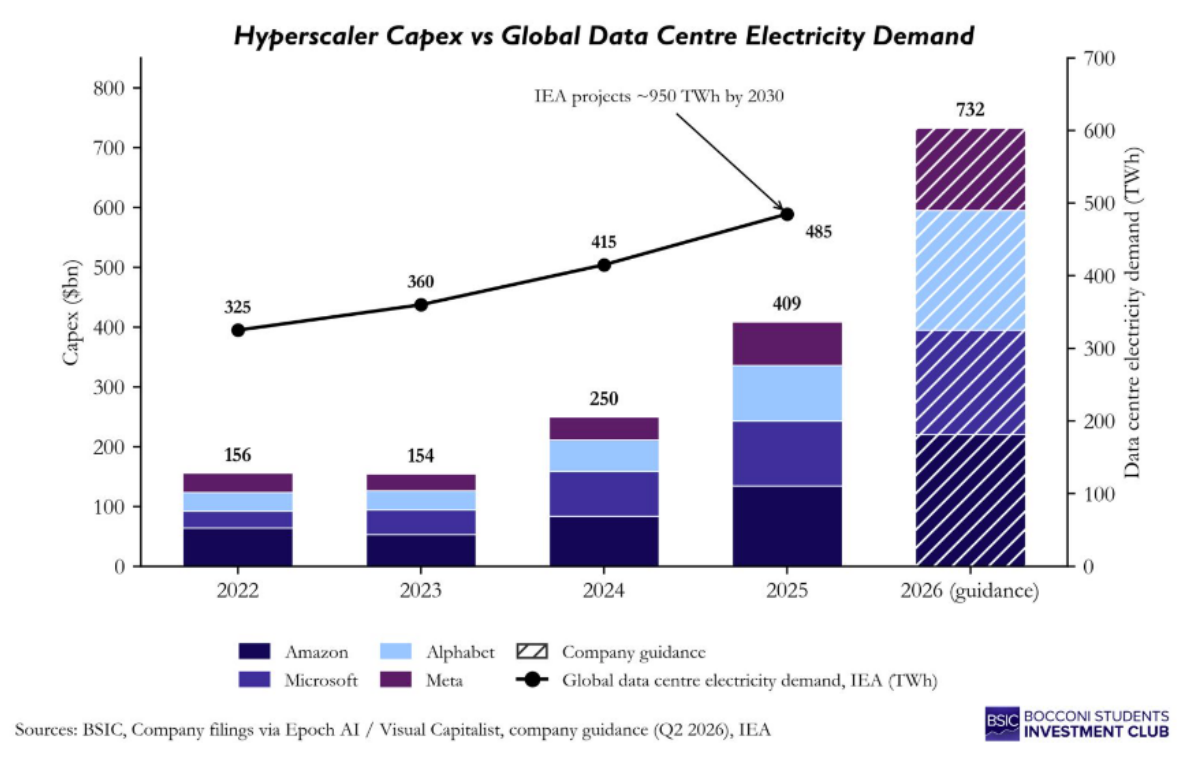
The capital is already committed. Amazon [NASDAQ: AMZN], Microsoft [NASDAQ: MSFT], Alphabet [NASDAQ: GOOGL] and Meta [NASDAQ: META] spent roughly $155bn a year between them on capital expenditure in 2022 and 2023. That rose to $250bn in 2024 and $409bn in 2025, and their combined guidance for 2026 now sits at around $732bn, close to five times the 2023 level. Electricity demand is following the money. The IEA estimates that global data centre consumption rose from 325 TWh in 2022 to 485 TWh in 2025, and it projects roughly 950 TWh by 2030. Europe is moving along the same curve. S&P Global [NYSE: SPGI], through its 451 Research unit, expects European data centre demand to climb from about 145 TWh in 2025 to 238 TWh by 2030, with data centres accounting for about a quarter of all growth in European power demand over that period. The figures are large, but they are not what holds the build-out back. Europe is not short of electrons in any meaningful sense. Its ten largest power markets logged 3,687 hours of negative prices in 2025, another record, which is hardly the profile of a continent running out of generation. The difficulty lies elsewhere: delivering that power to one particular plot of land, on one particular date, with enough certainty that a hyperscaler will commit a multibillion-euro campus to it.
The industry now calls this “time-to-power”, and it has displaced capex as the variable that decides where capacity gets built. Pamela MacDougall, who heads energy markets and regulation for AWS in EMEA, described the mismatch bluntly earlier this year: a new data centre takes around two years to bring online, while securing the power for it can take up to seven. The IEA puts connection waits across the EU anywhere between two and ten years, with the long end sitting precisely in the FLAP-D hubs hyperscalers want most, namely Frankfurt, London, Amsterdam, Paris and Dublin. For a company spending tens of billions a year on AI capacity, a five-year gap between a finished building and an energised one is not an inconvenience. It is capital sitting idle while a competitor trains the next model.
Therefore, this change in scale adds complexity to the problem. Data centres used to be sized in tens of megawatts and could usually be slotted into spare capacity on the local distribution network. AI campuses belong to a different order of magnitude. All 99 data centres in London together draw around 760 MW at peak, whereas several campuses coming online in the United States this year are designed for a gigawatt or more each, and the European pipeline is moving the same way. A load of that size cannot be absorbed by reinforcing a nearby substation. It has to connect at transmission level, which means joining the longest queue in the system and depending on the slowest infrastructure to build.
Regulatory Rationing of Grid Capacity
The obvious answer is more transmission, and Brussels has now put a number on it. The European Grids Package, published in December 2025, estimates that EU electricity networks need around €1.2tn of investment by 2040, roughly €477bn of it for transmission, and proposes capping permits for grid projects at two years with a possible one-year extension. The Dutch government’s own estimate puts the lead time for new high voltage transport capacity at eight to twelve years, and TenneT’s 380 kV line between Eemshaven and Groningen, commissioned in 2023, took three years to build after thirteen years of preparation. Equipment adds its own delay. The IEA reports supply gaps of around 30% for large power transformers in key markets, with lead times in some cases stretching past 127 weeks against roughly 50 before 2021. A campus designed today would be on its second or third generation of chips before a line built for it entered service. Regulators have therefore been left doing what regulators do when a scarce resource cannot be expanded quickly enough. They ration it.
Ireland got there first. From 2022 EirGrid stopped offering new data centre connections in the Dublin region, signalling the freeze could last until 2028, and the effect shows up clearly in the pipeline: Dublin now has around 1,343 MW operational against just 105 MW under construction. The regulator formally reopened connections in December 2025, but only for projects that bring their own generation or storage and source 80% of their demand from new Irish renewables within six years. That is less an open door than a toll, and EirGrid’s own adequacy assessment still warns of peak shortfalls running through 2028, with data centres already consuming close to a third of the country’s electricity.
The Netherlands shows what happens when rationing reaches the courts. TenneT’s national waiting list held 212 offtake requests adding up to 38 GW at the start of this year. When Goodman [ASX: GMG] sued the grid operator to force through a 70 MW connection for a data centre near Schiphol, a Dutch court ruled in April that TenneT was entitled to leave it in the queue, with capacity in the area potentially constrained until around 2035. Germany has overhauled how large loads are allocated as well, a change important enough to the legal case for coal sites that the article returns to it later.
Britain offers the clearest view of what rationing does to everyone else in the queue. In 2022 the Greater London Authority warned developers that large housing schemes in Hillingdon, Ealing and Hounslow might not secure a connection until 2035, because data centres clustered along the M4 corridor had absorbed the available capacity. Four years on the constraint has eased only at the margins, and London’s connection queue still runs at about ten times what the local network can supply. Nationally, Ofgem’s July consultation counts roughly 315 data centres waiting for around 73 GW of connections, comfortably more than Britain’s entire winter peak demand.
Overall, the pattern across all four markets is the same. Grid access has stopped being a service a developer buys and turned into an entitlement a developer holds. Anyone already sitting on a firm, energised connection at transmission level owns something nobody can replicate on a timeline a hyperscaler would accept. The regulators’ own behaviour confirms it, since rules designed to stop speculation in the queue only make sense if a place in the queue is worth speculating on.
The Embedded Infrastructure of Decommissioned Coal Sites
That is where decommissioned coal plants come in. A large coal unit existed to push hundreds of megawatts into the transmission system, so it sits on a high voltage switchyard and substation that were energised for decades and in many cases still are. The connection usually outlives the boilers. So does most of the surrounding infrastructure. Coal stations drew enormous volumes of cooling water, which left them with abstraction rights on rivers and coastlines that a modern data centre, with a heavy cooling load of its own, can put straight to use. They were zoned for heavy industry in an era when few people lived nearby, and most were built around rail sidings that once brought fuel in by the trainload.
Very little of that can be assembled from scratch on any useful timeline. Anyone trying to permit a greenfield campus on the edge of Frankfurt today faces years of approvals before the first foundations go in, assuming the answer is yes at all. A retired coal site arrives with most of the hard parts already settled. The important caveat, picked up in the bear case later in the article, is that a connection built to export power is not automatically one that can import it. Even so, a connection that needs new transformers is years closer to service than one that does not exist.
Cambois in Northumberland shows how durable that value can be. The land once hosted Blyth Power Station, a coal plant that closed in 2001 and was later demolished. The same site then drew Britishvolt, which planned a £3.8bn battery gigafactory there before collapsing into administration in 2023. Blackstone [NYSE: BX] bought the land for its data centre business QTS and now holds consent for up to ten data centre buildings across 540,000 square metres, an investment put at £10bn and phased through to 2035. The coal has been gone for a quarter of a century and the gigafactory was never built, yet the site has attracted two separate waves of industrial capital since the plant shut.
Powered Land as a Distinct Asset Class
The result is a distinct asset class that the market has taken to calling “powered land”, where the grid connection is the product and the hectares come attached. Linklaters, which has advised on a number of these transactions, argues that once proximity to demand is accounted for, reliable near-term access to power has become the main driver of land value. Deal terms increasingly say so outright. One U.S. hyperscale campus acquisition the firm advised on was made conditional on securing a 600 MVA grid connection before it could close.
Prices now reflect this. JLL [NYSE: JLL] estimates that prime powered land in the FLAP-D hubs costs around €2.26m per MW of IT load, up 82% since 2021, with primary markets trading at 2.3 times secondary locations and four times tertiary ones. Linklaters’ valuation bands make the role of timing explicit. In core markets powered land can command between €800,000 and €1.4m per MW of grid capacity, while sites whose power arrives later trade more like development options at €200,000 to €700,000 per MW, on the logic that a megawatt delivered in 2028 is worth materially more than one delivered in 2032. In Britain, industrial land with power attached has changed hands at £8m to £15m per acre, against £4.5m to £6m for ordinary London industrial land. Even the regulator now thinks in these units. Ofgem’s proposed commitment fee for data centres, designed to deter speculative queue positions, would be set between £237,500 and £712,500 per MW.
The clearest European example this year did not involve coal at all. In May, Nasdaq listed IREN [NASDAQ: IREN] agreed to buy Nostrum Group, a Spanish engineering business founded in 2009 to build renewable projects. What IREN was really paying for was around 490 MW of secured, grid connected power in Spain, which on completion in June became the whole of its European platform. The price was never disclosed, but the market ran its own numbers and IREN’s shares rose close to 8% on the announcement. A renewables developer had been repriced as a data centre company purely on the strength of what it held in the connection queue.
Buyer Concentration and the Division of Value
For gigawatt scale sites in Europe the buyer pool is, in practice, four companies. Amazon and Microsoft each account for roughly 9 GW of European corporate power procurement according to S&P Global Platts, Google for around 4 GW, and Meta rounds out the group. Speculative development has largely dried up as a result, and JLL notes that partial pre-lets are now the norm across major markets, so the hyperscaler is usually committed before the first building rises.
A market with four buyers and a few dozen credible sites is not really a property market. It is a bilateral negotiation in which the seller holds something the buyer cannot manufacture and the buyer holds the only cheque large enough to pay for it. The price that emerges is bounded on both sides. The ceiling is set by the buyer’s alternatives. It can wait its turn in the queue, or it can build its own generation behind the meter, an option Linklaters notes developers are increasingly exploring through co-located plants and private wire networks. The floor is whatever the site is worth to its owner without a data centre on it. Where the price settles between those two bounds, and therefore how much of the value a utility sitting on an old coal site actually captures, is the question the next section takes up.
From Liability to Asset: How Value Is Captured
Europe sits on hundreds of decommissioned power plants that were shut down through economic obsolescence or environmental regulation. These vacated sites carry no economic value and sit empty because decommissioning, disposal and habitat restoration costs outweigh the benefits of carrying them out. The result is a large negative NPV attached to old coal and gas plants across the continent. US studies suggest only around 20% to 30% of demolition costs can be recouped by site owners, which is what leads to the backlog of dormant plants. BNP Paribas [EPA: BNP], through its asset management arm, estimated in 2023 that global decommissioning liabilities across energy, mining, industrial, waste and shipping assets total at least $8tn. Germany’s coal exit illustrates the scale of the numbers involved: the European Commission approved €2.6bn of state compensation to RWE [ETR: RWE] and €1.75bn to LEAG for early lignite closures, payments that account for both the cost of demolition and the profits forgone by shutting down ahead of schedule. Decommissioning also carries risk beyond the accounting inconvenience it represents. In 2016, four workers were killed by the partial collapse of the boiler house at Didcot A in the UK, demonstrating that controlled demolition of these structures is dangerous and highly technical work. Deferral, therefore, is not merely convenient, but the value-maximising strategy for an owner with no alternative, productive use for the land.
However, each of these plants possesses one critical asset: an established grid connection. Power and grid access have become the binding constraints on AI infrastructure worldwide, to the point that hyperscalers have begun acquiring energy companies outright. Google completed its $4.75bn acquisition of Intersect Power in January 2026, the first full vertical integration by a hyperscaler into generation and storage, bringing roughly 6.5 GW of capacity. More importantly, Intersect’s grid-tied assets were carved out prior to the acquisition, meaning Google specifically targeted the behind-the-meter portion of its portfolio. xAI, whose facilities have received limited grid connection allowances, runs Colossus 1 primarily on methane gas turbines, solar and Tesla [NASDAQ: TSLA] battery systems. This strategy of acquiring immediate power generation demonstrates that the real problem is a queuing issue, and that is precisely what Europe’s dormant plants bypass.
Three Structures, Three Risk Profiles
Owners are monetising these connections through three routes, and the choice between them reveals how much of the future premium the seller believes is still to come. Outright sale transfers ownership in full to a hyperscaler who will then turn the acquisition into a productive asset themselves. The owner converts a decommissioning provision into immediate cash and removes the liability from the balance sheet. This is the cleanest option and the easiest solution for a landowner that does not operate their own energy production business, but it also caps participation in future profits. Every subsequent euro of connection premium accrues to the buyer who now possesses the asset, and the long-term power supply relationship goes to the energy company that fits the needs of the hyperscaler. Ground leases trade that certainty for duration. The owner retains the asset, receives indexed rent over a 30 to 50-year term, and holds possession of an asset whose scarcity is still increasing, allowing them to capture future premiums. The trade-off is that the owner remains exposed to obsolescence: if cheaper power solutions emerge, or the tenant’s technology requirements change, the residual value assumption underpinning the lease weakens. Power purchase agreements (PPAs) are where the best economics sit. The issue is they are available only to owners who retain generation and a supply license. A PPA represents a long-term contract to buy electricity at a pre-agreed price outside the spot market; the generator gains contracted revenue that makes the asset bankable, and the buyer gains price certainty and, increasingly, physical access to power. The arithmetic explains why this strategy is preferable to both supplier and contracting party: 1,000 MW at a retained margin of €10/MWh and a 75% load factor generates roughly €66m annually, which over twenty years exceeds the entire capital value of most of these sites.
Three technical constraints determine which structure is achievable. First, a retired thermal plant holds an export connection while a data centre requires import capacity, and whether a transmission operator will convert one without re-entering the queue varies by jurisdiction. This is the single largest variable in what these sites are worth. Second, connection rights are frequently tied to the owner rather than the land, so where they cannot be cleanly assigned, the seller must remain a counterparty, which pushes deal structures away from pure sales and towards leases and supply arrangements. Third, behind-the-meter supply carries regulatory risk: a large load bypassing the grid avoids network charges that other users then bear, and regulators have already forced one major transaction to restructure from behind-the-meter to a grid-connected retail arrangement.
RWE’s sale of Didcot A for €225m demonstrates the premium paid for a fully planned and permitted site. Didcot A, a 2,000 MW coal and oil plant, closed in March 2013 and was demolished over the following seven years. Press reports in 2021 indicated Amazon was examining the plot; RWE submitted its own planning application for a data centre campus in August 2022 and sold the consented site in late 2025. Amazon, the rumored acquirer, therefore bought not raw land but a de-risked, planned development site, with RWE having captured the value of the permitting work itself. Critically, the site adjoins Didcot B, an operational 1,440 MW site that RWE still owns, along with its transmission infrastructure. RWE sold the land while keeping the generation next door, preserving the option to supply the site it had just sold, taking the best of both worlds.
Montereau-Vallée-de-la-Seine, a former EDF thermal plant outside Paris, closed in 2004 and sat dormant for twenty-one years. In November 2025, EDF entered exclusive negotiations with OpCore, a data centre platform jointly owned by Iliad Group and InfraVia Capital Partners, for a roughly €4bn campus on a 20-hectare plot, with first commissioning targeted for 2027. The critical asset is not the plant, but the 700 MW grid connection authorised for it, which outlives the decommissioned generator. EDF, France’s third-largest industrial landowner, describes itself as site provider and enabler and is supporting OpCore through France’s fast-track connection regime for strategic computing projects. That continuing role, together with the earlier call for expressions of interest across multiple sites, indicates a lease or development partnership rather than a clean disposal. Terms have not been disclosed.
Uniper [ETR: UN01]’s Staudinger site, 25 km outside Frankfurt, holds a decommissioned coal plant, an operating 622 MW gas unit and an operating 522 MW coal unit, both designated system-relevant through March 2031. Uniper intends to add an 890 MW hydrogen-ready facility, which received preliminary approval in May 2026. The commercial design is the interesting part. Uniper is selling part of the plot to transmission operator TenneT so that TenneT can build a new 380 kV switchyard and central grid node on the site, operational by 2030. Uniper then retains all generation, monetising it through PPAs with data centre operators alongside district heating supplied directly to the local community. Other sites inherited a connection and are monetising it; Uniper is manufacturing one, converting its remaining land into the physical location where Rhine-Main’s new connection capacity will terminate.
Google’s €13bn Finnish investment, announced in September 2026, is the purest demonstration of what a PPA can unlock. Google contracted up to 50% of Fortum [HEL: FORTUM]’s Loviisa nuclear plant for twenty-two years, ramping from 2028 to full volume by 2030 and running to 2049. Fortum already had an approximately €1bn programme to extend Loviisa to 2050, but roughly 80% of the required projects and €700m of capital expenditure remained pending a final investment decision, leaving its future uncertain. Without this Google contract, the plant would likely not have continued past 2030. Fortum expects the agreement to raise return on net assets by around 1.4 percentage points. This single investment from Google is helping to extend the site’s life for another twenty years.
The NPV Mechanics
The rerating is not driven by the underlying assets but by timing arbitrage on the grid connection and the permitting that accompanies it. In the base case a retired plant’s NPV is straightforwardly negative: a decommissioning liability net of scrap value against no offsetting cash flow, which is why owners let sites sit rather than spend to demolish them. Deferral improves this number: pushing an €80m demolition obligation from year zero to year twenty-five at a 9% discount rate reduces its present cost by almost 90%, to around €9m, which is precisely why Europe’s decommissioning backlog has grown so large. What changes the calculus is that an already-permitted, already-connected site lets a developer skip the interconnection queue that governs everyone else. Wait times vary across Europe but exceed five years in many markets. Pulling a large, high-margin revenue stream forward by five to seven years is enormously value-accretive on time-value grounds alone: at a 10% discount rate, cash flows arriving in year one are worth roughly twice those arriving in year eight, before any change in margin or exit multiple. Because permitting risk is largely cleared, the discount rate a buyer applies also compresses, compounding the effect.
The structures themselves are migrating in response. RWE’s Rhineland and Didcot disposals in 2024 and 2025 were utilities treating these as surplus property, booking proceeds against a provision and exiting. Within eighteen months, EDF was retaining a role at Montereau, Uniper was refusing to sell at all, and RWE had built a platform advertising lease and PPA alongside sale across roughly 30 industrial sites and 3 GW of applied-for grid capacity. What changed was not the buyers’ willingness to pay, but the sellers’ understanding of what they had been holding. The early transactions priced these sites as real estate. The later deals price them as energy infrastructure, and with the connection bottleneck set to persist for years, that repricing has considerable distance left to run. These connections have become a strategic asset in an AI race in which Europe generally lags and could allow the continent to capture a share of the GDP growth that data centre investment brings. How far that repricing can run, however, depends on how many of these sites Europe actually has, and how many more its coal exit will release.
The European Picture
The first section showed that the bottleneck for Europe’s data centre build-out is the grid connection, not demand. Political ambition is only adding to the pressure. The EU’s proposed Cloud and AI Development Act aims to triple EU data centre capacity in the next five to seven years, whilst Germany’s National Data Centre Strategy, adopted on 18 March 2026, describes data centres as critical infrastructure for the country’s digital future and aims to double overall data centre capacity and quadruple AI and high-performance computing capacity by 2030. The question for this section is therefore how many sites with an existing high-voltage connection Europe actually has and will have in the future.
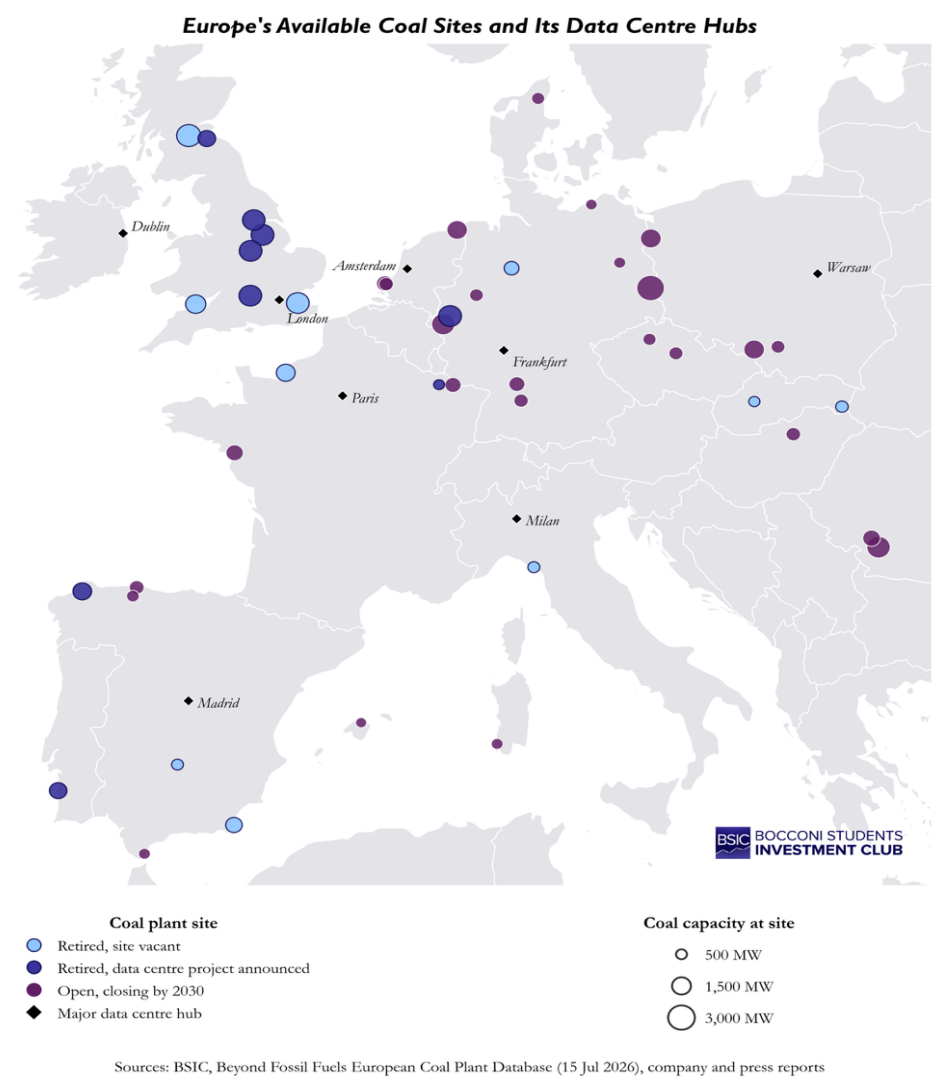
The map shows coal plants in the EU and UK with at least 500 MW of coal capacity that either retired since 2005 or close by 2030. Of around 60 large retired sites, only 19 have not been converted to other uses, such as gas generation or battery storage, with 10 currently vacant and 9 having data centre projects announced on them. Out of all countries, the UK is the leading developer, holding 8 out of 19 usable sites. It has already created precedents, for example RWE’s sale of the Didcot project to an unnamed hyperscaler, widely reported to be Amazon, in a transaction reported at about €225m in November 2025. On the other hand, in Germany 11 of 13 large retired sites already host another use, such as batteries, hydrogen or gas plants. It is important to note though that the map only includes fully retired plants, so sites such as Uniper’s Staudinger plant, where some units remain in reserve and Uniper is creating a data centre hub next to a new battery and gas plant, are not shown. Many of the 41 reused sites could also still host a data centre alongside their current use. Thus, the actual number of sites is likely much larger than the 19 shown above. Furthermore, the map also excludes gas, oil, and nuclear sites which could all potentially also be redeveloped to house data centre projects, as well as small plants with a capacity below 500 MW. The next wave will add plants with 29.9 GW that close by 2030 (excluding Italy’s Brindisi Sud and Torrevaldaliga Nord, which must stay on standby after Italy delayed its coal exit to 2038), about 9.8 GW of that within 200 km of a FLAP-D hub, adding even more potential sites for data centre development.
The Bear Case
Firstly, it is important to note that a connection is not necessarily a data centre connection. A coal plant’s connection was built to send power out, while a data centre needs to draw power in. The existing lines and switchyard may be reusable, but import capacity, transformer configuration, protection, metering, fault levels and reliability requirements must all be reassessed. For example, at Didcot, National Grid [LSE: NG] is extending the substation with three new transformers to connect data centres. Furthermore, reliability is especially important. Data centres normally require more than one electricity supply route, as well as batteries and backup generators, so that they can continue operating during a grid failure. Additional equipment may also be needed to prevent the facility’s large and rapidly changing electricity demand from disrupting the wider network. In short, the existing grid connection is a major advantage, but it is not a ready-made solution. Its real value depends on whether it can be converted into a reliable, high-capacity electricity supply without requiring prohibitively expensive network upgrades.
Secondly, the regulatory and legal question arises. Who owns the right to the connection and who is allowed to connect first? Since April 2026, Germany has implemented a “first ready, first served” model, meaning that transmission grid operators allocate connections to data centres and storage by how ready a project is. Similarly, in the UK, Ofgem has proposed requiring data centres to show evidence of financial capability, commercial maturity and equipment procurement to keep their place in the queue. The legal question regarding the sale of the right to connect has not yet been answered. The fight over connection rights is most likely to come from competing developers, who could argue that a site sale lets a buyer skip a queue that everyone else has to wait in. In addition, activist groups are likely to challenge these projects on planning and environmental grounds in the coming years. Together, these challenges will likely force precedents or regulation to be implemented. If a ruling decides that the connection right is tied to the operator instead of the land, this might significantly deteriorate the value proposition of the sites.
Thirdly, political backlash can arise as the coal exit deals promised jobs in new developments, but data centres employ very few people. For example, at Lübbenau in Lusatia, Schwarz Digits is investing €11bn in a 200 MW data centre on a former power plant site. The plant once employed 5,000 people at its peak (370 when it closed in 1996); the data centre will employ about 60 people in its first phase. This will be less of a problem on a national scale, but local politicians whose popularity is highly dependent on employment will likely oppose many developments.
Finally, as the first section showed, the value of these sites depends on a very small group of buyers, led by Amazon, Microsoft, Google and Meta. The risk is less the number of buyers than the fact that they all depend on the same spending cycle. The four are expected to spend over $700bn on capex in 2026, much of it being on AI infrastructure, thus the whole price rests on one capex cycle. If the hyperscalers slow their build-out, there are few other buyers able to absorb gigawatt-scale sites, and the price per MW of powered land could fall sharply. For utilities, this makes the timing of a sale or lease almost as important as the site itself.
Does the Scarcity Last?
The premium on powered land rests on one condition: that building a new grid connection keeps taking longer than building a data centre. For now, that holds. Connection queues in Europe’s main hubs run seven to ten years, while a data centre campus can be built in around two years once power is secured, making the connections valuable. Still, the value proposition is eroded by a variety of forces. Supply is steadily increasing as companies like RWE, Uniper and EDF are now marketing sites across their wider portfolios, including gas and partly operating sites, whilst many additional sites will be retired by the 2030s. Coupled with the increase in political regulation on an EU and national level, this makes owning an existing connection worth less. The main force pushing the other way is security of supply. Germany has declared more than 10 GW of power plant capacity system-relevant, which blocks their closure and keeps their connections locked up.
The US offers a preview of where Europe is heading. FERC, the US federal energy regulator, first rejected in 2024 a proposal to expand the data centre load co-located with Talen [NASDAQ: TLN]’s Susquehanna nuclear plant, which supplies Amazon, from 300 MW to 480 MW, then a year later directed PJM, the grid operator for Pennsylvania and a dozen other states, to develop clearer rules and new transmission services for data centres located at power plants. Regulators did not ban the model; they set the rules and the price for it. The value of a site is shifting from simply owning a connection to being the first project ready to use it by investing and repurposing the site effectively. The winners of this transition are likely to be the incumbent utilities with many sites, since they can sell to data centres, keep the connections for their own batteries and gas plants, or use both.
Conclusion
Europe’s coal and gas exits have quietly created a new asset class: high-voltage grid connections that outlived the plants they served. Now that grid access, not generation, is the binding constraint on AI infrastructure, these assets are being repriced as “powered land,” and sites that once carried negative NPVs are fetching large premiums. Those premiums are showing up in deals across Europe, from RWE’s €225m Didcot A sale to the €2.26m per MW now paid for powered land in the FLAP-D hubs, while Google’s Loviisa contract shows how a single offtake agreement can keep a plant running well past its former life expectancy. The premiums are conditional, however. They hold only as long as a new connection takes longer to build than a data centre does, and grid investment, tighter regulation and a growing supply of retired sites are all narrowing that gap.


0 Comments