Introduction
The first space race raged between two economic superpowers one upping one another to demonstrate technological superiority. Half a century later, the space race is back on, however this time it is being led by privately owned companies rather than geopolitical superpowers. Throughout the 20th century, space travel resulted in massive bottom line losses, propped up by taxpayer dollars with little more than scientific research and spectacular pictures to show for it. At the turn of the century, growing concerns over climate resulted in some people hypothesizing that making humans interplanetary could be solution to this problem. To make space travel viable for large masses in a manner it never was before, Elon Musk believed the most important challenge to solve was making space travel “affordable” which ultimately led to the beginning of SpaceX [NASDAQ: SPCX]
SpaceX
It doesn’t take a lot to see that SpaceX has fundamentally shaped the space industry. Founded by Elon Musk in 2002, the company went from near-bankruptcy in 2008 to the largest IPO in stock market history. SpaceX evolved from a venture-backed aerospace startup into a vertically integrated technology conglomerate spanning rockets, spacecraft, satellite communications, defense systems and artificial intelligence. In the early years the company struggled with repeated technical failures and financial pressure, however it took a turn with the fourth Falcon 1 flight in September 2008, making SpaceX the first privately financed company to send a liquid-fueled rocket into orbit. It continued with Falcon 9 in 2010, Dragon in 2012, becoming the first commercial spacecraft to deliver cargo to the International Space Station. In 2015, SpaceX achieved its first booster landing, and in 2017 re-launched a recovered booster. In 2020, it launched astronauts aboard Crew Dragon, and expanded its business through Starship, a reusable system intended for satellite deployment and Mars exploration. Its ownership structure evolved alongside these achievements, with Musk providing early funding and retained voting control, while investors including Fidelity, Google and Founders Fund joined through private rounds. Starlink, launched in 2020, became its principal revenue engine: it expanded from 4.6 million customers in 2024 to over 9 million across 155 markets by December 2025. Starlink’s demand for satellite deployment kept Falcon 9 operating regularly.
SpaceX’s acquisition of xAI, announced and completed on February 2nd, 2026, was an all-stock transaction ahead of SpaceX’s much anticipated public offering. Each xAI share converted into 0.1433 SpaceX share, implying values of approximately $75.46 per xAI share and $526.59 per SpaceX share. This valued SpaceX at roughly $1tn and xAI at $250bn, a combined enterprise value near $1.25tn: the largest merger, private or public, in history. However, analyses produced a much wider range from $859bn to $1.26tn, as neither company has a continuously traded public price, leaving the exchange ratio dependent on private financing rounds, secondary transactions, forecasts and assumptions about businesses with radically different cash-flow profiles. The rationale behind this deal, as Musk put it, was the creation of “the most ambitious, vertically integrated innovation engine on (and off) Earth”, fusing Starlink’s satellite network with xAI’s compute and large language models to pursue his goal of orbital data centers.
But why structure it as a merger rather than an IPO? For one, xAI’s financials would not have survived IPO scrutiny on their own: xAI was valued at $230bn on roughly $500mn of ARR, a 460x revenue multiple. Blending xAI into SpaceX buries that multiple in a much harder-to-scrutinize consolidated entity, where SpaceX’s cash-generative businesses dilute xAI’s burn rate. Secondly, SpaceX brings the balance sheet and cash flow that xAI needs: xAI, like the majority AI labs, is capital-intensive. SpaceX has consistent revenue from its contracts to NASA/Department of Defense as well as Starlink and hard physical assets which can support debt financing and reassure IPO investors. Lastly, merging pre-IPO allows Musk to set the exchange ratio privately, using secondary-market and Series E pricing, rather than letting two public markets independently price SpaceX and xAI. The structure creates significant governance liability issues: Musk controlled both sides, which created conflict on whether the exchange ratio treated minority shareholders fairly. SpaceX’s Texas office offers a management-friendly environment, while the new Nevada entities could affect applicable fiduciary standards. Minority holders can still challenge the valuation process, board independence or disclosures.
The $1.25tn merger was not derived from single earnings multiple: it was a negotiated break-up value assessment based on SpaceX’s private-market price. In December of 2025, a secondary transaction valued SpaceX at $800bn, or $421 per share. The merger marked SpaceX’s shares at $526.59, 25% above the reference point, while assigning xAI around $230-250bn of value. Investors basically are buying into four components: Starlink, a fast-growing subscription and telecommunications platform; a launch franchise built around Falcon and Starship; xAI, competing against OpenAI and Anthropic; and an unusually large Musk brand. xAI, with a reported revenue of $500mn, is the weakest fundamental factor underlying this transaction: the $230bn valuation implied roughly 460 times revenue, far above ordinary software multiples. Much of that price represents high expectations for future compute capacity. The market offered its opinion fast: after June 2026, the combined entity, SPCX, with shares priced at $135 climbed to a market capitalization of $1.49tn by late July, raising approximately $75bn before underwriters’ option. Clearly, it shows the market’s willingness to pay the merger price. However, it doesn’t solve the question of what has to be true for the price to hold. Firstly, Starlink’s subscribers must be held and potentially increased, as it is collateral supporting the more speculative AI segment, and any slowdown removes the “cash-flow cushion” that sustains xAI. Secondly, Starship must achieve reliable reusability and high launch cadence, driving deployment costs low enough for solar-powered orbital compute to compete with data centers. Thirdly, Grok must close the revenue gap with OpenAI and Anthropic, or compensate through distribution on X and access to the Colossus supercluster. All these, in addition to continued government contracts with NASA and the Defense Department, dependable access to capital, and Musk’s reputation and fundraising ability provide an important valuation floor.
Ultimately, SpaceX’s valuation depends on whether its consolidation model creates a virtuous cycle: Starlink and the launch operation provide constant revenue, infrastructure and access to capital which can subsidize xAI’s spending on chips and data centers. If this persists, SpaceX will demonstrate that a cash-generative hardware and connectivity platform can absorb the cost of AI development. This can apply beyond Musk’s companies and is a lesson to competitors that a leadership in space depends less on rockets and more on controlling the chain from launch and orbital assets to connectivity, data and software. SpaceX offers both a warning and a template for success: vertical integration can lead to compound advantages but concentrates capital requirements, risk and governance exposure.
Race for the Stars
SpaceX’s IPO at a valuation of $1.75 trillion raising $85bn reset the bar for how space companies are valued and the willingness of investors to underwrite an industry which previously seemed like something out of a science fiction movie. Now, after early backers of SpaceX made incredible returns, investors are keen to invest and be a part of the space boom.
There are a few structural tailwinds that are increasing the attractiveness of the Space Industry. The advancements in AI have enabled AI-accelerated engineering, prototyping and simulation. This allows companies to cut design cycles, iterate designs more quickly and avoid wasting resources by testing too many prototypes. Additionally, the launch cost per kilogram of payload dropped dramatically from $10,000+ to under $3,000. This lowers the barriers to entry into space allowing startups to design satellites and other products that can be sent into space.
The relevant players in the space industry can be categorised as pure-play launch or vertically integrated companies. Pure-play launch companies sell launches typically priced per kilogram or per mission. As a result, their revenue is tied to launch frequency. These companies are the key enablers of space technology as they are responsible for getting satellites into orbit. However, the pure-play launch business model is inherently non-recurring and very capital intensive. As a result of this and the increasing competition in launch many companies have shifted towards a vertically integrated model. The only real pure-play launch companies are ULA (a JV between Boeing [NYSE: BA] and Lockheed Martin [NYSE: LMT]), Arianespace, Stoke Space and LandSpace. Arianespace and LandSpace are the EU and Chinese sovereign launch companies respectively which demonstrates the strategic significance that space holds not only for commercial reasons but also military application. These considerations are key tailwinds that underpin the large amount of investment in space capabilities.
In contrast to the pure-play launch specialists are the vertically integrated companies that do everything from launch to designing and manufacturing satellites as well as operate constellations to sell a service. The most notable recent example of this is SpaceX which utilises its reusable rockets to create a large fleet of Starlink satellites to sell broadband subscriptions directly to customers. By owning the full operational chain SpaceX avoids being reliant on any third party for key space technology while rapidly innovating and increasing its number of satellites. Additionally, the final broadband services the satellites provide are recurring revenue rather than the cyclical revenue tied to launches.
Other notable vertically integrated players include Jeff Bezos’ Blue Origin which includes launch, engine manufacturing, satellite manufacturing, and constellation operation. Their broadband service TeraWave, announced in January 2026, is specifically positioned as enterprise/government infrastructure and space-based data transport thereby targeting a separate niche and differentiating itself from Starlink’s more consumer focused service. In terms of valuation, privately held Blue Origin was valued at $130bn as of its July 2026 funding round. This is much smaller than SpaceX and partially a result of limited disclosed revenue as well as some major launch setbacks including a New Glenn rocket booster exploding on the pad during a test in May 2026.
Another key player that has been pushing to capture more parts of the value chain is Rocket Lab [NASDAQ: RKLB]. Founded in 2006 by Sir Peter Beck, it has experienced significant recent revenue growth (+80% average YoY since 2021). Despite this growth, the company remains loss-making, and while historically a launch company, its Space Systems segment already accounts for over 60% of 2025 revenue, meaning it has arguably already moved past being a pure-play launch business. Rocket Lab has recently announced its proposed acquisition of Iridium Communications, valued at $54 per share for a total enterprise value of $8bn. This acquisition adds Iridium’s 66-satellite Low Earth Orbit (LEO) constellation, exposing Rocket Lab to the higher margin recurring service revenue. This is the latest in a string of acquisitions, including GEOST (sensors) and Mynaric (laser communications), in an attempt to vertically integrate and move past being a pure-play launch company.
Interconnected Industries: How Telecom and AI are Shaping the Future of the Space Industry
For the first 20 years of space travel, the enterprise remained solely a government venture. Rockets were used to show off political dominance, scientific research, and strategic and military defense. This began to change as the internet become more widespread. Industries partnered with the government and used satellites for mapping resulting in products we all use today such as GPS.
Once companies such as SpaceX [NASDAQ: SPCX] and Blue Origin revolutionized space travel by building reusable rockets and drastically lowering the cost per kilogram, space has become a viable frontier for the expansion of many existing and new industries. The most widespread space application has come through telecommunication satellites. With the lower cost per kilogram and rapid relaunch schedule, private companies can now build and launch (contract out their launch) their own satellite constellations.
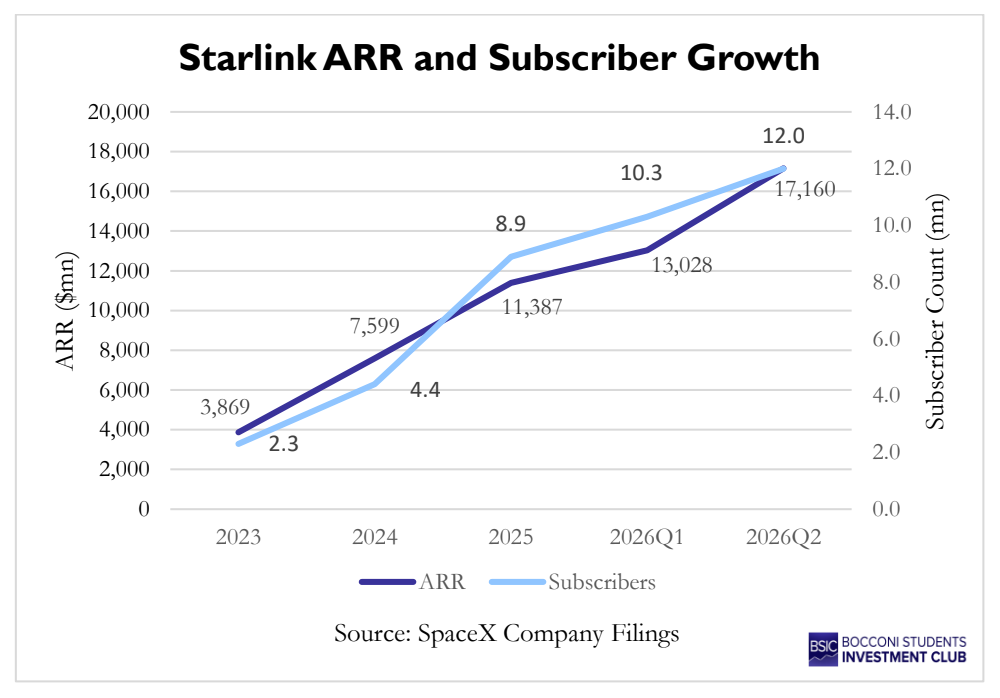
The prime example of this is the SpaceX subsidiary Starlink. Starlink offers several connectivity services ranging from home Wi-Fi dishes for remote location homes to a partnership with United Airlines, bringing Starlink Wi-Fi to every United flight. Starlink is expanding into direct-to-cell offering via legacy carriers such as T-Mobile and partners with the US government on Starshield for government and defense. SpaceX also completed an asset acquisition for about $19.6bn with EchoStar to take control of its wireless spectrum licenses, helping pave the way for SpaceX’s own direct to consumer cell service in the coming years. Starlink subscribers have skyrocketed from around 2.3mn in 2023 to more than 10mn by Q1 of 2026 and this does not even include government or enterprise contracts.
Other space companies have also been exploring the telecom segment. In January of 2026, Blue Origin, the rocket company founded by Jeff Bezos in 2000, announced the launch of TeraWave, its new telecommunications network. This constellation will consist of more than 5,400 satellites in low and medium orbits and is set to come online in late 2027. TeraWave is Blue Origin’s attempt to directly compete with SpaceX for DTC orbital connectivity. In September 2026, NASA awarded Blue Origin with a $700mn contract to build the Mars Telecommunications Network (MTN) which will serve as the primary communications network for future Martian orbit and expeditions. Rocket Labs [NASDAQ: RKLB] is currently going through the process of acquiring the telecommunications provider Iridium for $8bn, mixed cash/stock transaction. This deal received immediate support with RKLB’s stock +16% within 48 hours of the deal announcement.
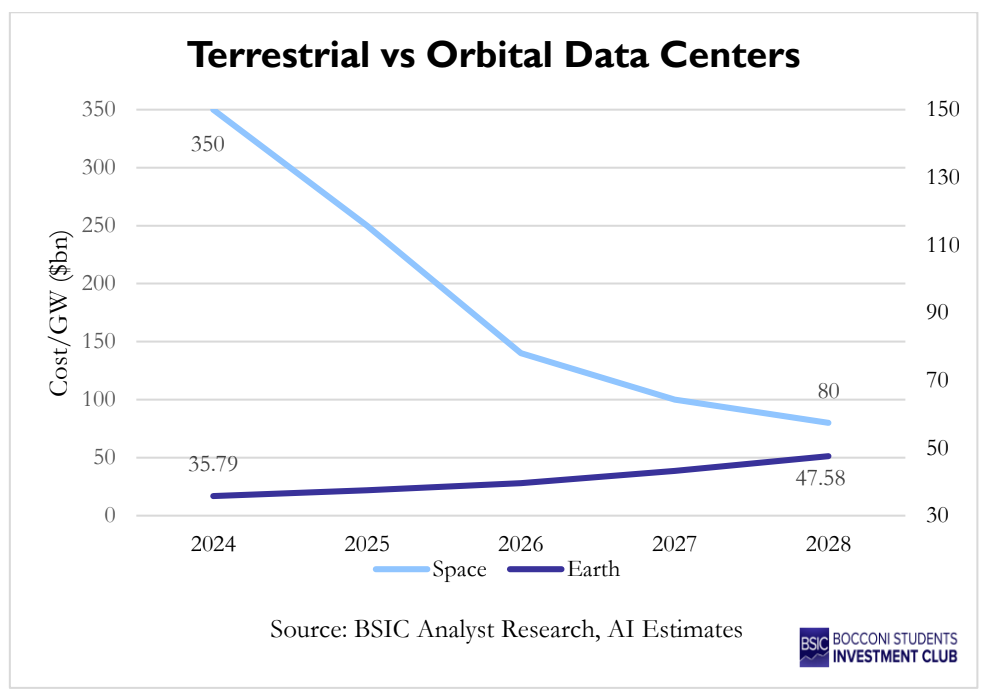
AI infrastructure is also an industry that is rapidly crossing paths with the space industry in a way that infrastructure and technology have never touched paths before. Throughout the summer, Elon discussed the possibility of data centers in space which would solve several of the biggest problems: with 24/7 solar power there will be no energy constraints, cooling is much less an issue, and there will be no environmental or noise pollution. The constraint is the current cost per kilogram to launch data center constellations into the stars; however, this will begin to change as Starship, SpaceX’s super heavy-lift rocket, is improved and cost to production is reduced. Starship’s cost per kilogram is currently estimated to be about $100, however SpaceX targets this to come down to $10-20. As data centers currently cost around close to $45bn per GW of compute power including shell, compute, and activation, it is clear to see that there will be a crossing point where cost per GW of a space data center becomes more efficient than standing up data centers on earth. The bull case for orbital data centers is that the launch cost per kilogram will continue to come down as launches become more efficient and rapid, while the price of terrestrial data centers is only increasing as the amount of land and approvals needed for frontier model compute is only increasing.
When Elon first proposed the idea, people laughed at the prospect, however now Nvidia is producing a next generation AI training rack specifically built for space called the Vera Rubin Space-1. This project is targeted for 2028 and will ensure that all of the hardware will be purpose built to thrive in space rather than retrofitting existing hardware. Google [NASDAQ: GOOGL] is partnering with Planet Labs on Project Suncatcher which will be Google’s Trillium TPU competitor to the Nvidia Vera Rubin rack. With major names pouring billions of dollars CapEx into AI infrastructure in space, the idea has turned from science fiction to a nearing reality. In addition to the major hyperscalers, smaller privates are also taking up the challenge of putting AI infrastructure into space. The truest pureplay AI infrastructure in space is Starcloud, part of Y-Combinator class of 2024 and the fastest every YC unicorn. Starcloud was founded and purpose built to put data centers into orbit. It reached a billion-dollar valuation in 17 months from inception with investment from the likes of Nvidia, Sequoia, a16z, EQT, and more.
The problem for sci-fi orbital data centers? Government defense contracts completely outbid the private sector revenue streams for the time being. The White House revised its budget estimates for project Golden Dome, a futuristic system of defense satellites that can detect and launch interceptor missiles to destroy ballistic missiles headed for the US during their initial launch phase, to $185bn, however the Congressional Budget Office estimates that the project could reach up to $1.2tn depending on the scope. The US Space Force supposedly ordered 36 Golden Dome satellites for a total of $1.75bn, about $48.6mn each. It is impossible to understand the true size and cost of the project because the details and highly classified, however it is clear that the demand for launch capability, and price the US government is willing to pay, will cause backlog years into the future.
Conclusion: The Future
The second space race will not be decided by who builds the best rocket. SpaceX’s $1.25tn merger, Rocket Lab’s pursuit of Iridium, and Blue Origin’s move into TeraWave all point to the same conclusion: launch is the entry point, but scaled business lies elsewhere. Decreasing launch costs are pushing launch companies into seeking new forms of income. Whether it be telecommunications or AI infrastructure, it is clear that to command the types of valuations the industry is beginning to see, it is crucial to convert the non-recurring, capital-intensive launch economics into recurring revenue streams. With the kind of valuations based on future cash flows these businesses are demanding, it is clear that the space industry is here to stay.


0 Comments