Introduction
Since the Covid-19 pandemic, sportswear and athleisure companies have seen outstanding growth, with the sector’s TAM growing from roughly $300bn in 2019 to $450bn today, an increase of around 50%. As a result, the market has seen many new entrants, including On, Alo, Vuori, and others, resulting in stiffer competition in the growing segment. In our March 2026 article, “Athleisure: Is the Rise of Comfort Reshaping the Economics of Fashion?”, we explored how changing lifestyles, more versatile clothing, and brand recognition were reshaping the industry. Since then, brands have followed very mixed trajectories. Some continue to attract customers through innovative products and marketing campaigns and have delivered profitable growth as a result, while others face weaker demand and heavy discounting due to poor performance and shifting customer preferences.
Athleisure Update
Lululemon [NASDAQ: LULU] has seen these pressures in effect, with shares declining 55.8% between end-2025 and October 2026. Second-quarter FY2026 revenue fell 4% to $2.42bn, while comparable sales declined 9%, including 12% in the Americas. International revenue grew 4%, but comparable sales fell 3%, suggesting store expansion masked weaker underlying demand. Management lowered full-year revenue guidance to $10.35-10.50bn, implying a 5-7% contraction attributed to weaker engagement, adverse commentary, and disappointing product launches. Fewer store visits, lower purchase conversion, and lower-value orders weighed on Americas sales. Reported gross margin reached 60.5%, but excluding tariff refunds, it would have reduced to 54.9%, down from 58.5% a year earlier. Higher markdowns and increased store and distribution costs relative to revenue contributed to this deterioration, indicating that the brand is facing pressures beyond sales growth to the profitability of those sales. Lululemon announced changes to its executive offices in the last week, bringing in the CEO of Athleta to be the new Chief Product Officer and a new COO from Walmart Canada to focus on direct-to-consumer expansion.
Meanwhile, Alo Yoga and Vuori are expanding into the markets that support Lululemon’s international business. Mainland China generated $407m of Lululemon’s quarterly revenue, exceeding its $392m Rest of World segment. Alo entered Tmall in August, recording over RMB10m (~$1.5m) within the first minute of pre-sale checkout, according to Alibaba. Similarly, Vuori plans to expand from eight Chinese stores to twenty by end-2027 and exceed 300 globally by 2030. This suggests that competition in athleisure is becoming increasingly international, with growth depending more on product differentiation and repeat customers than on entering previously underserved markets. The premium athleisure market is certainly becoming a more competitive industry; however, this competition is not being driven by price at all. This is positive news for the lagging Lululemon, as it will be able to introduce new products without having to cut prices and further erode their margins.
Adidas [ETR: ADS] offers a contrasting operating performance. Second-quarter revenue rose 13% to €6.74bn, supported by World Cup collections and running products despite weaker lifestyle footwear. Nevertheless, its shares fell 13.2% between end-2025 and October 2026, partly reflecting disappointment over profits as higher World Cup marketing costs weighed on margins and strong sales failed to translate into an improved earnings outlook. Under Armour [NYSE: UAA] reported a 3% June-quarter revenue decline to $1.1bn and cut its annual sales outlook amid softer North American and Asia-Pacific demand. Its shares fell 3.0% over the same period. Its emphasis on full-price sales highlights an industry trade-off. Discounts clear inventory and release working capital but squeeze margins and encourage customers to await promotions. Limiting them may instead mean accepting slower sales and reduced orders.
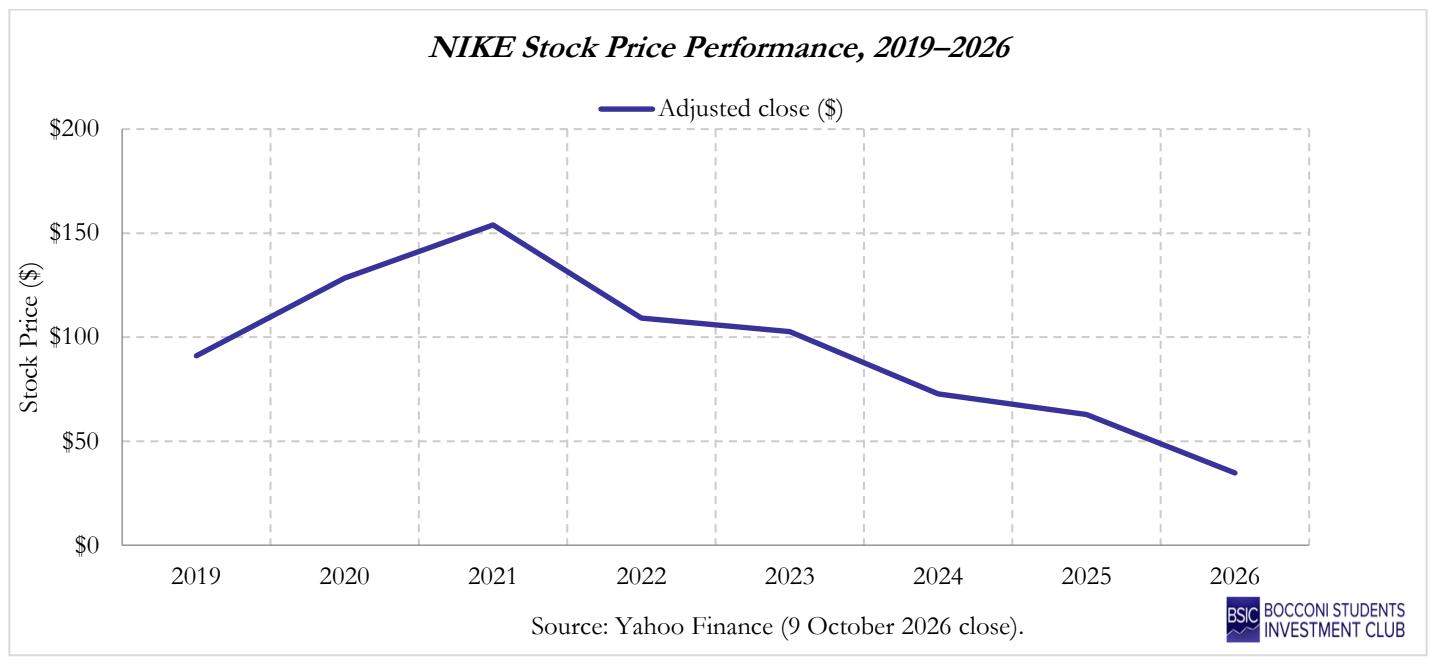
At Nike [NYSE: NKE], pricing pressures are compounded by the need to refresh its product offering. First-quarter fiscal 2027 revenue fell 4% to $11.2bn, as growth in performance products failed to offset weakness in Sportswear, Jordan Brand and Greater China sales. Management attributed some of this weakness to excessive similarity across lifestyle products, highlighting how limited differentiation can weaken demand and increase exposure to price competition. Against this backdrop, its shares fell 46.1% between end-2025 and October 2026. We explore these challenges in greater depth later in the article.
Such weakness can also affect wholesale partners, as slower consumer purchases leave retailers with excess inventory and increase pressure to discount. At DICK’S Sporting Goods [NYSE: DKS], a major Nike retailer, management cited older footwear styles and underperforming launches as pressures weighing particularly on its acquired Foot Locker business. Foot Locker’s pro forma comparable sales fell 3.6% in Q2 FY2026, against 4.9% growth in the existing DICK’S business. The disappointing results and reduced outlook announced on 25th August were followed by a 30.7% fall in share price.
These declines reflect consumers returning to the office: the Covid-era tailwind that drove strong performance at many athleisure and casual shoe brands has faded, while demand has shifted towards more premium products that serve broader use cases. This overall shift has seen massive rerating in many stocks within the industry and lowered future guidance as the industry becomes more competitive.
Nike’s Decline Leads to Removal from S&P 100
Nike [NYSE: NKE] is a brand we are all familiar with, and one whose top-line revenue we have likely all contributed to. Until five years ago, it seemed to be establishing a kind of duopoly over the athletic sportswear and footwear markets alongside Adidas [ETR: ADS]. Now, it has just been removed from the S&P 100, following stock losses of about 46% YTD. So, what went wrong?
Nike’s stock peaked on November 21st, 2021, with a stock price of $161.91. This peak came as a by-product of the Covid-19 pandemic. In 2020-2021, the world saw a massive surge in Covid-19 cases, which lead many countries to institute social restrictions, including full lockdowns. These played a massive role in directing consumer spending as people were no longer able to travel, eat at restaurants, or even spend money on modern-day ubiquitous expenses such as Uber. People thus shifted their attention towards online shopping and other digitally available services. Another trend that came out of the pandemic was increased spending on comfortable, casual clothing, which saw resulted in massive performance from traditional sneaker brands. Nike profited massively with revenues increasing by 19%, 5% and 10%, respectively, in fiscal years 2021-2023.
This growth, however, did not last, and some of the decisions Nike made during this period in order to take advantage of the Covid-19 tailwinds would have drastic consequences for the company in the long run. The first error Nike made was in believing the changes brought about by the pandemic would become permanent shifts. In 2020, Nike, following the exponential growth in digital sales due to the pandemic, decided to switch their focus from business to business to business to consumer and began targeting digital sales of 50% of its business. It reduced its presence in retailers such as Urban Outfitters and deprioritised its lower-priced footwear, instead opting to focus on established retro franchises. Nike also reorganised away from sport-specific units such as tennis and football into broader men’s, women’s, and children’s categories. All these changes shifted Nike away from the foundations of their business and the very things that had made them so successful in the first place. High-performance footwear for athletes was no longer the target customer.
The reliance on retro franchises, especially Jordan brand, was an especially destructive decision for Nike. Starting in 2021, Nike ramped up the production and release schedule of Jordans. Between 2023-2024 Nike produced more than 700 different Jordan models, a shoe that had become popular due to its limited and collectible nature was now everywhere destroying the brand. By 2024, the damage could be seen as new Jordans were now sitting on shelves unsold for the first time in years and even facing discounts. This offended many collectors and diehard Nike supporters who felt like they had been taken advantage of.
Finally, Nike also began facing increased competition in both the footwear and sportswear spaces. Newcomers such as Swiss On [NYSE: ONON] and Hoka have grown rapidly in recent years with their revenues increasing from CHF 724.6m in 2021 to CHF 3.0bn in 2025 and $571m in 2021 to $2.59bn in 2026 respectively. These brands leveraged strategies such as celebrity athlete endorsements: famously Roger Federer and now Kylian Mbappé both joined the On team after having been Nike athletes throughout their careers. Nike’s market share in global athletic and sports footwear fell from 25.9% in 2022 to 22.9% in 2025. This growth of smaller brands is partly Nike’s own doing. When Nike pivoted to focus more on direct-to-consumer and online sales, the freed shelf space in traditional sneaker stores could be filled by the smaller, new entrants, a concept that would have been hard to imagine in Nike’s prime just a few years ago.
The most obvious illustration of Nike’s fall from grace is its recent delisting from the S&P 100. Nike held a spot in the index representing the 100 most valuable American companies for close to two decades. While this is not a surprise to those of us who have seen it drop over $200bn in market cap since its 2021 high, it is still shocking to see a global titan, which holds partnerships with some of the world’s most famous and influential people including Michael Jordan and Cristiano Ronaldo, be replaced by a variety of tech stocks that have seen exponential valuation growths as a result of the AI buildout, including Dell Technologies [NYSE: DELL] and Sandisk [NASDAQ: SNDK]. Nike, amongst the most famous brands in the world, is being pushed aside by companies that even a couple of years ago were seen as mature and belonging to a by-gone era.
Ultimately, Nike’s decline can be attributed to the Covid-19 pandemic and the subsequent management decisions that led to a shift away from their core businesses that had been fundamental to its success, the deterioration of its brand image, and allowed for the rise of new competitors.
On Cloud Signs Mbappé
On September 18th, 2026, On [NYSE: ONON] announced the signing of Mbappé as a new global ambassador to the brand, with the role of assisting in the development and testing of On Football footwear and apparel.
L’Équipe reports that his agreement with the brand runs for 10 years and is set to expire around 2036; however, the exact expiry date has not been published. After roughly 20 years with Nike, Mbappé turned down what was reported as a proposal worth about €20m a year. The report described a proposed term of roughly 10 years, giving a total headline value of about €200m. The key difference between Nike’s proposed deal and Mbappé’s agreement with On is the nature of the compensation. Reuters reports that On’s arrangement includes both cash and an equity stake in the company, not to mention the fact that Mbappé will be the face of On Football.
On did not stop with Mbappé, as Thierry Henry, another major global name in football, had been working on On’s football entry as early as late 2025 and was announced as Director of Football alongside Mbappé’s reveal. His role covers product development, athlete relationships, and the wider culture of the sport. Henry told L’Équipe that his work includes recruiting further ambassadors, foreshadowing a planned athlete roster rather than a single endorsement. Henry’s contract length, compensation and any equity interest have not been disclosed.
Mbappé’s deal illustrates why a share of future sales or an equity stake can appeal to athletes. Back in 2018, Roger Federer changed the sports world when he left Nike in 2019 and chose to sign a sponsorship deal with Uniqlo and, shortly thereafter, the blossoming Swiss brand On Cloud. Federer received an equity stake in Uniqlo; however, he became an On co-owner and worked closely with the company on product development, marketing, and fan engagement. His purchase price and original stake were not publicly disclosed. Forbes estimated Federer’s stake at roughly 3% near On’s 2021 listing and valued it at more than $375m in August of 2025. While the potential upside for athletes is much higher than that of traditional sponsorship contracts, equity also exposes an athlete to a downside: Forbes estimated Federer’s same stake at about 2.5% in August of 2026 and reported a decline of at least $52m in his estimated net worth in one day when On shares fell roughly 19%. Mbappé, likewise, has an ownership component, but his stake and possible payout remain unknown. He told L’Équipe that the entrepreneurial element mattered to him, while saying that product co-creation was the deciding attraction. A 2016 FIFPRO survey of 14,000 footballers across 54 countries found that club contracts last, on average, just under two years. This statistic explains a football player’s attraction to building commercial value that can endure beyond a playing contract, especially considering the unusually long nature of the one Mbappé signed with On. This shows how prioritizing equity gives an athlete exposure to a company’s future value and may align the athlete with building products over many years. Nike has previously given an athlete a share of product sales, as Michael Jordan’s negotiating agent Donald Dell recalls an original 5% royalty on products bearing Jordan’s name. The company has since then retired this practice, offering contracts that are almost exclusively cash, turning down athletes such as Federer and now Mbappé who went looking for other sorts of brand sponsorship deals with more upside.
Though the announcement shook the sports world, On faces a long journey before entering the segment and selling boots to the public. On plans to sell its first football boots in 2027, through its website, app, stores, and selected retailers. It has announced neither a boot name nor a retail price. The proposed boot uses On’s new LightSpray technology upper; football-specific stud layouts, fits, with both laced and laceless versions in development. In February 2026, the company announced a South Korean facility with 32 LightSpray robots, alongside four at its Zurich facility, and a projected 30-fold increase in overall LightSpray capacity during 2026. On says that a conventional shoe upper can involve roughly 200 production steps across multiple locations, however, using LightSpray, a robot can spray 1.5km of filament into a seamless, one-piece upper in approximately three minutes, greatly reducing production time. Replacing many conventional production steps potentially lowers per-unit costs as production scales. At its September investor day, On’s President described the prospective supply-chain benefit as producing nearer to consumers so it can respond to demand, hold less inventory, and sell more at full price. He predicted LightSpray technology could eventually represent 10% of On’s overall footwear business. While On has never disclosed actual cost savings, the supply-chain benefits of being close to the consumer and quicker production times making demand easy to react to are exactly two issues shoe brands have not been able to react to in the past. Strategically, this bodes well for On’s future in footwear.
While On is still far from commercial sales of football boots, the publicity is undoubted. Le Monde reported Mbappé wearing On-logo boots in a match on September 25th, 2026, and unlocked 136m Instagram followers through his pages. On the other side of the equation, On came prepared, as it already has a retail route for footwear: its Q2 2026 filings record CHF 388.4m in direct-to-consumer sales out of CHF 850.3m in total sales, 45.7%. On’s marketing percentage of sales rose from 11.9% to 12.5% from 2024 to 2025, showing that the cost of sponsorship was not nominal. Its 2025 Form 20-F records CHF 376.5m in companywide marketing expense, versus CHF 276.6m in 2024: an increase of CHF 99.9m, or 36.1%. Its first-half 2026 Form 6-K records CHF 228.0m in marketing, versus CHF 170.5m a year earlier: CHF 57.5m more, or 33.7%. The expense rose from 11.6% in the first half of 2025 to 13.6% in the first half of 2026. It’s important to keep in mind that both reporting periods ended prior to the September announcement, which was the kick-off of a global marketing campaign that may incur more marketing costs in the future.
Federer’s partnership offers a precedent for what Mbappé could help On build in football. On launched THE ROGER Centre Court with 1,000 pairs in 2020, moved into retail shoes in 2022, signed Iga Świątek and Ben Shelton in 2023, and introduced tennis apparel in 2024. A separate Federer edition in 2026 was limited to 20,000 pairs at $200 each in the US. On credited THE ROGER franchise with a meaningful contribution to its 2023 shoe-sales growth and said tennis apparel sales nearly tripled in the second quarter of 2026. Although it does not disclose tennis revenue or how much growth Federer generated alone, it reported CHF 2.8bn in 2025 shoe sales, a 997.2% increase from the CHF 255.6m in 2019 shoe sales.
Football presents a tougher road ahead. In Footpack’s survey of 1,248 players selected for the 2026 World Cup, 534 wore Nike boots and 496 wore Adidas, a combined 82.5%. BMO Capital Markets estimates football brings Nike approximately $2.1bn annually, roughly 5% of Nike Brand sales. Applying a similar ratio to On’s projected sales yields $375m-$400m in potential annual On football revenue by fiscal year 2031. Once On’s boots go on sale in 2027, the test will be whether Mbappé’s influence helps win customers from those established brands at a scale that covers product development and marketing while supporting On’s companywide targets of at least 65% gross margin and 22% adjusted EBITDA margin by 2029.
Conclusion
The divergence across athleisure can no longer be explained by the post-pandemic boom alone. Lululemon, Nike and Under Armour are all contending with softer demand and heavier discounting, while newer brands such as Alo, Vuori and On continue to win customers through product differentiation rather than price. Nike’s removal from the S&P 100 illustrated how quickly a dominant franchise can erode once it drifts from its core performance customer, overexposes its most valuable icons, and gives up shelf space to challengers in an ever more competitive industry.
On’s signing of Mbappé is, in many ways, the mirrors those mistakes. By offering equity and product co-creation rather than cash alone, On has secured one of football’s most marketable athletes over a decade-long horizon and aligned his incentives with the long-term value of the brand, a model it has already tested with Federer in tennis. If LightSpray scales as management expects, On could also gain a structural advantage in inventory and full-price selling. The 2027 launch will be the real test of whether athlete ownership and manufacturing innovation can translate into share gains in football at margins consistent with On’s 2029 targets. For Nike, the lesson is equally clear: the path back to growth likely runs through the same product differentiation and athlete relationships that built the brand in the first place.



0 Comments