Introduction: Can Defence Fill the Gap?
Germany’s car industry is shrinking while its defence industry is growing. Carmakers and suppliers are cutting jobs and carry more plant capacity than they need, while a sharp rise in military spending has left defence manufacturers short of production capacity. The temptation is to put the two together: if car factories can build military vehicles, drones and components, defence could absorb the plants and workers that the car industry no longer needs. Volkswagen’s [ETR: VOW3] plan to sell its Osnabrück plant for defence production is the most visible test of that idea so far.
This article asks whether that idea can work at scale. It first sets out the size of the two industries and why the shift is happening now, then examines the routes through which carmakers and suppliers are entering defence. It next tests whether these routes can offset the car industry’s job losses, before turning to the outlook for companies, policymakers and investors. The answer is a partial rescue: defence can secure selected plants and suppliers, but not the industry as a whole.
Two Industries Moving Toward Each Other
Germany’s car industry, the country’s largest manufacturing sector, is increasingly attracting interest from defence manufacturers as military spending rises. Demand for military equipment has risen significantly since the Ukraine war started, while the 2025 reform of the debt brake has allowed the government to increase defence spending. In September 2026, Volkswagen signed a statement of intent to sell its Osnabrück plant to Aurelius Capital, which would become majority owner, and the state of Lower Saxony. Rafael would be the industrial partner for air-defence systems and components. The deal remains subject to final agreements and regulatory approval. Rheinmetall [ETR: RHM] had also considered the plant but ruled out a takeover in March 2026, choosing to expand its existing capacity in Kassel instead.
Osnabrück is one of several cases in which defence companies have sought to use automotive production capacity. The Franco-German tank manufacturer KNDS has discussed taking over Mercedes-Benz’s [ETR: MBG] van plant in Ludwigsfelde. For automotive suppliers, the move into defence can also take place through agreements to produce components. Schaeffler [ETR: SHA0], for example, has agreed to manufacture and source electronics for drone producer Helsing. This would give Helsing access to Schaeffler’s manufacturing expertise and supplier network, while providing Schaeffler with a new source of demand outside the car industry.
These transactions can preserve individual plants, but the difference in scale between the two industries limits how much lost automotive production the defence sector can replace. According to Destatis figures published by the VDA, Germany’s automotive industry generated €533.7bn in revenue in 2025, whereas the defence sector revenue can be estimated at around €60bn in 2025. This figure is based on Rheinmetall, Hensoldt [ETR: HAG], Diehl Defence and TKMS, the four German companies included in SIPRI’s 2024 Top 100. Together, they generated a combined defence revenue of approximately €16.9bn in 2025. Applying their combined revenue growth between 2022 and 2025 to the government’s €31bn sector revenue figure for 2022 gives the total of €60bn in revenue. However, this figure could be an upper bound, as it assumes that the wider sector grew at the same rate. Nonetheless, the defence revenue would still amount to only around one-ninth of the automotive sector total. Employment shows a similar gap, with around 732,000 people working in the automotive industry compared with an estimated 100,000 in defence, as illustrated in the graph.
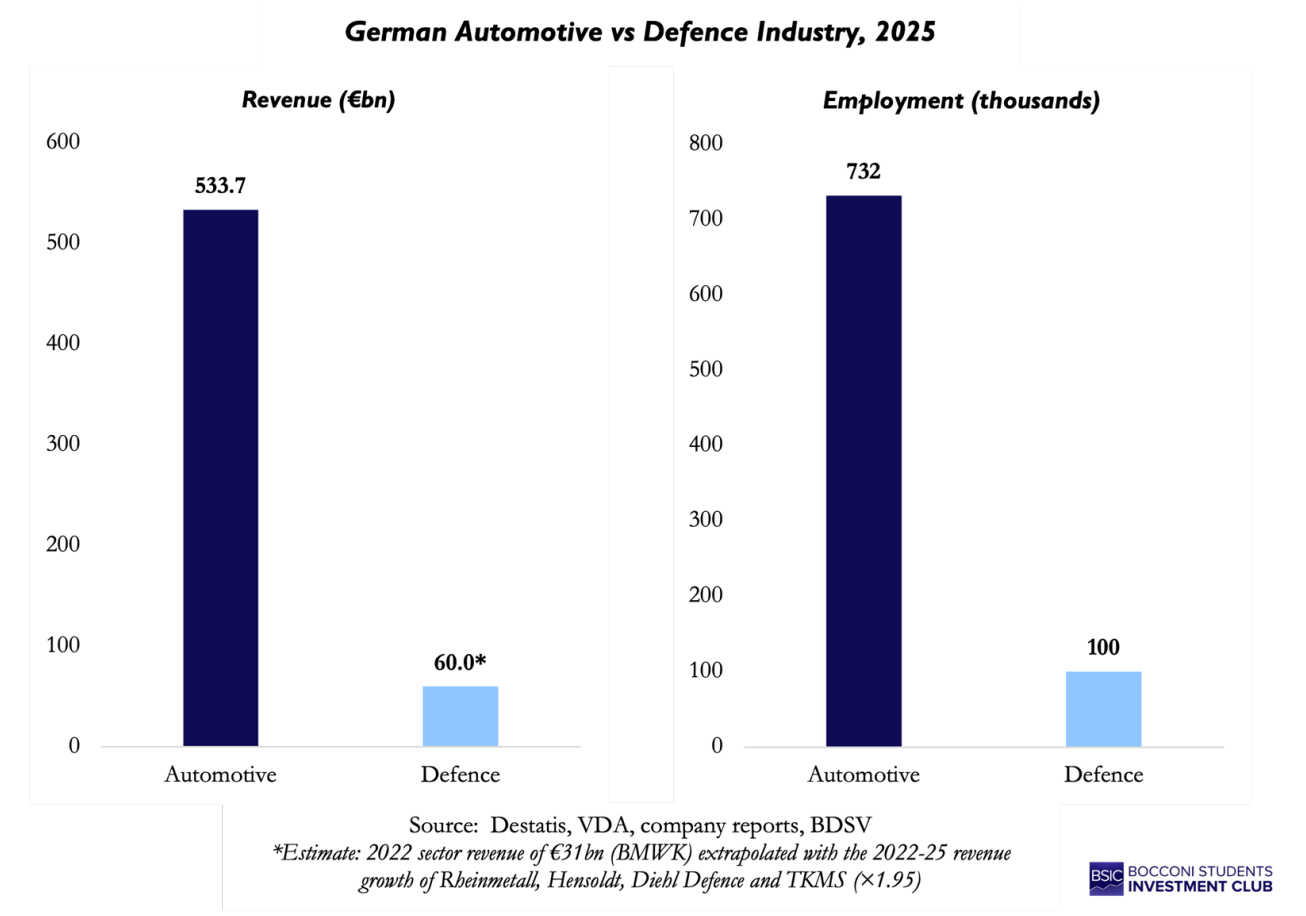
The relevant question is therefore whether defence can absorb a significant share of the capacity and employment lost in the car industry, or whether it represents a temporary solution for a limited number of sites. The evidence available so far points to a partial shift. Carmakers and suppliers have underutilised plants and a skilled workforce, while the expansion of the defence budget has increased domestic demand for military equipment. At the same time, underused automotive plants and the availability of skilled workers give defence companies opportunities to expand their production capacity.
Why Now: Push and Pull
The timing reflects both a push from the car industry and a pull from defence. Falling profits have increased the pressure on German carmakers to find new uses for their plants and workforce. According to Euronews, high production costs and weak European demand have coincided with stronger competition from Chinese manufacturers and US tariffs. The transition to electric vehicles has also been slower than many manufacturers anticipated, with pressures even reaching premium manufacturers. Mercedes-Benz, for example, reported a net profit of €5.3bn in 2025, just over half of its €10.4bn profit in 2024. With earnings falling, manufacturers and suppliers have less capital to reinvest, increasing the attractiveness of alternative uses for underutilised plants and workers.
Lower profits alone, however, do not explain why carmakers are selling plants. The industry also has more production capacity than it currently needs, which can be seen in the case of Volkswagen. The CEO, Oliver Blume, estimates the group’s excess capacity in Europe at around 500,000 vehicles. Volkswagen’s supervisory board has approved a restructuring plan that includes 100,000 job cuts by the end of the decade, also leaving the future of four German plants undecided. Suppliers face similar pressures because their orders depend on how many vehicles carmakers produce. Thus, their employment losses have been even greater. Destatis figures published by the VDA show that the average employment among German car-parts manufacturers fell by 11.1% in 2025, compared with 2.1% among vehicle manufacturers.
However, reducing output does not remove the cost of maintaining a factory. Plants without future models thus remain a financial burden, but closing them would require negotiations with employee representatives. It could also face political opposition, particularly where the plants provide a large share of local employment. Selling a site to a defence company may therefore allow the carmaker to reduce these costs while preserving some jobs. At Osnabrück, for example, around 1,400 of the plant’s roughly 1,800 employees are expected to move to the new owner. The target workforce is around 1,200, with jobs protected until the end of 2029.
For a defence company to take over such a plant, it must expect enough demand to justify the investment. Germany’s increased procurement initially relied heavily on the €100bn special fund established in 2022, which provided a fixed amount of additional funding. The March 2025 constitutional amendment allowed spending to rise beyond this temporary arrangement by exempting defence expenditure above 1% of GDP from the debt brake’s borrowing limit. Germany allocated €108bn to federal defence spending in 2026, including the special fund, compared with €86.5bn in 2025. The government’s financial plan sets out a further increase to €183.7bn by 2030.
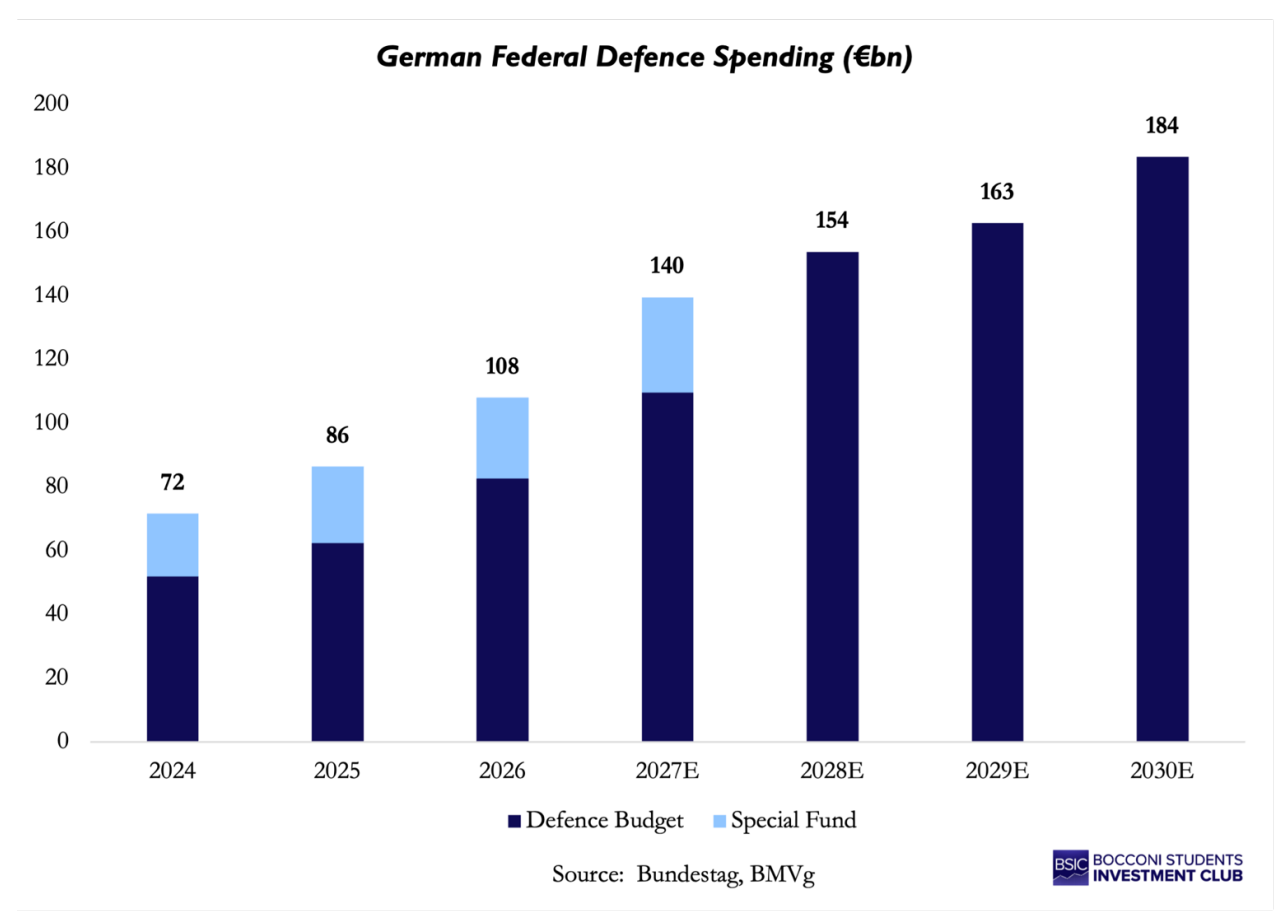
The increase in spending has already led to a large number of new contracts. For example, Rheinmetall, Germany’s largest defence company, ended 2025 with an order backlog of €63.8bn. This is more than six times its annual sales of €9.9bn, and although part of this backlog consists of framework agreements that may not be fully called off, the company will need considerably more production capacity over the coming years. Since building new facilities takes time, existing car plants offer an alternative. The car industry’s weakness also benefits defence companies in other ways. Hensoldt, for example, sought to recruit skilled workers from Continental [ETR: CON] and Bosch, and its CEO, Oliver Dörre, stated in 2025 that the company was benefiting from the difficulties of the car industry.
The suitability of car plants for defence production mainly depends on the type of product. Their core advantages are existing permits and infrastructure, as well as workforces experienced in precision manufacturing and in managing large supplier networks. These are most valuable for products built in large volumes, such as military trucks, drones and electronic components, which is also the basis of Schaeffler’s agreement to produce and source electronics for Helsing. Tanks and missiles, by contrast, are produced in small numbers under extensive certification requirements, which limits the benefit of automotive mass production.
Political support further encourages these conversions. Lower Saxony’s Minister-President compared the state’s role in Osnabrück with its 2024 investment in the Meyer Werft shipyard, while Schaeffler’s CEO presented the agreement with Helsing as a way of strengthening German and European defence capabilities and creating employment opportunities. Such involvement can make transactions easier to complete, but it also raises the risk that some are driven more by employment objectives than by industrial logic.
Similar developments can be seen in other European countries. In France, the procurement agency DGA brought Renault [EPA: RNO] into a drone programme with the defence company Turgis Gaillard. According to Le Monde, the two companies received a contract worth around €90m to develop the drone and establish the production line. In Finland, Valmet Automotive and Patria expanded their agreement to produce armoured vehicles in June 2026. Both cases combine automotive production capacity with defence expertise, as Schaeffler’s agreement with Helsing does in Germany. These partnerships also allow automotive companies to take on defence production while retaining ownership of their plants, whereas Volkswagen plans to sell its Osnabrück site. This raises the question of which approach is more likely to preserve production capacity and employment in the long term.
Routes into Defence
The pressures described above are already producing concrete deals. In Germany, these arrangements adopt different forms, ranging from entire plant sales and conversions to component supply agreements and the adaptation of existing vehicles for military use. The first approach is illustrated at Osnabrück, where the proposed sale would give the site new industrial ownership after automotive production ends.
Through a sale or a lease, a carmaker can transfer an existing plant to new owners or operators, who adapt its facilities and manufacturing capabilities to defence production. Rafael Advanced Defense Systems would contribute technology and expertise for the potential manufacture of air-defence systems and components for Germany and Europe. Volkswagen would support the transition with its industrial experience and existing infrastructure. The announcement disclosed neither the exact equity split nor the acquisition financing. The site’s automotive production has already contracted substantially. Osnabrück completed around 23,800 Porsche [ETR: P911] 718 Boxster and Cayman vehicles in 2024, compared with around 15,900 in 2025, a decline of about one third. The production of these models ended in October 2025, leaving the T-Roc Cabriolet as the only remaining car production programme, scheduled to finish in summer 2027. The conversion would therefore replace the departing production programmes at a site covering 430,000 m² and experienced in small-series manufacturing.
For Volkswagen, selling a factory without a successor automotive programme could reduce long-term exposure to payroll and site overheads after vehicle production ends. Transferring employees to the new business could also reduce the restructuring costs associated with closure. In turn, the incoming partners would gain an already established workforce and industrial infrastructure, considerably shortening the process of setting up production while reducing construction, recruitment and training costs. However, the existing facilities still require adaptation to the intended defence products, and Volkswagen’s announcement disclosed neither a purchase price nor a conversion budget, limiting the scope to assess whether acquiring the site would be cheaper than developing new manufacturing capacity.
The employment arrangements point to a smaller operation. According to the works council, further reductions, including retirement and partial retirement, would bring the target workforce to around 1,200, approximately 67% of its September 2026 level. Solutions for the remaining employees, particularly those in technical development, are still being sought. The protection until the end of 2029 consequently provides a transition period, while longer-term employment depends on sufficient production work.
At Mercedes-Benz’s Ludwigsfelde plant, a partial lease has also been discussed, which could allow KNDS to manufacture its military vehicles alongside continued van production. Unlike the Volkswagen case, this would give the defence company access to part of the site without transferring ownership of the entire factory. However, September reporting indicated that the proposed asset acquisition had stalled because KNDS’s capacity requirements depended largely on securing a major Bundeswehr order, and the outcome therefore remained linked to procurement decisions rather than the availability of the plant alone. Rheinmetall’s withdrawal from Osnabrück, mentioned earlier, reinforces this constraint. The company had considered the site for 6×6 armoured vehicles but no longer required additional capacity for those products, and it expanded Kassel to meet demand for Boxer 8×8 vehicles instead. Plant conversion can therefore be replicated where the facilities, workforce and timing match a specific defence production requirement. Its commercial appeal depends largely on the conversion costs and orders available to each buyer, which explains why the same automotive site may attract one defence company and be rejected by another.
Beyond plant transactions, automotive suppliers can diversify through component contracts and procurement partnerships alongside their existing activities. Schaeffler’s December 2025 memorandum with Helsing envisages manufacturing drone electronics and securing semiconductor and raw-material supplies. Helsing contributes drone technology and software, retains final production and gains Schaeffler’s industrial expertise. Helsing co-CEO Gundbert Scherf outlined the company’s target of producing 10,000–20,000 drones in 2026. However, Schaeffler’s investor-relations head, Heiko Eber, confirmed in April 2026 that a definitive contract remained unsigned, pending government procurement. Ultimately, the automotive company’s revenue opportunity depends on contracted volumes and its component value per drone. Reusing manufacturing resources could improve overall asset utilisation, but expansion still requires financing. Schaeffler’s first-half 2026 attributable net income rose from €43m to €93m on €11.7bn in revenue, equivalent to approximately 0.8% of sales. Free cash flow before M&A remained negative at around €300m, including around €240m in restructuring and integration payments. CFO Christophe Hannequin consequently emphasised selective investment and tighter inventory management. These figures support a disciplined expansion where additional defence sales must generate returns after equipment investment and working-capital requirements.
Existing defence activities offer an established route to expansion. ZF supplies military drivetrains, Mahle provides military-vehicle cooling systems, and Bosch Rexroth supplies automation equipment for defence manufacturing. Yet their financial significance requires perspective. In April 2025, Automobilwoche reported that defence represented less than 0.5% of ZF’s revenue. Doubling that business would therefore increase group revenue by less than 0.5%, assuming that other activities remained unchanged. Strong defence growth can therefore coexist with a limited contribution to the supplier’s overall revenue.
For smaller suppliers seeking similar contracts, financing and qualification remain key barriers to entry. A 2025 Allensbach survey covering 47 automotive suppliers found that 28% faced tighter credit access; among those experiencing financing difficulties, 92% postponed investment. FTI-Andersch partner Ralf Winzer also identified unfamiliar approval procedures and product cycles as obstacles. Expansion is consequently more credible where existing products need limited adaptation. New entrants must commit capital for qualification before earning revenue, while uncertain volumes and dependence on a few customers can leave those costs unrecovered.
As the chart below shows, defence leads, named by 25% of the suppliers expanding outside automotive, ahead of energy at 16% and aviation, medical technology and rail at 9% each. This interest suggests suppliers see defence as another outlet for their automotive capabilities. If these diversification plans translate into contracts, they could strengthen commercial links between the two sectors. Three quarters of these suppliers did not name defence, however, and the survey shows where suppliers are seeking or expanding business rather than the revenue secured.
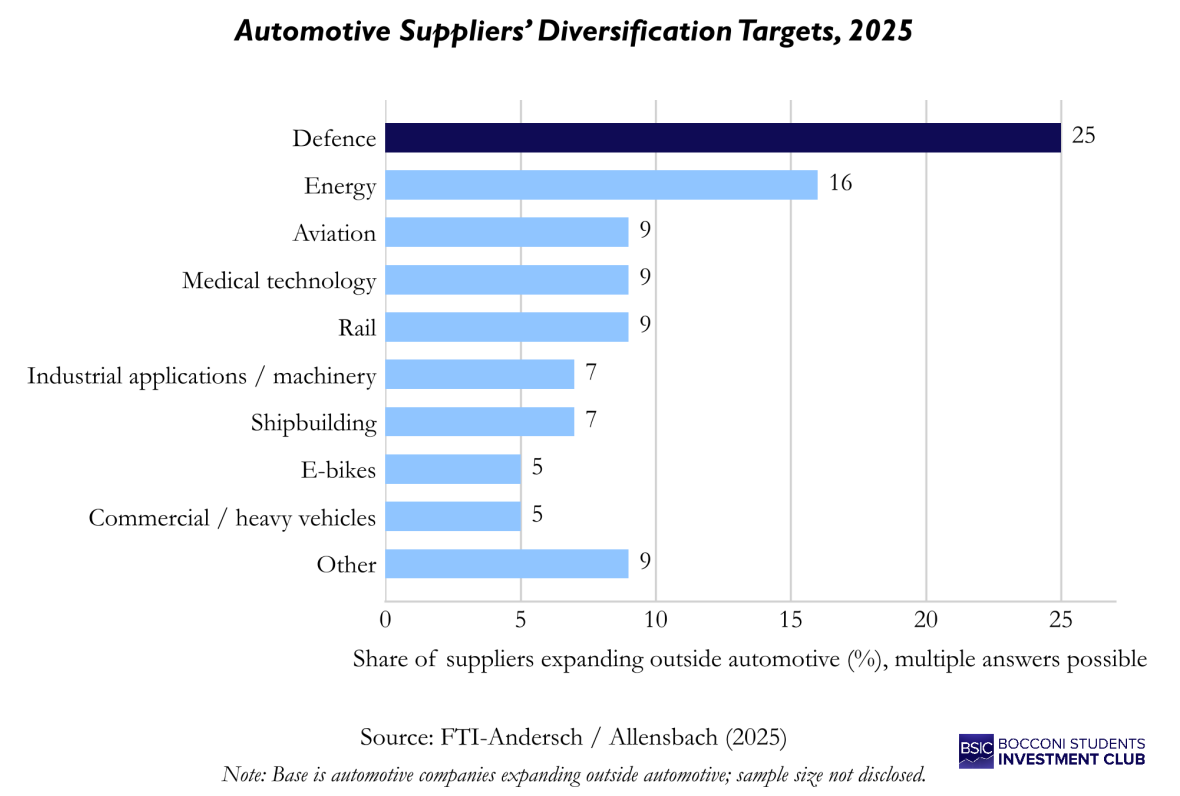
Alongside these supply relationships, defence companies are also recruiting directly from the automotive workforce, offering a separate benefit. In January 2025, Hensoldt planned to recruit nearly 100 employees each from Continental and Bosch, with the Continental intake representing almost 28% of Wetzlar’s 360 threatened jobs. A subsequent development centre near Stuttgart targets 300 positions by end-2027, open to qualified Bosch applicants. Dörre specifically identified Bosch’s software-engineering expertise as a way of accelerating defence-system development. Such recruitment can relieve skills shortages and preserve employment, without replacing the former employer’s lost sales.
The use of automotive capabilities in defence also extends to complete vehicles, as illustrated by Volkswagen’s MV.1 and MV.2. Carmakers can develop military versions of existing products. Presented at Enforce Tac in February 2026, the Amarok-based MV.1 supports the transport of personnel and equipment, while the Crafter-based MV.2 offers medical and logistics configurations, including space for up to four patients lying down. Volkswagen’s March statement described the vehicles as market exploration, leaving series production undecided.
The commercial advantage depends on how much vehicle engineering and component commonality survives adaptation. Reusing these elements could reduce incremental development expenditure and simplify maintenance for military customers. Yet the MV.1 required structural modifications and separate 12- and 24-volt electrical systems, illustrating the limits of straightforward reuse. As tailored engineering increases, more expenditure must be recovered from military orders alone, raising the programme’s break-even volume. The approach therefore appears most attractive for transport and support roles that retain substantial commonality with the original vehicle. Mercedes-Benz CEO Ola Källenius framed a complementary perspective in May 2026: defence could contribute to earnings while remaining a minor share of the company’s business. His position supports treating military variants as a complementary product market, whose appeal depends on adaptation costs and achievable margins. Together, these arrangements illustrate how automotive assets, skills and products can find new applications in defence.
Does It Actually Work? Demand, Jobs and Scale
These arrangements are real, but they must still be measured against the scale of the car industry’s job losses. Whether defence can absorb them depends on four factors: whether German demand suits converted car plants, whether displaced automotive workers move into the defence industry, how much a euro spent on defence returns to the economy, and whether the defence spending is large enough to make an impact.
Car plants are built for high-volume production, whereas most German defence orders are not. According to the Kiel Institute, 61% of German order value since 2020 has gone to established, platform-centric systems (large crewed platforms such as tanks, frigates and fighter jets). As noted earlier, car plants suit high-volume products such as military trucks. However, the share of order value going to the systems arguably best suited to mass production, new-paradigm systems such as drones and other autonomous platforms, fell from 22% in 2020–21 to around 9% in 2024–26. Spending on these has stayed roughly flat at €10–12bn, so the demand that best suits converted car plants’ high-volume production is not shrinking but is barely growing as the rest of the budget expands.
Timing is another limitation. According to the Kiel Institute, where final delivery dates are specified, defence orders in Germany, the UK and Poland typically take two to four years to deliver, while fully delivering a German order takes around four to five years. Moreover, around 70% of recent German orders have no final delivery date at all, a trend not seen in the UK or Poland. This makes it difficult for manufacturers to plan hiring. Car industry jobs are being lost now, while defence manufacturers that could absorb the labour do not yet know how much labour they require.
Nevertheless, there is some movement of labour from the industrial sector into defence contractors. According to an IAB (Institute for Employment Research) study, around 1,100 workers from other industrial sectors and 1,400 workers from non-industrial sectors moved into defence in 2025, representing a threefold increase for the former and a doubling for the latter with respect to the pre-2020 level. This is, however, a small amount in comparison to the 23,000 workers that moved from the industrial sector into public administration or social security in the same year and the roughly 41,000 jobs the car industry lost in 2025 alone.
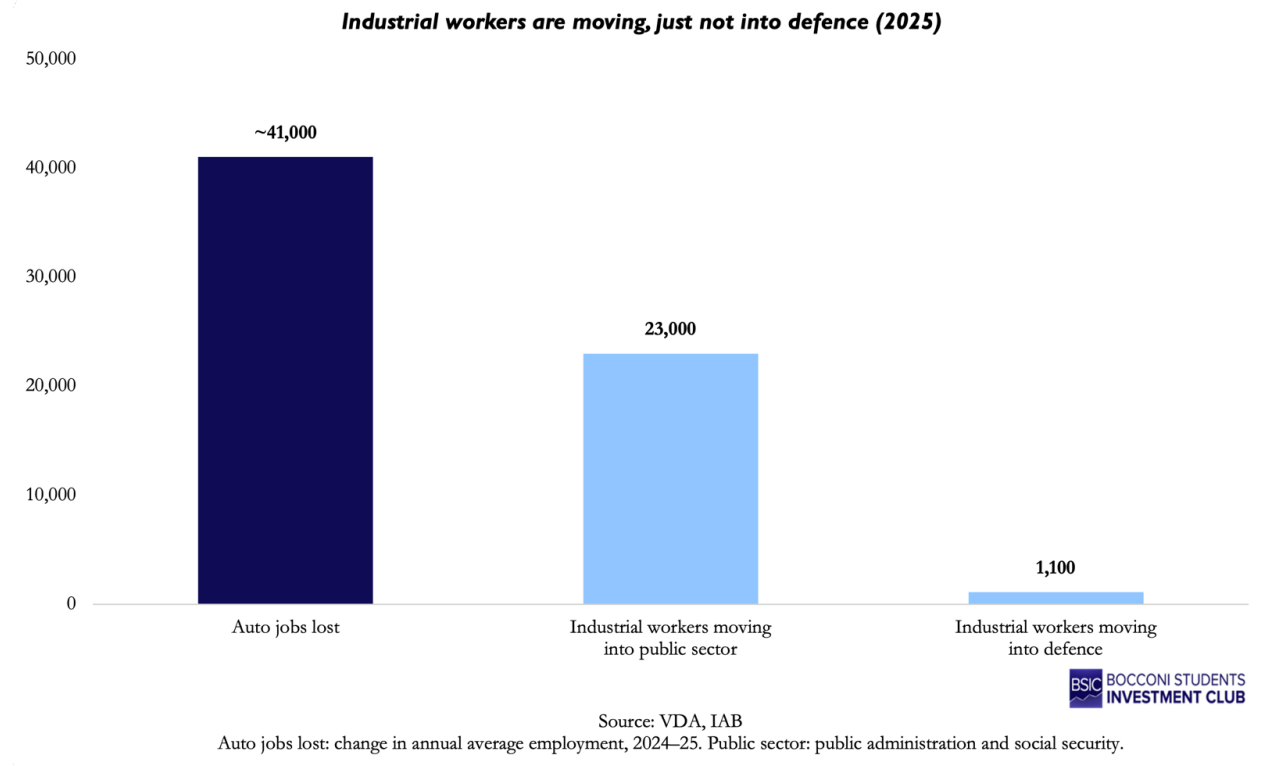
The chart shows that mobility itself is not the problem: twenty times more industrial workers moved into the public sector than into defence. Skills also appear not to be the main barrier, as both industries rely on metal and electrical trades as well as systems integration. The deeper issue is weak hiring due to low investment, which according to the IAB has fallen for years, leaving newly reported vacancies at historic lows.
Union resistance has not been a bottleneck in this transition. At Osnabrück, rather than opposing the sale, IG Metall and the works council negotiated the safeguards in the statement of intent, including continued collective agreements and works council structures. IG Metall’s chair and local politicians nonetheless stress that the deal is not a final solution for the entire workforce, and insist that Volkswagen remains responsible for the rest.
To judge whether the transition could work, the economic weight must be considered. A fiscal multiplier indicates how much GDP changes for each euro spent in public expenditure. A multiplier below one shows that part of the euro is lost, either through leakages abroad via imports or by crowding out private activity. While estimates vary widely, economists at the University of Mannheim concluded in 2025 that Germany’s short-term multiplier for defence is no more than 0.5 and possibly close to 0, suggesting that every euro spent by Germany’s government on defence returns at most 50 cents to the GDP. A 2026 study by the German Economic Institute (IW), modelling the planned increase in defence spending to 2030, finds a cumulative multiplier of about 1, suggesting that every euro spent on defence returns 1 euro to the GDP. Even on the optimistic estimate, spending on defence generates no additional growth beyond the spending itself.
Imports are a smaller leak than they may appear to be: two thirds of orders placed in 2025 went to German firms, and only 12% of orders since 2020 went to non-European companies. Urgency can change this quickly, however. The non-European share exceeded 40% in 2022, when Germany quickly purchased large amounts of US-only systems such as F-35 fighter jets and Patriot missiles. The share of foreign orders may be underrepresented due to the data assigning each order to the country of the company’s headquarters, meaning that some offshored work may not be accounted for. The larger factors are composition and capacity. The planned 2026 military budget allocates €47.9bn to procurement, €24.7bn to personnel, but only €1.6bn to research and development, representing just 1.5% of the €108bn budget, below the EU average of 4.5% reported in the 2024 Draghi report. Spending resembling consumption (such as personnel) raises GDP far less than spending on investment, with a 10-year multiplier of about 0.2 compared with about 1 for investment, according to the Bank of Finland, lowering the multiplier for total defence expenditure. Capacity is the other constraint: German defence contractors are already stretched, and the Mannheim study argues that any increase in orders would mainly lead to an increase in price.
Using the 2025 estimates presented earlier, the defence sector supports roughly 1,700 jobs per €1bn of revenue, compared with roughly 1,400 jobs per €1bn of revenue in the automotive industry. This is likely due to the small batch production of the defence industry being more labour-intensive than that of the automotive industry. The defence industry is small, but produces a proportionately larger number of jobs given the revenue.
Given defence firms’ capacity is already stretched, increases in spending will not necessarily lead to an increase in output. This is where repurposing car plants would help most. A BCG (Boston Consulting Group) analysis found that German car plants ran at 67% utilisation in 2025, well below their cost-optimised capacity utilisation rate which sat at 80%. Conversions such as Osnabrück aim to put this idle capacity to use, but so far only slowly and at a small scale.
There is evidence of spillover benefits from military spending, with a 2025 Kiel Institute report suggesting that the R&D spillovers from military spending of 1% of GDP are enough to raise productivity by 0.25%. However, Germany only allocates a very small portion of its military spending to R&D expenditure, likely reducing the spillover benefits found. Regardless of the return per euro, the main question is whether there will be enough euros to cover the job losses from the declining automotive sector.
Even the most advanced conversion of an auto plant into defence is small compared to the declining auto industry. If completed, the Osnabrück deal would keep the 1,200 to 1,400 jobs mentioned earlier, against the roughly 41,000 auto jobs lost in 2025. If Osnabrück were replicable, it would need to be replicated around 30 to 35 times to offset a single year of losses.
A rough calculation suggests that even rising procurement cannot close this gap. The planned rise in procurement from 2025 to 2026 sits at €15.6bn. Assuming two thirds of procurement goes towards local suppliers as it did in 2025, that results in €10.4bn in new domestic demand. Considering the sector’s 2025 estimate of 1,700 jobs per €1bn of revenue, this could fund around 17,000 to 18,000 new jobs, less than half of the roughly 41,000 auto jobs lost in 2025. This estimate is generous as it assumes the planned spending is fully spent, the spending goes towards equally labour-intensive products, and the output increases rather than price.
The defence industry can rescue individual automotive plants, but not the whole industry. The procurement falls short of being able to cover the job losses, the demand favours products that car plants are poorly suited to produce, and workers have not been moving into the defence industry at scale. Whether the government can steer defence demand into idle auto capacity is a question for the outlook.
Outlook: Who Gains and What Could Go Wrong
The limits outlined above leave the government with a narrower task: matching funded defence orders to automotive capacity that can realistically deliver them. Larger budgets alone will not achieve this. The most repeatable model is likely to involve selected production lines and suppliers, where existing skills and equipment reduce the cost of entry. Military trucks, support vehicles and certain components offer a more natural fit than tanks or missile systems. Drone manufacturing may also create opportunities for individual suppliers, but this should not be confused with a broad shift in German procurement towards drones. As the Kiel data discussed above show, new-paradigm systems have accounted for a falling share of order value.
The benefits will therefore depend on where a company sits in the supply chain. Established defence contractors are best placed to capture value because they control programme access, product designs and customer relationships. Specialist mid-sized (Mittelstand) suppliers can build attractive businesses where their components are difficult to replace. Firms offering interchangeable manufacturing capacity will have less bargaining power. For policymakers, the priority should be to connect procurement schedules with qualification, training and investment decisions. For companies, the crucial question is whether a contract covers the cost of adapting a plant and keeping it occupied, rather than simply adding revenue.
Financing that transition is a separate challenge. In the first half of 2026, Rheinmetall’s operating result rose to €786m from €453m a year earlier, while operating free cash flow deteriorated from minus €631m to minus €1,616m. The company linked the outflow to advance-payment timing, inventories, receivables and capacity investment. Half-year cash flows are sensitive to payment schedules, and these figures do not establish a permanent funding shortfall. They do show why rising profits are insufficient evidence that expansion can finance itself. For smaller automotive suppliers, advances and payment milestones may determine whether an otherwise attractive defence order is viable.
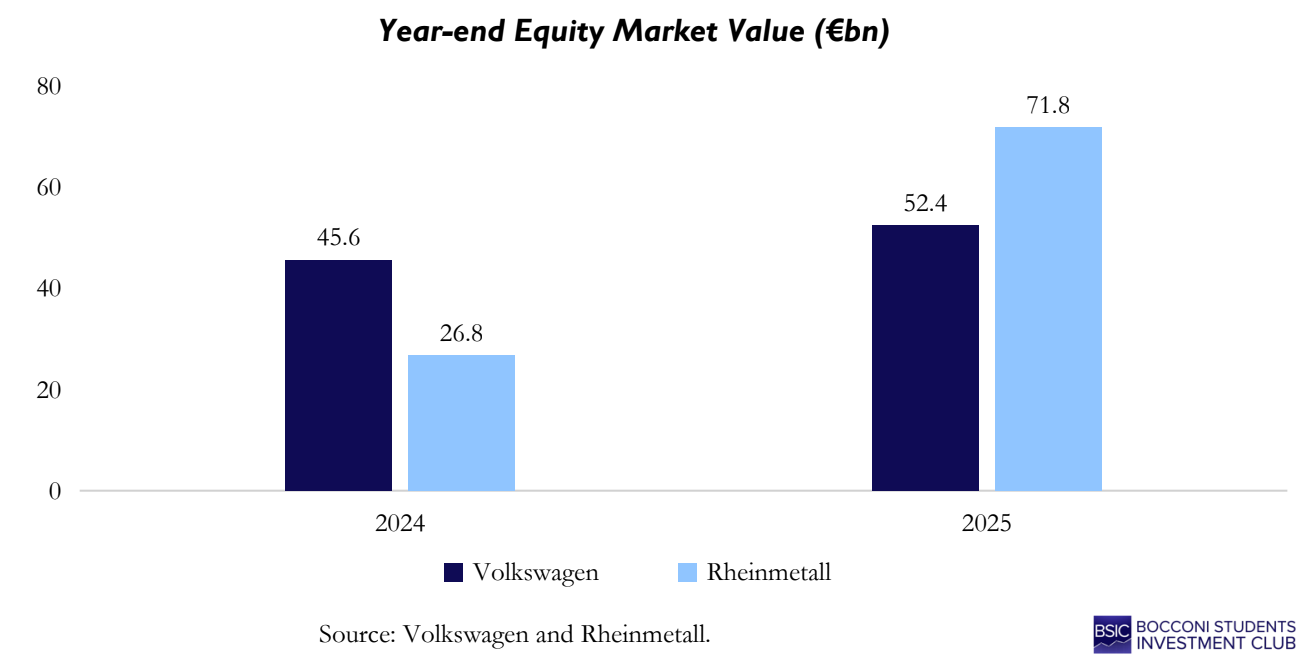
Note: Company-defined measures, continuing operations. H1 2026 includes Naval Systems following its acquisition. Figures are not full-year results.
Demand should extend beyond the immediate requirements of the war in Ukraine. NATO’s Hague declaration commits allies to at least 3.5% of GDP in core defence spending by 2035 and identifies Russia as a long-term threat. A ceasefire would not automatically remove the need to rebuild military capacity. It could, however, weaken the urgency behind new orders or change the equipment governments prioritise. The spending path will be reviewed in 2029, and a political commitment still needs to become a funded contract. Programme risk also persists within a growing market: Rheinmetall reduced its 2026 sales guidance by €300m following the cancellation of the F126 frigate programme.
The workforce implications require similar care. The Osnabrück figures above describe different stages of a proposed transition: the employees expected to transfer, the smaller target workforce and the protection period running to the end of 2029. They should not be read as a completed sale or a permanent guarantee of every existing job. The longer-term test is whether orders sustain the site after the initial protection period, making the timing of contracts and retraining central to its prospects.
There is also a danger of reproducing excess capacity in a new industry. Several suppliers may invest against the same expected programmes, only to find that actual orders cannot keep every line occupied. Expanding in stages against committed volumes would reduce this exposure. Public support is most useful where it addresses a specific bottleneck, such as qualification or workforce training. Subsidising capacity without a credible product and customer risks postponing the restructuring that defence is supposed to help manage.
Equity markets have already priced in very different prospects for the two industries. At year-end 2025, Rheinmetall’s market capitalisation was €71.8bn, compared with €52.4bn for Volkswagen. A year earlier, the figures were €26.8bn and €45.6bn respectively. This reversal reflects investor expectations about future earnings; it does not establish that defence can replace automotive output or employment. Market capitalisation is an equity measure, and differences in debt, financing operations and business mix also matter when comparing the groups. Both valuations have since fallen: at 30 September 2026, Rheinmetall’s market capitalisation was around €44bn and Volkswagen’s around €35bn. For investors entering after the revaluation, execution and cash generation need to justify the expectations already embedded in prices.
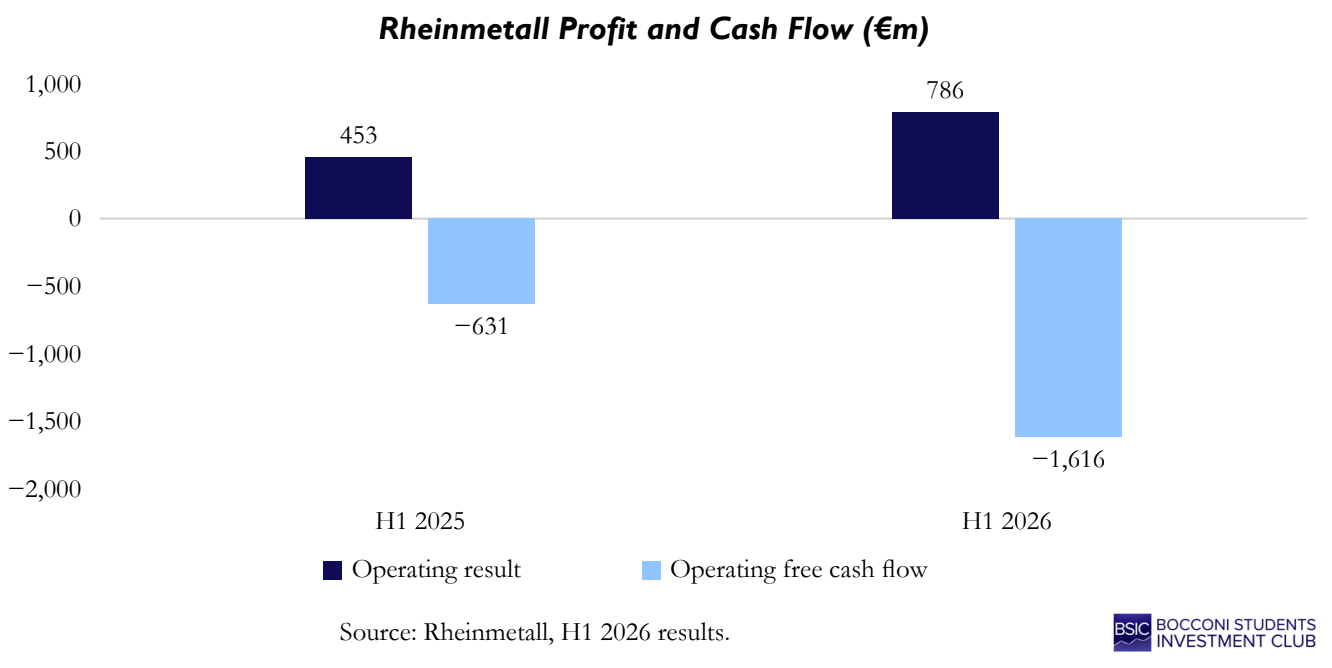
Note: Reported equity values at each year-end. Volkswagen includes both ordinary and preferred shares.
Rheinmetall and Hensoldt offer direct exposure to defence demand. Hensoldt’s first-half 2026 order intake doubled to €2.8bn, supported by European procurement across sensors and optronics. Automotive suppliers such as Schaeffler offer a less direct route: the partnerships discussed earlier need to translate into funded orders and a material profit contribution. For Volkswagen, the initial benefit should be assessed through proceeds, avoided costs and any retained exposure. Mercedes-Benz has no agreed deal, as the Ludwigsfelde talks have stalled. A plant conversion alone is insufficient grounds to value the wider group like a defence contractor.
Defence can provide a future for selected factories and a new market for capable suppliers. The strongest projects will combine a suitable product, transferable capabilities and contracts that finance the transition. Their success should be measured by sustainable orders and returns after conversion costs, alongside the industrial skills they preserve. That would be a meaningful outcome, even if it cannot offset the wider adjustment facing German carmakers.
Conclusion: A Partial Rescue
Defence can save selected plants and suppliers, but it cannot replace what the car industry is losing. The gap in scale is large. Even on a generous estimate, defence revenue is only around one-ninth of automotive revenue, and Osnabrück would have to be replicated around 30 to 35 times to offset a single year of automotive job losses. The planned rise in procurement could fund around 17,000 to 18,000 jobs, less than half of the roughly 41,000 lost in 2025.
The shape of demand adds to the problem. Most order value goes to large crewed platforms that car plants are poorly equipped to build, delivery takes years and around 70% of recent orders have no final delivery date, and few industrial workers have so far moved into defence. Where product, skills and contracts do line up, as at Osnabrück if the deal completes, conversion offers a real future for a site and its workforce.
For German carmakers, defence is therefore a partial cushion. What happens next depends on whether the government steers procurement towards idle automotive capacity, whether contracts are large and firm enough to cover conversion costs, and whether jobs at converted sites outlast the guarantees that end in 2029. For companies, policymakers and investors alike, the test is sustained orders rather than announcements.
References
- Verband der Automobilindustrie (VDA), “Jahreszahlen der Automobilindustrie: Allgemeines” (Destatis data), 2026. Link
- Stockholm International Peace Research Institute (SIPRI), “The SIPRI Top 100 Arms-Producing and Military Services Companies, 2024”, 2025. Link
- German Federal Ministry of Defence (BMVg), “Deutschland investiert in Verteidigung und stärkt das Bündnis”, 26 November 2025. Link
- Kiel Institute for the World Economy, “Leading in spending, lagging in innovation: German defence procurement compared to the UK and Poland”, Kiel Report No. 8, May 2026. Link
- Weber, Enzo and Yilmaz, Yasemin (IAB), study reported in “IAB-Studie: Rüstung kann Jobverluste nicht ausgleichen”, t-online, September 2026. Link
- Krebs, Tom and Kaczmarczyk, Patrick, “Wirtschaftliche Auswirkungen von Militärausgaben in Deutschland”, University of Mannheim, June 2025. Link
- Volkswagen Group, “Setting the course for the future of the Osnabrück site”, 7 September 2026. Link



0 Comments