Introduction
On 23rd September 2026, Switzerland’s upper house of parliament, the Council of States, voted to require the Swiss parent bank of UBS Group AG [SWX: UBSG] to back the value of its foreign subsidiaries with 90% Common Equity Tier 1 (CET1) capital, a decision UBS says would require ~$16bn of additional capital. Within days, Semafor reported that the bank was discussing an exit from Switzerland, sending the shares higher, and on 30th September Artisan Partners, one of UBS’s largest shareholders, wrote to the board that Switzerland is “no longer an attractive or desirable location” for the bank. Later, Cevian Capital, which owns ~1.5% of UBS, went from insisting in early 2025 that “Switzerland is good for UBS, and UBS is good for Switzerland” to stating later that year that it saw “no other realistic option but to leave”.
In our earlier piece, “Switzerland’s Financial Paradox: Stability Built on Fragility”, we argued that Swiss stability rests on a banking system far larger than the economy standing behind it, with UBS’s balance sheet now far larger than the Swiss economy, around double the size.. For the Swiss state, the lesson of Credit Suisse is that a bank of this size must be able to absorb its own losses, particularly those arising abroad, without the need for a rescue. Hence the Federal Council’s demand that UBS AG, the group’s Swiss parent bank, fully back its foreign subsidiaries with CET1, softened by the upper house to 90% phased in over seven years, but still well above today’s ~45% CET1 plus 17% AT1. For UBS, the financial implications are significant of this proposal is significant.
UBS have several routes to choose from, such as redomiciling the group abroad, merging with a foreign bank, staying in Switzerland but shrinking abroad, restructuring its legal entities, or using the threat of any of these to negotiate a softer rule. In this article, we first revisit how the collapse of Credit Suisse created today’s dispute and explain the capital mechanics behind the new rule. We then weigh the case for leaving against staying, assess how UBS could practically leave and the frictions that would make any move costly, before giving our view on where this is likely to end.
Credit Suisse: From Scandal to Shotgun Merger
UBS’s current regulatory dispute is a consequence of the collapse of Credit Suisse. For several years, Credit Suisse had been weakened by repeated governance failures and poor risk management. The most visible examples came in 2021, with the collapse of Greensill Capital, which froze ~$10bn of Credit Suisse supply chain finance funds, and the default of Archegos Capital Management, costing the bank ~$5.5bn. These scandals came with persistent losses in the investment bank and a restructuring plan in October 2022 which failed to restore confidence, and exposed weaknesses in the bank’s internal controls. Although Credit Suisse continued to meet formal regulatory capital requirements, clients withdrew upwards of CHF 110bn in 4Q 2022 alone. The final blow came in March 2023, with the collapse of Silicon Valley Bank unsettling markets, and days later Credit Suisse disclosed material weaknesses in its financial reporting. When its largest shareholder ruled out providing further capital, outflows accelerated, pushing the bank close to failure.
Faced with the risk of a disorderly failure, the Swiss government arranged an emergency takeover by UBS over the weekend of 19th March 2023. UBS agreed to acquire Credit Suisse for ~CHF 3bn in shares, under emergency legislation that allowed the deal to proceed without shareholder votes at either bank. To facilitate the deal, the Swiss National Bank provided liquidity support and the federal government guaranteed up to CHF 9bn of potential losses on Credit Suisse assets after UBS had absorbed the first CHF 5bn. The rescue prevented a collapse, but came with a cost, creating a much larger UBS and one which concentrated a greater share of Swiss financial system risk.
The rescue also left a legal dispute that remains open today. As part of the deal, the Swiss Financial Market Supervisory Authority (FINMA), the country’s banking regulator, wrote down ~CHF 16bn of Credit Suisse Additional Tier 1 (AT1) securities to zero. AT1 securities are designed to absorb losses when a bank enters severe financial distress, but the decision became controversial because shareholders still received consideration through the UBS takeover, reversing the treatment in which shareholders bear losses before bondholders. In October 2025, the Swiss Federal Administrative Court overturned the write-down in the first test case, finding that FINMA’s decision lacked sufficient legal basis. FINMA and UBS have appealed to the Federal Supreme Court, and until it rules the bonds remain written down.
More importantly for UBS today, Credit Suisse revealed weaknesses in the capital structure of the standalone parent bank. FINMA concluded that Credit Suisse AG was one of the weakest capitalised entities within the group and highlighted the regulatory treatment of investments in foreign subsidiaries as a key vulnerability. Losses in those subsidiaries could erode the parent’s capital precisely when the group was already under stress, and the parent could not easily spin off divisions without taking a further hit to its own capital. Preventing the same weakness from arising at UBS is now at the core of Switzerland’s proposed capital reforms.
Capital Mechanics
To understand what Switzerland is asking of UBS, it is vital to distinguish between the two legal entities. UBS Group AG is the consolidated holding company, whose key metrics, such as its CET1 ratio, are typically used by investors. UBS AG is the main operating parent bank, and owns the group’s major foreign subsidiaries, such as its US and European operations. On UBS AG’s own balance sheet, these subsidiaries appear as a single asset, with its investments in them known as participations. The current debate is not simply about raising UBS’s overall CET1 ratio, but how much high quality equity UBS AG itself must hold against the value of these participations, which is the weakness FINMA identified at Credit Suisse AG.
One of the core underlying concerns is double leverage. Suppose UBS AG owns a foreign subsidiary valued at $10bn. Under the current rules, roughly 45% of that stake must be backed by CET1, so ~$4.5bn of the parent’s equity stands behind it, with the remaining $5.5bn funded with debt and other instruments. If the subsidiary then falls in value from $10bn to $6bn, UBS AG records a $4bn loss on its assets, while its debt remains outstanding in full. The loss consumes almost all of the $4.5bn of equity in the stake. With full CET1 backing, the parent could absorb even a total loss on the subsidiary or sell it below book value without impacting its capital ratio. This is exactly the problem Credit Suisse faced in 2023, where it was unable to sell or wind down foreign units without further weakening its parent’s capital.
This is the vulnerability regulators are trying to address. Under the current framework, UBS AG must back its foreign participations with approximately 45% CET1 plus 17% AT1. The Federal Council proposed increasing this to 100% CET1, so participations would effectively have to be fully backed by the highest quality form of bank capital. UBS estimated this would require ~$20bn of additional CET1 and argued that the requirement would be far stricter than international standards and would reduce its ability to compete with major global banks.

The political process has since produced a compromise. In September 2026, the Council of States supported a requirement of 90% CET1 backing, phased in over seven years, below the government’s 100% proposal, but still substantially above the current framework. UBS estimates this would require ~$16bn of additional CET1, on top of ~$2bn from separate charges regarding how certain assets count towards capital. The proposal now moves to the lower house, where a compromise of around 75% has been discussed. Earlier proposals had considered allowing a larger role for AT1 capital, such as a 50/50 CET1/AT1 split proposed by the upper house’s committee and backed by UBS, but the Council of States chose to rely mainly on CET1.
It is worth noting that these figures are gross requirements rather than the actual shortfall. The government puts the gap at only ~$5bn under 90% and ~$9bn under 100%, while analysts estimate it at closer to $6bn to $8bn once the excess capital UBS AG already holds is taken into account. The difference between CET1 and AT1 is important. CET1 consists mainly of common shareholders’ equity and retained earnings and represents the strongest form of loss absorbing capital. Losses reduce CET1 immediately. AT1, by contrast, is a hybrid capital instrument. It normally pays investors a coupon but can be converted into equity or written down when certain conditions are triggered. From UBS’s perspective, using AT1 is attractive because it reduces the amount of common equity the bank needs to retain. It is also cheaper: AT1 coupons are typically below the return shareholders demand on equity, and in many jurisdictions they are tax deductible, whereas dividends are not.
From the Swiss government’s perspective, however, Credit Suisse demonstrated why relying too heavily on AT1 can be problematic. The CHF 16bn Credit Suisse AT1 writedown led to major litigation and remains legally controversial. As a result, Swiss policymakers prefer capital that absorbs losses more easily and reliably during a crisis. If stricter requirements are introduced, UBS has several ways to respond. The first is to retain a larger share of future earnings. Instead of distributing profits through dividends and share buybacks, the bank can keep more capital on its balance sheet and gradually build the required CET1 buffer. Morningstar sees this as the base case, arguing that the requirement “appears manageable and should not require an equity raise”.
A second option is to repatriate capital from foreign subsidiaries. If overseas businesses hold more capital than required by local regulators, UBS can potentially upstream part of that excess capital to the parent bank. UBS has already indicated that capital repatriation could offset part of the new requirement, although the amount available depends on local regulatory restrictions. UBS could also issue new common equity, although this would dilute existing shareholders and is therefore relatively unattractive. Another possibility would be to reduce the size of foreign subsidiaries through disposals or restructuring. This would lower the value of the participations against which UBS must hold capital, but it could also reduce future earnings and weaken the bank’s global franchise.
For shareholders, the main cost of the reform is therefore not that the additional capital simply disappears. The issue is opportunity cost. Capital retained to satisfy regulatory requirements cannot necessarily be deployed in the highest return activities or distributed to shareholders. This matters directly for UBS’s return on CET1. If UBS is required to hold substantially more common equity while earnings remain broadly unchanged, the denominator in the return calculation increases and RoCET1 falls. JPMorgan estimates the proposal would reduce UBS’s return on tangible equity by half a percentage point in 2028. Greater capital retention can also reduce share buybacks, limiting EPS accretion and lowering the amount of capital returned to investors. For Swiss regulators, however, this lower capital efficiency is an acceptable cost. The objective is to ensure that losses in foreign subsidiaries are absorbed by UBS shareholders rather than creating a situation in which the Swiss state may again need to intervene.
The Case for Leaving vs Staying
It is precisely this opportunity cost that large shareholders have seized on. On 30th September 2026, the investment management firm Artisan Partners, based in Milwaukee, published a letter suggesting UBS’s relocation, following the 23rd September vote of the upper house on a regulatory environment that would impose an excessive burden on the Swiss bank in terms of regulatory capital requirements. Artisan Partners owns 1.8% of UBS shares and is concerned by the recent turn of events, with the upper house rejecting the softer 50/50 CET1/AT1 deal discussed above in favour of a 90% CET1 requirement. The issue is that such an expensive type of equity would depress the profitability of the bank. Artisan Partners offers a quick example of the impact of such reform. It claims that UBS is currently required to hold $56bn of CET1, which would increase to $72bn under the new regulation. By changing jurisdiction, and hence benefitting from more lenient regulation, those additional $16bn could be freed up and made available to generate returns for shareholders. The assumption stated in the letter is a 15% return, which would yield $2.4bn more income. Artisan Partners then mentions how at a 15x multiple that would yield “a $36bn foregone market capitalization, which is equal to roughly 23% of UBS’s current value”.
While less stringent capital requirements could improve UBS’s financial position, these claims rely on several assumptions. First, it is unclear whether the entire sum could be freed up by moving to a different jurisdiction; secondly, there should be sound reasons standing behind the 15% return cited; and finally, the same must be true for the 15x multiple. For multiples, to obtain a range to verify whether a 15x multiple is reasonable, we turn to FactSet: the actual P/E multiple is currently 16.19x, but the forward ones, P/E FY1 and P/E FY2, are respectively 12.99x and 11.15x, hence at the moment 15x falls within the range. One could wonder whether this remains credible as markets evolve. Regarding the 15% return, it seems to be taken from the targets disclosed by UBS itself. In fact, UBS discloses that it aims for a 15% underlying return on CET1 capital by the end of 2026. It remains to be seen whether this target is attainable. Two of the three inputs are therefore broadly consistent with UBS’s own data now. The less certain one is whether the full $16bn would be freed, particularly given the smaller shortfall estimates discussed above, and whether it could be deployed at UBS’s average return. Overall, the $36bn is to be read as an upper end illustration.
Even if UBS were to truly move, the question appears obvious: where to move? In this respect, it is interesting to compare different geographies in terms of CET1 capital requirements. Before deep diving into the topic, it is paramount to understand that we will be discussing requirements, but most of the time banks display CET1 ratios much higher than the required ones to have a buffer to act comfortably. That said, let us compare the US, the UK, the EU and Switzerland.
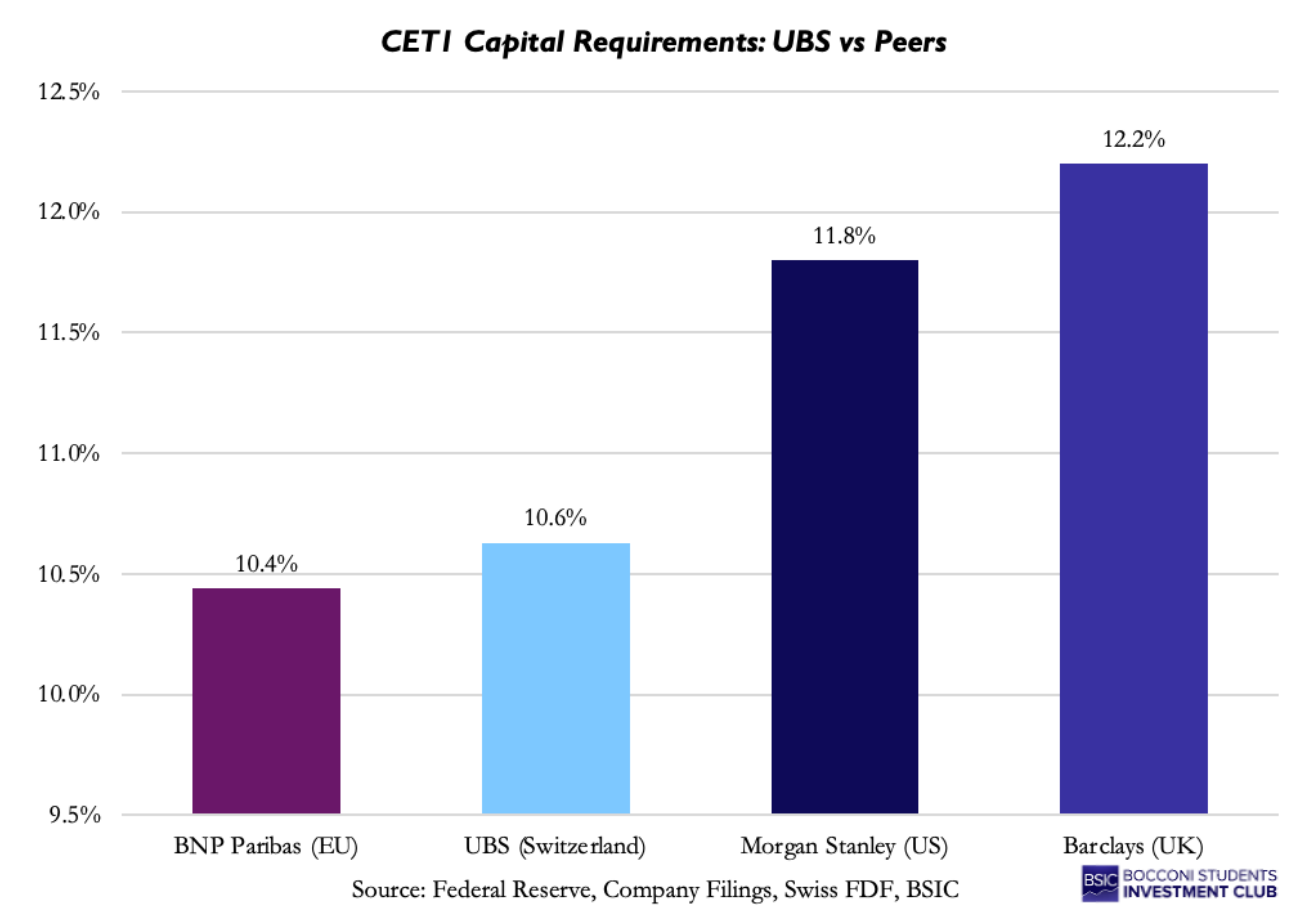
Headline CET1 requirements do not suggest that Switzerland is exceptionally restrictive: UBS’s 10.63% is broadly comparable with BNP Paribas’ 10.44%, and slightly lower compared to Morgan Stanley’s and Barclays’. The regulatory divergence instead lies primarily in Switzerland’s proposed treatment of foreign subsidiaries. While these subsidiaries already hold capital to satisfy local regulators, UBS AG must also hold CET1 against the value of its stakes in them, with the proposed reform substantially increasing this parent level burden. It should be flagged that regulators state that, by 2030, UBS will have a minimum CET1 capital requirement of 11.3%. Nevertheless, this would still place it below requirements in the UK and in the US. Hence, Switzerland is not an outlier in terms of mere CET1 ratio requirements; the complaints concern a narrower topic, that of foreign subsidiaries, for which we found no equivalent requirement in other jurisdictions. It is worth looking at multiples to understand how UBS’s valuation compares with other bulge bracket banks to assess the current situation.
Looking at actual P/E, UBS’s 16.19x is above both the 14.40x median and 13.22x average. It is in line with US comparable companies, such as Morgan Stanley’s 16.09x, and ranks ahead of European and British banks such as BNP Paribas (7.96x) and Barclays (8.98x). Moving to another relevant metric for the banking sector, P/BV, UBS trades at 1.67x P/BV, against 2.56x at JPMorgan and 2.89x at Morgan Stanley. The gap tracks returns: UBS earns an ROE of 10.5%, against 17.7% and 18.0% respectively. Since higher capital requirements enlarge the equity base, they weigh directly on ROE, which is the activist argument. Capital is, however, unlikely to explain the entire gap. UBS’s efficiency ratio, which capital rules do not directly drive, is 72.9% against 47.6% at JPMorgan and 65.0% at Morgan Stanley. Relocating alone could therefore not address the entire gap.
In such a context, it is interesting to assess investors’ views on the situation. To do so, let us look at market reactions to the key recent developments. Following the Council of States vote on 23rd September, on 24th September UBS fell 0.55% from the previous day, compared with a 0.52% decline in the ETF tracking the STOXX Europe 600 Banks Index, implying a market adjusted excess return of −0.03%. On 24th September, Semafor reported that UBS was considering exiting Switzerland: on the following trading day, UBS rose 3.50%, compared with 0.91% for the European banking index ETF, with an excess return of approximately +2.60%. This apparently suggests a positive reaction following the news, but one must be cautious in drawing conclusions. On 30th September, the day Artisan Partners’ letter was published, UBS stock fell 0.59% from the previous day, in line with the banking index ETF’s −0.50%, suggesting instead no particularly strong reaction. Moreover, it is paramount to keep in mind that these market adjusted returns cannot isolate the announcements from other contemporaneous information and should not be interpreted as establishing causality.
Regardless of true investor sentiment, it should be noted that discussions about UBS’s relocation might also take other factors into consideration. On one hand, beyond capital requirements, relocation could offer UBS broader strategic advantages. One instance is specific to the US and is reported by the Financial Times: UBS could benefit from moving to the United States, as the country accounts for almost half of the group’s invested wealth assets and it represents the largest concentration of private wealth globally. Moving headquarters could push expansion in this direction. Moreover, an interesting consideration concerns UBS’s size compared to Switzerland’s economy: the IMF reported that in 2025 UBS’s assets reached approximately 167% of Swiss GDP, raising questions about the credibility and capacity of Switzerland’s financial safety net in a future crisis. Relocation to a larger jurisdiction could potentially reduce this mismatch and improve perceptions of sovereign support.
On the other hand, there are also clear advantages to staying. First, the regulatory decision is not yet final: the decision must still pass through the lower house, leaving room for a potentially less restrictive compromise. More importantly, UBS’s Swiss identity represents a valuable competitive advantage. Switzerland’s longstanding reputation for political neutrality, financial stability and discretion has helped establish UBS as a leading global wealth manager. As Reuters Breakingviews highlights, relocating to the US could terminate relationships with certain international clients, particularly those reluctant to place their fortunes under American jurisdiction. Any potential capital savings must therefore be weighed against the risk of losing client assets and the associated fee income.
How UBS Could Leave: Deal Structures
If UBS were to act on these arguments, “leaving” Switzerland would not free UBS from capital rules, but rather change who writes and enforces such rules. Two options exist for UBS to avoid the 90% requirement: make a regulator (other than FINMA) its main supervisor, so the Swiss bank only needs capital for its Swiss business, being just one part of a foreign group, or take the foreign businesses out from under the Swiss parent. UBS has reportedly already scoped these options, even sounding out Nordea on its 2018 move from Stockholm to Helsinki, although Nordea has denied that its executives discussed it. In short, the real benefit would be the gap between Swiss regulation and the alternative G-SIB surcharge, stress testing regime and leverage requirements. With that in mind, each potential exit route should be weighed on relief, approvals and cost.
One option is redomiciling the group. The structure employed in 2014 to create UBS Group AG (share for share exchange offer and squeeze out) could allow UBS to create a new foreign holding. Alternatively, UBS could also follow Nordea’s example of a cross border merger. Both routes pose challenges as the foreign branches and subsidiaries currently sit under UBS AG and would have to be moved under the new parent holding (needing a qualified shareholder majority approval as well as approval from FINMA, and from the new home regulator and the host regulators in each country where UBS operates). The timeline for such a move would be in the order of years, while UBS is still undergoing the integration process of Credit Suisse. In the event of redomiciling, London emerges as the most natural move, with a large existing presence, potential FTSE inclusion and PRA rules in line with international standards, at the cost of the bank levy, 3% bank surcharge, and 0.5% stamp duty. However, some investors see the UK as less viable, as its capital requirements are closer to those in Switzerland. New York, on the other hand, offers the highest potential when it comes to wealth management, adding to that a deregulating Fed, but the whole group would then fall under the Fed’s annual stress tests (CCAR) and the full US G-SIB surcharge (stricter than the international standard, so part of the capital freed would be absorbed again). Frankfurt, via UBS Europe SE, offers access to the banking union but also EU bank valuations, which are typically unfavourable.
Every potential destination shares two problems: the new home regulator would have to take over the resolution plan and bondholders may need to agree on substituting the debt, and UBS’s retained reserves would face Switzerland’s withholding tax of 35%, with only the capital contribution reserves largely exempt, potentially adding to a substantial exit cost.
A second option could be merging with a foreign bank. Recent reports suggest that UBS has revived the route of merging with or acquiring a foreign bank, with Morgan Stanley [NYSE: MS], Standard Chartered [LON: STAN] and Deutsche Bank [FRA: DBK] appearing as some of the most frequently mentioned names in press speculation, although there is no indication that any side is currently pursuing a transaction. Morgan Stanley (with a ~$300bn market cap, versus UBS’s ~$150bn market cap, as of 08/10/26) would act as a buyer, with expected synergies coming mostly from combining two of the largest US adviser networks. This would require approval from the Fed, DOJ, FINMA and PRA, and the combined entity would land in a higher G-SIB bucket (versus the current Bucket 2) given its combined size, facing a stricter US surcharge, which would absorb a meaningful part of the capital saved. Standard Chartered (~$65bn market cap, as of 08/10/26) and Deutsche Bank (~$65bn market cap, as of 08/10/26) would see their roles inverted when compared to a potential transaction with Morgan Stanley, i.e., UBS would act as the buyer and use the deal to move to London or Frankfurt, gaining overlap with Asian wealth (Standard Chartered) or investment banking scale and an EU base (Deutsche Bank), but taking on a second integration not long after Credit Suisse.
A further option would be a reverse takeover, in which a smaller foreign bank, potentially in the US, acquires UBS in an all-share deal but UBS shareholders emerge with a majority stake in the combined group. Morgan Stanley analysts note that such a structure could avoid the exit tax, although it would require a smaller bank willing to merge with UBS and could mean ceding control of the combined group.
UBS could also choose to stay in Switzerland but will be forced to shrink abroad. Every dollar of foreign business sold both cuts the capital UBS AG must hold against its participations and releases capital. The US wealth unit, whose margins are below those of other parts of the group, is the obvious candidate, followed by Asset Management. However, selling under regulatory pressure rarely allows the seller to realise full value. A spinoff can hand value to shareholders on a tax neutral basis, whereas a sale can fund buybacks. The cost is the global franchise that justified buying Credit Suisse, which management has so far refused to give up, with CEO Sergio Ermotti stating in October 2026 that UBS needs a presence in the US “to be successful”.
UBS could also restructure via moving foreign subsidiaries from under UBS AG to sit beside it under UBS Group AG (similar to HSBC’s model of independently capitalised subsidiaries) would sidestep a parent bank rule, but regulators or lawmakers would almost certainly extend the rule to the group, making this a bargaining chip rather than an exit. It would also be complicated by the fact that much of UBS’s overseas business, particularly its Asian wealth management operations, is booked directly through foreign branches of UBS AG rather than subsidiaries.
The real purpose of UBS’s signals may very well be simply to gain leverage over the Swiss parliament. If there were room for negotiating a middle ground, UBS could push the lower house towards a more lenient measure such as the one originally favoured (the 50/50 CET1/AT1 split discussed above), or secure longer transition periods.
Overall, divesting selected parts of the business out of Switzerland would prove to be the easiest path, but also the one with the least relief. In turn, merging with or acquiring a foreign competitor would likely provide the greatest relief (although a higher surcharge would partially offset it), at the cost of a heavy regulatory burden with the hardest approvals. Redomiciling poses a pathway in between the two, being a slow process, costly to execute both monetarily and legally, but credible enough to use as leverage against parliament, which may very well be the real purpose, with the final decision possibly not being made before 2027.
Frictions and the Exit Bill
Whichever route UBS chooses, it would not be able to leave on its own terms. Finance Minister Karin Keller-Sutter insists leaving Switzerland would be “much more expensive and legally very complex” than complying. Any redomiciliation or cross border merger would require Swiss approvals, giving the state the ability to slow or shape the process, and parliament could go further by creating an explicit exit bill designed to discourage a move.
The largest single cost is likely to be tax. As mentioned above, UBS’s retained reserves would face Switzerland’s 35% withholding tax on leaving. With profit reserves of ~CHF 29bn, one Swiss tax law professor estimates the bill could reach CHF 10bn, while Morgan Stanley analysts put a possible exit tax at up to $10bn, unless a structure such as a reverse takeover avoids it. Set against an actual capital shortfall that may be as low as $6bn to $8bn, an exit bill of this size would wipe out much of the value of leaving. A move would also put UBS’s client franchise and funding at risk. Beyond the wealth clients who value Swiss neutrality and discretion, a new domicile could prompt rating agencies to reassess the support and resolution framework behind the bank, and any downgrade would raise funding costs across the group.
Finally, the shareholder base itself could shift. If UBS ceased to be a Swiss company, it could lose its place in Swiss indices such as the SMI, forcing Swiss index funds to sell, while Swiss pension funds, which typically have a strong home bias, might reduce their holdings. Selling of this kind would weigh on the share price, at least temporarily, partially offsetting the valuation uplift activists expect from a move.
Conclusion
The broader irony is that the Credit Suisse rescue created both UBS’s current strength and its current regulatory problem. UBS became significantly larger and more dominant after absorbing Credit Suisse, but this also made the bank more systemically important to Switzerland. The government is therefore trying to ensure that the enlarged UBS can absorb future losses without requiring another emergency rescue. Yet the rule meant to prevent the next Credit Suisse is now pushing Switzerland’s largest bank away.
In our view, leaving is primarily a negotiating tactic. The true capital shortfall is likely well below the headline $16bn and can largely be built through retained earnings over a seven-year transition period, while an exit bill of up to $10bn, the risk of losing wealth clients, index selling and years of regulatory approvals would consume much of the value Artisan’s $36bn estimate implies. Redomiciling is credible enough to give UBS leverage, but not attractive enough to be its preferred outcome. The most likely result is that UBS stays, pays a reduced bill, and continues to push for a lower CET1 percentage, a role for AT1 or a longer transition period.
There are several things to watch next. UBS reports its results for the third quarter on 28th October 2026, which should give an update on capital, buybacks and its RoCET1 target. The lower house’s committee meets on 26th and 27th October and 23rd and 24th November, with a floor vote possible in December; if the two chambers disagree, the bill will move back and forth, and the Social Democrats have threatened a referendum if the final law is seen as too lenient. Finally, signals from FINMA and the Federal Council, as well as the Federal Supreme Court’s ruling on the Credit Suisse AT1 write-down, will shape how much room for compromise remains.



0 Comments