The sponsor premium and why it matters
When lenders price a leveraged loan, they assess more than the borrower’s financial position and credit agreement. They also consider the private equity sponsor, which can influence how a portfolio company responds to distress and how aggressively it uses the flexibility contained in its loan documents.
This creates a potential trade-off for sponsors. A liability-management exercise may preserve liquidity and equity value at one portfolio company, but it can also shape how lenders approach the sponsor’s future transactions. If those perceptions carry across investments, decisions taken at one company may affect the pricing and terms of debt raised by otherwise unrelated borrowers.
This article examines whether such a sponsor-level financing effect exists. It first explains how liability-management transactions can redistribute value, before using Apollo and Caesars to show how lender perceptions develop. It then considers the broader evidence from the US leveraged-loan market and tests whether a similar effect appears in Europe.
How liability management transfers value
Liability-management exercises, or LMEs, are transactions that change a company’s debt arrangements, generally outside formal insolvency processes. They may extend maturities, reduce outstanding debt or provide additional funding. The more aggressive transactions also redistribute value by changing creditors’ rights and relative positions. Their feasibility depends on the credit documents and applicable law, and the main techniques often overlap within a single transaction.
In an uptier exchange, participating lenders exchange their existing loans for new debt that ranks ahead of the claims of non-participating lenders, often while providing additional capital to the borrower. Where the documents allow for the necessary changes, a consenting group can obtain this advantage without every lender agreeing. Excluded lenders consequently face a lower position in the repayment order.
Borrowers can also change priority by moving assets outside the original collateral. In an asset dropdown, the borrower transfers assets, such as intellectual property, to an entity, often an unrestricted subsidiary, which can then borrow against them. This gives new lenders priority against the transferred assets while existing lenders lose the direct security those assets previously provided.
These changes can also favour some existing lenders over others. In a non-pro-rata exchange, the borrower offers selected creditors access to an exchange, or more favourable terms, without extending the same opportunity proportionately to all holders of the relevant debt. An exclusive uptier is one example, but unequal treatment can also concern exchange prices or other benefits. Such arrangements can divide creditors who previously had similar interests, allowing the borrower to obtain support from a group whose improved position comes partly at the expense of those excluded.
These transactions can also include new-money super-priority financing, under which a company raises additional cash by granting the providers a claim ahead of existing debt. That priority makes lending to a distressed business more attractive but can leave less value available for creditors further down the repayment order. Whether the transaction ultimately disadvantages those creditors depends partly on the new funding’s ability to support a viable recovery and preserve business value.
These mechanisms affect lenders in several ways. Lower priority or weaker collateral coverage can reduce expected recovery if the borrower later fails. Unequal exchange terms can also weaken excluded lenders’ bargaining position. In principle, leaving a small amount of debt outstanding in a lower-ranking position may make it harder to trade, adding a liquidity cost to the expected credit loss. Even lenders offered to participate may agree to less favourable terms if refusing would leave them in a worse position. Agreement to an exchange is therefore not necessarily evidence that the transaction benefits creditors collectively.
For the sponsor, an LME can increase the company’s financial flexibility and reduce pressure to contribute further equity. An exchange below face value may reduce debt, although borrowing new money can increase it. A central benefit is preserving the equity option, as shareholders retain the possibility of benefiting from a future recovery even when current business value is insufficient to repay creditors in full. As Buccola explains in “Sponsor Control”, this can encourage sponsors to delay a restructuring that would realise their losses. Preserving that option may transfer downside risk to creditors, without necessarily improving the company’s underlying operations.
Lenders may respond in later deals by requiring a higher return or stronger restrictions on asset transfers and changes in priority. Buccola and Nini find that uptier blockers became more common after Serta Simmons, while overall susceptibility to dropdowns changed little after J. Crew. Lenders therefore appear to distinguish between forms of flexibility. The sponsor premium asks whether their assessment of who will exercise that flexibility also affects the price of new debt.
Apollo and Caesars Case Study
Caesars provides an early example of how lenders can carry their assessment of a sponsor from one portfolio company to another. The transactions preceding its bankruptcy affected recoveries at Caesars, but also shaped how investors viewed Apollo-backed debt elsewhere. The case therefore links the contractual flexibility described above to a potential sponsor-level financing premium.
Apollo and TPG acquired Harrah’s Entertainment in January 2008 in a transaction valued at approximately $30.7bn, including $12.4bn of assumed debt and around $1bn of acquisition costs. The buyout was financed with term loans, senior notes, payment-in-kind toggle notes, property-level debt and sponsor equity. Harrah’s, later renamed Caesars Entertainment, entered the financial crisis with a heavy debt and interest burden as gaming revenues weakened.
After a series of refinancings and exchanges, the main creditor dispute centred on transactions that moved assets and guarantees away from Caesars Entertainment Operating Company, or CEOC, where most of the group’s debt sat. In 2013, Caesars formed Caesars Growth Partners with capital from Apollo, TPG and public investors. Assets including Caesars Interactive Entertainment and Planet Hollywood were placed in the new structure. In 2014, four additional casino properties and related assets were sold to Growth Partners for approximately $2.2bn.
Caesars argued that these transactions raised liquidity, reduced debt and supported growth. Creditors alleged that valuable assets had been transferred to sponsor-controlled affiliates for less than fair value. The dispute widened when Caesars sold a minority interest in CEOC and asserted that the sale released its parent guarantees of certain CEOC notes. Transactions with selected noteholders also amended creditor rights. Lenders challenged whether the guarantee releases, exchanges and affiliate transactions complied with the relevant indentures.
CEOC entered Chapter 11 in January 2015 with approximately $18bn of debt. A court-appointed examiner concluded that the estate could bring several claims of varying strength, including fraudulent-transfer and breach-of-fiduciary-duty claims. This was not a finding that Apollo, TPG or Caesars had committed criminal or common-law fraud, and Caesars maintained that CEOC had received fair value. Nevertheless, the potential claims strengthened creditors’ negotiating position and contributed to a settlement that provided them with additional value.
The case illustrates the economic trade-off behind sponsor reputation. Moving assets outside CEOC and disputing its guarantees could preserve value for the sponsors in that investment. At the same time, lenders could interpret those decisions as evidence of how Apollo might act if another portfolio company became distressed. The immediate benefit at Caesars could therefore be offset by higher financing costs across unrelated Apollo-owned businesses.
CORE Media Group reinforced this perception. Apollo acquired the owner of rights associated with programmes such as American Idol in 2011. The company later suffered an operating decline, but creditors also challenged asset sales and its combination with Endemol and Shine. Following CORE’s 2016 bankruptcy, creditor representatives alleged that the transactions had removed value and liquidity from the entities responsible for the debt. Apollo disputed the allegations. Although neither Caesars nor CORE alone establishes systematic mistreatment of creditors, together they could influence how lenders assessed Apollo’s likely behaviour in distress.
The effect became visible during Apollo’s acquisition of Presidio. In January 2015, as the Caesars dispute intensified, arrangers struggled to place the acquisition’s $650m term loan. The proposed spread increased from 475 to 525 basis points, the issue price fell from 99 to 97, and call protection was extended from six months to one year. Reuters reported that some investors referred to an “Apollo premium” and linked their reluctance to Caesars.
Presidio also had high leverage, limited tangible assets and business-specific risks, so the pricing change cannot be attributed entirely to Apollo. The financing nevertheless shows how sponsor reputation can affect the primary market: weaker demand forces a borrower to offer a higher yield or stronger lender protections. Caesars therefore provides the historical context for testing whether this effect appears systematically across sponsor-backed loans.
Evidence from The Sponsor Premium
Buccola and Nini test whether the pattern illustrated by Caesars and Presidio appears systematically across the leveraged-loan market. Their sample contains 1,889 first-lien term loans issued by sponsor-owned borrowers between 2016Q3 and 2025Q4, covering 259 sponsors. The study compares similarly rated loans issued in the same period while controlling for industry, loan purpose, market conditions and sponsor scale.
Sponsor identity explains a meaningful share of pricing differences left after these controls. Adding sponsor fixed effects increases the model’s adjusted R-squared from 0.79 to 0.84. The authors then measure reputation in three ways. Apollo-backed loans carry an estimated premium of around 100 basis points. Borrowers owned by sponsors that had conducted at least one LME by the end of 2025 pay around 20 basis points more. Finally, moving from the most lender-friendly to the most aggressive sponsor in a reputation ranking of the 25 largest sponsors is associated with a difference of around 60 basis points.
This reputation effect operates alongside an opposing scale effect. Doubling a sponsor’s number of loans is associated with yields around 20 basis points lower, consistent with larger sponsors benefiting from repeat relationships and future business for lenders. Aggressive sponsors can therefore retain the advantages of scale while paying more than their market presence alone would predict. The premium also does not appear to compensate lenders for looser terms: Apollo-owned borrowers have lower first-lien leverage and tighter documentation than comparable companies, yet still pay higher yields.
The results remain associations rather than proof of causality. Ratings and other controls may not capture every difference in borrower risk, and aggressive sponsors may select or manage companies differently. The LME measure also includes transactions completed after some loans were issued, creating a timing problem, while the reputation ranking may reflect public commentary about loan pricing itself. The authors therefore cannot establish that reputation causes the entire premium.
Nevertheless, the consistency of the results across the three measures supports the central argument: lenders appear to price not only the borrower and its documents, but also the expected behaviour of its sponsor. These estimates provide the benchmark for examining whether the same relationship exists in Europe.
Testing whether the premium travels to Europe
Having established that US lenders price sponsor reputation, we tested whether the same effect appears in Europe. The European market provides a useful comparison: the largest global sponsors remain active, but lenders operate across a more fragmented set of legal regimes and a less developed market for aggressive liability management exercises.
We constructed a sample of 831 European leveraged-loan observations associated with the 20 largest private equity sponsors. The sample covered term loan B transactions issued between 2016 and 2025 by borrowers in the EU, the UK and Switzerland. We used the margin over the reference rate as our measure of loan pricing.
We then reviewed the transaction history of each sponsor and identified whether it had completed a creditor-adverse liability management exercise. Nine sponsors met this criterion. Because Bain Capital’s relevant transaction predated our loan sample, the pre- and post-event analysis focused on the remaining eight sponsors. Loans issued by sponsors without an identified transaction formed the control group.
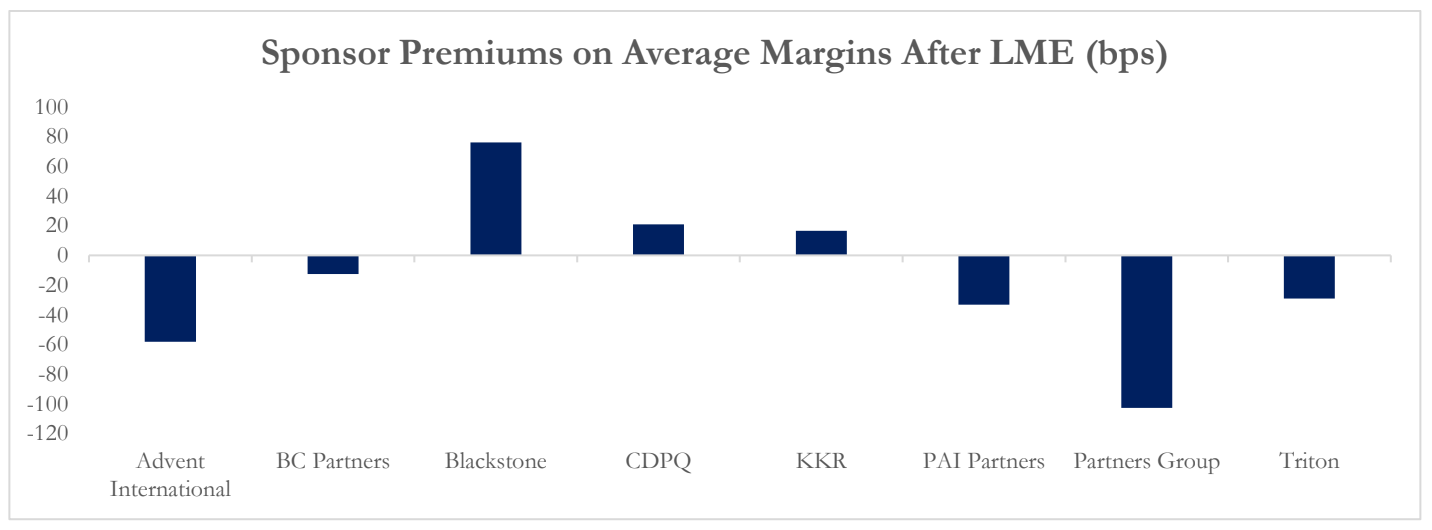
The initial comparison provided little evidence of a broad pricing penalty. Average margins for treated sponsors fell by approximately 15 basis points in the two years following their first identified transaction. Only Blackstone, CDPQ and KKR recorded higher post-event margins, while pricing for the other sponsors remained stable or declined.
We then estimated three progressively more detailed regression models. The unadjusted model indicated that margins fell by 18.76 basis points following an LME, with the result statistically significant at the 1% level. After we added year fixed effects, the estimated decline narrowed to 10.73 basis points and was no longer statistically significant. Finally, we controlled for loan size, industry and currency. The estimated effect declined further to –8.85 basis points, with a p-value of 0.180 and a 95% confidence interval ranging from –22.14 to +4.44 basis points. These controls materially improved the model’s explanatory power, raising R² from 0.009 in the initial specification to 0.348 in the fully controlled model.
These results do not support the existence of a consistent sponsor-level pricing penalty in Europe. However, the negative coefficients should not be interpreted as evidence that aggressive transactions reduce borrowing costs. Instead, they indicate that any reputational effect is too small or inconsistent to separate reliably from changes in market conditions and loan characteristics.
One possible explanation is Europe’s legal fragmentation. Although the EU’s Preventive Restructuring Directive introduced minimum standards, it does not create a single European equivalent to Chapter 11. National regimes continue to differ in the conditions for opening proceedings, creditor ranking, avoidance powers, the formation and voting of creditor classes, cross-class cram-down and the role of courts. The UK operates a separate Part 26A restructuring-plan regime, while Switzerland relies on its own debt-enforcement and bankruptcy framework. These differences affect the time and cost of enforcement, creditors’ negotiating leverage and expected recoveries. As a result, the same sponsor action can carry different implications depending on the borrower’s jurisdiction and the law governing its debt, making a common European pricing effect more difficult to detect.
The aggregate result also conceals meaningful differences between sponsors. Blackstone’s post-event margins increased by approximately 70 basis points relative to the control group, while most other sponsors experienced little or no increase. Given the small number of events and differences in deal composition, these sponsor-level estimates remain illustrative. Nevertheless, they suggest that European lenders may respond to the circumstances and severity of individual transactions rather than applying a uniform penalty to every sponsor associated with an LME.
Blackstone and TriMark: a potential cross-border effect
The aggregate European result may conceal stronger reactions to individual sponsors. The clearest exception in our sample was Blackstone, whose post-event European loan margins increased by approximately 70 basis points relative to the control group. Blackstone’s treatment event was the September 2020 restructuring of TriMark, a US foodservice-equipment distributor co-sponsored by Blackstone and Centerbridge.
Facing severe pressure during the pandemic, TriMark raised $120m of new super-senior financing. Participating lenders were also allowed to exchange $307.5m of existing first-lien debt into a new super-senior tranche, while excluded lenders were effectively pushed from first-lien to third-out status. The excluded lenders challenged the transaction in Audax Credit Opportunities Offshore Ltd. v. TMK Hawk Parent Corp. In August 2021, the New York Supreme Court allowed the principal breach-of-contract claims to proceed, although it dismissed the tortious-interference claims against Blackstone and Centerbridge. The dispute was settled in January 2022: all remaining first-lien debt was exchanged into the second-out tranche, while the new-money financing retained its senior position.
TriMark therefore provides a possible explanation for Blackstone’s distinct result. The transaction was highly visible, directly disadvantaged a group of lenders and generated extensive litigation. Subsequent repricing of Blackstone-backed European loans would be consistent with investors carrying their assessment of the sponsor across both portfolio companies and markets. However, the 70-basis-point estimate remains based on a limited number of observations and may partly reflect differences in borrower risk or deal composition. It should therefore be treated as evidence of a possible sponsor-specific response rather than proof that TriMark caused Blackstone’s European financing costs to increase.
Implications for sponsors
For private equity sponsors, aggressive liability management involves a trade-off beyond the immediate portfolio company. A transaction may preserve liquidity, extend maturities or protect equity value, but it can also affect how lenders assess the sponsor’s behaviour in future deals. Caesars demonstrates how these perceptions can develop around a major restructuring, while the broader US evidence suggests that they can translate into higher borrowing costs across a sponsor’s portfolio.
Our European results show that this effect is neither automatic nor uniform. We found no statistically significant market-wide premium after controlling for loan and market characteristics. However, Blackstone’s experience following TriMark suggests that lenders may respond more strongly to particularly visible transactions or individual sponsors. Sponsor reputation therefore operates less like a fixed premium and more like contingent financial capital: it becomes most valuable when a portfolio company requires lender support and most vulnerable when creditors believe that their contractual position has been deliberately weakened.



0 Comments