Introduction
For much of the past decade, governments have borrowed for the long term at rates close to zero, with markets taking these conditions as close to a permanent feature rather than a temporary one. This assumption is breaking down. At the end of 2021, the 10-year and 30-year U.S. Treasury yielded 1.52% and 1.90%, respectively. By September 21st, 2026, those yields had risen to 4.96% and 5.29%. The shift has not been confined to the United States: Germany’s 10-year government-bond yield also moved from an average of -0.30% in 2021 to 3.00% in 2026. Both markets have moved away from the assumption that governments can borrow for long periods at rates close to zero.
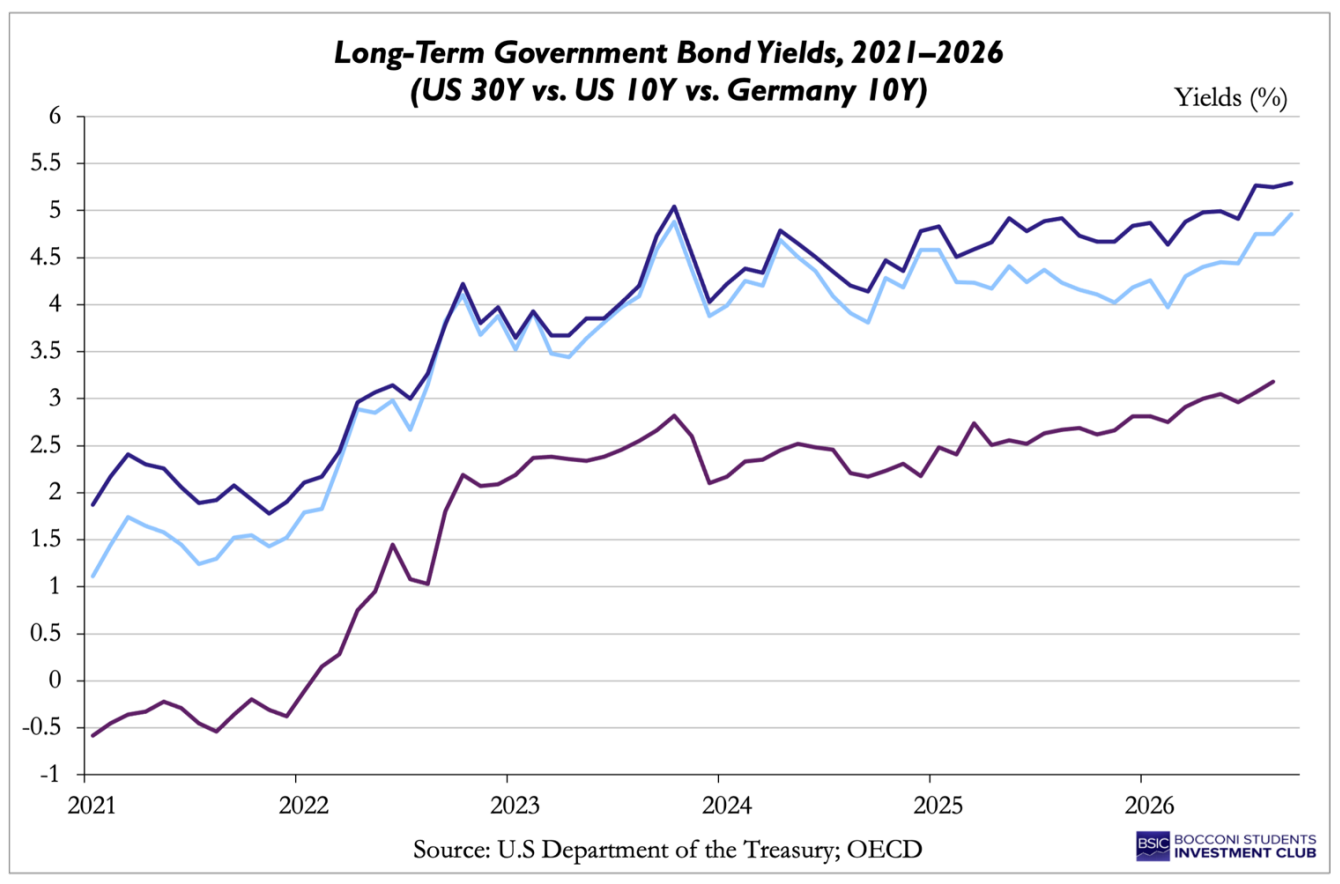
This repricing extends beyond losses incurred by government bondholders. Sovereign yields form the base rate over which much of corporate finance is priced. Higher long-term rates also raise the risk-free component of the weighted average cost of capital and increase the discount rate applied to future cash flows, causing more expensive financing and a lower valuation. The government curve is not the only determinant of corporate financing conditions, but it establishes the level from which other required returns are built.
The persistence of high long-term yields is therefore as relevant as the increase. Part of the explanation lies in expectations for future policy rates and inflation, while the other reflects the additional compensation investors require to hold long-duration assets. The balance between government borrowing needs and the investors available for that debt has also changed. Central banks are no longer expanding their sovereign-bond portfolios, traditional pension systems are gradually losing their role as structural buyers of long maturities, and a larger share of new debt must be placed with investors that respond more directly to price.
Unpacking the Drivers of Elevated Long-Term Yields
A government bond yield can be broken into two core components, the first being interest rate expectations over the life of the bond, and the second being the term premium, the extra compensation investors demand for holding longer-dated bonds. Fundamentally, the first component reflects the market’s view of future interest rates, and the second represents uncertainty surrounding future monetary policy, inflation and liquidity conditions.
Inflation affects long-term yields through two distinct channels, the first being the investors’ inflation expectations. This is seen in breakeven rates, the spread between nominal and inflation-protected yields. This September, the five-year forward inflation rate stood just above the Federal Reserve’s 2% target, indicating inflation expectations remain broadly anchored. The second channel is the degree of confidence behind the forecast. Although the estimate remains anchored near the target, the range of outcomes is widening, stemming from tariff-driven price shocks and energy market volatility. This uncertainty is continuously extending to monetary policy expectations, with forecasts becoming more volatile. Anchored inflation expectations imply expected-rates component of the yield hasn’t shifted drastically; however, elevated uncertainty is raising the term premium. Quantitative tightening (QT) removes a large, price-insensitive buyer from the government bond market, as central banks allow maturing bonds to leave their balance sheet with minimal reinvestment, leaving the private sector to absorb both pre-existing and newly issued debt. These private investors require higher compensation for duration risk, raising the term premium as well.
Taking a closer look at the U.S., rates were recently raised to 3.75-4% in mid-September, following the 2024-2025 cutting cycle. The market consensus indicates a further rate hike before year-end, raising the expected-rates component of Treasury yields. The Fed concluded its balance sheet reduction in December 2025, no longer actively withdrawing demand from the market, however this does not mean QT’s effect on yields has stopped completely, since holdings of government debt is far lower than before the cycle. The euro area presents a case where both channels are moving in the same direction, with the ECB also raising rates in September by 25bps to 2.50%, and unlike the Fed, the ECB’s QT remains fully active, meaning both expected-rate repricing and central bank withdrawals are compounding.
In the UK, the BoE chose to hold rates at 3.75% this September, with a 6-3 vote, and the MPC used its annual QT review to slow the programme, reducing the sale of long-dated gilts and allowing its remaining long-maturity holdings to mature. Earlier this year, the BoE estimated that QT had contributed 20-30bps to a 200bps rise in term premia on government bonds since 2022, which is a modest share alone, but coupled with concerns over long-gilt liquidity, it makes a case for caution. Taken together, these examples demonstrate that the recent rise in long-term yields is not a single phenomenon, but the product of various dynamics.
Who’s Left to Buy the Debt?
Bond auctions can still succeed even as borrowing costs rise. If traditional buyers step back, more price-sensitive investors will generally demand higher yields. The Federal Reserve noted this shift in June 2026, as Treasury ownership moved from official institutions like defined-benefit pension funds towards private investors.
Defined-benefit pension funds were particularly important because the structure of their liabilities closely matched the structure of long-dated government debt. Their liability-driven investment creates demand that is based less on whether a 30-year bond appears attractive and more on whether it offsets the fund’s long-term obligations. This made defined-benefit schemes stable buyers at the long end of the curve. The gradual replacement of these schemes can change the maturity and asset classes into which those savings are directed.
The United States illustrates the shift towards defined-contribution provision. In a Bureau of Labor Statistics measure, the share of private-industry workers with access to a defined-benefit plan fell from 20% in 2010 to 14% in March 2025. Access to defined-contribution plans rose from 59% to 70% over the same period. Under a 401(k), the final pension depends on contributions and investment performance; the need to hedge a predetermined stream of liabilities therefore largely disappears.
The resulting portfolios contain bonds, but not in the same form or proportion as a traditional pension fund. At year-end 2023, 75% of the assets in the EBRI/ICI 401(k) database were invested in equities. Target-date funds represented 42% of assets and were held by 71% of participants. These funds gradually raise their fixed-income allocation as retirement approaches, but younger members remain heavily exposed to equities and bond allocation such as corporate credit and broad market funds, rather than long-term government bonds. Retirement savings still support bond markets, but demand for long-dated government bonds has weakened. Defined-contribution investors spread their savings across more asset classes and are more sensitive to prices and returns than traditional pension funds.
The UK shows how the same transition can affect the sovereign market more directly. Private-sector defined-benefit schemes held 52% of their assets in gilts in late 2024, compared with only 7% for defined-contribution schemes. Yet 86% of private-sector defined-benefit members were in schemes closed to new entrants, so these funds will gradually shrink as they pay out benefits. The Office for Budget Responsibility projects that total pension-sector gilt holdings will fall from 29.5% of GDP in 2024-25 to 10.9% in the early 2070s. The OBR’s modelling also provides an estimate of the potential price effect. Under its assumptions, weaker pension demand could eventually add around 0.8 percentage points to government borrowing rates and approximately £22bn a year, in current terms, to debt-interest spending.
The Netherlands introduces a more immediate change at the euro-area long end. The Dutch reform replaces long-dated government bonds and swaps with contribution-based contracts built around personal pension assets and age-dependent investment policies. Younger members take more equity risk, while older members and pensioners retain greater exposure to bonds, often with shorter maturities. This reduces the need for bonds and swaps maturing beyond 25 years.
Implementation is already under way. By June 30th, 2026, 34 Dutch pension funds had moved to the new framework, covering €589bn of the sector’s €1.72tn in assets. De Nederlandsche Bank estimates that the full transition could reduce pension-fund positions in government bonds and interest-rate swaps by approximately €100bn to €150bn. This reform is likely to weaken demand for long-dated European bonds over time, markets may also begin pricing in this change before funds formally adjust their portfolios.
Central banks also became major holders of government bonds after the financial crisis and the pandemic, reducing the volume that private investors had to absorb. That support is now being reversed: the Eurosystem stopped reinvesting maturing securities under the Asset Purchase Programme in July 2023 and ended reinvestments under the Pandemic Emergency Purchase Programme at the end of 2024. Its portfolios are consequently declining as bonds mature, meaning that governments can no longer rely on reinvestment flows to replace a portion of maturing official demand.
Foreign reserve managers remain large holders of safe government debt, but their role is also less reliable at the margin. Federal Reserve custody data show that marketable Treasuries held for foreign official and international accounts fell from approximately $2.79tn in 2025 to $2.60tn in 2026. This leaves more Treasury debt to be absorbed by private investors, who are more likely to compare returns across markets and demand higher yields.
Demand for long-dated government bonds has therefore declined in the presence of institutions that were incentivized to hold long maturities with limited sensitivity to the initial yield. The remaining investors can absorb the debt left behind, but their participation depends more closely on price and expected returns relative to other assets. The clearing mechanism is a higher yield and potentially greater volatility at the long end. This is only one reason government borrowing costs have risen. However, with fewer price-insensitive buyers, governments must offer higher yields on long-term debt, which also increases financing costs for companies.
The Growing Bill: Issuance and Maturity
Government borrowing has grown from larger deficits and rising costs of refinancing outstanding debt. In the U.S., the federal budget deficit for fiscal-year-to-date is $1.97tn as of mid-September, with total debt topping $40tn, more than double its level in 2017. Interest payments to finance this debt load have become the second largest federal outlay, with net interest costs approaching $1tn in 2025, and accounting for ~14% of the nation’s spending. Such an accumulation reflects both continued deficit spending, partially due to tax cuts under the Trump administration, and a higher cost of servicing debt which was issued at lower rates during the previous decade. The picture in the EU is largely the same, with France recording a government debt-to-GDP of 115.6% in 2025. The mechanism leading to higher yields is self-reinforcing, with larger deficits requiring more debt to be issued, and existing debt maturing at low legacy rates is being replaced with debt priced at today’s high yields, raising the average interest costs, feeding back into larger deficits.
As previously discussed, historically the buyer base for long-dated debt was dominated by price-insensitive holders, with central banks buying for policy reasons, and pension funds to match long-dated liabilities. This set of buyers would absorb new issuance while demanding minimal compensation. This buyer base has shrunk and shifted to price-sensitive investors who demand higher yields as compensation, and this dynamic is evidenced at bond auctions. Faced with weaker demand at the long end, government are leaning more heavily towards issuing bonds with shorter maturities. The U.S. has moved furthest and fastest with an increasing share of Treasury bills, with a maturity of a year or less, contributing to outstanding federal debt. Europe is beginning a similar shift; bills have historically played a far smaller role in European government financing than in the U.S., however with growing bond issuance, analysts expect European governments to follow the pattern seen in the U.S., to moderate financing costs amid a steepening yield curve.
However, such a shift towards shorter maturities is a trade-off for government, which must accept greater exposure to future interest rate movements in exchange for cheaper borrowing today. This creates an environment where government finances are more sensitive to shifts in market sentiment and rising yields.
From Treasury Yields to Corporate Financing
Determining which rates matter for corporate borrowing requires separating the marginal cost of new debt from the average cost of a firm’s existing debt stock. Companies that locked in low fixed rates in 2021 remain protected until their debt matures. For new bond issuance, the relevant benchmark matches the debt’s currency and maturity: a 10-year corporate bond is priced against a comparable government bond yield plus a credit spread reflecting credit and liquidity risk. So, when long-term yields rise, they raise the cost of new long-term corporate debt. Since long-term rates reflect expectations of future short-term rates and a term premium, financing remains expensive even when a central bank cuts policy rates. This is different for small and mid-sized firms that rely on bank lending rather than public bond markets. Many bank loans carry floating rates linked to short-term benchmarks, so borrowing costs are affected more directly by central bank’s policies and banks’ funding conditions than by long-term government yields. Thus, a bank-dependent firm can be protected from a rising term premium while a bond-market dependent firm faces significantly higher financing costs, despite both operating in the same macroeconomic environment. Companies try to match the length of their borrowing to the life of the assets or projects they finance. A project that will take a longer time to generate returns will be financed with long-term debt, making its financing costs more sensitive to long-term interest rates.
It may seem counterintuitive at first that corporate borrowing costs have risen even though credit spreads have remained historically tight. The answer lies in recognizing that a corporate yield is the sum of two components: the risk-free government yield and the credit spread. A low spread doesn’t necessarily imply cheap borrowing: if the yield rises and the spread stays unchanged, the company pays more to borrow. Higher borrowing costs can reflect a higher benchmark rate without investors perceiving the company as riskier. If yields and credit spreads rise at the same time, investors may be worried about companies’ failure to pay or being able to sell their bonds easily. The higher rates may reflect expectations that short-term interest rates will stay high, a higher term premium or both. Companies will face higher financing costs either way but the cause of it matters: if the term premium falls, the borrowing costs could ease without an improvement in the credit quality. Strong investor demand for corporate bonds can also keep spreads low, even when companies issue large amounts of debt. Higher yields may attract buyers seeking income, limiting the extra return the companies must offer, which helps companies with strong credit ratings continue raising funds relatively smoothly, even though they pay more than during the low-interest-rate years, 2020-2021.
Many companies borrowed at very low fixed rates in 2020-2021, securing cheap financing for a good number of years. As the debts mature, companies needing to replace them must borrow at current market rates, which are substantially higher. Some companies may run into a “maturity wall”, which happens when large amounts of debt mature within a short period of time. Refinancing this debt at higher rates increases interest payments, leaving less cash for investments, dividends or debt repayment, and reduces interest coverage. For companies with several loans or bonds maturing over successive years, the average cost of debt can rise gradually as each is refinanced. Firms with high debt and limited financial flexibility, usually private-equity-owned businesses, property companies or borrowers with weak credit ratings, will be most vulnerable as their exposure depends on when their debt matures and how much cash they can generate.
Higher long-term yields differ across continents, as firms rely on different sources of funding. Take the US, where large companies use bond markets more extensively; they will be faced with higher interest payments when they refinance. In Europe, for small and medium sized companies, bank loans play a larger role. As loans have floating rates linked to short-term benchmarks such as Euribor. Their costs are influenced directly by ECB policy rates and banks’ funding costs. Banks also affect financing through their lending decisions: stricter requirements, higher lending margins or reduced loan availability that can make borrowing harder without an increase in yields. This is a broad distinction, as both US and Europe can be affected by both the bond market and banks’ ability to lend, however it just shows that each continent is focused on one of them more.
The most direct way in which long-term yields affect corporate decision-making is the cost of capital itself. Higher long-term yields make new borrowing more expensive and increase the return shareholders expect: since safer investments offer higher returns, investors will demand more from shares as well. Since the weighted average cost of capital (WACC) combines the cost of debt and equity, a rise in the risk-free rate pushes up both components simultaneously, and so WACC rises, even if the company itself has not become riskier. This has a direct effect on company valuations: a higher WACC lowers the present value of expected future cash flows. Firms whose value depends heavily on profits, such as tech companies, or companies that invest heavily in research and development are particularly sensitive, while mature businesses generating more of their cash today are less sensitive; however, stronger earnings expectation can offset the effect of higher rates. The consequences extend beyond just valuations and can influence actual investment decisions. Companies require projects to earn enough to justify the cost of capital, but as that cost rises, some projects that looked attractive when rates were low no longer meet the required return. Businesses can delay certain projects or focus solely on those that generate cash sooner. If this happens widely, it can weaken business investment and slow growth in the economy’s productive capacity. It is also important to note that if a rise in yields is driven primarily by a higher term premium, the effect on WACC is likely to prove more persistent.
Faced with structurally higher costs of long-term debt, companies have begun to adjust how they finance themselves, sometimes adopting similar debt-management strategies. The most common response has been a shift towards shorter maturities and floating-rate instruments: firms can avoid locking in long-term rates while retaining the option to refinance on more favourable terms if yields eventually decline. However, these choices are not always cheaper: short-term debt needs refinancing sooner and floating-rate loans leave companies exposed to changes in short-term rates. Alongside this shift, companies have considered alternative financing options. One of them is using convertible bonds, which usually carry lower interest payments, as investors have the option to convert them into shares, however this can dilute existing shareholders’ ownership. Another way is to reduce debt and strengthen the balance sheet: companies can use available cash to repay borrowing or refinance and extend debt before it matures. Spreading repayments over several years reduces the risk of having to refinance a large amount at an unfavourable time. These choices are affected by the decision of balancing today’s financing costs against future risks.
Among the consequences of the low-rate years is the proliferation of “zombie firms”: companies whose interest coverage ratio is sustained by exceptionally low cost of servicing debt and not operational strength. Cheap borrowing has allowed these companies to operate without fixing their underlying problems, and maybe even keep raising new financing. The rise in long-term yields threatens the existence of these companies. As previously discussed, debt issued during 2020-2021 now must be refinanced at higher rates, and for zombie companies this not only lower their margins but can also push interest coverage below sustainable levels. Financially stronger companies may be able to absorb this increase in yields, but zombie firms have less room to cope, and may need to sell assets, restructure debt or close if financing becomes unavailable. Evidently, this leads to further consequences for workers, suppliers and lenders. There is also an argument from institutions such as BIS and OECD that deal with zombie firms, which states that keeping such firms can crowd out more productive companies: tying up capital, labour and market share that would otherwise have gone to healthier competitors. Looking at it from this perspective, the closing of zombie firms under higher long-term rates may lead to a more productive economy.
Higher borrowing costs can make mergers and acquisitions harder to finance, especially leveraged buyouts which use substantial amounts of debt to fund the purchase. Higher borrowing costs reduce the amount of leverage a target’s cash flow can support, so buyers may need to contribute with more equity or offer a lower price. Higher discount rates reduce buyers’ valuations of future cash flows and if sellers remain attached to earlier, higher valuations, the gap between their expectations and buyers’ offer can delay or prevent deals. Private credit has emerged as an alternative source of financing when bank loans or public debt markets are difficult to access. Higher base rates have reinforced this growth from the lender side: private credit loans carry floating interest rates and can offer investors higher yields than were available during the low-rate years, drawing in substantial capital from institutions looking for returns without the volatility of public credit markets. As always, this growth comes with a risk: higher income for lenders means higher interest payments for borrowers. Heavily indebted companies may struggle to meet such payments, increasing the risk of restructuring or default, which can lead, as mentioned earlier, to zombie firms. These risks are hard to assess as private loans trade infrequently and information is less available: values may appear more stable, but this may not be due to the borrower being less risky. Higher rates, therefore, create a trade-off: greater potential income through private credit but more pressure on borrowers and greater risk of losses if borrowers cannot meet their interest payments.
Conclusion
In conclusion, the rise in long-term government yields is better understood as the result of several forces reinforcing one another. Higher expected policy rates and greater uncertainty have increased the compensation investors require for duration, and larger fiscal deficits have raised the volume of debt that markets must absorb. At the same time, defined-benefit pension schemes are gradually shrinking, and a greater share of government debt is being placed with investors that respond more directly to price. The result is a market in which governments may need to offer higher yields even when demand remains sufficient to clear new issuance.
For companies, the effect extends from refinancing pressure to WACC, valuations, investment decisions and M&A financing. Companies with stronger balance sheets can respond by changing maturity profiles or relying more heavily on alternative sources of capital, while highly leveraged borrowers have less room to absorb the increase.
This does not mean that current yield levels are permanent. A sustained decline in inflation would lower the expected path of policy rates and could also reduce the term premium. Fiscal consolidation and smaller deficits could reduce interest costs and additional borrowing needs. The direction of long-term rates depends overall on both macroeconomic conditions and the balance between the supply of government debt and the investors willing to hold it. Until those forces become sufficiently strong, elevated sovereign yields will continue to shape how governments borrow and how companies finance, value and allocate capital.



0 Comments