Introduction
KKR’s leveraged buyout of Alliance Boots plc (then a FTSE 100 company) in 2007 was Europe’s largest private equity buyout at the time. Alongside Stefano Pessina, the former CEO of Alliance UniChem and executive deputy chairman of Alliance Boots, KKR bought Alliance Boots for £11.39 per share, valuing the equity at about £11.1bn. The timing of the transaction, at a time of record-high PE activity and right before the global financial crisis, raises the question of how this deal, made at a relatively high valuation with a 39.8% take-private premium, was profitable. The answer lies in three things that the rest of this article unpacks: the business changes under KKR and Pessina, the management of the debt and the exit to Walgreens.
Alliance Boots was created in 2006 in a merger between the UK pharmacy and health-and-beauty retailer Boots and the pharmaceuticals wholesaler and pharmacy group Alliance UniChem. Boots brought the UK pharmacy network, a trusted consumer brand and beauty products such as No7, while Alliance UniChem brought wholesale distribution and international reach, with its largest operations in France and the UK. The merger was an attempt to create an international pharmacy and health company, with expected cost synergies of £100m per year.
Pessina and KKR’s interest in Alliance Boots stemmed from their belief that it could consolidate its position as a leading pharmacy, health and beauty player in the UK and a leading wholesaler in Europe. Pessina and KKR partner Dominic Murphy saw opportunities for the business to grow and operating margins to increase. Their value creation story relied on a few key assumptions. Firstly, Alliance Boots was a highly cash-generative business and operated in the relatively non-cyclical pharmaceuticals industry. FY2007 cash generated from operations was £887m on the company-reported full-year pro forma basis, providing a stable basis for a high level of leverage. This cash flow was supported by prescription demand and repeat customers due to strong brand trust. Additionally, Boots was the UK pharmacy and health-and-beauty leader with its own brands, while Alliance was a leading European wholesaler. This meant that the company was vertically integrated, controlling retail outlets as well as wholesale distribution.
The general outlook for the pharmaceuticals industry was mixed. Pressure to reduce drug prices was squeezing wholesale and retail margins, while manufacturers selling directly to pharmacies threatened to bypass the wholesale channel. On the other hand, ageing population demographics and a trend towards self-care were driving demand in the health and personal care industries. The investment rationale therefore relied on using Alliance Boots’ cash generation and market position as a base for growth.
The value creation plan revolved around operational improvements, organic growth and M&A. A major value creation lever was speeding up the 2006 merger integration process to realise the £100m in synergies. Part of the extra profit was expected to come from efficiency rather than cuts, through lower administrative costs, consolidation of distribution channels and economies of scale, including combined purchasing in generics, and Pessina stated that the strategy “contains no new plans for short term cost cutting”. Additionally, KKR and Pessina aimed to consolidate all the retail pharmacies under the Boots brand and the wholesale business under the Alliance brand. This represented a significant opportunity to rebrand Alliance’s pharmacies under the strong and trusted Boots brand. Furthermore, the consortium intended to grow the Alliance Boots retail business by investing in existing stores as well as opening and relocating UK stores. They also planned to improve its online offering and expand the role that pharmacists play in advising clients. This organic growth strategy was not limited to the UK, as KKR and Pessina planned to expand in Europe both organically, by replicating the Boots pharmacy approach in other European countries, and through potential add-on acquisitions in Continental Europe and emerging markets.
On the wholesale side, growth was to be achieved through new delivery contracts aiming to stop manufacturers from bypassing the wholesale channel, investment in generics distribution and expanding into new markets. At underwriting, protecting wholesale margins was a defensive priority, while international expansion offered a separate opportunity to grow the division.
One of the key advantages of this buyout was the expertise of Stefano Pessina. Having been operationally involved in the business and the pharma industry for many years, and having served as CEO of Alliance UniChem until 2004, Pessina brought the expertise and operational know-how that helped KKR underwrite this investment. Pessina would play a key role in the effective integration process between Boots and Alliance UniChem as well as being a driver of the growth strategy. He also put £1bn of his own money into the deal alongside KKR’s £1.22bn of equity, so the two sides contributed roughly equal amounts. Pessina’s operational knowledge was supported by KKR’s capital and financial expertise, which gave the consortium the capacity to pursue potential add-on acquisitions. The consortium also explicitly stated a long-term investment horizon to support this growth.
The Deal and the Underwriting
KKR and Stefano Pessina faced a bidding contest to win Alliance Boots. Their opening approach, a non-binding proposal of £10 per share on 9 March 2007, was rejected by the board, which argued that it undervalued the business and did not reflect the merger synergies to come. A revised proposal of £10.40 per share on 30 March was overtaken by Terra Firma, backed by the Wellcome Trust, who offered £10.85 in cash. KKR responded with £10.90. Terra Firma then brought in HBOS and raised the offer to £11.15, a 36.8% premium above the share price before the takeover became public. KKR and Pessina raised their offer on 24 April to £11.39, a 39.8% premium, and so Terra Firma withdrew, with the price having risen almost 14% in six weeks. Pessina’s role made the deal more complicated: he was both a buyer and Alliance Boots’ Executive Deputy Chairman. He and fellow director Ornella Barra did not take part in discussions regarding the offer and how to respond to rival bids. For the buyer, the higher price also led to consequences: with roughly 968m shares, raising the offer from £10.00 to £11.39 added around £1.3bn to the cost of buying shares, without actually improving the business. The buyers therefore needed stronger business growth to make the investment work than they would have at £10.00 per share.
The acquisition was financed through external borrowings, loan notes and £3.8bn of issued share capital. The debt sat in layers, with different repayment priorities, alongside a credit facility for day-to-day business needs. Some junior debt carried payment-in-kind interest, so part of the interest was added to the debt rather than paid immediately in cash. This reduced immediate cash payments, but increased the amount owed. KKR’s $2.45bn investment consisted of $1.4bn from its 2006 Fund, $750m from European Fund II and $300m from its own balance sheet. Pessina already held approximately 15.05% of Alliance Boots before the buyout, and other investors supplied the remainder of the equity. By March 2008, the company reported net borrowings of £8.746bn. This was a subsequent balance-sheet figure, rather than the amount borrowed at closing.
The financing made cash generation central to the investment. Alliance Boots had to cover cash interest while continuing to fund stores, distribution infrastructure and other investment. Higher profits would increase the cash available to repay debt and build equity value. The deal carried clear risks. KKR and Pessina had paid a high price after the bidding war, leaving little room for weak results. The two halves of the business had only merged in 2006, and a failed integration could prevent the expected cost savings from materialising. If cost savings were delayed or pharmacy reimbursement cuts hit margins, the company would have less room to invest and service debt. The financing also carried restrictions, although the covenant-lite terms reduced the pressure from regular financial maintenance tests. The immediate risk was therefore whether the business could keep generating enough cash to meet its obligations, rather than simply whether a fall in earnings would trigger a covenant breach.
Value Creation Through Business Transformation
Under private ownership, Pessina pushed to deliver the merger synergies faster than originally planned, using the buyout to execute operational changes away from public market scrutiny. The immediate focus was therefore to finish the merger. By late 2008, the conversion of UK Alliance pharmacies to the Boots brand was well underway, serving as the visible front for sweeping operational overhauls across the group.
Behind the scenes, the owners radically restructured purchasing and distribution channels. The group upgraded its supplier procurement and IT systems to better connect the retail and wholesale arms. By combining purchasing, particularly in generics distribution, the group leveraged its massive scale to strengthen its bargaining power with suppliers, seeking savings through larger consolidated orders. Furthermore, streamlining distribution centres eliminated duplicated operations, creating a much more efficient, direct route from suppliers to the pharmacies.
While protecting wholesale margins had been a defensive priority, expansion abroad made the division the main source of revenue growth. The group increased its stake in Hedef Alliance to 80%, strengthening its position in Turkey. In Germany, Alliance Boots took control of its former associate ANZAG, which also gave it control of the Romanian wholesaler Farmexpert. ANZAG had acquired 60% of Farmexpert in 2006 and increased its holding to 80% in 2012. Finally, recognising the massive demographic potential in Asia, the group formed a 2008 joint venture with Guangzhou Pharmaceuticals in China, allowing Alliance Boots to inject its advanced logistics and distribution expertise into the Chinese market and marking its entry into the Asian market.
In the stores, the strategy centred on refurbishments, improved merchandising, and promoting proprietary brands like No7. The commercial logic was to capitalise on the steady foot traffic of customers picking up prescriptions by cross-selling higher-margin health and beauty products. Retail revenue grew roughly 12% from £6.848bn in FY2008 to £7.671bn in FY2012. The division’s reported trading profit also increased, from £603m to £813m, taking its trading margin from approximately 8.8% to 10.6%. These figures indicate an improvement in divisional profitability, although they do not isolate the contribution of refurbishments, own brands or procurement savings.
The group figures showed a different pattern: EBITDA margins decreased from approximately 6.7% in FY2008 to 6.3% in FY2012. This should not be read as evidence that retail profitability deteriorated. Wholesale revenue expanded at roughly six times the rate of retail revenue over the period, increasing the weight of a lower-margin business in the group total. Acquisitions and changes in consolidation also affected the comparison, so this was not purely organic growth. Regulatory pressure on drug prices and weaker conditions in some European markets added to the operating challenges, but the consolidated figures do not establish the precise contribution of each factor to the margin change.
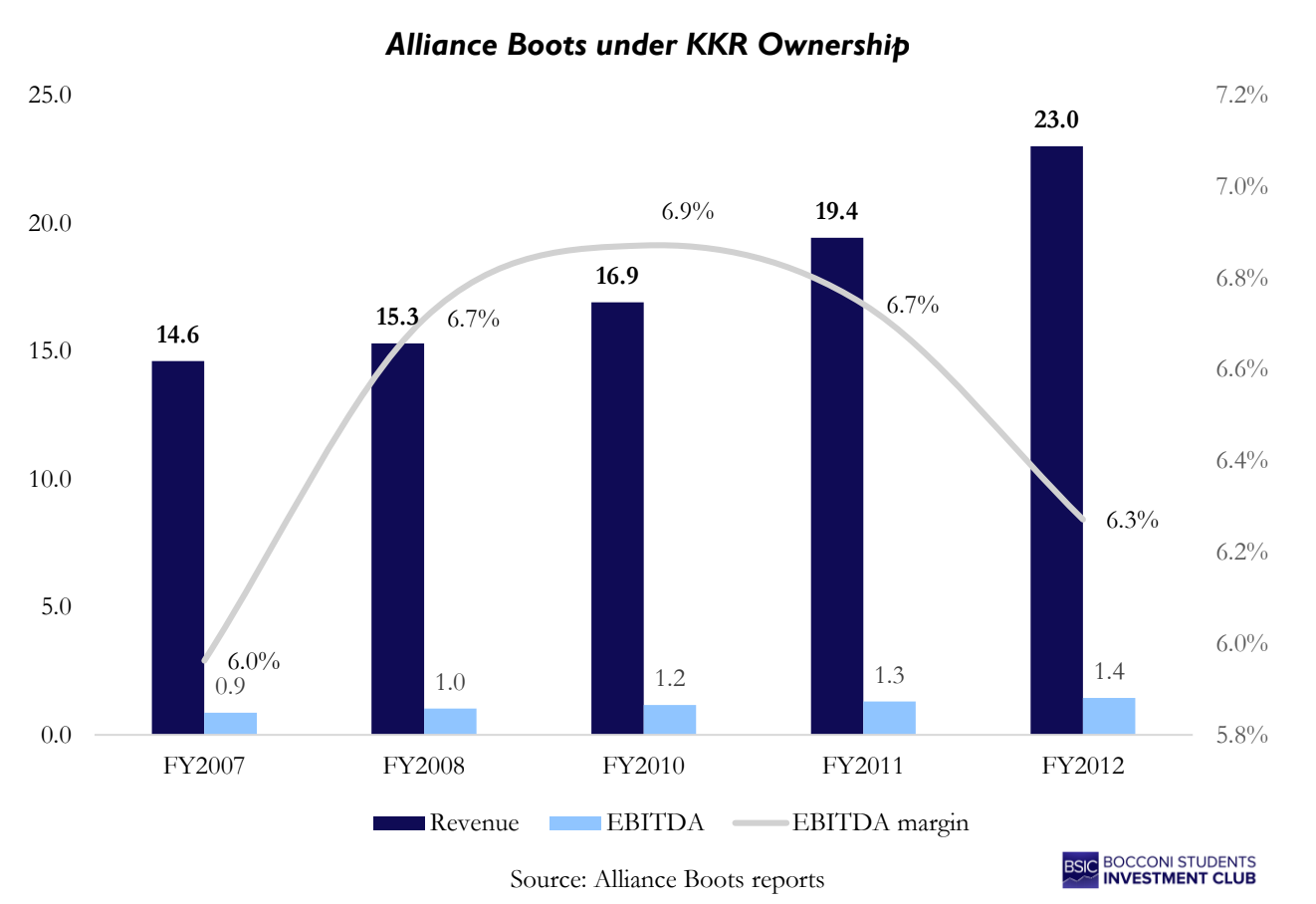
Ultimately, the execution of the 2007 buyout thesis yielded mixed results. Management successfully accelerated the post-merger integration. By late 2008, the rebranding of UK pharmacies was well underway, accompanied by critical upgrades to procurement and IT infrastructure. The wholesale division emerged as the most definitive operational success driven by strategic market entries into Turkey, Germany, and China. Conversely, the retail segment’s performance is more ambiguous. While retail revenues expanded, consolidated group EBITDA margins contracted, leaving the extent of store-level profitability improvements and the precise magnitude of procurement savings unconfirmed.
Crucially, the deal’s value drivers suggest that KKR’s returns came from EBITDA growth and capital structure management rather than multiple expansion or margin improvement. KKR acquired Alliance Boots at an entry EV/EBITDA multiple of 14.4x, implying an enterprise value of more than £12bn, and exited at a lower multiple of 11.3x. Despite this contraction, EBITDA grew from a value of £0.84bn in 2007 to £1.57bn at exit in 2012, supporting an exit enterprise value of more than £17bn. The sponsors also increased equity value through debt reduction and the repurchase of debt at a discount, while revenue growth drove the expansion in EBITDA.
Managing Debt Through the Financial Crisis
The buyout closed mid-2007, shortly before the credit market seized up. Within weeks, lending conditions began to worsen, and by late summer, the market for leveraged loans had effectively shut. This created a serious problem for banks. About £8.2bn of debt finance was arranged by investment banks, including Deutsche Bank and Citigroup. The same banks had also invested around £1.4bn in the company’s equity through underwriting arrangements. They had expected to sell most of their loans to other investors. When buyers disappeared, debt remained on their balance sheets, alongside their equity exposure to a business bought at the top of the market. Alliance Boots was in a different position. Its financing was already in place, so it could continue using the loans on the agreed terms. The lenders’ difficulty in selling the loans did not itself require Boots to refinance them.
Those financing terms gave management time to respond to the downturn. Long maturities limited the need to replace acquisition loans while credit markets were closed, while covenant-lite terms reduced the pressure from regular financial tests. These terms did not remove the obligation to pay interest or all restrictions on the business, but they reduced the risk that a temporary deterioration in performance would immediately force negotiations with lenders. The same lending environment that had allowed the buyers to borrow aggressively therefore also provided flexibility during the downturn.
That flexibility depended on the business continuing to generate cash. Cash generated from operations reached £1.130bn in FY2010 and £1.601bn in FY2012, before tax, interest and investment requirements. This provided the cash from which those obligations could be met while the group worked down its acquisition debt.
Falling interest rates also helped. Much of the borrowing carried floating rates, allowing reductions in reference rates to lower the cost of existing debt even as new financing became harder to obtain. The benefit was moderated by hedging: Alliance Boots used both interest-rate swaps, which fixed rates on part of its debt, and caps, which protected against rising rates while retaining exposure to lower rates. Management therefore benefited from having secured long-term funding before the crisis without fixing the interest cost of the entire capital structure.
The collapse in loan prices created another opportunity: Alliance Boots could buy back and extinguish its own debt below its contractual value. Management reported purchases at prices as low as 60p in the pound. Paying £60 to cancel £100 of debt would reduce net debt by £40 before costs and tax, and remove future interest on the retired principal. In FY2010, the group repurchased £367m of nominal acquisition borrowings and recognised a £128m discount after related prepaid financing fees. The crisis had created an additional route to deleveraging beyond ordinary repayments.
These discounted purchases formed part of a broader debt-reduction programme. By March 2014, Alliance Boots disclosed that £3.678bn of acquisition borrowings had been repurchased or repaid since early 2009 at a cost of £3.402bn. This included repayments as well as discounted purchases; the lowest prices achieved during the crisis were not representative of the whole programme. Reported net borrowings fell from £7.017bn in March 2012 to £5.051bn in March 2014, although currency movements and other adjustments also affected these balances. Operating cash generation and opportunistic buybacks drove debt reduction, while higher earnings made the remaining obligations easier to support. Together, these changes left the business with a more manageable debt burden ahead of the final sale to Walgreens.
The Walgreens Exit
Walgreens and Alliance Boots had strengths that complemented each other. Walgreens was the US’s largest drugstore chain, with nearly 8,000 stores and annual sales of $72bn. However, it had no international presence. Alliance Boots had over 3,330 stores worldwide, with revenue of £23bn in its 2012 financial year. The European pharmacy business and Boots brand sat alongside a wholesale arm that served more than 170,000 pharmacies, doctors, health centres and hospitals from over 370 distribution centres in 2012. This wholesale network was what Walgreens lacked. Together, the companies would become the world’s largest buyer of prescription medicines. Finding a buyer was difficult due to the size of the business: a Barclays banker told Euromoney that a sale to another private equity firm was highly unlikely, as few companies could make such a large acquisition. Walgreens was one of them. It was also facing problems at home. Its US business had lost sales after it stopped filling prescriptions for Express Scripts members earlier that year. Even so, some investors questioned the deal, due to its decision to expand in Europe during the euro crisis. Walgreens’ shares fell around 6% on the day of the announcement. However, Walgreens’ CEO framed the deal as accelerating its core strategies “in the United States and now internationally”.
Walgreens announced its plan to buy Alliance Boots in two stages on 19 June 2012. The staged structure let it commit gradually, with an initial minority investment and an option to buy the rest.
Stage one (2012). On 2 August 2012, Walgreens acquired 45% of Alliance Boots for $4.025bn in cash and 83.39267m Walgreens shares, valued at about $6.7bn when announced. It paid the cash from existing and new borrowings, and the existing owners kept the remaining 55%. Walgreens also had the right, but not the obligation, to buy the rest. The price was fixed in advance at £3.133bn in cash plus 144.333468m Walgreens shares. The option window was meant to open two and a half years after the initial closing. There was also a penalty for not using it: if Walgreens let it lapse, its stake would fall to 42%, in exchange for a token payment.
Stage two (2014). An amendment brought the option forward, and Walgreens exercised it on 5 August 2014. The deal was completed on 31 December 2014, as Walgreens became a subsidiary of the new holding company, Walgreens Boots Alliance. Walgreens financed the cash through bond offerings of more than $10bn, which also refinanced Boots’ borrowings.
The mix of shares and cash allowed the sellers to share in the combined company’s upside while reducing the cash Walgreens needed to fund the acquisition. Pessina chose to receive his consideration in stock rather than cash.
The purchasing opportunity was reflected in the synergy targets: at signing, Walgreens expected $100m to $150m in the first year and $1bn by the end of 2016, shared across both companies. The biggest savings were expected from buying together, including prescription medicines, over-the-counter products and other store supplies. Combining orders from the US network and Alliance Boots’ wholesale arm gave the group more leverage with suppliers than either had alone. Another opportunity came from selling Boots’ brands in the US, for example, when it launched No7, a Boots skincare and cosmetics brand, at a Walgreens in Los Angeles. The third pillar came from sharing pharmacy and logistics practices.
Reported results suggested the plan was progressing. The companies reported $504m in combined net benefits during the first nine months of the 2015 financial year, putting them on track for at least $650m that year. In July 2016, they reported that they had reached the target of at least $1bn for the 2016 financial year. This excluded benefits from the AmerisourceBergen relationship, cheaper refinancing of Boots’ debt and the proposed Rite Aid acquisition. These results came after the sale of Alliance Boots, although KKR retained exposure to the combined company through its Walgreens shares until 2016.
KKR received both cash and shares from the sale to Walgreens, so the two need to be considered separately. In the first stage in 2012, it received $1.8bn in cash and 7m Walgreens shares worth around $200m for its part of the 45% sale, representing about 15 percentage points of its roughly 33% holding. At the announcement-date dollar values, the cash alone covered roughly 73% of its original investment, rising to about 82% when the shares were included. KKR had recovered most of its initial investment while still owning a substantial stake in Alliance Boots.
The second stage worked a bit differently, because the number of Walgreens shares paid for the remaining 55% was fixed in advance and their value depended on Walgreens’ share price. The Wall Street Journal reported that Walgreens shares had more than doubled since the deal was agreed, increasing the total value received by all sellers, not just KKR, from $16.2bn to $27.3bn. At completion in December 2014, a person familiar with the matter told the WSJ that KKR received about £4.7bn in cash and stock against roughly £1.2bn invested, close to four times its money in sterling. This included shares valued at completion, rather than the final cash proceeds from their subsequent sale. No official investment IRR was disclosed in the cited announcements. Part of the gain came from Walgreens’ rising share price alongside improvements in Alliance Boots’ business.
At the end of 2014, KKR held 4.6% of Walgreens Boots Alliance. It sold this holding in stages during 2016: 15m shares in May, 15m in August and 20.5m in November, with another 2m sold to a Pessina affiliate. In May, the stock traded at around $81. The stock consideration therefore extended KKR’s exposure beyond its ownership of Alliance Boots, with the final outcome also depending on the price at which those shares were sold.
Conclusion
Alliance Boots shows how a buyout completed at the top of the market could still deliver a strong return. KKR and Pessina accelerated integration, expanded the business and used its cash generation to reduce debt, while long maturities and flexible financing terms gave them time to manage the crisis. Discounted debt repurchases provided an additional source of value, and the Walgreens sale combined a strategic buyer’s purchasing ambitions with further upside from stock consideration. The outcome depended on execution across the business, financing and exit, with each reinforcing the others.
References
[1] Beroiz, Sara “How Value is Created Through LBOs in Healthcare Buyouts”, 2022, HEC Paris research paper, June 2022. Link
[2] Walgreens and Alliance Boots, strategic partnership announcement, 19 June 2012, and initial transaction completion announcement, 2 August 2012. Link
[3] Walgreens Boots Alliance, 2014 proxy statement/prospectus, including Alliance Boots financial review and transaction terms. Link
[4] “Alliance Boots directors will make more than £10m from sale of the company”, The Guardian, 9 May 2007. Link
[5] Association of Corporate Treasurers, The Treasurer, July/August 2007, discussion of Alliance Boots financing. Link
[6] Alliance Boots GmbH, 2013 consolidated financial Link
[7] Walgreens Boots Alliance, fiscal 2016 third-quarter results, 6 July 2016; fiscal 2015 third-quarter results, 9 July 2015. The $1bn synergy goal was achieved in June 2016 and reported in July. Link


0 Comments