Introduction
The pharmaceuticals industry is characterised by one of the most extensive R&D processes in the economy. The productivity of the process has been a topic of intense discussion for close to two decades. The underlying metrics indicating the poor productivity of the process are best highlighted by the long timelines that are required to take a drug from an initial idea to a newly approved medicine, which on average takes 14 years, and the high average costs of getting a medicine on the market, which peaked at approximately $2.7bn in 2025. The latter number also features the cost of failures, which are a key risk and an inherent part of the process. Based on data collected on approximately 2,100 active ingredients, resulting in close to 20,000 clinical trials across the period from 2006 to 2022 conducted by 18 leading pharma companies, the average likelihood of first approval of a compound that enters Phase 1 clinical trials is 14.3%. That said, the price of failed trials is a key component of the economics behind every successful drug that enters the market. To further illustrate the magnitude of R&D related expenses, according to an article published by Investopedia, the average pharmaceutical firm dedicated 25% of its revenues to the process, with the number being substantially higher for some companies. This value can be quantified by focusing specifically on Novartis AG [SWX: NOVN] (Mkt cap as of 16/10/26: CHF253.41bn) and Roche [SWX: ROP] (Mkt cap as of 16/10/26: CHF307.56bn), which collectively spent CHF21.5bn on global R&D in 2025 alone.
That said, with the rapid advancement in the development of AI, the industry is hoping for a substantial productivity improvement in the process, with both reduction of costs and shortening of timelines. Novartis and Roche are taking two distinct approaches to capitalise on this potential opportunity, which will be discussed later, but let’s first lay down the traditional drug development economics and how AI is reshaping the process.
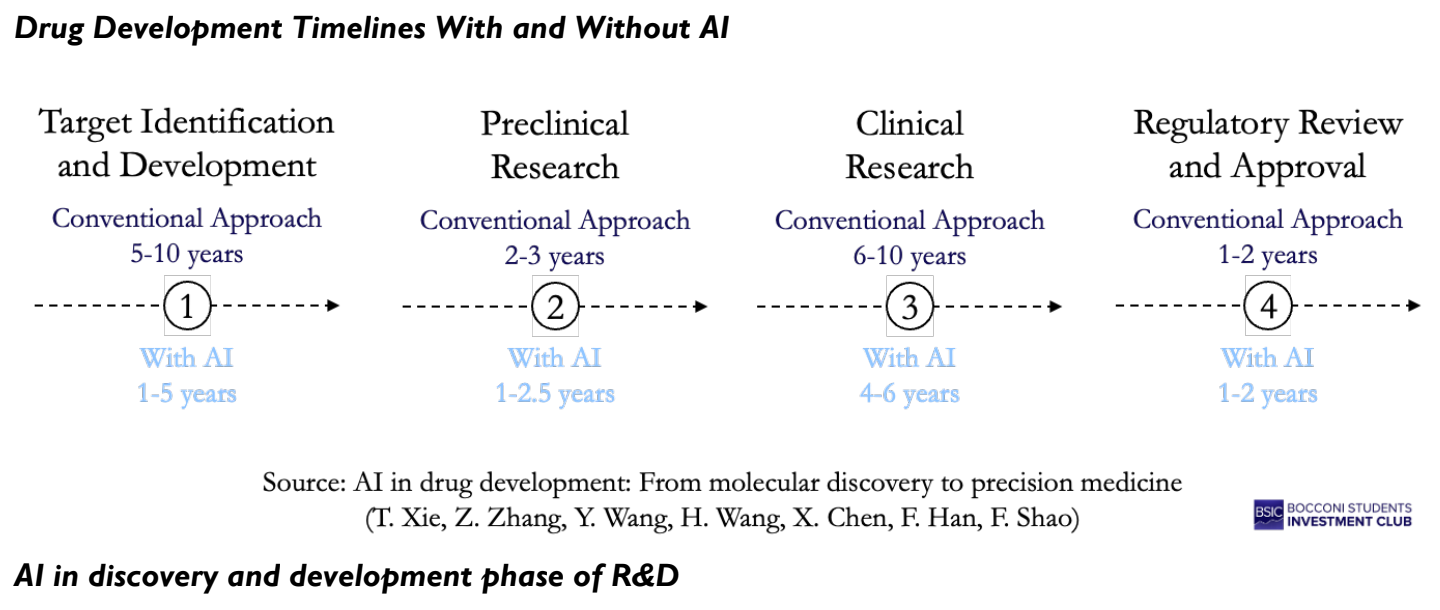
The R&D process is commonly split into 4 distinct stages. It starts with discovery and development, where researchers must identify a specific molecule (DNA sequence, RNA molecule, or protein) that plays a crucial role in the development of a disease and, importantly, one that can be targeted by a compound and, in turn, produce beneficial or therapeutic effects. After identification, researchers search for a compound or a mixture of compounds that interact with the target molecule and could become potential drug candidates. The conventional approach to the process on average takes 5-10 years, but with augmentation from AI technologies, that timeline is reduced to 1-5 years. The two channels through which technology changes the process are faster discovery and picking better targets. Discovery refers to generating and then ranking hypotheses on what molecule to target (identifying the molecule leading to the development of a disease). AI improves this process by combining genomic, transcriptomic (activity of genes), and phenotypic (observable traits of a disease) data far quicker than a human analyst is able to. Among the most important technological advancements is the prediction of protein structures. This is done through Google [NASDAQ: GOOGL] DeepMind’s model AlphaFold, which achieves near-atomic accuracy in this task. To design a medicine for an identified target, you need to understand its structure and produce a 3D design of it. This task used to take long periods of time, which AlphaFold significantly cut. The technology allowed working with targets that were deemed untargetable beforehand due to a lack of knowledge of their shape. One example of AlphaFold use cases so far when it comes to speed is the discovery of a potent inhibitor of CDK20 (a cancer-related protein); development is currently at the preclinical stage. As for limitations of AlphaFold, the model struggles especially with weird or unusual DNA and RNA structures. Moving to the second channel, the better selection of exact biological molecules to target in order to cure diseases. It is a very important part of R&D. Lack of clinical efficacy of studied compounds accounted for 40-50% of clinical trial failures between 2010 and 2017 and was the most common reason why development failed. Cutting that number has the potential to substantially reduce R&D expenses coming from failed drug development. AI could contribute to this channel by ranking targets based on the likelihood that they are the key cause of an illness. The most prominent example of this is Insilico Medicine’s [HKG: 3696] PandaOmics platform. The leading candidate protein linked to IPF (idiopathic pulmonary fibrosis), identified as TNIK, became the target of the compound Rentosertib, which performed well in Phase 2 trials and entered Phase 3, but the outcome of its clinical research isn’t expected to be known until 2029. Thus, evidence that AI helps with better identification is still missing. In short, AI has clearly made target discovery faster, but the second channel, which carries the larger economic potential, has yet to be proven in the clinic.
How AI could accelerate preclinical research
The next stage of the process is preclinical research, the goal of which is largely to test whether a compound has the potential to cause significant harm. The two most common forms are in vitro (in a test tube, laboratory tests) and in vivo (in animals). Further, it examines what the drug does to the body and also what the body does to the drug (absorption). The usual duration of this part is 2-3 years, but estimates suggest that AI can cut the required time to 1-2.5 years. AI streamlines the process here in three primary ways. Starting with lead optimisation (refining a promising molecule into a real drug candidate), ML models predict how changes in the molecule’s structure will affect its efficacy and its ADMET (absorption, distribution, metabolism, excretion, and toxicity) profile, which allows for weak candidates to be filtered out early on. Secondly, when it comes to in vitro (lab) testing, results often represent very large datasets, and AI models streamline their analysis as well as reduce reliance on the judgement of analysts, which risks the presence of bias. Lastly, AI supports the creation of digital twins, which represent computer simulations of organs and biological systems. This in turn allows for the desired shift away from animal testing. To conclude on this part, AI models do make the preclinical research faster, cheaper, and more consistent. However, model performance weakens when applied to new data. An example of this occurring is that some toxicity models reach only 65-77% accuracy on external data, and one liver-toxicity model in particular fell from 80.5% accuracy in training to between 61.9% and 70.3% on independent datasets. This is important, since toxicity accounted for 30% of the failed trials in the same 2010-2017 data previously cited. A model’s accuracy is key for the prevention of this. Here too, clinical proof of the reduction of failures in human trials is missing as of now.
How AI changes the most cost-intensive stage of R&D: Clinical Research
Moving over to clinical research, the third stage of the drug development process and the most cost-intensive one. This is where the safety and efficacy of compounds in humans are tested. This stage is divided into four phases. Given that safety and efficacy are successfully demonstrated here, the drug can advance to an FDA review. The effect of AI on this part of the process is dual, both on molecular analysis and on the operational aspects of the procedure. AI is currently being actively applied to optimise dosing, improve patient enrichment and support early detection of safety signals. As for a phase-by-phase breakdown, in Phase 1, AI is primarily used to optimise dosing and improve safety. As for Phase 2, it augments patient stratification (the process of classifying patients into subgroups based on shared characteristics) and efficacy assessment. For Phase 3, it accelerates enrolment and increases diversity, and in Phase 4, it supports the monitoring of results from data delivered by the biomarkers tracker by smart electronic devices. It is estimated that AI adoption can cut this part of the process from 6 to 10 years to 4 to 6 years due to improvements in efficiency. As for many of the previous stages, the technology is still early, and clinical evidence is lacking.
Review and approval procedure timelines, which represent the last stage of the process, are estimated to be relatively unchanged and are estimated to remain around the 1-2 year mark, though the FDA has outlined plans for AI adoption in its procedures. Productivity gains here depend on regulatory adoption of emerging technologies and optimisation of internal processes.
To wrap up, as outlined by external industry experts (McKinsey), while early-stage timeline acceleration is evident, most AI-native clinical assets remain in Phase I or Phase II safety and dose-ranging trials. Definitive Phase III efficacy readouts for AI-originated molecules remain years away, leaving their ultimate impact on clinical success rates an open question.
What are Novartis and Roche paying to access AI?
If AI really does change the economics of pharma R&D, one of the first places to look for evidence is the contracts the largest buyers sign. Novartis and Roche have gone about this differently. Novartis has largely rented AI capability through research collaborations weighted heavily towards milestones. Roche has used partnerships too, but also bought a company and taken AI into diagnostics. Looking at four of these transactions shows what each company is buying, how much it commits before any results exist, and which rights it holds on to.
Novartis x Isomorphic Labs: AI for molecule design
Isomorphic was spun out of DeepMind and is backed by Alphabet. It was launched in 2021 as an autonomous subsidiary of Alphabet to build on AlphaFold’s protein folding work. Its current model exceeds proteins, additionally covering small molecules and nucleic acids. For a medicinal chemist this is the relevant step, since the practical question in drug design is how a candidate molecule binds to its target, not simply what shape the protein takes.
Under the agreement signed in January 2024, the two companies are working on small molecules against three undisclosed targets. Isomorphic received $37.5m upfront and can earn up to $1.2bn in performance-based milestones plus tiered royalties of mid-single to low double digits on net sales. A year later, in February 2025, the partnership was widened by up to three further research programmes on the same financial terms.
The upfront payment is about 3% of the headline milestone value. Novartis is therefore paying mainly for access to the platform, and most of the money only changes hands if molecules progress. According to Novartis, it deliberately picked particularly difficult targets for the first programmes. The partnership looks like a test of whether AI can make progress on biology where conventional chemistry has repeatedly failed. No clinical candidate has been disclosed yet, so the strongest public sign of confidence is that Novartis chose to expand the deal.
Roche x Recursion: AI for mapping disease biology
Recursion [NASDAQ: RXRX] sits earlier in the value chain than Isomorphic. Rather than designing molecules for targets already identified, it uses automated cell imaging and machine learning to build “phenomaps” (large datasets recording how cells react when genes are switched off or chemicals are added). The microglia map gives a sense of the scale involved: 46m images, produced from more than 100bn stem-cell-derived microglia.
The 2021 agreement gave Recursion $150m upfront. Roche and Genentech can start up to 40 programmes, each of which could bring Recursion more than $300m in development, commercialisation and sales milestones, plus tiered royalties. Multiplied out, this produces the widely reported figure of about $12bn, a number that only holds if every programme succeeds. Roche also pays separately for the data. If it takes up the option to use the raw images outside the collaboration for all 12 eligible phenomaps, those fees could exceed $250m.
To date, the payments have been triggered by data, not drugs. Recursion received a $30m acceptance fee for the first neuroscience phenomap in September 2024 and another $30m for the second in October 2025, bringing total receipts to $216m. Six phenomaps have been accepted, and one small-molecule programme has been initiated on the back of them. For Roche, the attraction is proprietary biological data in neuroscience, a field where FDA approval rates are less than half those of other therapeutic areas. Risk is transferred in stages. Roche pays as each dataset is delivered and accepted, and commits to programme-level milestones only once a target seems worth pursuing.
Roche (Genentech) x Prescient Design: buying the capability outright
Prescient is the only one of the four deals that was a full acquisition. The company was founded in January 2021 to build a “lab-in-the-loop” protein design platform. Genentech acquired it in August 2021, and its focus then shifted towards antibody design.
The terms were never disclosed, which is not surprising given the size of the business at the time. When it was acquired, Prescient had just a few employees and one protein-modelling algorithm, so the deal was closer to an acqui-hire than a conventional M&A transaction. Genentech has since built the team up to 80 people, who between them have developed more than 20 machine-learning models.
Owning the capability means Roche keeps the full upside, along with the staff, the know-how and the cycle of feeding lab results back into the models. A partner could eventually take these to a competitor; an owned subsidiary cannot. In exchange, Roche carries the integration risk and the risk of losing key people. The model makes most sense where a single capability serves many programmes, as antibody engineering does at Genentech.
Progress is still measured in research results, however. A walk-jump sampling method developed by the team produced antibodies with a 92% expression rate, close to that of B-cell clones, but this remains a preclinical result rather than a regulatory one.
Roche x PathAI: AI on the diagnostics side
Unlike the other three deals, the PathAI agreement is about selecting patients, not discovering molecules. PathAI’s algorithms analyse digitised tissue samples, and the partnership focuses on companion diagnostics, the tests used to decide which patients should receive a targeted therapy. The two companies already had a relationship. An October 2021 agreement had integrated PathAI’s image-analysis algorithms into Roche’s navify Digital Pathology platform.
On May 7th 2026, Roche agreed to acquire PathAI for $750m upfront and up to $300m in additional milestone payments, taking the potential consideration to $1.05bn. At announcement, closing was expected in the second half of 2026, subject to regulatory approvals. PathAI would join Roche’s Diagnostics division, combining its AISight image-management software and AI analysis with Roche’s pathology portfolio and global distribution network. The intended benefits extend to laboratory workflows, clinical trial support and biomarker discovery.
The acquisition changes the economics of the relationship. Roche is moving from contractual access to an external developer towards ownership of the platform, with roughly 71% of the maximum consideration committed upfront. That creates greater integration and commercial execution risk than the earlier partnership. The investment case rests on whether Roche can expand adoption through its existing diagnostics business and capture benefits that continued collaboration could not secure. Compared with early-stage molecule discovery, this offers a more direct route to commercial deployment, although the purchase price alone does not establish that the expected returns justify the commitment.
Benchmarks: what conventional oncology M&A looks like
Two acquisitions Novartis made in 2024 help explain this, although neither involved AI. Novartis bought MorphoSys mainly for its drug candidates that were already in advanced clinical trials. Novartis offered €68 per share, valuing the equity at €2.7bn, mainly to secure the myelofibrosis drug pelabresib. Almost the entire price was paid at closing, so the clinical risk moved to Novartis in full. That risk did not take long to show. A safety signal delayed the regulatory path, and Novartis recorded an $800m impairment in its third-quarter results.
Mariana Oncology was a platform purchase at a much earlier stage, in radioligand therapy (RLT). Novartis agreed to pay $1bn upfront and up to $750m more on pre-specified milestones. Mariana was still a preclinical-stage company, with RLT programmes ranging from lead optimisation to early development.
Novartis paid more upfront for this one preclinical radioligand platform than the two companies have disclosed paying upfront to Isomorphic and Recursion combined. The comparison suggests that buyers are willing to commit more capital at closing when the underlying therapeutic approach has been validated, as radioligand therapy has been through Pluvicto. AI-led discovery still relies heavily on small upfronts and large contingent payments. However, Roche’s agreement to acquire PathAI for $750m upfront and up to $300m in milestones marks a step towards larger ownership commitments where AI capabilities have established commercial applications. The rationale extends beyond improving Roche’s own drug pipeline: PathAI’s software and algorithms can be distributed through its existing diagnostics business. Hence we see that willingness to pay appears to depend on the maturity of the application and the benefits ownership offers over continued partnership. Whether those benefits justify the purchase price, and whether a platform can be worth more than a single asset, is what the next section examines.
Does the investment case add up?
For pharmaceutical companies, the financial importance of AI lies in whether it makes successful medicines less costly to develop or brings them to market sooner. Platforms such as Isomorphic and Recursion [NASDAQ: RXRX] could help deliver those improvements, but the buyer must retain enough of the resulting value to justify its payments. For an individual drug programme, risk-adjusted net present value (rNPV) is the basic valuation model for assessing this by accounting for the timing and probability of future revenues and development costs.
From faster research to higher value
In 2025, Genentech researchers reported testing more than 1,800 antibody variants through four rounds of a system combining machine learning with laboratory experiments. They identified variants with approximately 3 to 100 fold improvements in binding affinity across the targets studied demonstrating the ability for optimisation of a specific molecular property. These results demonstrate improved antibody binding in laboratory tests, but do not yet show that more candidates will succeed in human trials.
Clinical development provides a more direct connection to time savings. McKinsey reported that AI based site selection accelerated patient enrollment by 10-15% or more across therapeutic areas. Its broader analysis of operational AI/ML pilots reported an average six-month reduction in development timelines per asset. Hence, these faster enrollment can help trials reach their recruitment targets sooner, allowing researchers to obtain results earlier.
Furthermore the report demonstrated how financial value is observed. McKinsey reported that firstdraft preparation time was reduced from three weeks to three days and halved the required writing time from 200 hours to 100 hours. Across its analysis, McKinsey estimated that AI assisted report preparation shortened timelines from 14 weeks to 8 weeks, increasing NPV by approximately $15m-$30m per asset.
The results so far also differ between the two approaches. Novartis’s expanded Isomorphic collaboration shows a willingness to fund further research, but does not establish that the partnership has improved approval rates or generated a positive financial return. Genentech’s antibody results provide evidence of improved laboratory performance within Roche’s research operations, although their clinical value remains unproven. PathAI offers a strong path to separate commercial opportunities within Roche’s diagnostics business. Ownership could allow Roche to deploy the technology to a greater degree, but would also leave Roche responsible for the purchase price, integration and continuing investment. Neither company has disclosed enough information to establish which approach produces the better return.
Conclusion
The evidence therefore supports an investment case based on measurable improvements in research performance and development speed. For Novartis, the Isomorphic partnership offers access to AI discovery capabilities while making much of the payment contingent on future achievements. Its expansion shows that access can deepen without an acquisition. Roche’s acquisition and build-out of Prescient and PathAI takes a different approach, embedding AI expertise within its research operations so that the capability can support multiple drug programmes. These transactions illustrate how pharmaceutical companies are choosing both how to deploy AI and how much financial commitment to make upfront. Faster enrollment, shorter reporting timelines and improved laboratory results give that investment a concrete economic rationale. The ultimate measure of success will be how much of the productivity gained creates valuable medicines and financial returns after partner payments and development costs.
References
- Deloitte. “Weight loss drugs boom drives pharma R&D returns”. 2026.
- Drug Discovery Today. “Benchmarking R&D success rates of leading pharmaceutical companies An empirical analysis of FDA approvals 2006-2025”. 2025.
- Investopedia. “What Are the Average Research and Development Costs for Pharmaceutical Companies”. 2026.
- T Xie Z Zhang Y Wang H Wang X Chen F Han and F Shao. “Artificial intelligence in drug development From molecular discovery to precision medicine”. 2026.
- US Food and Drug Administration. The Drug Development Process. accessed 17 October 2026.
- F Ren and colleagues. AlphaFold accelerates artificial intelligence powered drug discovery Efficient discovery of a novel CDK20 small molecule inhibitor Chemical Science 14 1443-1452. 2023.
- Insilico Medicine. “Insilico Initiates Phase III Clinical Trial for Rentosertib”. 2026.
- Insilico Medicine. “Insilico Medicine Doses First Patient in GENESIS IPF 3”. 2026.
- ClinicalTrials.gov. “NCT07687459 Study Evaluation Rentosertib INS018 055 in Idiopathic Pulmonary Fibrosis”. 2026.
- Journal of Chemical Information and Modeling. “Deep Learning for Drug Induced Liver Injury Journal of Chemical Information and Modeling”. 2015.
- US Food and Drug Administration. “Step 3 Clinical Research”. 2026.
- Roche. “Roche enters into a definitive merger agreement to acquire PathAI to transform AI driven diagnostics”. 2026.
- Isomorphic Labs. “Isomorphic Labs 2 0 Series B funding announcement”. 2026.
- N C Frey and colleagues. “Protein Discovery with Discrete Walk Jump Sampling ICLR 2024”. 2024.
- Roche. “Roche enters into collaboration agreement with PathAI to expand digital pathology capabilities for companion diagnostics”. 2024.
- Morgan Stanley. “3 Biotech Industry Trends Reshaping the Healthcare Market”. 2026.
- McKinsey and Company. “Unlocking peak operational performance in clinical development with artificial intelligence”. 2025.
- ZS. “AI ROI in pharmaceutical R&D A framework for measuring value”. 2026.
- Roche. “First half 2026 results”. 2026.
- Harris Williams. “Outsourced Pharma Services Accelerating Momentum and Investor Interest”. 2026.


0 Comments