Introduction
Distressed debt investing offers the potential for outsized returns by purchasing the debt of troubled companies at significant discounts, but these opportunities come with substantial risks. Arini Capital, one of Europe’s fastest-growing credit hedge funds, has recently experienced this first-hand, with its flagship fund suffering heavy losses in 2026 following years of strong performance. Two of its major investments, Aston Martin and Altice International, have become embroiled in disputes over financing arrangements and creditor rights, raising questions about how well investors can protect their claims on a company’s assets. In this article, we examine these two cases and explore whether Arini’s recent difficulties reflect flawed investment decisions or the inherent risks of pursuing distressed credit opportunities with leverage.
What Is Distressed Debt Investing?
Distressed debt investing is a type of credit investing strategy that focuses on investing in securities of companies experiencing operational and/or financial difficulties, typically at significant discounts to their face value. These difficulties can range from temporary liquidity shortages or maturity walls to more fundamental operational problems like eroding competitive advantage or declining end market. Importantly, financial distress does not necessarily imply default. A company may continue servicing its debt while investors become increasingly anxious about its ability to repay or refinance upcoming maturities or sustain its existing capital structure. For distressed investors, such situations present an opportunity to acquire debt at prices potentially below the value that can ultimately be recovered.
To understand these opportunities, it is first necessary to understand how bonds are priced. A bond’s value reflects the present value of its expected future cash flows – coupon payments and principal repayment – discounted at the yield representing the required return defined by the relevant benchmark interest rate plus credit spread. As a borrower’s financial position deteriorates, investors demand higher yields to compensate for an increased probability of distress, and hence default, causing the price of its outstanding debt to decline. In distressed situations contractual payments can no longer be assumed with confidence. Instead, valuation increasingly depends on two variables: the probability that the borrower will meet its obligations and the amount creditors could recover if it fails to do so.
This relationship can be illustrated through a simplified example. Consider a bond with €100 face value, a €5 coupon payable in one year and an assumed recovery of €40 in the event of default. If the bond trades at €70 and the risk-free interest rate is 4%, its price implies a risk-neutral default probability of approximately 50%, assuming default and recovery occur at maturity. This follows from discounting the probability-weighted outcomes of receiving €105 if the borrower repays its obligations or €40 if it defaults. Importantly, the implied probability is not necessarily the actual likelihood of default, as market prices also reflect compensation for bearing credit risk. Moreover, the calculation depends heavily on the assumed recovery rate: a higher recovery assumption would imply a higher default probability for the same bond price. Consequently, a bond trading at 70% of face value does not necessarily imply an expected recovery of 70%, nor does its price alone reveal a unique probability of default.
Distressed investors place bets exploiting differences between these market-implied expectations and their own assessments, with investment opportunities broadly arising in two ways. The first way to make money as a distressed credit investor is to bet on companies that you believe will deliver better financial performance than the market expects. Through fundamental analysis an investor may conclude that the borrower is more likely to meet its obligations than the market anticipates. This type of bet, to an extent involves similar analysis and expressing a similar to what equity investors do, albeit expressed via a more conservative and forgiving instrument – its possible that the turnaround is just good enough to make the creditors whole while equity holders still suffer. A notable example of a fundamental credit bet is Baupost Group’s investment in Ford Motor Credit during the 2008–2009 financial crisis. At the time, bonds issued by automotive financing companies traded as low as 40 cents on the dollar amid concerns about the survival of American automakers. Baupost founder Seth Klarman believed that Ford was better positioned than its competitors and that the market was overestimating the deterioration in automotive loan portfolios. According to his analysis, even a scenario in which 40% of Ford’s loan portfolio was wiped out would leave the bonds worth approximately 60 cents on the dollar, while less severe losses could justify repayment at par. The opportunity therefore arose from an assessment of the underlying business that was materially more favourable than the assumptions reflected in market prices.
The second way credit investors can make money is buying debt of companies where they believe the recovery in a restructuring or bankruptcy process will exceed market expectations. Unlike the first strategy, this does not necessarily require the borrower to avoid default. Instead, an investor focuses on determining how much value will remain available to creditors once the business is reorganised or its assets liquidated. This can involve identifying assets that the market has undervalued or expecting a recovery in enterprise value during the restructuring process. An illustrative example is Hertz, which filed for Chapter 11 bankruptcy protection in May 2020 following the collapse in travel demand. In June of that year, its bonds were valued at just 26 cents on the dollar. However, the subsequent recovery in the travel and used-car markets, together with competing proposals to acquire the reorganised company, dramatically improved the value available to creditors. When Hertz emerged from bankruptcy in June 2021, holders of its unsecured senior notes received full repayment of principal and specified interest. The case demonstrates how a substantial discount can offer attractive returns even after a company has entered formal insolvency proceedings.
Crucially, estimating recoveries requires expertise not only in financial analysis but also in law. While enterprise value determines the overall pool of value available to creditors, its distribution depends on the priority and enforceability of individual claims. Debt indentures, collateral arrangements and guarantees establish creditors’ contractual rights, but these can become subject to competing interpretations during a restructuring. Investors may therefore identify opportunities where they believe the market has underestimated the strength of particular claims or the potential to challenge transactions that transfer assets away from existing creditors. One prominent example is the bankruptcy of Caesars Entertainment Operating Company in 2015. Creditors challenged earlier asset transfers and the release of parent-company guarantees, arguing that these transactions had improperly deprived them of valuable claims against the wider group. Following extensive litigation and negotiations involving creditors and Caesars’ private equity sponsors, Apollo and TPG, a revised restructuring agreement announced in September 2016 increased the estimated recovery for second-lien bondholders from approximately 39 to 66 cents on the dollar. Rather than resulting simply from improved operating performance, this increase reflected additional cash, equity and convertible debt made available through the settlement.
The importance of contractual interpretation was further demonstrated by the restructuring of mattress manufacturer Serta Simmons. In 2020, the company entered into a financing transaction that allowed selected lenders to exchange their existing claims for debt ranking ahead of other creditors. The transaction relied on an exception in the original credit agreement permitting certain “open market purchases”, which the excluded lenders argued did not apply. In December 2024, a US appeals court agreed with the excluded lenders, ruling that the transaction breached provisions requiring equal treatment of lenders. The dispute illustrates how the interpretation of a single contractual provision can determine whether creditors retain their original position in the capital structure or find themselves subordinated to competing claims.
Ultimately, both approaches depend on purchasing debt for less than the value an investor expects to receive, whether through repayment, refinancing, restructuring or litigation. However, accurately estimating that value is only part of the challenge. Restructuring negotiations and litigation can take years, while the outcome of legal disputes and the value of the underlying business may change substantially during that period. For investors using leverage, falling market prices can also trigger additional collateral requirements, potentially forcing them to liquidate positions before their anticipated recoveries materialise. Successful distressed investing therefore requires not only a sound assessment of the borrower’s financial position and creditors’ legal rights, but also the ability to maintain an investment through a potentially prolonged and uncertain restructuring process.
Arini: its approach to credit investing
Arini Capital Management was founded in 2021 by former Credit Suisse trader Hamza Lemssouguer and began trading the following year. Primarily active in Europe, the firm invests across public and private credit markets and has since expanded beyond its original hedge fund. As of 31 August 2026, it reported $22bn in assets under management.
These assets are spread across several strategies, including long and short credit, structured credit, opportunistic credit, direct lending and asset-based finance, with the flagship Arini Credit Master Fund aiming for absolute returns through long and short credit positions. According to an assessment by the San Bernardino County Employees’ Retirement Association (SBCERA), the flagship is an open-ended fund that mainly invests in European bonds, loans, credit default swaps (CDS) and structured credit. The separate Arini Credit Opportunities Fund is a drawdown fund for restructurings, refinancings and capital solutions. Arini also makes senior secured loans through its direct lending business, focussing on companies whose recurring cash flows are expected to support debt service.
To identify investments for these funds, Arini assigns specific industries to its sector specialists, who regularly review the operating performance and financial position of the companies they cover. SBCERA’s assessment describes this continuing coverage alongside comparisons between public and private credit opportunities. When prices move drastically, the team can fall back on its existing research and compare the debt with other investments carrying similar risks. This helps analysts to decide whether the lower price reflects a deterioration in the borrower’s finances or whether it signals an investment opportunity that other investors may have overlooked.
A lower price thus only makes an investment more attractive if the borrower can keep servicing its debt, or if creditors would recover enough when it cannot. Lemssouguer made a similar point in an April 2026 interview with Institutional Investor. In this interview he emphasised the need for predictable cash flows, adequate asset coverage and protection in the debt’s contractual terms. According to him, repayment should not depend on continued growth or the borrower always being able to refinance cheaply. Arini’s analysts therefore have to estimate how much cash a business could still generate in a downturn and what creditors could recover if it defaults. If either estimate is too optimistic, even debt bought at a large discount could ultimately result in a loss.
In September 2026, the Financial Times reported that Arini had bought and sold CDS protection, including protection on first-loss tranches of credit indices in some cases. Buying protection would allow the fund to gain in the case of a borrower’s credit deteriorating. But if it were to sell protection instead, the fund would receive a regular premium and become liable for losses if the underlying borrowers default. The risk thus lies in how the sold protection relates to Arini’s bond holdings. Arini may then lose on both positions if the borrowers behind its bonds and the protection it sells are affected by the same economic pressures.
Holding a large share of a borrower’s debt also allows Arini to influence the terms when that debt is renegotiated. The Financial Times identified the firm as a major Aston Martin [LSE: AML] bondholder and as one of the creditors negotiating with Altice International. In situations like these, the terms of a refinancing or restructuring can impact where existing creditors rank for repayment and what access they have to collateral, which in turn affects the value of Arini’s holdings. Arini therefore has an incentive to coordinate with other creditors and press for terms that protect its recoveries, while its research on the borrower allows it to assess competing proposals. The extent of its influence nonetheless depends on the relevant voting thresholds, the rights attached to its debt and any cooperation agreements with other creditors.
However, negotiations can take time, and Arini has to keep funding its holdings until a refinancing or restructuring is completed. If these positions were financed with borrowed money, a fall in debt prices could lead to lenders demanding additional collateral before the borrower repays its debt. This month, Bloomberg reported that Arini’s flagship fund had cut positions and reduced gross leverage, with plans for greater diversification. For its investments in Aston Martin and Altice International, the outcome will also depend on which assets remain available to existing creditors and whether their contractual rights protect access to them.
Aston Martin: the limits of collateral protection
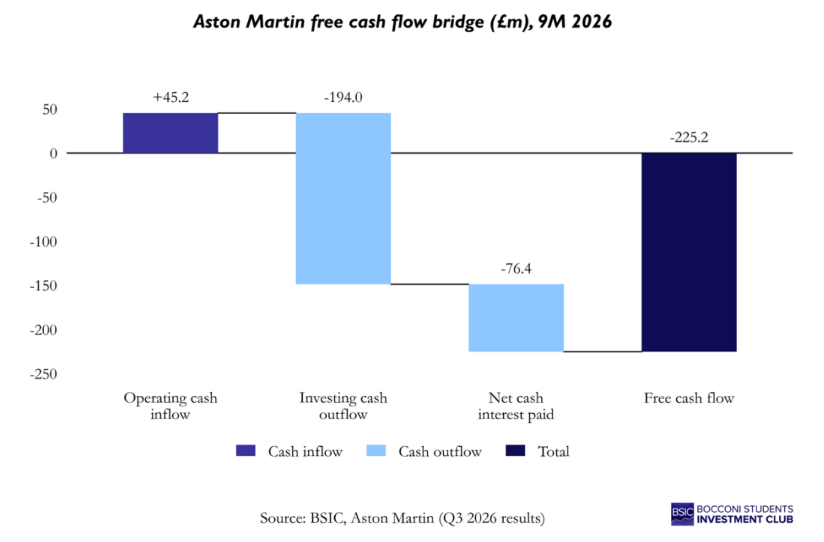
Arini’s investment in Aston Martin [LSE: AML] brings to light the difficulties associated with lending to a business whose valuable brand is accompanied by persistent cash outflows. In the first half of this year, supported by deliveries of its Valhalla model, the carmaker’s revenue grew by 38% to £629m and its gross margin increased to 33.8%. Despite this, the company had a free cash outflow of £198m which included £75m in net cash interest payments. On the 30th of June, the company had net debt of £1.54bn and available liquidity of only £145m. The improvements in sales and margins are therefore not enough to cover the investment expenditure and debt servicing, resulting in Aston Martin being still dependent on further financing.
According to the Financial Times, Arini is one of Aston Martin’s largest bondholders, holding hundreds of millions of pounds of its debt. Arini’s subsequent court filing confirmed that its Credit Master Fund held senior secured notes issued by Aston Martin Capital Holdings Ltd due in 2029. On the 30th of June 2026, the company’s outstanding senior secured notes comprised $1.05bn carrying a 10% coupon and £565m carrying a 10.375% coupon.
Under the original financing structure, the notes had guarantees in place from specific group companies and first-priority security over shared collateral, with only the revolving credit facility and certain hedging obligations in front of the notes in the distribution of collateral proceeds. To assess bondholder protection, it is therefore necessary to examine both the security package and also the contractual payment waterfall. In July 2026, 9fin reported that Arini and Sculptor were coordinating a cooperation agreement with other creditors representing more than half of the senior secured notes, allowing them to negotiate collectively as Aston Martin looked at the potential of additional financing.
On the 22nd of July, Aston Martin announced a £550m financing package led by funds managed by HPS Investment Partners. The package included a £450m senior secured term loan and a £100m delayed draw term loan, priced at SONIA plus 675bps and maturing in July 2031. The £450m proceeds went towards repaying the company’s fully drawn £170m revolving credit facility, £20m borrowed from members of the Yew Tree Consortium and transaction costs, with the rest left for general corporate purposes. The transaction also boosted the company’s available liquidity to approximately £340m, giving enough additional time to pursue the company’s ambitious future product plans.
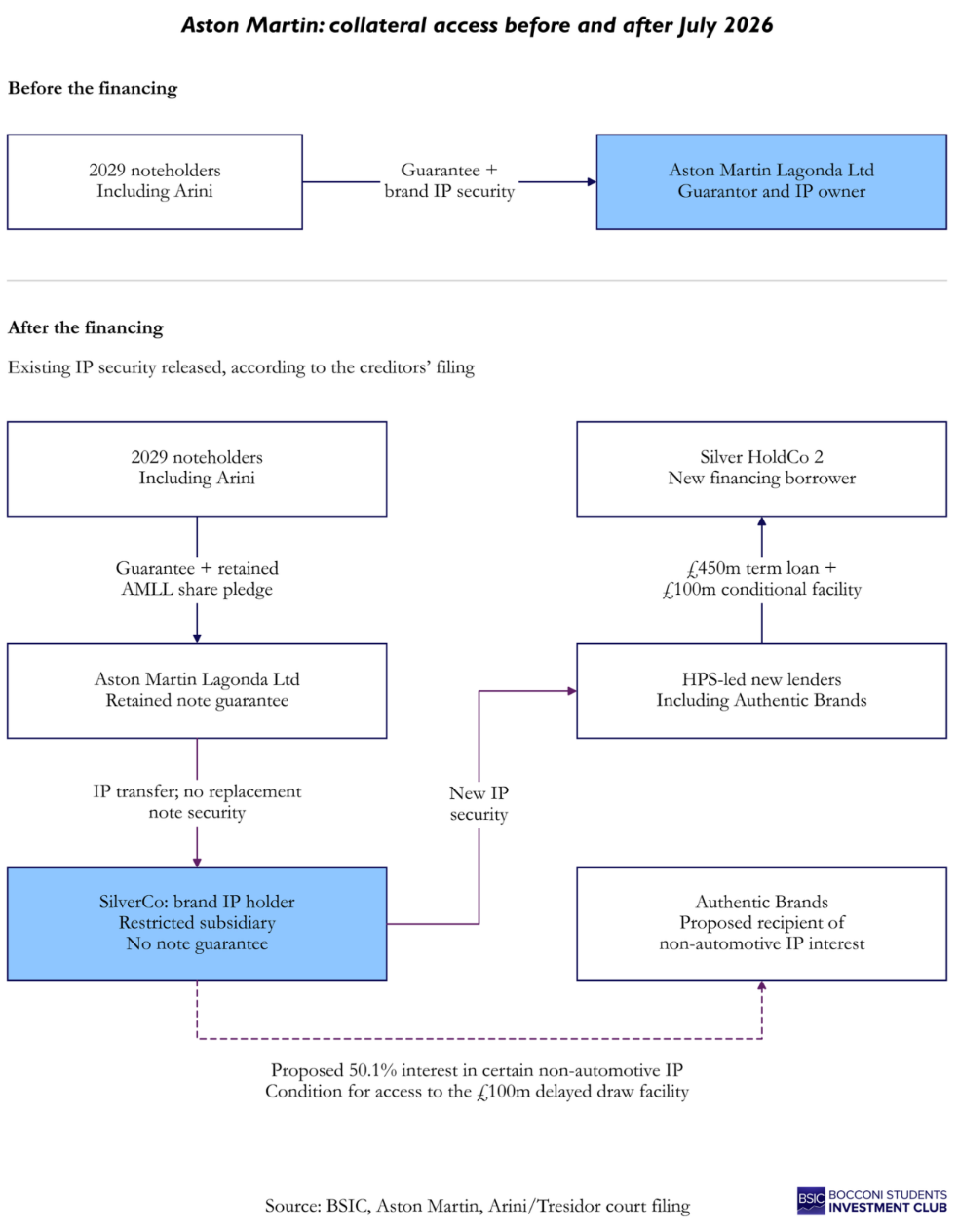
For the existing bondholders, the conflict arose due to the assets supporting this new financing. Some of Aston Martin’s most valuable trademarks and designs, including the distinctive winged logo, had been transferred to SilverCo, a newly incorporated subsidiary that did not guarantee the existing notes or provide replacement security. These assets and intellectual property now instead served as collateral for the new incoming lenders. The bondholders argued that these arrangements, where valuable brand assets were removed from the security package supporting their notes, significantly weakened their recovery position.
The existing notes retained a pledge against shares in Aston Martin Lagonda Limited, an indirect parent of that subsidiary, but not over shares in the subsidiary itself. The economic concern is therefore that security over a parent company’s shares only provides access to the residual value of its subsidiaries when their own creditors have already been satisfied. Based on this, assets can remain within the corporate group but become less accessible to the existing bondholders. The transaction leads to additional liquidity which can improve the company’s chance of survival, but at the same time, the associated financing structure weakens the potential recoveries for those bondholders.
The £100m delayed draw facility introduced another condition. Access to this additional financing depends on a transfer of 50.1% of certain intellectual property rights outside the automotive business, including licensing rights for clothing, watches, and other lifestyle products, to Authentic Brands. A part of the concern is that HPS was a shareholder in Authentic Brands and held a minority stake in the separate, privately-owned Aston Martin Formula One team controlled by Lawrence Stroll. These overlapping relationships sparked bondholder concerns regarding potential conflicts of interest and the governance process underpinning the transaction.
Aston Martin’s choice of financing provider is particularly interesting since existing bondholders had voiced their willingness to provide additional capital. In Arini and Tresidor’s court filing, they stated that the creditor group had offered alternative, more favourable financing to the company. One potential explanation for preferring HPS is the immediate liquidity provided without the need for a restructuring of the outstanding notes or an equity injection. Negotiations with existing bondholders could have started a discussion about debt sustainability and the allocation of value between the debt holders and shareholders. Aston Martin maintained that its board had reviewed all available financing options had decided on the one that it deemed was in the company’s best interests.
Arini responded to these concerns by requesting further information and initiating a legal challenge with some of their fellow creditors. On the 24th of August, Arini and Tresidor applied to the US District Court for the Southern District of New York under Section 1782 for documents and testimony from HPS, Authentic Brands, Moelis, and Lazard to use in expected English legal proceedings. According to 9fin, the creditor group has now become more than 90% of senior secured notes and has decided to raise claims related to the bond documentation and transactions prejudicing creditors. On the 1st of September, the US court set a timetable for responses and ordered the preservation of all evidence that could be relevant. That procedural order didn’t determine the merits of the underlying transaction.
Meanwhile, Aston Martin’s operating performance has continued to improve. Its results in October revealed revenues of £1.02bn for the first nine months of the year and an improved gross margin of 35.2% compared to last year’s 28.3%. Free cash outflow also reduced from £415m to £225m, while net debt increased to £1.57bn. Despite the operational improvements, Aston Martin still heavily consumes cash. For Arini, the key question remaining is whether this positive operational recovery can produce sustained positive free cash flow before a further injection of capital is required.
The Aston Martin case highlights how assessing asset coverage depends on both the value of a borrower’s assets and the creditors’ ability to get a hold of these assets in the event of a deterioration in the company’s operations. From Arini’s perspective, the outcome of the investment hinges on the business’ operational recovery and the extent to which contractual protections and legal remedies help them in the event of a downturn. A large bond stake and coordination among the other creditors can help improve negotiating leverage, but preventing transactions working against them depends on the rights attached to their notes and the legal grounds available.
Altice International: asset transfers and creditor recoveries
Altice International is a holding company based in Luxembourg and controlled by Patrick Drahi. It has telecoms businesses in Portugal, the Dominican Republic and Israel. Its most valuable asset is Altice Portugal, which operates under the MEO brand. The business remains profitable, but performance has deteriorated: EBITDA declined 4.8% to €947m in 2025. Altice International’s main difficulty is its debt burden rather than a collapse in its operations. On a pro forma basis for November 2025, the company had approximately €8.9bn of senior secured debt (5.8x EBITDA) and €9.6bn of total debt (6.3x EBITDA). This included €675m in subordinated notes due in 2028 and about €3bn in net debt due in 2027. But with an average interest cost of 5.8%, it looks increasingly unlikely that the company can refinance those obligations without asset sales or debt restructurings. Altice France’s 2025 restructuring could serve as a model, with the company reducing its debt by €8.6bn to €15.5bn and creditors receiving 45% of its equity.
The secured notes and term loans are issued by Altice Financing and guaranteed by Altice International as the parent guarantor. Together with the operating subsidiaries that provide guarantees and security, these entities form the “restricted group”, which backs approximately $9bn of secured claims. Other Drahi-controlled companies, such as Altice Luxembourg and Altice Group Lux, sit above this group. These holding companies are neither borrowers nor guarantors under the debt. The covenants weaken the protection offered by this structure. The financing documents permit the company to designate subsidiaries as “unrestricted”. Once designated, those subsidiaries are effectively released from the guarantees, asset pledges and covenants which secure the lenders. This type of provision has become increasingly common in the high yield market, where it can be used to move assets beyond the reach of the lenders. Altice International’s incorporation in Luxembourg also means that some of the director duties and clawback rules that constrained the Altice France restructuring do not apply.
The transaction at the heart of the claim (“Project Déjà Vu”) was announced on 28 November 2025. Altice Portugal and Altice Caribbean (the holding company for the Dominican operations) were both designated as unrestricted subsidiaries. Altice Portugal then raised €750m from a related party. The plaintiffs contend that this debt is structurally ahead of the existing lenders. A further €2bn of debt capacity was allocated to the Portuguese business. Altice Caribbean was subsequently moved into a subsidiary of Altice Group Lux, thus taking it out of the restricted group. Before the transaction, Portugal and the Dominican Republic together accounted for 79.8% of adjusted EBITDA. The plaintiffs estimate that restricted group net secured leverage rose from 5.2x EBITDA to over 25x. Following the announcement, the 2028 secured notes fell from around 77 cents to 66 cents. The creditors describe Project Déjà Vu as the latest in a series of transactions dating back to 2021. Since then, in the region of $5.4bn has been lent upstream to Altice Luxembourg (a holding company with no operating cash flow). However, the assets which could have been used to repay these loans have since been moved elsewhere. Altice Luxembourg’s stake in Altice France (valued at around $6.7bn) was transferred to Altice Group Lux for no consideration. Its 50% stake in the German fibre JV OXG was sold to the Drahi affiliate Geodesia for €178.5m.
Arini has not disclosed the size of its position, but it is a member of an 11-fund senior secured steering committee (advised by Houlihan Lokey and Gibson Dunn). By December 2025, the committee’s co-operation agreement covered approximately 87% of the senior holders. From July 2026 some of the committee members (Arini and Silver Point amongst them) started to push for a preferential payout compared with other senior lenders, presenting this as being in recognition of their willingness to go to court. Elliott’s potential participation would take the group to around 60% of the secured debt. The news of the proposal added further pressure to the bonds and Altice International became the flagship fund’s largest single-name loss in July. As Arini has not made its investment case public, the following is our own interpretation. Prior to the asset transfers, net secured leverage was 5.2x EBITDA. The market valued the Portuguese business at around 7x EBITDA and the Dominican business at roughly 4.5x. On those assumptions, secured creditors appeared to have substantial asset coverage. An investor buying the 2028 notes at about 66 cents could make a return of more than 50% if the collateral were ultimately restored. The Altice France restructuring also suggested that organised creditors could potentially negotiate a recovery.
On 14 July 2026, holders of over 25% of the 2028 secured notes issued a default notice, claiming that the company had defaulted on over €2bn of debt. They argued that the subsidiary designations had breached the indenture, should have triggered a change-of-control offer and amounted to a disposal of substantially all of the company’s assets. In their view, that disposal would have required the consent of 75% of the noteholders. The noteholders offered to indemnify the trustee, but the trustee took no action for over 60 days. On 13 October 2026, the steering committee (including Arini, Elliott and Diameter) filed a lawsuit in the New York Supreme Court on behalf of the lenders owed approximately €8bn. The complaint alleges that the transferred assets now “indirectly line the pockets of Drahi”. It brings 27 claims including breach of covenant, improper release of collateral, actual and constructive fraudulent transfer and claims under Luxembourg law. The plaintiffs are seeking to unwind the designations, recover the transferred assets and direct the recoveries to themselves. On 5 November, two Farallon funds also filed a separate action on similar grounds. Altice described the November 2025 measures as a way of funding capital expenditure and upcoming debt service and as part of a strategic review of potential disposals. The company declined to comment on the action. No court has yet ruled on the claims.
In July 2026, Altice International agreed to sell HOT Mobile for NIS 1.22bn (€356m), further shrinking the Israeli business, which prior to the drop-down had only contributed around 20% of adjusted EBITDA. In late October, the company was in the process of negotiating a restructuring of ~€8bn of debt with the lenders in the litigation. The negotiations were being conducted under an NDA which was due to expire very shortly. At the time of writing, no agreement has been announced. By October, the group’s most senior bonds were trading at less than half of face value.
The residual restricted group seems to offer very little recovery on its own. At leverage in excess of 25x EBITDA, the prospects of the secured lenders are very much dependent on the strength of their legal position. The range of possible outcomes has also broadened. A settlement or a court win could restore much of the value which has been lost through the transfers. A bad outcome could leave the lenders with a very much smaller asset base. There may also be a range of recoveries within the class of creditors. The committee’s request to have recoveries go to the plaintiffs and Farallon’s own action would suggest the potential for competing claims. Some of the bank trading desks have reportedly been quoting the bonds held by the group in litigation at a higher price, which suggests that Arini’s seat on the committee may help protect its own recovery. The fall in the price of the senior bonds from 77 cents to below 50 cents is not necessarily indicative of a fall in the ultimate recovery. However, creditors in negotiations are often prohibited from trading as they will have access to private information. Restructurings may also require new capital. For a leveraged investor, therefore, the ability to wait for a recovery cannot be taken for granted.
What has been going wrong – and does it expose a flaw in the strategy?
The big losses occurring at Lemssouguer’s Arini have not been a historical characteristic of the fund. In 2024, for instance, the master fund returned 21.2% against roughly 8.5% for Bloomberg-tracked credit funds, and even including this year’s drawdown it has beaten the average credit fund by 250–300bps annually over four and a half years. In its first four years, the fund boasted cumulative returns of 73%, but is now down 32% YTD in 2026.
Arini’s flagship fund had been flat through the first half of 2026, but has since faced a serious downturn. The real question is what led to this deterioration. As of the end of August 2026, Arini’s master fund was already down considerably, whereas its Credit Opportunities and Direct Lending funds were up 12% and 7% respectively. There are several reasons why the main flagship fund struggled while the other funds performed better, even though all three fall under the same umbrella strategy of debt investing.
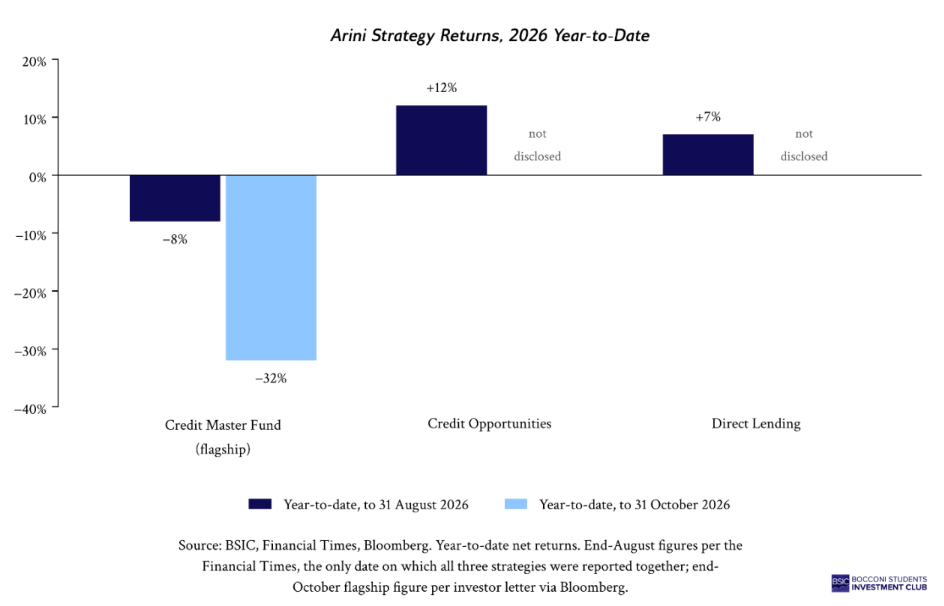
The dated figures show how quickly this unravelled. The flagship was roughly flat through June, lost almost 8% in July and a further 1% in August, leaving it down around 8% at the end of August. September cost an estimated 7.6%, taking the year-to-date decline to 15.7%, and October alone cost 19.7%. The comparison with Arini’s other strategies is only clean at the end of August, the single date on which all three were reported together. Neither Credit Opportunities nor Direct Lending has published a figure since.
A key reason behind the flagship fund’s struggles is the difference in its financing structure, compared with the firm’s other vehicles. The master fund has struggled compared to the other funds because it runs bank leverage that is callable. When the master fund portfolio begins to struggle, the bank can call Arini, forcing the managers to sell positions at a discount to liquidate more quickly. The reason for these terms lies in the raise agreements with investors; Arini’s master fund is redeemable by investors and therefore must invest in more liquid assets and does not get as flexible lending terms from banks. On the other hand, the other funds focus on much more long-term distressed debt situations, with 3–5 year holding periods and fund lock-ups. This allows the portfolio managers to persevere through a downturn and not have to sell at discounts due to the bank’s leverage terms.
Diving into the master fund, the positions driving the major losses failed in varying ways. One major position, Aston Martin, has struggled because of genuine business deterioration and the transfer of valuable assets beyond the reach of its creditors. This saw its bonds fall from roughly 55 cents at the start of October to 47 within a few weeks. Altice International was not primarily an operating story; in this case, the group relocated its most valuable assets outside the collateral pool pledged to lenders, and senior bonds now trade at less than half their face value because of this. Brightspeed, where Arini holds around $2bn of debt, has warned that it may not continue as a going concern and is reported to be preparing a filing as early as December. The common thread is not weak credit analysis but weak documentation: in each case the paperwork allowed value to move away from the creditors who had lent against it. As a result, creditors have gone to court. A group of Altice International bondholders including Arini, Diameter Capital Partners and Elliott Investment Management filed suit in the Supreme Court of the State of New York in October, alleging that the defendants fraudulently shifted assets beyond their reach in a multi-year scheme orchestrated with the help of controlling shareholder Patrick Drahi. Arini and Tresidor Investment Management have separately sought evidence from a US court ahead of a UK claim over Aston Martin’s financing. Proceedings like these may cost funds billions and run for years, which is why others have chosen to just sell for a loss.
That distinction matters more than the headline drawdown. A widening in credit spreads is a price movement and can reverse, potentially creating opportunity to add on; an asset transfer out of a collateral pool is permanent and reduces the ultimate recovery regardless of what spreads do afterwards. Arini believes that its losses are price moves rather than impairments, and that its conviction remains firm. Some of the decline is clearly technical, but part of it reflects a genuine reset in expected recovery, and it is hard to know exactly what the split is.
The problems with the overall strategy and portfolio construction may be more obvious. Arini’s five largest positions accounted for roughly two-thirds of net asset value, and they were not independent bets. All of them were lower-rated, distressed, European and US credits exposed to the same liability management risk, so they fell together. Filings put the master fund’s gross assets at approximately $21.8bn against around $7.5bn of net equity, meaning each 1% move in the book is worth more than $200m. When the margin calls arrived, Arini sold roughly $800m of debt and then over $2bn of face value in a single week, with Pimco and Oaktree among the buyers and rival funds shorting its largest holdings. Because the Altice position was restricted by restructuring NDAs, the fund was forced to sell its better and more liquid names instead, leaving the remaining portfolio more concentrated than before. Hedge funds operate in a competitive industry, and Arini serves as yet another example that rivals will swoop in to buy up cheap assets or short the fund’s remaining positions when they know there is profit to be made from doing so.
Arini believes that it has the structural duration of capital to hold its positions until catalysts arrive, and on the investor side this is largely true: the master fund is closed to new money and the firm attracted $389m in a single week of a $1.5bn raise. Investor lock-ups, however, were never the binding constraint. Locked equity offers little protection when the leverage sitting on top of it can be withdrawn at the lender’s discretion, and Arini has conceded that while some catalysts have accelerated, others have been pushed further out.
Arini’s own explanation is that it underestimated the dislocation in CCC-rated credit, and that the sell-off was technical, driven by CLOs approaching their limits on CCC exposure and by targeted short selling at uneconomic levels. The first claim is well supported: when S&P downgraded Altice International in early 2025, it noted that Altice France and Altice International together accounted for around 30% of European CLOs’ CCC buckets, against a 7.5% threshold. The uncomfortable implication is that Arini’s largest position was itself a principal cause of the technical pressure that forced it to sell. The firm has since re-underwritten its five largest holdings, cut gross leverage to its lowest level since early 2022 and promised greater diversification, which is as close to an admission of the flaw as an investor letter is likely to offer.
While the underlying strategy has generated alpha for more than four years running, Arini’s recent decline does demonstrate the risks of running such a concentrated portfolio with leverage. In some ways, this example is similar to that of Leopold Aschenbrenner’s Situational Awareness fund, which was forced to sell the bulk of its public equity book to Citadel at discounts after heavy leverage turned a sharp reversal in AI stocks into margin calls from its brokers. In a concentrated portfolio that is leveraged to amplify returns, unseen one-off declines, market downturns, and predatory shorting can have a major impact on the overall portfolio, resulting in significant underperformance.
Conclusion
Arini’s recent struggles highlight the two central questions underpinning distressed debt investing: how much value a borrower can generate and how much value creditors are able to recover. With the Aston Martin and Altice International case studies, disputes over further financing and asset transfers have resulted in the enforcement of contractual protections essential to that assessment. In Arini’s case, coordination between creditors can help improve their negotiating position but the value they are able to preserve remains uncertain.
That uncertainty becomes more difficult to deal with when a small number of positions dominate a leveraged portfolio. An investment could, in the end, recover more than its current market price but still produce a realised loss for a fund that was required to sell their holding before the recovery occurs. Arini’s plans to reduce leverage and seek greater diversification could improve its ability to protect itself against further volatility but can’t settle the underlying recovery questions. The eventual outcomes will help determine whether the investment made sense. The fund’s drawdown already highlights why the financing of a distressed position deserves the same level of scrutiny as the assets and contractual rights underpinning it.



0 Comments