Introduction
On 20 October 2026, Elon Musk confirmed during SpaceX’s third-quarter earnings webcast that SpaceX [NASDAQ: SPCX] and Tesla [NASDAQ: TSLA] had formed special committees of independent directors to explore a merger. No terms have been agreed, and Musk has recused himself from the discussions as a conflicted party. A combination would bring the world’s largest electric vehicle manufacturer by market capitalisation together with the dominant commercial space company, extending the consolidation of Musk’s business interests.
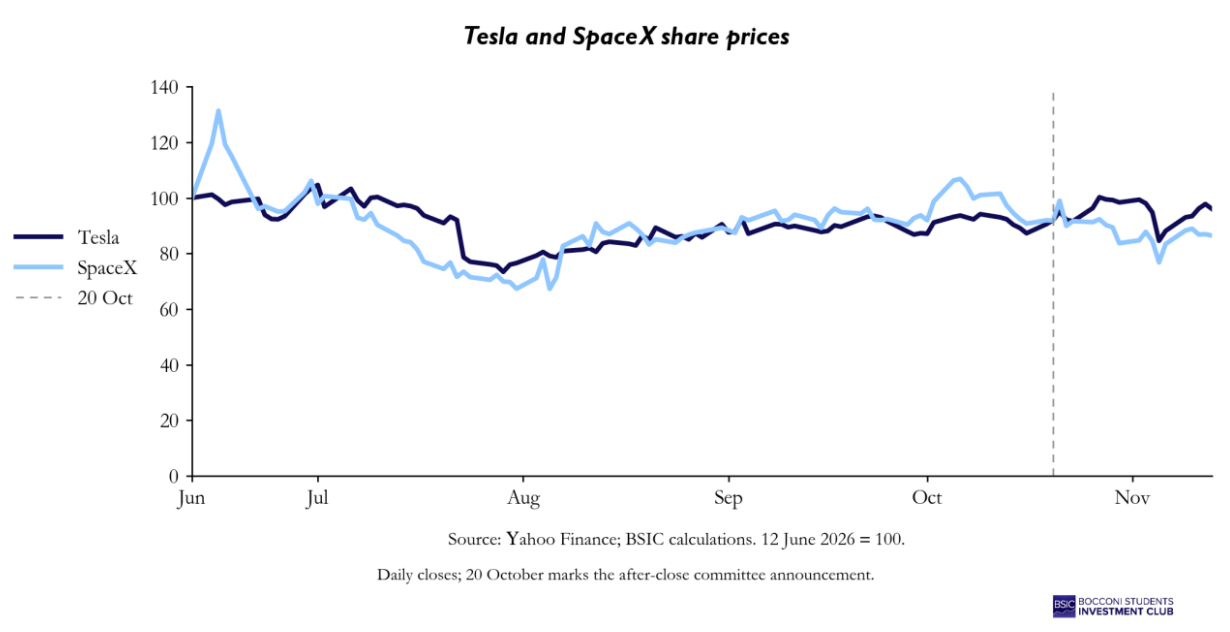
The potential transaction is unprecedented in scale. At their closing prices on 13 November 2026, Tesla and SpaceX had equity values of $1.38tn and $1.97tn, respectively. Together, they represent approximately $3.35tn after deducting Tesla’s existing stake in SpaceX, before any acquisition premium or synergies. A SpaceX acquisition of Tesla at its prevailing equity value would be the largest corporate transaction in nominal dollars, far exceeding the more than $190bn Vodafone [NASDAQ: VOD]–Mannesmann deal completed in 2000.
BSIC’s previous article, “3-2-1 Liftoff: The Launch of the Space Industry”, examined SpaceX’s development and its acquisition of xAI. A merger with Tesla would take this consolidation a step further, bringing under common ownership automotive manufacturing, energy storage, satellite communications and artificial intelligence.
For shareholders, however, the central question is the exchange ratio. With Musk on both sides of the transaction, the negotiated terms would determine how ownership of the combined group is divided between Tesla’s public shareholders and SpaceX’s Musk-controlled shareholder base. Any assessment of potential synergies must therefore consider how those benefits would be shared and whether they justify the price paid by each side.
This article examines the commercial relationships already linking the companies, their contrasting financial profiles and the strategic rationale for a combination. Since much of the proposed cooperation could also be achieved through contracts, the independence of the approval process and the terms negotiated will be central to the investment case. We then use our merger model to assess how different exchange ratios and synergy assumptions affect the outcome for each shareholder group.
One Empire, Many Balance Sheets: How We Got Here
The deal sequence
Elon Musk has been steadily consolidating his business interests over the past decade. First, Tesla acquired SolarCity in 2016, then X and xAI were combined in 2025, and finally in 2026 SpaceX acquired xAI. Throughout all these transactions, shares have been the principal acquisition currency, thus making the relative valuations of each business critical to how ownership would be redistributed. Musk’s position on both sides of the transactions frequently raised questions about how independently terms were negotiated and whether minority shareholders were receiving fair treatment. The transactions summarised below provide a basic overview of how Musk has operated previously and therefore offer a useful basis from which to assess the possible governance and financial structure of a Tesla-SpaceX combination.
| Deal and Date | Consideration | Valuation and Pricing | Approval Process | Shareholder + Court Response |
| Tesla acquires SolarCity (November 2016) | All-stock acquisition. SolarCity shareholders received 0.110 Tesla shares per share. | Approximately $2.6bn at announcement. Exchange ratio negotiated between companies supported by Evercore and Lazard fairness opinions. | SolarCity formed a special committee; Tesla did not. Approval required from disinterested shareholders of both companies | Shareholders approved the transaction, but some Tesla investors challenged it as a bailout. Courts found the acquisition entirely fair in 2022, affirmed on appeal in 2023. |
| X combined with xAI (March 2025) | All-stock combination, with ownership rolled into a new holding company, X.AI Holdings. | xAI valued at $80bn; X at $33bn equity value (EV $45bn with $12bn debt). Privately agreed valuations announced by Musk. | An independent special committee or fairness opinion could not be confirmed from public materials reviewed. | Some investors welcomed the combination, including Prince Alwaleed bin Talal. Public information on minority approval was limited; no comparable court fairness judgment was identified. |
| SpaceX acquires xAI (February 2026) | Primarily stock, plus roughly $2.95bn cash. Eligible service providers could elect cash consideration. | SpaceX valued at $1tn; xAI at $250bn. Boards adopted private valuations following MS analysis; the bank reportedly provided no fairness opinion. | The agreement records board approvals and identifies xAI’s sole director. An independent special committee was not identified in the disclosed agreement. | xAI investors gained exposure to SpaceX and its approaching IPO; some existing SpaceX investors expressed concern over AI-related risks. No comparable court fairness judgment identified. |
SpaceX’s June 2026 IPO brought the possible merger of SpaceX and Tesla one step closer. SpaceX sold 638.9m Class A shares at $135 each, raising approximately $85.7bn after fees at a valuation of approximately $1.8tn. Class A shares carry one vote each, while Class B shares carry ten and allow their holders to elect the majority of directors. The prospectus reported that Musk, through the use of Class B shares, would retain about 82.3% of voting power. With both SpaceX and Tesla now publicly listed, an all-stock merger becomes much easier to price: observable share prices provide a benchmark for the exchange ratio, whereas prior to SpaceX’s IPO the valuation had to be determined using financial analysis as well as private-market transactions. However, while the IPO provides a public reference for an all-stock merger, an observable price does not necessarily establish a fair exchange ratio.
Related-party ties already in place
SpaceX’s IPO disclosures also show how closely the business is already intertwined with Tesla through investment, product sales and overlapping leadership. Tesla’s January 2026 agreement to invest $2bn in xAI converted into a right to SpaceX shares following the February acquisition. The investment was completed on 12 March for a stake of less than 1%. Commercial links have also already been established through product sales: SpaceX’s prospectus records $131m of Cybertruck purchases as well as $506m of Megapack purchases in 2025, the latter by xAI before it joined SpaceX. Tesla also identifies xAI as a customer primarily purchasing Megapack batteries in its related-party disclosures.
These related-party ties also include shared management as well as combined development projects. Musk is the CEO of both companies, while Ira Ehrenpreis sits on both boards of directors. SpaceX directors Antonio Gracias and Steve Jurvetson also previously held positions on Tesla’s board, and Gracias’s Valor Equity Partners provides funding to xAI subsidiaries. Cooperation between the two firms also includes joint development projects. Through Terafab, Tesla and SpaceX aim to build chip-manufacturing for Tesla’s vehicles and Optimus robots, as well as SpaceX’s AI infrastructure. Their planned Macrohard venture would also connect SpaceX’s AI business with Tesla’s processors, further intertwining their hardware and software development. While the companies remain separate, related-party arrangements will continue to face the added difficulties of contractual negotiations and the approval and disclosure processes outlined in their respective policies. Reducing this operational friction could strengthen the case for a merger, but the benefits must exceed integration costs and any loss of external discipline. Additionally, announced projects should be distinguished from committed spending and project agreements.
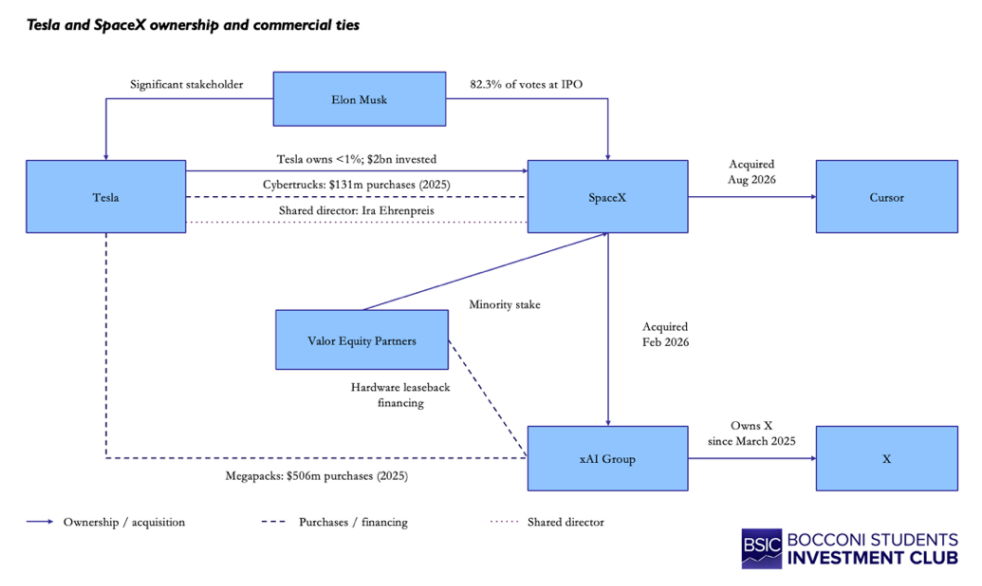
Musk’s case for the merger centres around the growing overlap between the companies in the fields of AI, robotics and computing. Tesla’s efforts with Optimus and autonomous cars would be combined with SpaceX’s LLMs, satellite communications and planned data centres, bringing a variety of complementary products under common ownership. A combined group could coordinate chip design, manufacturing, energy storage and compute, while also being able to allocate capital more efficiently due to the reduced number of negotiations. The case therefore rests on whether the merger would improve execution and provide benefits beyond those achievable as two separate entities. Musk clearly believes that the potential value is there.
Two Very Different Businesses
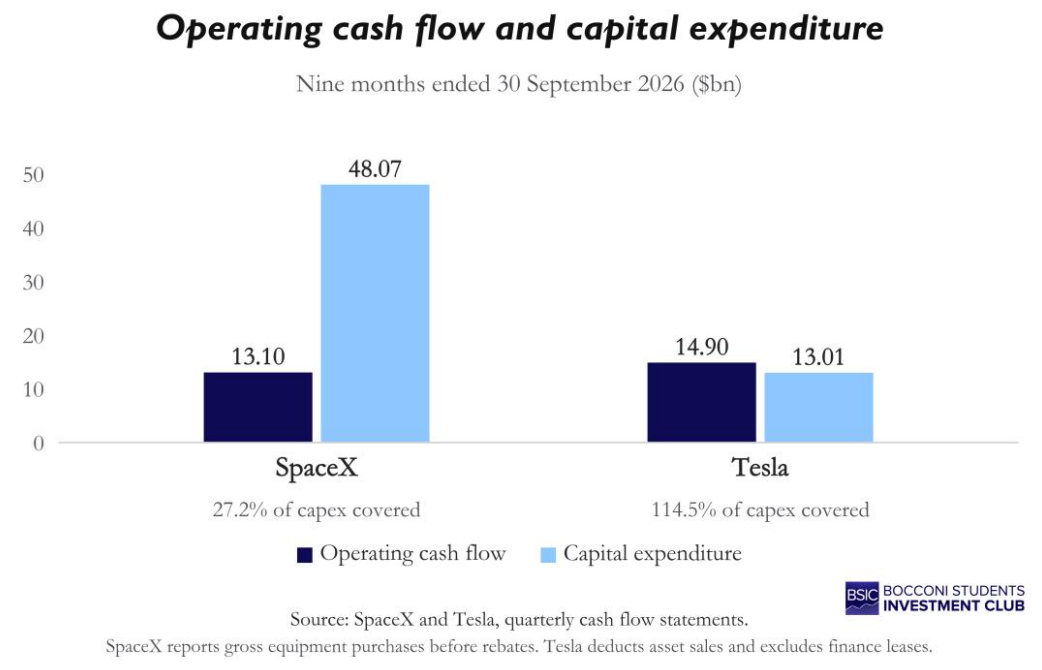
A potential merger, however, would combine two companies with substantially different growth rates and funding requirements. In the third quarter of 2026, SpaceX reported revenue of $14.58bn, an increase of 161.4% from the same period a year earlier. By comparison, Tesla’s revenue remained broadly unchanged at $28.05bn, while its operating margin declined from 5.8% to 2.6%. Tesla therefore generated almost twice as much revenue, but its larger sales base was accompanied by weakening operating profitability. SpaceX’s rapid expansion must also be considered alongside the investment required to support it. During the first nine months of 2026, its operating cash flow of $13.10bn covered approximately 27% of its $48.07bn in PP&E investments. Meanwhile, Tesla generated $1.88bn in cash after deducting reported capital expenditure from operating cash flow. These results provide different starting points for assessing their valuations: the comparison depends on how much growth each business can sustain, the investment it requires, and the cash ultimately available to shareholders.
SpaceX: Launch, Starlink and Super Intelligence
SpaceX’s launch, satellite broadband and AI businesses differ in the operating profits they generate and the investments they require to grow. Its expansion is increasingly driven by Super Intelligence (SI), while Connectivity remains its main source of operating profit. In Q3 2026, SI, which includes AI infrastructure, Grok, Cursor, and X, generated $7.56bn in revenue, compared with $5.25bn from Connectivity, including Starlink, and $1.77bn from Space, covering launch services and Starship. SI accounted for approximately 75% of the group’s year-on-year revenue increase, primarily through new cloud services agreements and Cursor’s acquisition. Connectivity generated $2.37bn in operating profit, against $431m from SI and a $7m loss in Space. The activities that are currently driving revenue growth therefore differ from those supplying most current operating earnings. Starlink’s growth combines an expanding customer base with lower revenue per customer. Consumer subscriptions reached 13.6m at September-end, compared with 7.2m a year earlier, while monthly average revenue per user fell from $83 to $69. SpaceX attributes this decline to its international expansion alongside its lower-priced plans. Enterprise and government revenue rose by 91% year on year, from $1.11bn to $2.13bn, mainly as more aircraft were fitted with Starlink. To expand satellite coverage for mobile phones, SpaceX agreed to buy spectrum licences from EchoStar [NASDAQ: ECHO] for approximately $19.6bn, including $11.1bn in SpaceX’s shares. Final acquisition closing is targeted for November 2027.
SpaceX reported net income of $4.40bn in Q3 2026, although it recorded a net loss of $413m for the first nine months of the year. The quarterly profit included a $561m unrealised gain on its stake in The Boring Company and a $390m tax benefit. Cursor, an AI coding platform which SpaceX acquired on 14 August, contributed $608m in revenue through the end of September. SpaceX also recorded $1.22bn in share-based compensation related to the Cursor and Mesh Optical acquisitions. Reported growth therefore includes acquired revenue, while earnings reflect both investment gains and acquisition expenses. Customer concentration adds another consideration: one SI customer accounted for 34.5% of group revenue in Q3, leaving future sales sensitive to changes in that customer’s spending.
Of the $19.59bn SpaceX spent on property and equipment in the third quarter, $16.44bn went to SI, accounting for approximately 84% of Q3 capital expenditure. Over the first nine months of 2026, SpaceX generated $13.1bn in operating cash flow, covering about 27% of its $48.07bn in cash purchases of PP&E, making external financing essential. The June IPO raised $85.68bn net, while debt principal stood at $38.01bn at September-end. SpaceX repaid a $20bn bridge loan in June using the proceeds of a bond issue. At September-end, it held $89.86bn in cash and short-term marketable securities. These reserves provide substantial funding capacity, although they do not establish whether the new infrastructure will earn sufficient returns. Equipment financing can reduce upfront cash demands while creating future payment obligations. On 26 October, SpaceX announced a commitment to lease roughly $40bn of AI chips and related equipment from an entity managed by Apollo [NYSE: APO]. The contemplated leases require quarterly principal repayments of one-twentieth of each equipment tranche’s financed cost. Applied to $40bn, this implies approximately $2bn per quarter once all tranches have commenced, before interest and expenses. The commitment remained subject to closing conditions, with leases expected to commence upon equipment delivery in the first half of 2027. As discussed in BSIC’s “Insuring the AI Boom”, such arrangements preserve immediate liquidity but commit future cash flows. If investment continues to exceed cash generation, further borrowing or equity issuance could increase financing costs or dilute existing shareholders.
Tesla: An Automaker Spending Like an AI Company
Like SpaceX, Tesla is investing heavily in AI, but its operating cash flow covered capital expenditure in the first nine months of 2026. Vehicle sales accounted for most of its revenue, although third-quarter deliveries fell 2% year on year to 486,532 and average selling prices declined at constant exchange rates. Automotive revenue fell 3% to $20.56bn. Part of that decline came from regulatory credits, which generated $113m compared with $417m a year earlier after Tesla reversed $475m of revenue from earlier credit sales. Despite weaker pricing, a shift towards vehicles that cost less to produce, together with tariff refunds, helped lift automotive gross margin excluding credits from 15.4% to 18.1%. Pricing pressure also affected Tesla’s energy business, where revenue fell 16% to $2.88bn even as storage deployments rose from 12.5 GWh to 13.7 GWh. Tesla attributed the decline partly to lower prices for its Megapack batteries and fewer Powerwall installations. SpaceX itself accounted for $221m of quarterly energy revenue through its Megapack purchases. At September-end, $588m of Tesla’s receivables from SpaceX related to Megapacks it had billed but had yet to deliver. Growth in services more than offset the decline in energy revenue, as used vehicle sales, repairs and paid charging helped lift services and other revenue by 33% to $4.61bn. Gross profit from these activities doubled to $734m, contributing $368m of the $440m increase in group gross profit.
That $440m gain was less than half the increase in research spending alone. R&D rose by $1.13bn to $2.76bn, helping explain why Tesla’s operating margin fell from 5.8% to 2.6% even as automotive margins improved. Two of the projects behind this spending began reaching customers and factories during the quarter. On 3 September, Tesla began carrying passengers in its Cybercab robotaxi in Austin, while its Fremont factory began producing Optimus humanoid robots. Both projects also require computing capacity to train their software, which Tesla’s SI programme aims to expand to 400 MW by year-end. Building that infrastructure adds to the demands on Tesla’s cash. Across the group, capital expenditure more than doubled to $13.01bn in the first nine months, reducing the cash left after investment from $4.80bn to $1.88bn. Tesla still held $45.45bn in cash and short-term investments at September-end, with a further $30bn available under undrawn credit facilities. Its own expansion, however, already places a claim on those resources. To meet management’s forecast of more than $20bn in full-year capital expenditure, Tesla would need to spend roughly $7bn in the fourth quarter, compared with $4.73bn in the third. The cash balance is therefore not entirely available to fund SpaceX without an opportunity cost.
What Each Share Price Assumes
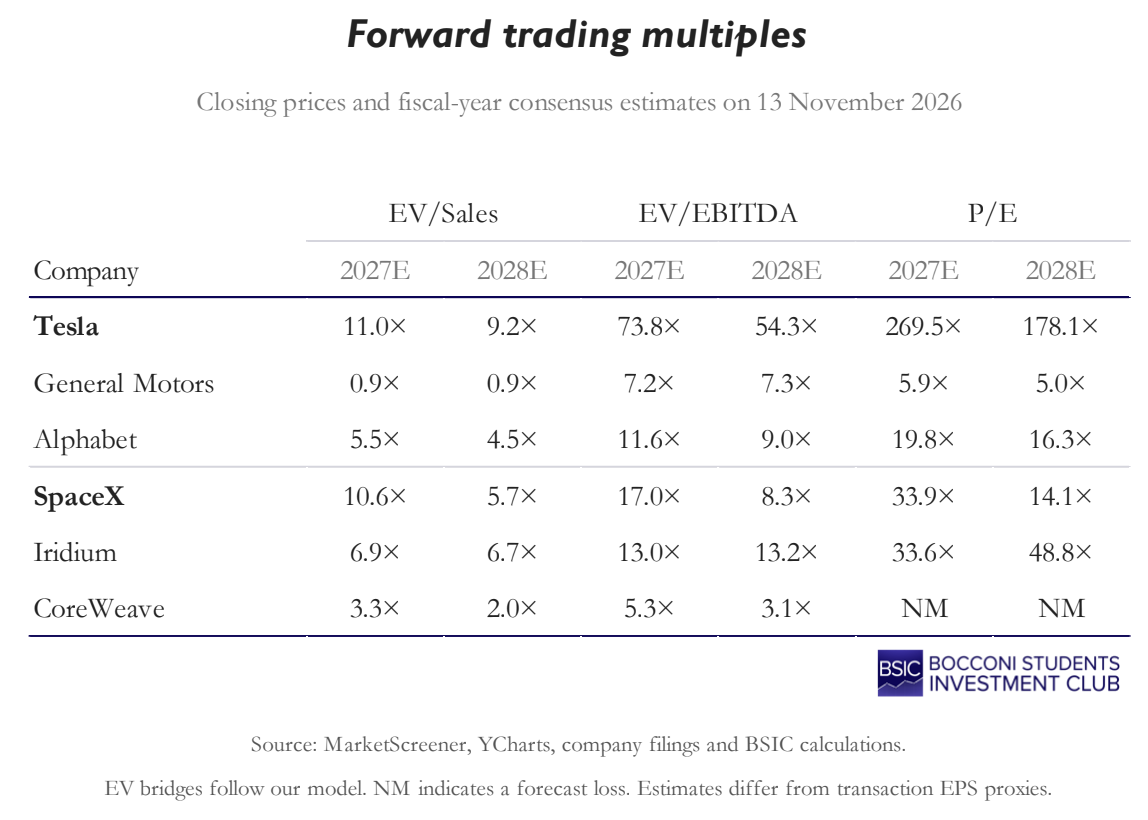
For a potential merger, the question is how much of each company’s valuation already depends on the returns from its investment programme. At their 13 November closing prices of $390.22 and $139.11, Tesla and SpaceX were worth approximately $1.38tn and $1.97tn on the diluted share counts. We compare their forward trading multiples and value their businesses separately to assess how much of those prices rests on future growth.
On 2027 consensus estimates, Tesla and SpaceX trade at 11.0x and 10.6x revenue, compared with 0.9x for General Motors [NYSE: GM] and 3.3x for CoreWeave [NASDAQ: CRWV]. Tesla’s 269.5x P/E also places considerably more weight on earnings beyond 2027 than SpaceX’s 33.9x.
Our sum-of-the-parts exercise first asks what the companies’ other operating businesses would be worth if priced at multiples from firms in their respective industries. This gives an illustrative benchmark for those activities. We then compare it with market equity value to assess the value implied for autonomy and Optimus at Tesla, and Super Intelligence at SpaceX.
Applying General Motors’ 0.92x trailing sales multiple to Tesla’s automotive and services businesses values them at $84.1bn. Fluence Energy’s [NASDAQ: FLNC] 0.29x multiple gives Tesla’s energy business a further $3.6bn. After adding net cash and Tesla’s stake in SpaceX, together with the other balance-sheet adjustments shown below, these activities account for approximately $126.7bn of Tesla’s $1.38tn equity value on 13 November 2026. That leaves $1.256tn, or approximately 91%, as the implied value of autonomy and Optimus on this basis.
For SpaceX, applying Rocket Lab’s [NASDAQ: RKLB] 39.51x trailing sales multiple to Space and Iridium’s [NASDAQ: IRDM] 7.68x to Connectivity gives $164.2bn and $123.0bn, respectively. Adding $51.011bn of net cash and $2.226bn of equity investments and digital assets brings these activities and balance-sheet items to $340.5bn. Against $1.97tn of market equity value, this leaves $1.634tn, or 82.8%, as the implied value of Super Intelligence. That is equivalent to 137.7x SI’s trailing revenue, compared with CoreWeave’s 9.1x, although SI includes businesses beyond the AI infrastructure provided by that peer.
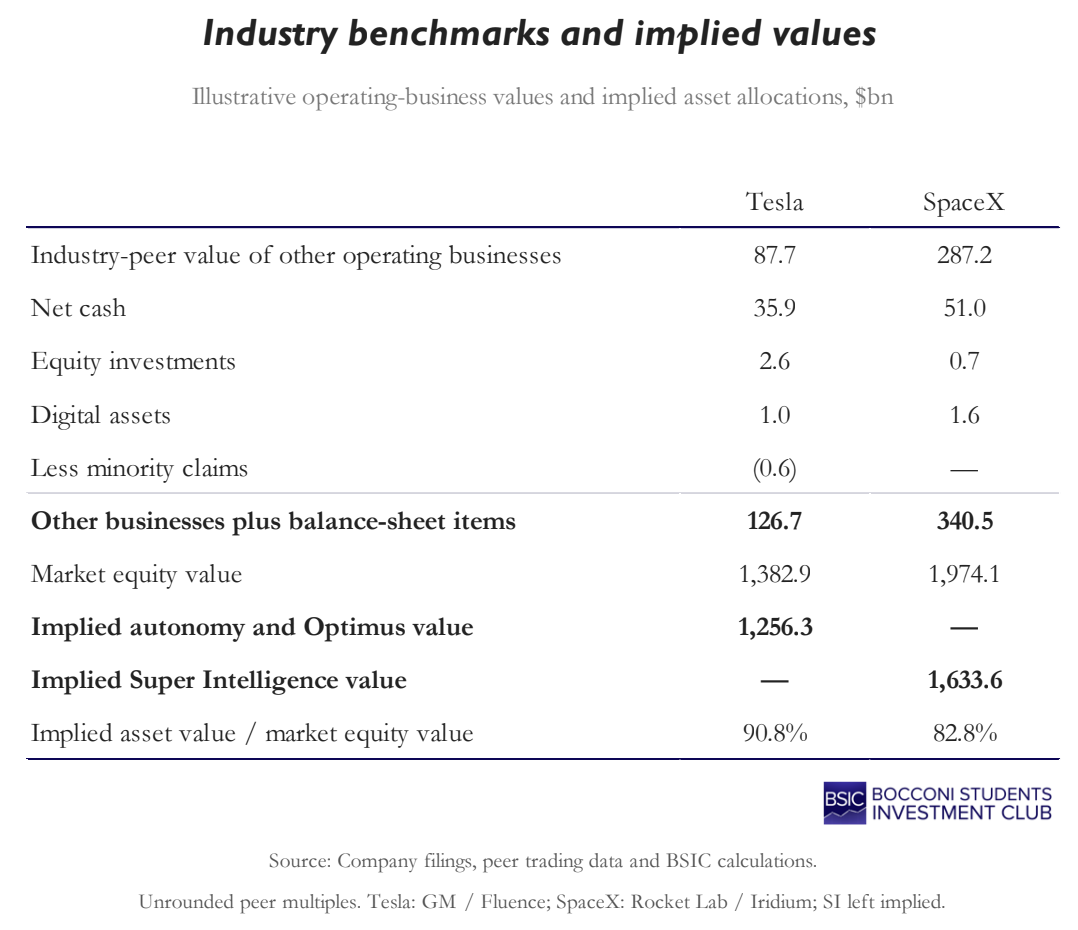
The benchmark values provide one way of pricing the operating activities; the remaining market value indicates what is being priced in for autonomy, Optimus and SI on that basis. This allocation also absorbs differences in the growth, margins and business mix of the benchmarked activities. Rocket Lab is itself a high-growth peer, so the comparison uses industry reference firms rather than a uniform set of mature businesses.
Analyst valuations show how differently those prospects can be assessed. Morgan Stanley’s October breakdown assigned Tesla $45 per share for autos, $40 for energy and $147 for network services, including driver-assistance software. Holding that $232 subtotal fixed leaves $158, or 41% of Tesla’s closing price, for robotaxis, Optimus and differences from the bank’s assumptions, compared with its own combined estimate of $178. This provides a separate analyst cross-check; FSD is already included in network services.
Morningstar valued Tesla at $475 per share and SpaceX at $70, while Morgan Stanley’s targets were $410 and $300. Against Morningstar’s estimates, Tesla traded at a $300bn discount and SpaceX at a $981bn premium on our share counts. These are dated opinions with different dilution and forecast conventions. For the merger, the question is how much of SpaceX’s premium survives when each share also exposes investors to Tesla’s automotive business, and how much of Tesla’s autonomy and robotics value SpaceX holders are willing to recognise. That difference affects the exchange ratio the two boards can justify.
The Strategic Case: What a Merger Does That a Contract Cannot
The strongest case for a Tesla–SpaceX merger is the ability to redirect scarce compute, chip capacity and engineering talent as priorities change. Most of the proposed product tie-ups are already within reach through commercial agreements. On SpaceX’s 20 October earnings call, Elon Musk said there was a “lot of merit” in combining the companies and pointed to superintelligence software, chip design, Terafab, robotics, connectivity and the planned Starmind orbital computing constellation. A single management team would also have greater discretion over which projects receive people and capital. Both companies have formed special committees to evaluate a potential combination.
Revenue Synergies
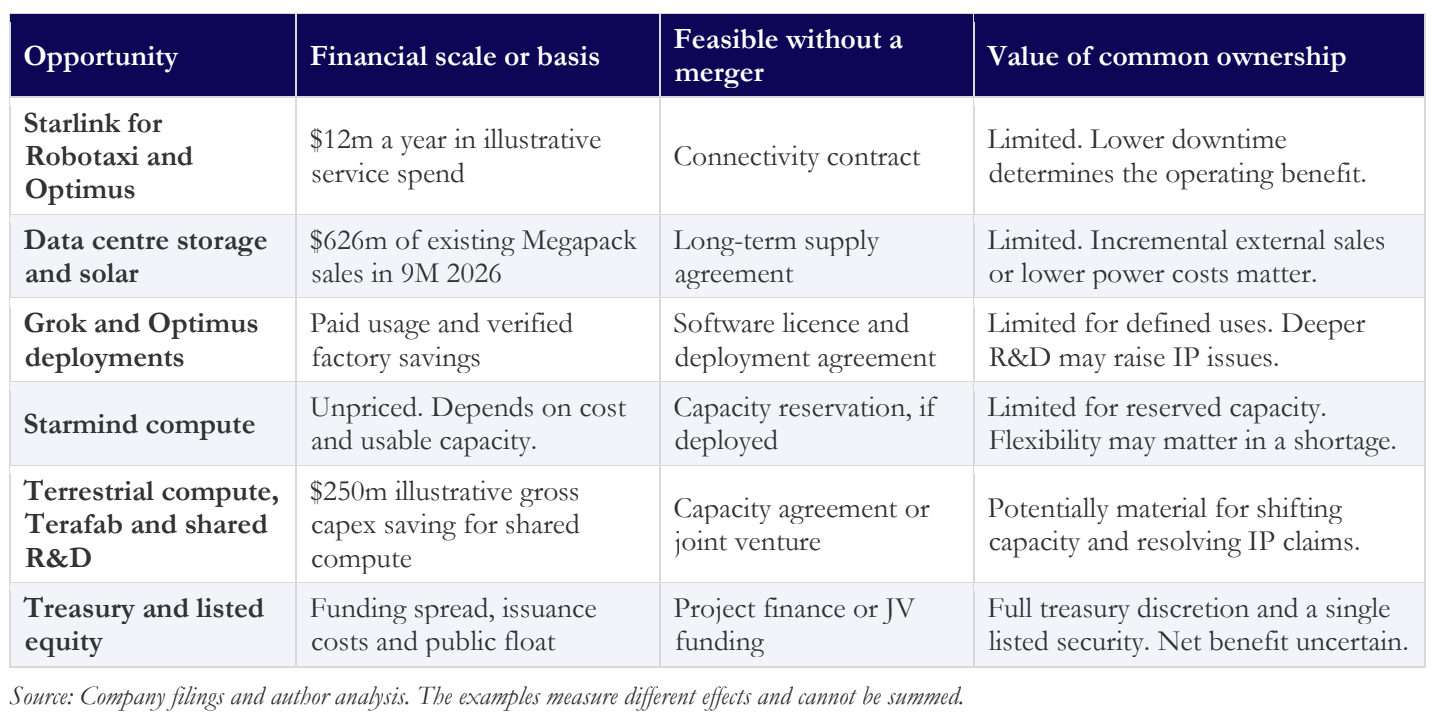
Starlink could provide backup connectivity for Robotaxi fleets and remotely supervised Optimus deployments. A service contract can specify coverage, uptime and price. At 100,000 connected devices and $10 per device per month, the annual service bill would be $12m on illustrative assumptions. Any group benefit would come from lower downtime or costs compared with other networks. The same distinction applies to energy. Tesla booked $626m of Megapack revenue from SpaceX in the first nine months of 2026. Those sales demonstrate existing demand. A long-term supply agreement can cover more storage and solar for SpaceX data centres, and sales between the two businesses would be eliminated on consolidation.
Tesla already offers Grok in eligible vehicles. A licence could extend the customer interface to Robotaxi and Optimus, while a supply and support agreement could place Optimus in SpaceX factories. Paid adoption and verified labour savings would determine the value of those deployments. Tesla could also reserve Starmind capacity for training autonomy and robotics models if SpaceX can deliver it at a competitive cost. Morningstar’s equity research argues that joint ventures or supply arrangements could capture much of this cooperation.
Cost and Capital Expenditure Synergies
A shared terrestrial compute buildout could avoid duplicate power, cooling and equipment spend. If 5% of a hypothetical $5bn buildout were duplicative, the gross capex saving would be $250m. A capacity-sharing contract or joint venture could capture much of it. Terafab already has a framework between Tesla and SpaceX, with Intel [NASDAQ: INTC] involved, and SpaceX’s IPO filing says that individual projects require separate agreements. Joint purchasing, shared manufacturing expertise and clearly scoped R&D also lend themselves to agreements.
Common ownership is most valuable where the companies would otherwise have to renegotiate who owns new IP, pays for the next chip revision or gets compute when capacity is scarce. A single owner could prioritise the highest-return workload and reduce disputes over transfer prices and repeated related-party approvals. The incremental saving is the cost of the remaining duplication, delays and bargaining under a well-designed joint venture.
Financing and Liquidity
Tesla held $45.4bn in cash, cash equivalents and short-term investments at 30 September. In the first nine months of 2026, Tesla’s operating cash flow exceeded net cash purchases of property and equipment by $1.9bn. SpaceX’s cash purchases of property and equipment exceeded its operating cash flow by $35.0bn before rebates, although SpaceX still held $89.9bn in cash, cash equivalents and short-term marketable securities. A combined treasury could use Tesla’s cash to defer a future SpaceX equity raise. Any benefit depends on financing costs saved and the returns Tesla forgoes. A larger public float could improve liquidity. Index membership and weight would depend on the index rules and the surviving security’s free float.
Synergy Matrix
Risks and Shareholder Trade-offs
A combined company could trade at a conglomerate discount if investors find it harder to value autos, launch, broadband and AI in one security. Tesla shareholders would also take on greater exposure to SpaceX’s AI investment cycle. Tesla itself expects more than $20bn of 2026 capex, so its cash has competing uses. Future equity raises could still dilute both shareholder groups if the combined buildout outpaces internal cash generation.
SpaceX’s U.S. defence and NASA work would sit alongside Tesla’s substantial China operations, including Gigafactory Shanghai. The International Traffic in Arms Regulations can treat the release of controlled technical data to foreign persons as an export, even within the U.S. Limits on access and separate teams could reduce the gains from sharing engineers. The combined security would also concentrate exposure to Musk’s leadership and succession.
Tesla shareholders would gain more exposure to SpaceX’s AI growth. Investors who bought Tesla for autonomy and robotics would also fund a much broader buildout. SpaceX would gain access to Tesla’s cash. Musk would gain managerial discretion, with his voting control and the treatment of his Tesla pay award depending on the final structure. The merger model should count only cash flows above the contract or joint-venture case, deduct integration and compliance costs, and test whether each shareholder group receives enough of that incremental value at the proposed exchange ratio.
Who Decides? Structure, Governance and Approvals
Both boards have formed their special committees by now, but the decision process is clearly asymmetrical. SpaceX’s Q3 Form 10-Q says that for any transaction, the approval of its special committee, its board, and its controlling shareholder, Elon Musk, is needed, while Tesla has to secure the approval of the majority of all of its outstanding shares, a criterion that Musk himself described on 18 November as a “big hurdle”. At the moment, no agreements have been signed, though Bloomberg says that the committees, along with their advisors, are negotiating the share exchange and the structure of the combined company, with an announcement possible as early as December.
Three Options, One Expected Outcome
Three options exist: SpaceX acquiring Tesla through an all-stock deal, Tesla acquiring SpaceX, or a holding company acquiring the two through merger subsidiaries. It looks like SpaceX is taking over Tesla according to available reporting, and the reason is control. SpaceX has a dual-class structure, where each Class B share carries ten votes, allowing SpaceX to issue ordinary Class A shares to Tesla shareholders while maintaining the voting majority for Musk. As Tesla only has one share class, an acquisition by Tesla would necessitate creation of a super-voting class to be approved by Tesla’s own shareholders.
This option, of course, has some costs when it comes to index membership. Tesla is a component of the S&P 500 Index, while SpaceX is not yet, as S&P refused in June to waive the seasoning criteria and will wait at least 12 months after the IPO. In case of a SpaceX acquisition of Tesla, Tesla’s weight would leave the index, while the decision about the treatment of the combined company by S&P will decide whether index funds have to sell SpaceX stocks received in exchange.
Two Committees, One Independent Vote
Neither company has disclosed the members of its committee, and their independence would likely be under scrutiny. Ira Ehrenpreis, who chairs both Tesla’s compensation and governance committees, has sat on SpaceX’s board since February, and while Musk, who backs the deal and the process in general and describes it as “an odd kabuki dance”, may be formally recused, his support for the deal is public. And on SpaceX’s side, the ultimate decision-maker is Musk, who controls about 82% of the votes and whose consent is explicitly mentioned in SpaceX’s 10-Q.
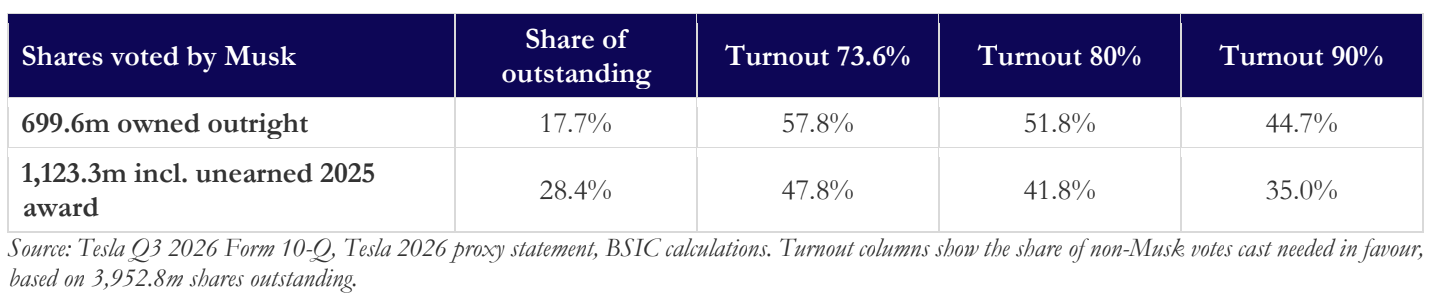
Thus, the key decision to be made is a Tesla vote. Under Texas law, the default merger requirement threshold is two-thirds of all outstanding shares, but Tesla’s certificate of formation drops it to a simple majority of the shares entitled to vote, so abstentions and non-voted shares count against the decision. There is nothing stopping Musk from voting his own 699.6m shares, while a majority-of-minority condition is applicable only if the committees negotiated it into the merger agreement. The precedents are not encouraging here, as in 2025 the proposal to remove Tesla’s supermajority provisions drew a 73.6% turnout and the support of 39.4% of outstanding shares.
The table shows the percentage of non-Musk votes necessary to support a deal under different voting rates, depending on whether the 423.7m unearned shares awarded to Musk in 2025 carry voting rights.
Tesla Vote Arithmetic
Texas law also restricts what may be disputed after the decision is made. Following the changes of 2025 to the Texas Business Organizations Code, directors’ decisions are to be assumed taken in good faith unless a shareholder proves fraud, intentional misconduct or a knowing violation of law, and the company may ask the Texas Business Court to confirm in advance whether the committee members are independent. Such a ruling would not address the fairness of the exchange ratio, though. Tesla’s 2016 acquisition of SolarCity was subject to Delaware’s entire fairness standard and was upheld only in 2023.
What Would Tesla Shareholders Be Giving Up?
Under the SpaceX-led acquisition, Tesla shareholders would be giving up the share in a company where Musk exercises significant influence but has no control over it in favour of shares in a company where Musk controls it outright. SpaceX relies on the controlled company exemption in accordance with Nasdaq’s rules, thus is not required to have a majority-independent board and independent compensation and nominating committees and warned about the possibility of limiting investors’ influence in the IPO filing. The shareholder remedies would also be narrowed down, as Texas law denies appraisal rights to owners of listed shares, which only receive listed shares in return, while Tesla bylaws require a 3% stake ($46bn at the price of 13 November) to bring a derivative lawsuit.
Would the Premium Trigger Musk’s Award?
Musk’s 2025 Tesla stock award adds another layer of negotiations. With a change in control, the operational milestones disappear, and Tesla’s market capitalisation is measured once, being calculated based on the number of shares outstanding multiplied by the higher of the last closing price and the per-share deal price, with any tranche earned vesting immediately. With 3.95bn shares outstanding, the first $2tn milestone would require the price of $506 per Tesla share or a 29.7% premium to the 13 November close, and the 35.3m shares from this tranche would be valued at around $16-18bn. The figure is close to the ones considered by analysts so far: JPMorgan considers 30-35% as a range, and HSBC considers the valuation of $507 per Tesla share in case of acquisition.
Musk’s overall incentives point in the opposite direction. He holds about 47% of SpaceX and only about 20% of Tesla, so any premium paid to Tesla shareholders costs him more as a SpaceX shareholder than he gains as a Tesla shareholder.
China: The Approval That Matters
As for the regulatory environment, the major challenge seems to be China rather than US antitrust due to the minimal overlap between the two businesses. A combination would put the production centre in China (Giga Shanghai) under the ownership of a major US defence contractor. JPMorgan regards Chinese approval as a more difficult task than the Tesla vote, considering that China provides about a fifth of Tesla’s revenues and an even bigger share of its operating profits and free cash flow, while Starlink cannot operate there yet. According to Bloomberg, ring-fencing of Tesla’s operations in China remains the major point left to negotiate. JPMorgan outlined a possible solution in the form of a Chinese consortium acquiring a majority stake in Tesla’s China subsidiary, with Tesla earning through licensing its name and software, but any such solution would imply duplicating the supply chain and increasing the costs of car production.
In the US, a former DOJ official suggested that the authorities could review the access of rival carmakers to Starlink, while the analysts generally expect an easier federal review due to Musk’s ties to the administration. But timing is also relevant, as a Democrat-led House Select Committee on China may begin reviewing the deal in January while Bloomberg reported that the companies aim to close before President Trump leaves office. After signing, SpaceX would have to register its new shares with the SEC, and Tesla would solicit proxies for a special meeting, with the processes running in parallel and China setting the schedule.
Thus, the most likely option is also the option which puts the most demands on Tesla’s public shareholders, who would give up one-share-one-vote, membership in the S&P 500 Index and appraisal rights in exchange for exposure to SpaceX growth. As SpaceX approval is practically predetermined, the 50% threshold in the Tesla vote and Chinese approval are now the two remaining binding constraints, being tested in the merger model.
Pricing the Deal: What the Merger Model Shows
Our model prices the structure that reporting points to: SpaceX issues new Class A shares to Tesla holders at a fixed exchange ratio, and Tesla becomes a wholly owned subsidiary. A holding company acquiring both companies through merger subsidiaries would produce the same economic split for the same ratio, since each Tesla and SpaceX share would simply be exchanged into the new parent; the two structures differ in votes, index treatment and approvals rather than in value. For a range of exchange ratios, the model answers three questions: who owns the combined group, whether the deal is accretive, and how large synergies must be to justify a premium. All market data are as of the 13 November close.
Inputs
Tesla’s 3,952.8m shares outstanding include the 423.7m unearned shares of Musk’s 2025 award, which only vest if a milestone is met. We exclude them from the economic share count and add about 15m of other dilutive securities, giving 3,544.0m fully diluted shares and an equity value of $1,383bn. SpaceX’s 13,581.1m Class A and Class B shares rise to 14,190.9m after 142m RSUs and 508m options, net of the 40.2m shares the treasury stock method assumes are repurchased with option proceeds at a blended strike of about $11. Both classes are priced at the Class A close of $139.11, giving $1,974bn. Tesla’s 19m SpaceX shares ($2.6bn) are cancelled on completion, leaving 14,171.9m legacy SpaceX shares. After $89.9bn of cash and marketable securities and $38.8bn of debt, SpaceX’s enterprise value is $1,923bn; Tesla’s is $1,344bn after $45.4bn of cash, $9.5bn of debt and finance leases, and its SpaceX stake. Apollo’s $40bn of equipment leases are excluded until they commence in 2027, and minority interests are small relative to these equity values.
For forecasts, we use consensus: SpaceX 2027E revenue of $181.3bn and EPS of $4.10, against $118.2bn and adjusted EPS of $2.48 for Tesla. Free cash flow is less useful as a yardstick. SpaceX’s was negative $35.0bn in the first nine months of 2026, so per-share cash flow comparisons say more about the timing of capex than about value, and we use revenue per share as the cross-check on EPS instead.
Exchange Ratio and Ownership
The exchange ratio is the number of SpaceX shares each Tesla share receives:
Exchange ratio = P(Tesla) × (1 + premium) / P(SpaceX)
At the 13 November close, the market-implied ratio is 2.8051 ($390.22 / $139.11), at which former Tesla holders would own 41.2% of the combined group. Each percentage point of premium is worth $13.8bn at the offer price, but because it is paid in shares that former Tesla holders will partly own, it moves about $7.8bn from legacy SpaceX holders to Tesla holders before any synergy is counted.
The table runs premiums from a 20% discount to a 50% premium, and each has an argument behind it. A discount would reflect the view that Tesla’s 157x 2027E P/E rests on autonomy and Optimus that SpaceX holders need not pay for, while Tesla holders gain exposure to SpaceX’s faster growth. The no-premium camp argues that the two shareholder bases overlap so heavily that a premium mostly moves money between the same pockets. A 10% premium is our “deal at market” case. A 30% premium matches JPMorgan’s 30-35% range and HSBC’s $507 per share, and is the point at which Tesla’s market value at the deal price crosses $2tn and the first tranche of Musk’s 2025 award vests. Former Tesla holders would only own half of the group at a premium of about 45%.
Exchange Ratio, Ownership and Accretion by Premium
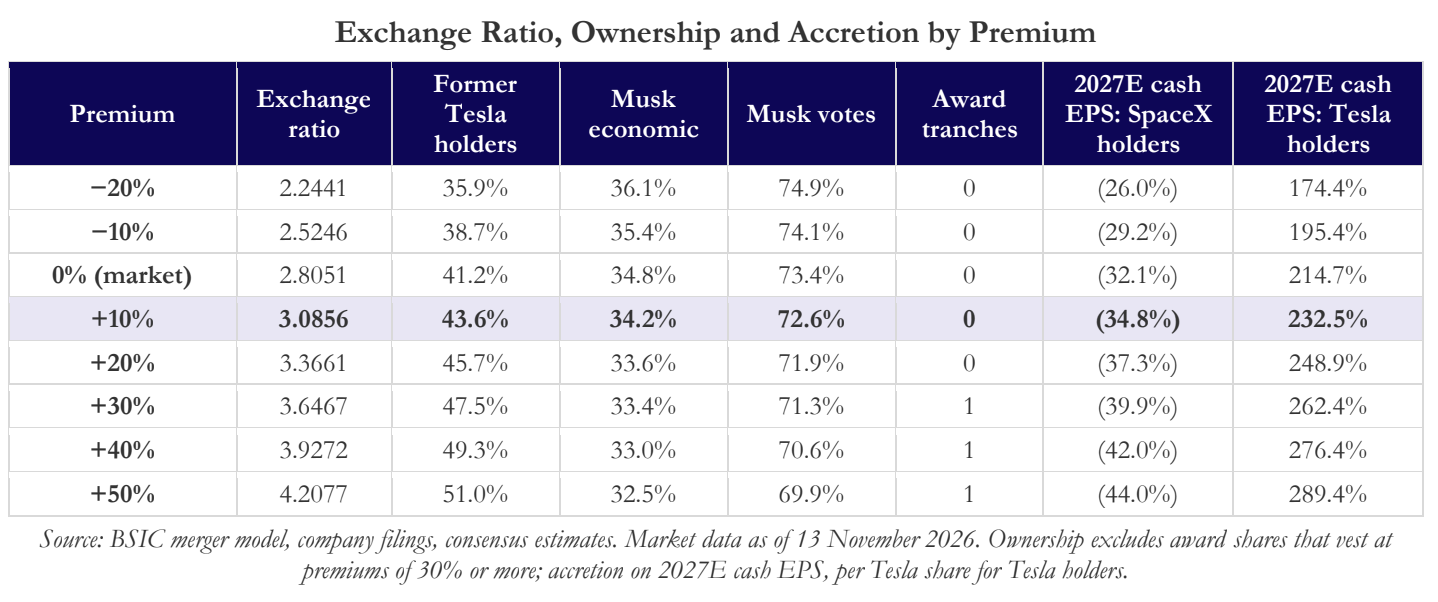
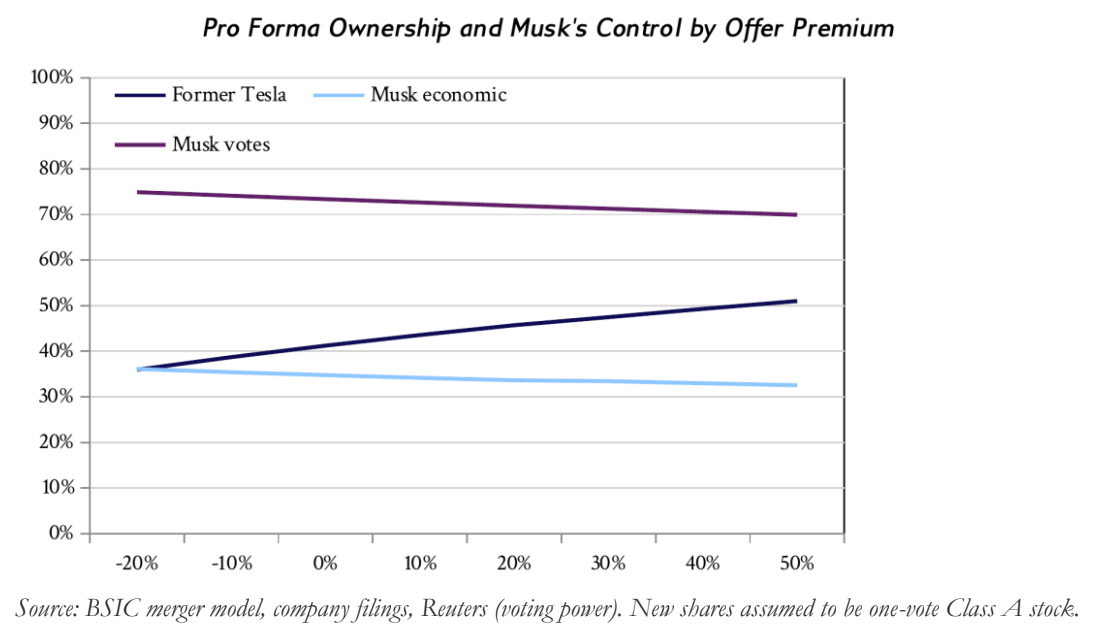
Control barely moves across the range. Musk’s voting power falls only from 74.9% at a 20% discount to 69.9% at a 50% premium, because the new shares are one-vote Class A stock while his Class B shares keep ten votes each. His economic stake falls from 45.2% of SpaceX today to between 32.5% and 36.1% of the combined group. For Tesla holders, the choice is therefore between roughly 36% and 51% of the economics of a company in which, collectively, they would hold less than a fifth of the votes. That trade-off is what the exchange ratio has to price.
Contribution Analysis
What Tesla holders could reasonably demand depends on which measure of contribution one accepts. On 2026E figures, Tesla contributes 68.5% of combined revenue and 55.6% of net income. On SpaceX’s 2027 consensus, which assumes its revenue more than triples to $181.3bn, Tesla’s share falls to 39.5% of revenue and 13.1% of net income. Tesla generated 53.2% of combined operating cash flow in the first nine months of 2026, while free cash flow cannot be compared, as SpaceX’s was negative. Market value, at 41.2%, sits close to Tesla’s share of 2027E revenue.
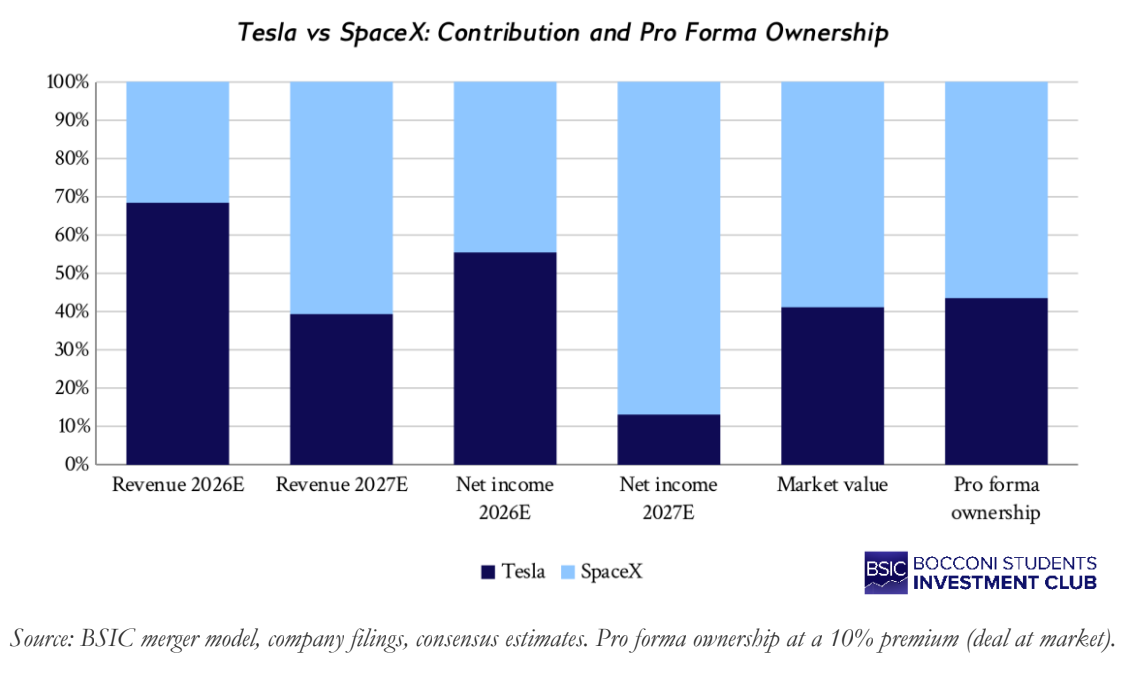
Converting each contribution share into the exchange ratio that would match it makes the gap clearer. Parity on 2026E revenue would require 8.70 SpaceX shares per Tesla share, and parity on nine-month operating cash flow 4.55, against 2.81 at market. Parity on 2027E revenue would require 2.61, and on 2027E net income just 0.60. Backwards-looking measures favour Tesla holders; forward-looking ones favour SpaceX’s. A ratio close to the market’s therefore asks Tesla holders to accept SpaceX’s 2027 consensus as the basis for the split, while their own 157x P/E already assumes that much of Tesla’s value lies beyond 2027.
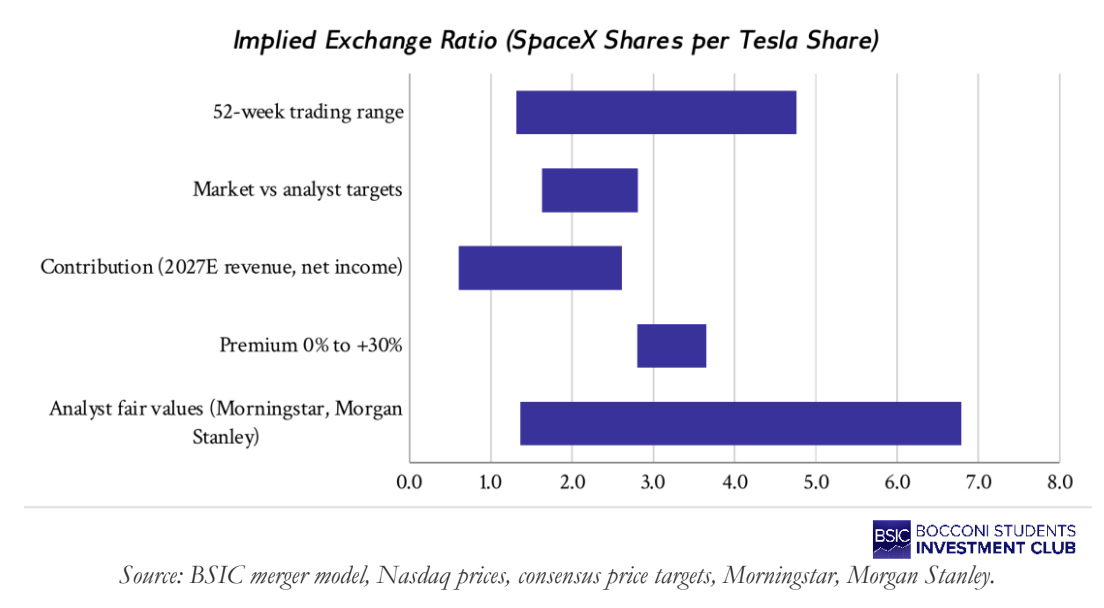
The football field brings the reference points together. Relative 52-week trading ranges span ratios of 1.32 to 4.76, consensus price targets 1.64 to 2.81, and analyst fair values 1.37 (Morgan Stanley’s $410 and $300 targets) to 6.79 (Morningstar’s $475 and $70). A premium of 0-30% covers 2.81 to 3.65. On the benchmark values in our sum-of-the-parts, which exclude autonomy, Optimus and SI, the ratio would be about 1.5, as Tesla’s established businesses account for a smaller part of its value than SpaceX’s do of SpaceX’s. No method dominates, which is why the negotiation will turn on the bargaining range set out below rather than on a fair-value point estimate.
Accretion / Dilution
In our deal-at-market case (10% premium, ratio 3.0856), SpaceX issues 10,935.5m new shares for a purchase price of $1,521bn, of which $138.3bn is premium. On 2027E consensus, pro forma cash EPS is $2.67 against SpaceX’s standalone $4.10, 34.8% dilutive for legacy SpaceX holders, and $8.25 per former Tesla share, 232% above Tesla’s own $2.48. Purchase accounting widens the gap. Against Tesla’s $89.3bn of book equity, the excess purchase price is $1,432bn; allocating an illustrative 5% of it to identifiable intangibles with an eight-year life adds $8.9bn of annual amortisation ($7.1bn after tax) and takes GAAP dilution for SpaceX holders to 41.7%. The remaining $1,360bn would sit as goodwill. Fees of about $0.8bn (0.05% of the consideration) are minor by comparison. Musk’s 2025 award adds no share-based compensation in this case, as Tesla’s market value at the deal price, $1,697bn on 3,952.8m shares, stays below the $2tn first milestone. At a 30% premium, one tranche of 35.3m shares would vest, worth $17.9bn at the offer price.
The 2026E figures point the other way, with 27.3% accretion for SpaceX holders and 21.7% dilution for Tesla holders, but only because SpaceX’s 2026E earnings include a loss-making first half. Neither year says much about value. An acquirer trading at 34x 2027E earnings that pays for a target trading at 157x will dilute its EPS, whatever the synergies, and both multiples rest on expectations well beyond 2027. Revenue per share, which is not distorted by the P/E gap, falls 6.6% for legacy SpaceX holders on 2027E consensus: Tesla’s slower-growing revenue base dilutes SpaceX’s growth profile, not only its earnings. The test of value therefore has to come from synergies and from the price paid.
Synergies and Value Creation
We value the synergies on a line-by-line basis, separating what a merger can deliver from what contracts could.
The table below summarises the result for the deal-at-market case.
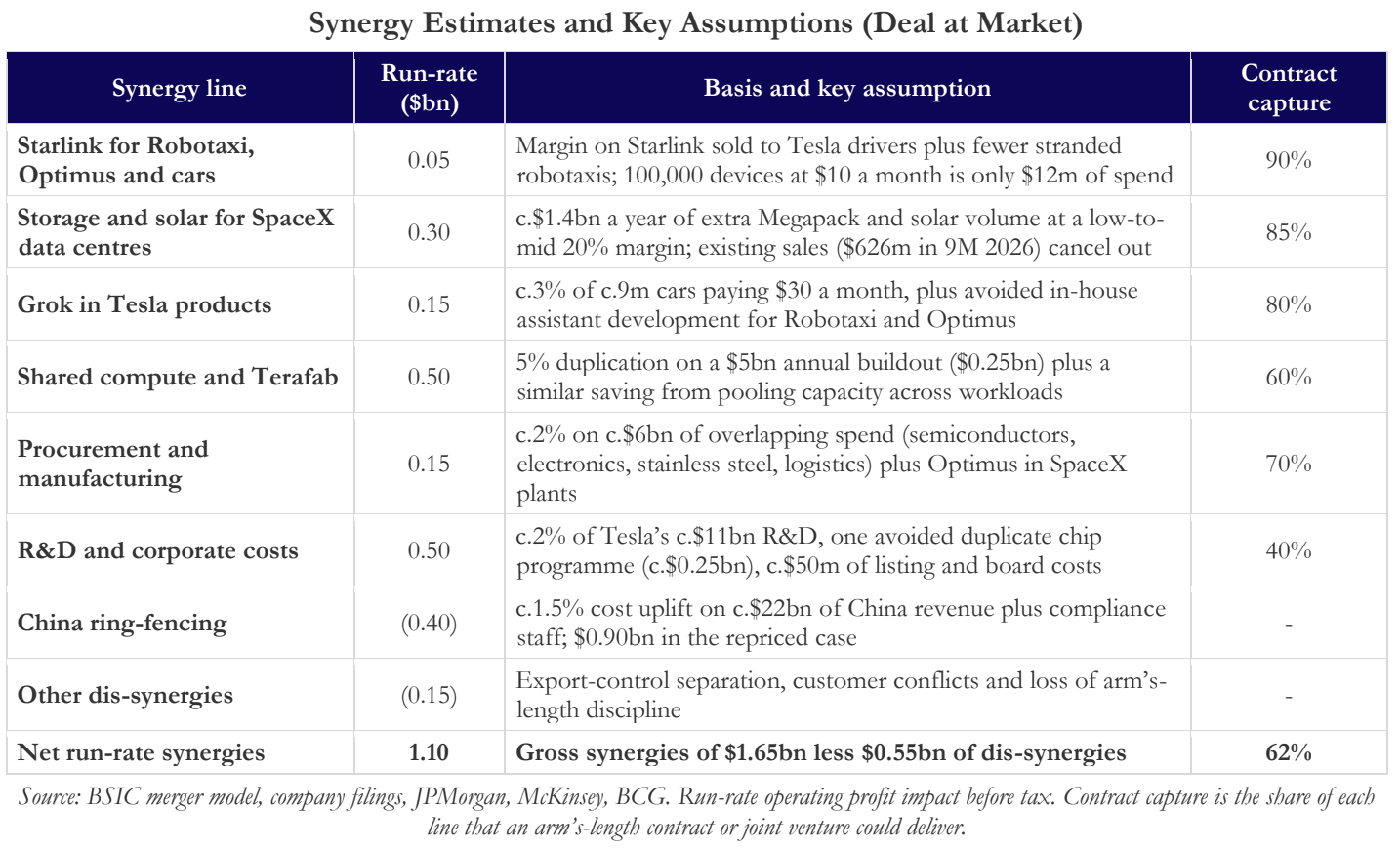
Revenue synergies are small by construction. Starlink is already built into the Cybercab, and the $12m of service spend previously mentioned becomes an internal transfer once the companies are combined. What remains is the margin on Starlink subscriptions sold to Tesla drivers and the value of fewer robotaxis stranded without a signal, which we put at $50m a year. Storage is the largest revenue line. SpaceX bought $626m of Megapacks in the first nine months of 2026, but those sales would simply cancel out in a combined group. We assume instead that common ownership steers an extra $1.4bn a year of storage and solar for SpaceX’s data centres towards Tesla, worth $0.30bn at the low-to-mid 20% gross margin Tesla guides for storage. For Grok, we assume about 3% of Tesla’s roughly 9m-vehicle fleet pays $30 a month, plus the development cost Tesla avoids by using Grok as the interface for Robotaxi and Optimus, for $0.15bn. Because revenue synergies take longer to build, we phase in only 25% of them in the first full year, against 50% for cost synergies.
Cost synergies are larger but limited by how little the two companies overlap. Compute is the main source. Following the strategic case, we assume 5% of a $5bn annual terrestrial buildout is duplicated, saving $0.25bn, and that pooling capacity between Tesla’s training runs and SpaceX’s AI workloads avoids a similar amount. We treat this capex saving as a recurring annual benefit taxed like operating profit, which roughly offsets the depreciation tax shield the group would forgo by spending less. On procurement, we apply a 2% saving to about $6bn of spend the two companies share, such as semiconductors, electronics, stainless steel and logistics, and add a small benefit from Optimus deployments in SpaceX plants, for $0.15bn. That is well below what horizontal deals achieve, because Tesla and SpaceX largely buy different things. On R&D and corporate costs, we assume a 2% saving on Tesla’s roughly $11bn of annualised R&D, one avoided duplicate advanced-node chip programme worth about $0.25bn a year, and $50m of listing, board and audit costs, for $0.50bn.
Two dis-synergies offset part of this. China accounts for about a fifth of Tesla’s revenue, according to JPMorgan, and placing Giga Shanghai under a US defence contractor would require firewalls, separate IT and export entities, and a dedicated compliance function. We assume this raises costs by about 1.5% of roughly $22bn of China revenue, plus compliance staff, for $0.40bn a year. In the repriced case, where a Chinese consortium takes control of the subsidiary, and Tesla earns licence income instead, as JPMorgan suggests, we raise this to $0.90bn to reflect a duplicated supply chain. Other dis-synergies of $0.15bn cover separate teams under export-control rules, customers such as rival AI labs and carmakers that may avoid buying from a competitor’s sister company, and the loss of the discipline that arm’s-length pricing imposes today. Both dis-synergies apply in full from the first year.
The contract capture rates follow the synergy matrix previously outlined. A connectivity contract can fix coverage, uptime and price (90%), a long-term supply agreement can cover storage (85%), and a licence can cover Grok’s defined uses (80%). Compute is less contractable (60%), because the ability to move scarce capacity between companies as priorities change is the strongest argument for common ownership. R&D and corporate costs are the least contractable (40%): two separate listings cannot be merged by contract, and the ownership of jointly developed IP is hard to settle in advance. Weighted by size, contracts could deliver 62% of gross synergies without a merger.
Netting the dis-synergies leaves $1.10bn of run-rate synergies, or $0.87bn after tax at 21%. We capitalise them at 10x, equivalent to a 10% discount rate with no growth. This is conservative next to SpaceX’s 34x 2027E P/E, but avoids paying for synergy growth that is itself uncertain. From this we deduct $2.0bn of one-off integration costs, about 1.2 times gross run-rate synergies, in line with BCG’s finding that integration costs average about one year of synergies, with an allowance for setting up the China ring-fence. We then discount for one year, our estimate of the time to completion given SEC registration, the Tesla vote and Chinese review, which leaves operating synergies worth $6.5bn. A combined treasury adds about $1.0bn: deferring roughly $20bn of SpaceX’s external funding for two years saves the gap between the 5.35-5.875% coupons on SpaceX’s 2031-36 notes and the roughly 4% Tesla earns on its cash, plus issuance costs. The total of $7.5bn equals 0.2% of the combined standalone equity value of $3,354bn.
The synergy break-even shows how far that is from what a premium requires. Legacy SpaceX holders are no worse off only if synergies cover the premium paid:
Required synergies = Premium × Target market cap
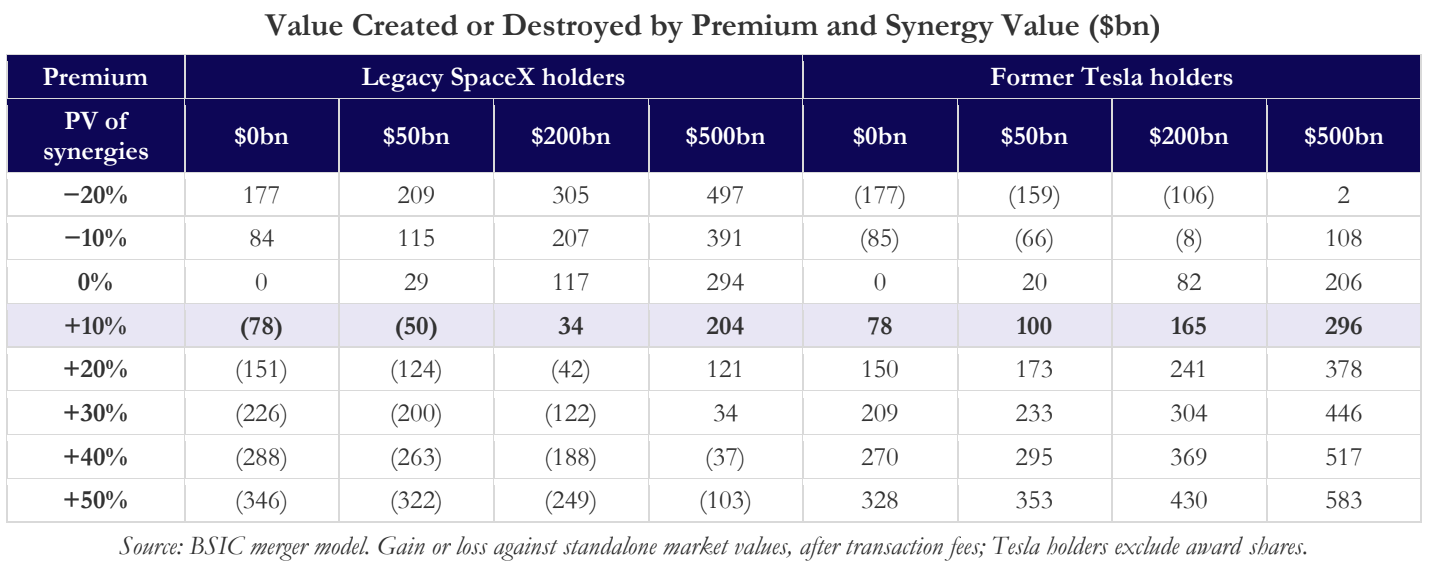
At a 10% premium, that is $138.3bn plus $0.8bn of fees, equivalent to $17.6bn of pre-tax run-rate synergies a year at our 10x multiple, 16 times our estimate. At a 30% premium, including the vesting award, the requirement rises to $433.7bn.
The value split then follows from the combined equity value: Tesla plus SpaceX plus the present value of synergies, less costs. In line with our model, we apply no conglomerate discount, so the combined group is worth the sum of the two market values plus net synergies, $3,361.1bn. At a 10% premium, the implied share price is $133.87, 3.8% below SpaceX’s close. Former Tesla holders gain $81.0bn, and legacy SpaceX holders lose $74.3bn: the $6.7bn of synergies net of fees is shared between them, and the rest of Tesla holders’ gain is a transfer through the exchange ratio.
The sensitivity table makes the split explicit. Each cell shows the gain or loss for one shareholder group at a given premium and synergy value. With no premium, both groups gain as soon as synergies exceed the $0.7bn of fees. At a 10% premium, legacy SpaceX holders need around $139bn of synergies to break even, and at 30% around $434bn, while Tesla holders come out ahead at any premium, even without synergies.
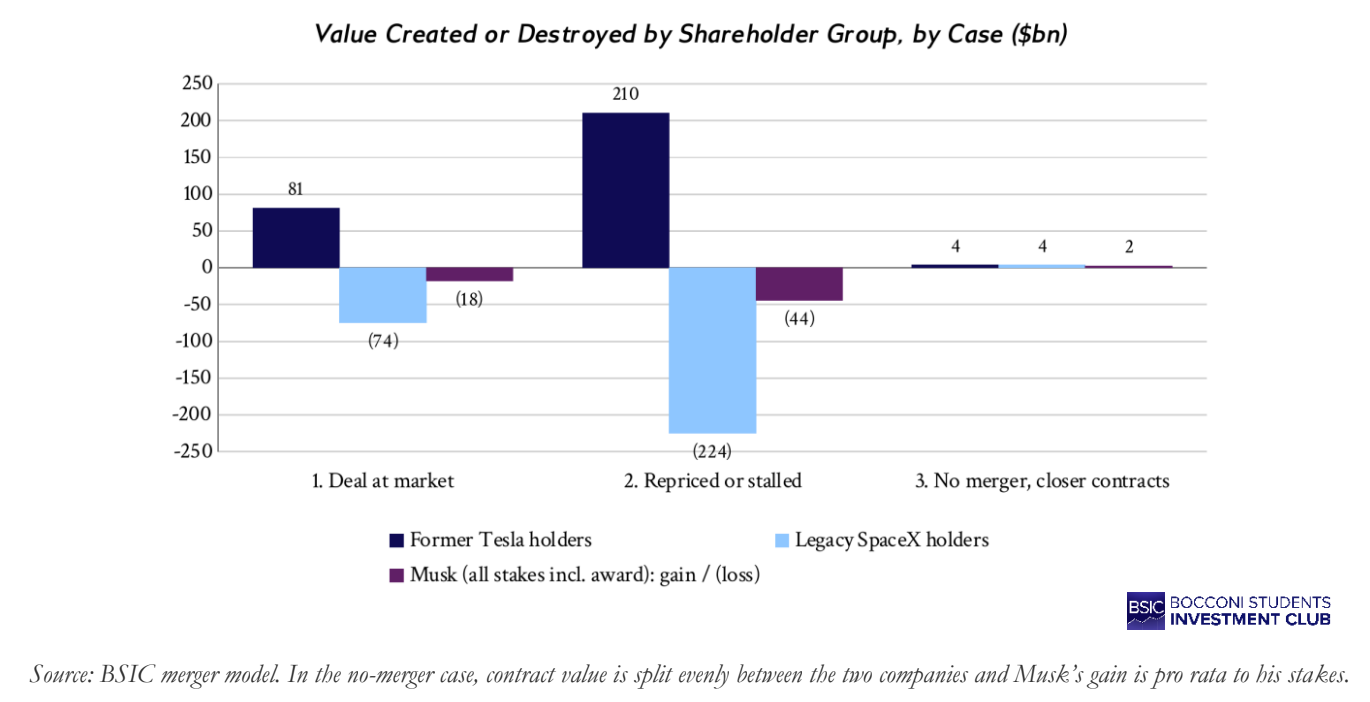
Musk sits on both sides of this table. In the deal-at-market case, he gains $16.0bn on his Tesla shares and loses $33.6bn on his SpaceX shares, a net loss of $17.7bn. Because he owns 19.7% of Tesla’s fully diluted shares but 45.3% of legacy SpaceX, each point of premium costs him roughly $2bn net. Even at a 30% premium, where his award vests, the $15.9bn the award shares are worth at the pro forma price still leaves him $44.3bn worse off in our repriced case. On these numbers, the premium is the price of control: Musk’s say over Tesla’s assets would rise from less than a fifth of Tesla’s votes to 72.6% of the combined group’s.
The Bargaining Range
Combining both sides gives the range of ratios that leaves each group whole. With our synergies, Tesla holders need at least 2.796 SpaceX shares per Tesla share, a 0.3% discount to the market ratio, while legacy SpaceX holders break even up to 2.819, a 0.5% premium. A deal that leaves both groups better off is therefore possible, but only within a band less than one percentage point of premium wide, and every point beyond it moves about $7.8bn between the two groups. Musk’s own break-even sits higher, at 2.837 or a 1.1% premium, because he is on both sides: between a 0.5% and a 1.1% premium, he would still gain while SpaceX’s other shareholders lose. That gap is why the independence of SpaceX’s special committee matters, even though Musk’s consent decides.
Conclusion
Three Scenarios
Deal at market. At a 10% premium (3.0856 SpaceX shares per Tesla share), former Tesla holders would own 43.6% of the group and gain $81.0bn at the implied price, while legacy SpaceX holders would lose $74.3bn and Musk $17.7bn. The combined shares would be worth about $133.87, 3.8% below SpaceX’s 13 November close, because $7.5bn of synergies offset only a small part of the $138.3bn premium. The deal would still need Tesla’s vote. At 80% turnout, with Musk voting only the 699.6m shares he owns outright, 51.8% of the remaining votes cast would have to be in favour; at the 73.6% turnout of 2025, 57.8%. We assume 55% support, so the vote passes narrowly at high turnout and fails at the 2025 level. The 2025 proposal for Tesla to invest in xAI, which drew support from only about a third of non-Musk votes, shows that a related-party deal with Musk is not an easy sell.
Repriced or stalled. If Tesla’s committee holds out for a 30% premium, in line with JPMorgan and HSBC, the ratio rises to 3.6467 and Tesla holders’ stake to 47.9%, including the award. Tesla holders would gain $210.2bn, and legacy SpaceX holders would lose $224.5bn, while Musk would be $44.3bn worse off even after his first award tranche vests. The deal fails on SpaceX’s side long before that: above about 2.82 SpaceX shares per Tesla share, a premium of just 0.5%, any ratio transfers more value to Tesla holders than synergies can return to SpaceX. In this case, two extra years of talks and a China carve-out of the kind JPMorgan describes also cut the synergy value to $2.5bn. The likelier outcome is therefore a stall rather than an outright rejection, with both stocks trading on merger expectations and the relative share price doing the negotiating.
No merger, closer contracts. Expanded supply, licensing and compute-sharing agreements reach $1.03bn of run-rate synergies, 62% of the gross merger figure, without a vote, a premium or a change of control. Because contracts avoid the China ring-fence, the dis-synergies and most of the integration cost, and can start sooner, they are worth $7.5bn, effectively all of the merger’s synergy value and $0.8bn more than the $6.7bn the merger leaves after fees. Split evenly on arm’s-length terms, each shareholder group gains about $3.7bn, and Musk about $2.4bn.
On our numbers, the merger mainly moves value and control rather than creating it, and three pieces of evidence point the same way. Ownership and contribution diverge by up to 30 percentage points depending on whether 2026 or 2027 figures are used, so the ratio, not the business case, decides who wins. The synergy break-even at a 10% premium is almost 19 times our estimate of synergy value. And the range of ratios that leaves both groups whole is less than one percentage point of premium wide, from a 0.3% discount to a 0.5% premium.
The industrial logic is real, but mostly achievable through contracts: compute, chips, storage and software already flow between the two companies through Terafab, Megapack orders and Grok. The financial logic is a transfer rather than a synergy. Tesla’s $45.4bn of cash and $30bn of undrawn facilities would help fund SpaceX’s capex, which exceeded its operating cash flow by $35.0bn in nine months, but for Tesla holders this is an investment in SpaceX’s buildout at the exchange ratio, worth perhaps $1bn to the group in lower funding costs. The governance logic is the clearest. Musk’s voting power over Tesla’s assets would rise from less than a fifth to over 70%, while Tesla holders would give up one-share-one-vote, appraisal rights and S&P 500 membership. The exchange ratio has to pay for that, and our model suggests that synergies cannot.
The coming weeks will show which scenario is unfolding. The names of the committees’ advisers and any fairness opinions will indicate how independent the process is, and any announced ratio can be read directly against the 2.80-2.82 range above. Tesla’s 3 December meeting carries no merger vote, but auto-voting take-up will show whether turnout can approach 80%. Fourth-quarter results will test SpaceX’s $35-40bn capex guidance and Tesla’s roughly $7bn capex catch-up, while litigation, the House Select Committee on China’s possible review from January and Beijing’s response will set the timetable. Until then, the relative share price, currently 2.81 SpaceX shares per Tesla share, remains the market’s running estimate of the terms. Musk has combined his companies before on terms largely set on both sides of the table by himself; this time, Tesla’s public shareholders hold the deciding vote.
0 Comments