Introduction
Anthropic, the developer Claude, filed its S-1 on 26 October 2026 and ammeded it during the first week of November before its expected listing on the 18th of November. After a private round at $965bn in May and summer talk of a $2tn listing, the filing gives investors their first audited view of the business behind those valuations. It shows revenue of $33.2bn in the first nine months of 2026, up from $2.5bn a year earlier, with a gross margin of about 85%. It also shows $900.9bn of purchase and lease commitments, almost entirely for compute.
In this article, we first review what Anthropic’s private funding rounds implied before the S-1 became public. We then assess what the filing reveals about its revenue, costs, balance sheet and commitments. Finally, we consider the risks to its valuation as the offering approaches, from the cost of staying at the frontier to weakening sentiment towards AI stocks.
Previous Valuations and What We Knew Before the S-1
Before the S-1 became public, the fundraising announcements and reported revenue figures of Anthropic [proposed NASDAQ: ANT] provided the main basis for assessing its valuation. Revenue was growing faster than equity value, bringing down implied multiples even as its valuation reached $965bn at Series H. Expectations this summer of a $2tn IPO, however, placed greater weight on growth still to come. Assessing this step-up requires separating the revenue already earned, from the growth pace investors expect Anthropic to sustain.
The four rounds below announced $111.5bn of funding. The most recent, Series H, led by Altimeter, Dragoneer, Greenoaks and Sequoia, raised $65bn at a $965bn post-money valuation, including $15bn of previously committed investments by hyperscalers.
| Round and announcement | Capital raised | Post-money equity value | Revenue run rate | Equity value/run rate |
| E – 3 Mar 2025 | $3.5bn | $61.5bn | – | – |
| F – 2 Sep 2025 | $13bn | $183bn | >$5bn | <36.6x |
| G – 12 Feb 2026 | $30bn | $380bn | $14bn | 27.1x |
| H – 28 May 2026 | $65bn | $965bn | >$47bn | <20.6x |
Source: Anthropic announcements
Between Series F and H, Anthropic’s equity value increased 5.3x, but its revenue growth outpaced that increase: using the disclosed run-rates at times of announcement, its implied equity-value-to-revenue multiple fell approximately 44%, from 36.6x to 20.5x. The rising headline valuation therefore obscured a lower price per dollar of annualised sales, suggesting that commercial expansion provided increasing support for its valuation. However, even at 20.5x, investors were paying substantially for future growth, leaving the valuation sensitive to any slowdown in adoption or customer spending.
Focusing on the denominator, annualised revenue extrapolates a recent sales pace; it neither measures recognised full-year revenue nor establishes contractually recurring revenue. Reuters reported an approximately $9bn exit run rate for 2025 and more than $65bn by July 2026. Separately, its review of the confidential prospectus disclosed nearly $4.6bn of actual 2025 revenue, up approximately twelvefold from the previous year.
The $965bn Series H valuation implied approximately 210x recognised 2025 revenue, 107x the year-end revenue run rate, and 20.5x the May 2026 run rate. The latest sales pace therefore made the valuation substantially easier to justify. However, annualised sales are not guaranteed future revenue: investors were paying for the potential sustainability of Anthropic’s recent rapid expansion, leaving the valuations vulnerable if that momentum weakens.
By August, investors cited by the Financial Times expected an IPO valuation of at least $2tn and a year-end revenue run rate of $100-120bn, implying an equity-value-to-run-rate multiple of 16.7-20.0x. Against July’s reported $65bn run rate, however, that valuation implied a more demanding 30.8x. With expectations subsequently moderating towards $1.5tn, the scenarios below illustrate how growth between July and year-end would affect the resulting multiple.
| Year-end revenue run rate | Growth from July | Implied multiple at $1.5tn |
| $65bn | 0% | 23.1x |
| $75bn | 15.4% | 20.0x |
| $90bn | 38.5% | 16.7x |
| $100bn | 53.8% | 15.0x |
| $110bn | 69.2% | 13.6x |
| $120bn | 84.6% | 12.5x |
Source: Reuters, Financial Times; BSIC calculations
At $1.5tn, matching the original 16.7-20.0x range required a year-end run rate of approximately $75-90bn, representing further growth of 15-38% from July. Continued expansion therefore remained priced in despite a 25% reduction from the summer valuation expectation. The central question was whether Anthropic’s customer demand and underlying economics could sustain that expansion, which the S-1’s disclosures on revenue composition, customer spending and costs would help assess.
What We Learned
The IPOs of OpenAI and Anthropic [proposed NASDAQ: ANT] have been amongst the most anticipated offerings since they each released their first models in 2022 and 2023 respectively. Since then, the private markets have poured money into AI companies resulting in massive valuations, including Anthropic’s Series H fundraising which valued the company at about $965bn. In the past months, the broader public and market have been worried that there is a bubble growing similar to the dot-com bubble of the late 1990s and early 2000s due to massive pre-IPO valuations and capex partnered with US 10-year Treasury yields passing 5% for the first time since 2007.
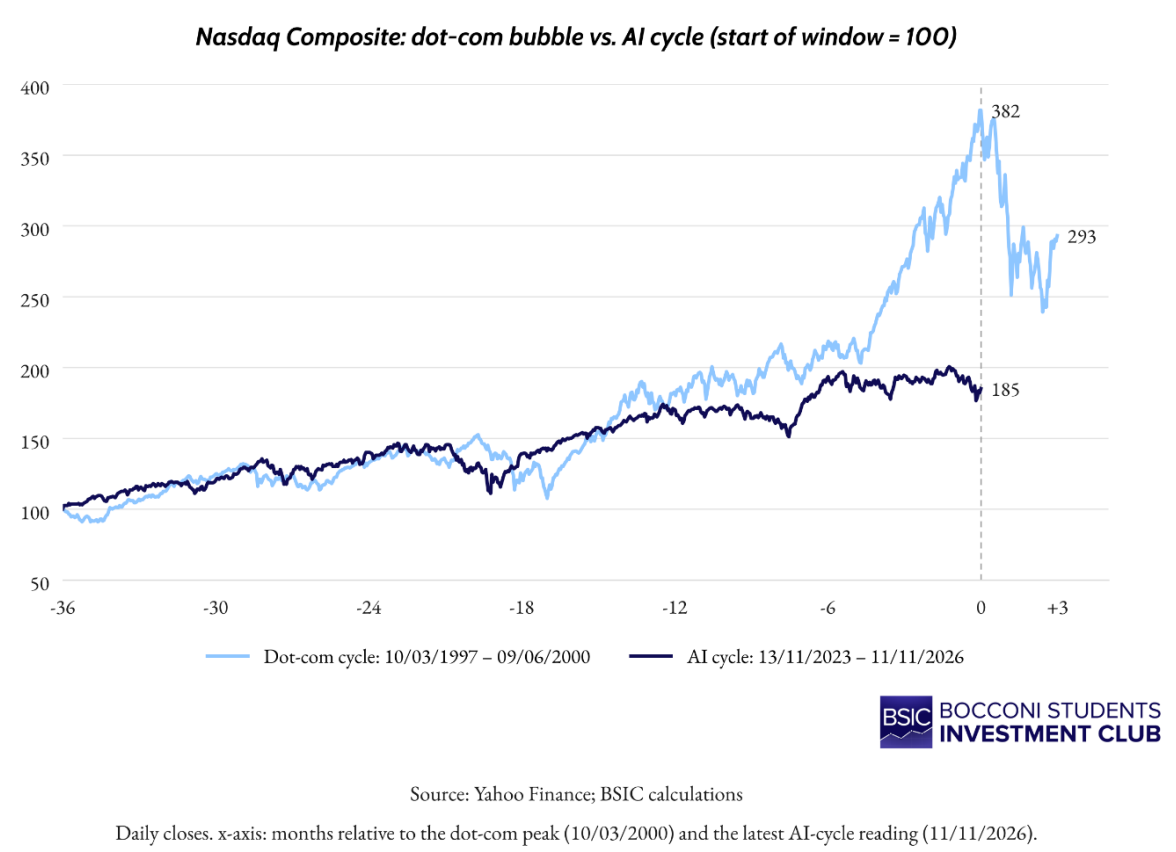
While Anthropic’s financial performance has been leaked several times in the past year, the S-1 and S-1/A, filed in late October and amended in early November, gave the first insights into the true revenue streams, costs, commitments, and overall operations of potentially the most groundbreaking company in the 21st century, if not ever.
Revenues
The first takeaway is how Anthropic makes its money. Of the $16.3bn of revenue in H1 2026, $13.1bn came from consumption, meaning customers paying per token through the API and cloud marketplaces. Only $3.2bn came from subscriptions. Roughly 80% of revenue is therefore usage-based, which makes Anthropic look less like a software company and more like a cloud infrastructure provider. Therefore, revenue rises automatically as customers run more workloads through its various Claude models. As agentic products scale, this revenue model will allow Anthropic to capture the maximum revenue from its customers rather than let high paying customers use as many tokens as they please. The trade-off is that there is little contracted revenue, and customers can cut usage at any time, a risk specifically flagged in the S-1.
The revenue quality, however, is strong. Net revenue retention was roughly 900%, meaning the average existing customer spent about nine times more than a year earlier, demonstrating the improvements of the models and their increased usage. Customers spending over $100k a year grew from roughly 950 to 11,900, more than 12x, over the same period. Growth is coming both from new enterprises adopting Claude and from existing ones expanding their use of it.
| Income statement ($m) | FY 2025 | 9M 2025 | 9M 2026 |
|---|---|---|---|
| Revenue | 4,585 | 2,545 | 33,242 |
| Compute and infrastructure | 7,326 | 4,381 | 18,808 |
| Personnel | 1,839 | 1,027 | 4,863 |
| Sales, marketing and partnerships | 568 | 322 | 5,529 |
| Other operating and administrative | 1,412 | 539 | 5,302 |
| Bartz settlement | 1,500 | 1,500 | – |
| Operating income (loss) | (8,060) | (5,224) | (1,260) |
| Net income (loss) | (41,965) | (25,107) | (104,039) |
| Compute and infrastructure | 159.8% | 172.1% | 56.6% |
| Personnel | 40.1% | 40.4% | 14.6% |
| Sales, marketing and partnerships | 12.4% | 12.7% | 16.6% |
| Operating margin | (175.8%) | (205.3%) | (3.8%) |
Source: Anthropic Form S-1/A; BSIC calculations.
The product cycle
One of the most interesting disclosures is the fact that over 80% of Q3 revenue came from models released in the prior six months. This means that Anthropic’s revenue is heavily tied to staying at the frontier. A model that is state of the art today becomes a minority of revenue within two quarters as users constantly seek the best model available, so the company must keep shipping better models to hold its revenue base. This links revenue directly to research spending, and it explains why training compute is the largest cost in the business.
On 22 September 2026, Anthropic launched Opus 5.5 with input and output token prices 20% below Opus 5 and claimed approximately 40% lower customer costs on typical workloads, combining lower prices with greater efficiency. Lower serving costs can protect profitability, and cheaper usage can stimulate demand. This is a version of the Jevons paradox: when a resource becomes cheaper to use, total consumption tends to rise rather than fall. If demand for tokens is price elastic, the increase in volume more than offsets the lower price per token, so overall revenue grows even as each task becomes cheaper. With roughly 80% of revenue usage-based, price cuts such as Opus 5.5’s can act as a growth lever rather than a concession, provided customers respond by running materially more workloads through Claude.
Costs: what is variable and what is fixed
The S-1 does not report gross margin, but it can be derived from the cost of revenue line. In the first nine months of 2026, cost of revenue was $4.8bn against $33.2bn of revenue, implying a gross margin of about 85%, up from 29% a year earlier. On an incremental basis the picture is stronger still. Between the first nine months of 2025 and 2026, revenue grew by $30.7bn while cost of revenue grew by only $3.0bn, an incremental gross margin of roughly 90%. Serving models to customers is highly profitable and becomes more so with scale.
While still positive, cost of revenue only includes the compute used for inference, which is the variable cost of serving customers. Of the $18.8bn of compute and infrastructure costs in the first nine months, only $4.8bn sits in cost of revenue; the rest is mostly training and research in R&D. Training compute behaves like a fixed cost: it is committed years in advance and arrives in large blocks regardless of current demand. Cloud marketplace fees are also excluded, as they are booked in sales and marketing. Analysts who include them put gross margin closer to 65%.
The fixed-cost nature of compute is what makes operating margins volatile. Anthropic posted its first operating profit in Q2 2026, $974m or an 8.4% margin, before swinging to a $567m loss in Q3 despite adding $5.4bn of revenue. Management attributes the reversal to expensive short-term compute and a roughly $2bn non-cash charge. Behind both sits $900.9bn of purchase and lease commitments, $70.7bn of which falls due in the next twelve months. The unit economics are excellent; the question for investors is whether revenue can grow into the fixed cost base fast enough to cover it.
Balance Sheet and Commitments
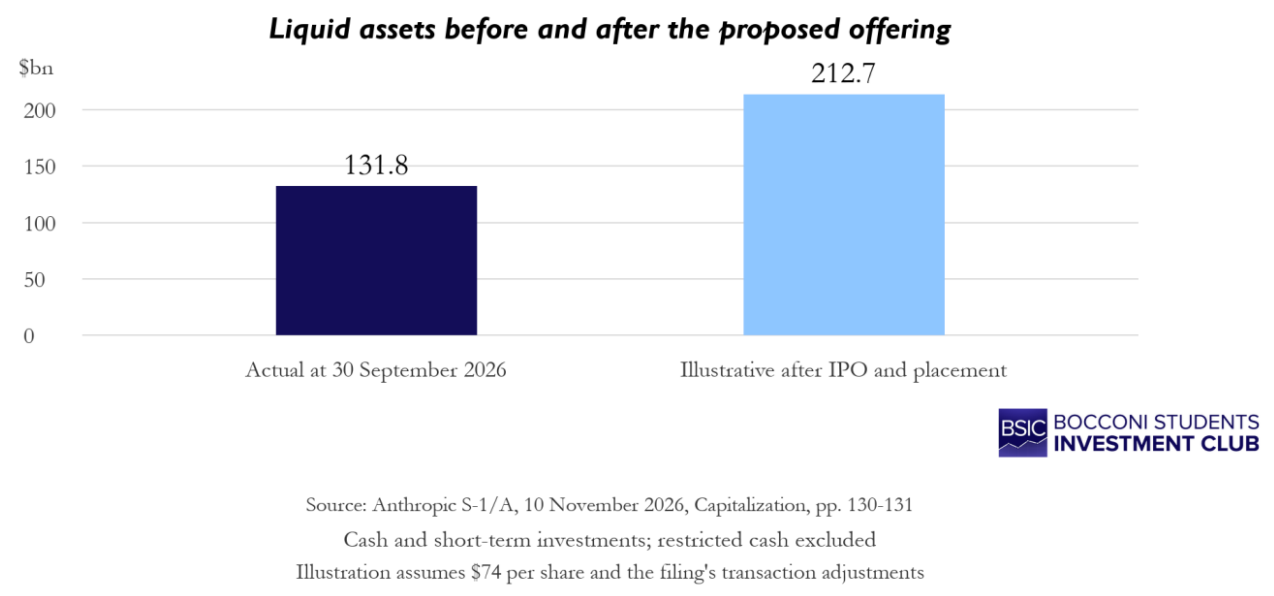
Anthropic [proposed NASDAQ: ANT] enters its IPO with $131.8bn in cash and short-term investments, giving it considerable room to fund the next stage of its expansion. However, the $900.9bn of purchase and lease commitments disclosed in its amended prospectus places a substantial claim on future cash generation. The balance sheet provides funding today; the commitments determine how much the business will need to earn over the coming years.
Much of the reserve comes from investors: financing activities generated $110.7bn of cash in the first nine months of 2026, compared with $6.6bn from operations. The cash flow statement also puts Anthropic’s reported losses in context. Its $104.0bn net loss for the period included $94.3bn of non-cash fair-value changes in convertible notes, derivative liabilities and SAFEs. These charges do not represent cash payments, but they do reflect claims on the company whose settlement can affect future stockholders, particularly through dilution.
The same instruments complicate the description of Anthropic as net cash positive. Its $131.8bn of liquid assets exceeded the $130.5bn carrying value of convertible notes by approximately $1.3bn, yet the principal outstanding on those notes was only about $6.2bn. Their much larger accounting value reflects conversion rights and fair-value measurement rather than cash borrowed, and neither measure incorporates the company’s future infrastructure payments.
The IPO will add cash as well as change the capital structure. At the assumed offer price of $74 per share, the prospectus illustrates $212.7bn of cash and short-term investments after the offering and concurrent private placement, an increase of approximately $80.8bn. Only proceeds from newly issued shares reach the business, and $110.9bn of convertible notes would remain outstanding because the ownership cap of Amazon [NASDAQ: AMZN] limits immediate conversion.
Compute commitments
The $900.9bn headline describes a spending programme rather than a single borrowing repayable at the reporting date. Fixed contractual obligations account for $320.0bn, of which purchase commitments make up $313.8bn. Leases executed but not yet commenced add another $451.2bn, with the remainder made up of short-term commitments and agreements signed after September-end. Substantially all of the spending relates to compute and infrastructure, most of which is still ahead of the business.

The payment schedule is less immediate than the headline might imply. Approximately $451.6bn is expected to be incurred before the end of 2030, including $70.7bn in the twelve months following 30 September 2026, with substantially all of the remainder due between 2031 and 2045. Existing liquid assets cover the near-term amount approximately 1.9 times, leaving roughly $61.1bn before customer receipts, other spending or new financing.
The headline can also move in either direction. Approximately $186.2bn of commitments is subject to termination rights or conditions before commencement, such as counterparties obtaining financing, facilities or regulatory approvals, although these do not necessarily allow Anthropic to cancel if its own demand weakens. Conversely, the total excludes an estimated $150bn-$175bn of payments under arrangements without fixed dollar commitments.
Financing the expansion
Beyond its cash, the prospectus identifies $14.8bn available under the revolving credit facility and up to $77.0bn of financing capacity under partner note purchase agreements, before adjustments for the concurrent placement. Some of that partner capacity is reduced by participation in the placement, so adding both to the post-offering cash balance would count part of the support twice.
Anthropic’s balance sheet gives it considerable capacity to fund its next stage of growth, but the commitments make sustained cash generation more important as that capacity is deployed. If enterprise spending continues to expand and long-term agreements lower compute costs, the reserve can finance infrastructure that improves future margins. If usage or pricing falls short, fixed payments would consume more of that reserve and increase dependence on external capital.
Risks and Market Saturation Outlook: Anthropic’s offering under pressure?
The IPO valuation of Anthropic [proposed NASDAQ: ANT] could come under pressure if investors question whether its exceptional revenue growth can be sustained. As of 30 September 2026, Anthropic has reported massive revenue growths with revenue retention rate above 900%. Menlo Ventures, an Anthropic investor, reported that enterprise AI adoption increased from 55% in 2025 to 65% in 2026. However, its September survey of nearly 400 US enterprise decision makers found that average spending reached 4.7 times the previous year’s level, compared with 2.2 times at the median, reflecting disproportionately strong growth among heavy users. These industry figures suggest substantial space for wider adoption, but do not establish that Anthropic can sustain its current rate of customer expansion.
Further expansion depends on customers’ ability to integrate Claude within their operations as it requires approving access to sensitive data and establishing records of agents’ actions. Anthropic’s prospectus identifies these requirements as potential obstacles to enterprise adoption. On 2 October 2026, the company committed $100m to Claude Frontier Academy, aiming to train 10,000 engineers by the end of 2027. Participants completed a 12-week residency implementing Claude within their organisations, illustrating the skill shortages and the work required to expand usage. For the IPO, broader adoption would support expectations of continued growth, while slower spending expansion could lead investors to adopt more conservative revenue forecasts and require a lower offer price.
Even if customer spending continues to expand, Anthropic’s IPO valuation will also depend on the cost of maintaining its technological lead. As previously mentioned, recent models leading up to 30 September 2026 generated over 80% of third-quarter revenue, pointing toward the fact that Anthropic will have to continue spending to maintain its location at the frontier of AI development to demand the type of revenue growth it has shown this year. Menlo Ventures estimates that Anthropic’s share of enterprise LLM API spending rose from 40% in 2025 to 55% in 2026, supporting its current competitive position, although maintaining this place requires further investments.
The roughly 85% gross margin calculated from the first nine months of 2026 also excludes $19.2bn in research and development expenses, alongside free-tier compute and channel partner costs recorded elsewhere.
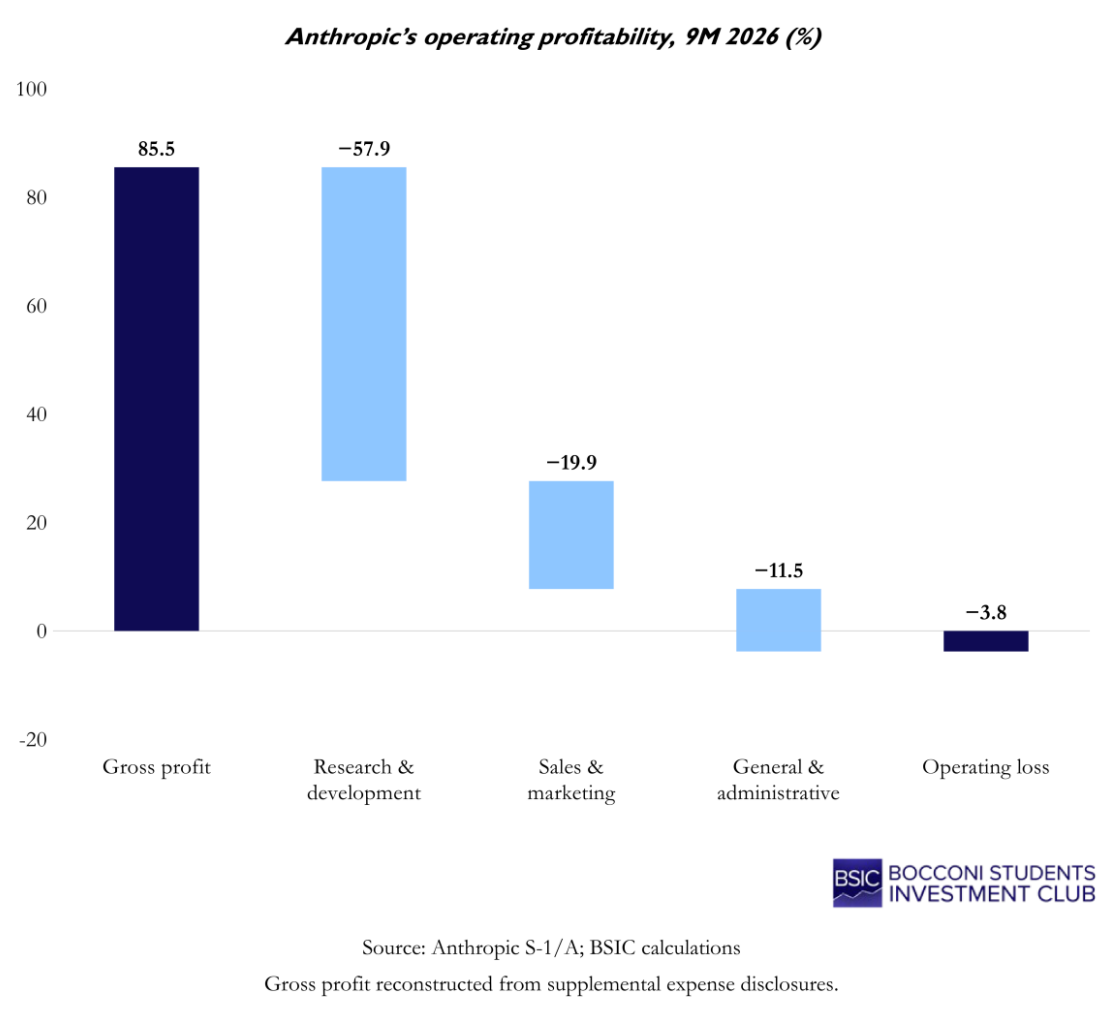
IPO investors must therefore assess how much research expenditure is necessary to retain customers as well as attract new ones. If market expansion slows while these expenditure requirements remain high, Anthropic could struggle to deliver the profit margins investors anticipate. This would weaken the earnings expectations supporting its IPO valuation and could lead investors to require a lower offer price.
These investment requirements also mean that Anthropic must secure computing capacity before future customer demand is certain. In its prospectus filed on 10 November 2026, the company disclosed $900.9bn in purchase and lease commitments, almost entirely related to compute and infrastructure. These obligations extend over several years, with $70.7bn due in the twelve months following 30 September 2026. At September-end, contracted revenue yet to be recognised stood at $13.8bn. This figure excludes future uncontracted usage and covers different periods from the infrastructure commitments, so the difference cannot be interpreted as a funding shortfall. It nevertheless shows that much of the spending depends on demand that customers have yet to commit to contractually.
Securing too little capacity also carries a cost. Anthropic’s adjusted operating margin fell from 19% in the second quarter of 2026 to 15% in the third, primarily because of $5bn in short-term compute purchases. This capacity cost more than comparable resources secured under longer-term agreements. Longer contracts can therefore lower costs, but leave Anthropic exposed if demand falls below expectations.
These arrangements also increase its dependence on infrastructure partners. On 20 April 2026, Anthropic announced a commitment exceeding $100bn over ten years to AWS technologies, securing up to 5GW of computing capacity. Amazon [NASDAQ: AMZN] also invests in Anthropic and distributes Claude through Bedrock, giving it a role in the company’s financing and customer access. A disruption to the Amazon relationship could therefore affect Anthropic’s computing capacity and funding at the same time. To that end, if enterprise AI spending slows, Anthropic could face payments for capacity it cannot fully use. The resulting pressure on future cash flows could lead IPO investors to require a lower valuation, even if revenue continues to grow. Anthropic’s use of other cloud providers and chip suppliers reduces this dependence, although replacing committed capacity could take time and involve additional costs.
Additionally, Anthropic’s ability to earn returns on its investments also depends on regulatory approval. On 12 June 2026, US export restrictions on Fable 5 and Mythos 5 prompted Anthropic to suspend both models worldwide because it could not reliably verify users’ nationality and a reported bypass of cybersecurity safeguards. The restrictions were later lifted on 30 June. Regulatory intervention can interrupt commercialisation after development costs have been incurred, independently of customer demand. Repeated interruptions could also encourage customers to retain alternative suppliers. IPO investors may therefore require a valuation discount for uncertain product availability.
Market conditions introduce a further risk to Anthropic’s IPO, as greater scrutiny of AI valuations and competing fundraising could affect investor demand and the price the company can secure. On 5 November 2026, following the US midterm elections, the Nasdaq Composite fell 5.5%, the Philadelphia Semiconductor Index declined 12%, and Nvidia [NASDAQ: NVDA] lost 9%.
Democratic gains raised concerns that opposition to data centres’ electricity and water consumption could delay construction permits and expansion for infrastructure. For Anthropic, potential delays make the availability of future computing capacity less certain.
Additionally, Nvidia’s leadership transition enhances uncertainty. On 12 November, the company announced Jensen Huang’s immediate resignation and appointed chief financial officer Colette Kress as interim CEO. The connection to Anthropic is direct. Nvidia has agreed to purchase $10bn of shares within the $26bn private investment accompanying the IPO. Huang’s departure does not itself cancel that commitment. However, any subsequent reduction in Nvidia’s willingness to finance AI customers could weaken confidence in the funding supporting the industry’s infrastructure expansion.
The timing makes the coming weeks particularly sensitive. Nvidia reports earnings on 17 November, immediately before Anthropic’s expected pricing on 18 November and trading debut on 19 November. Disappointing guidance or uncertainty over investment commitments could prompt investors to revise their orders or price limits before allocation, while also affecting Anthropic’s first weeks of trading.
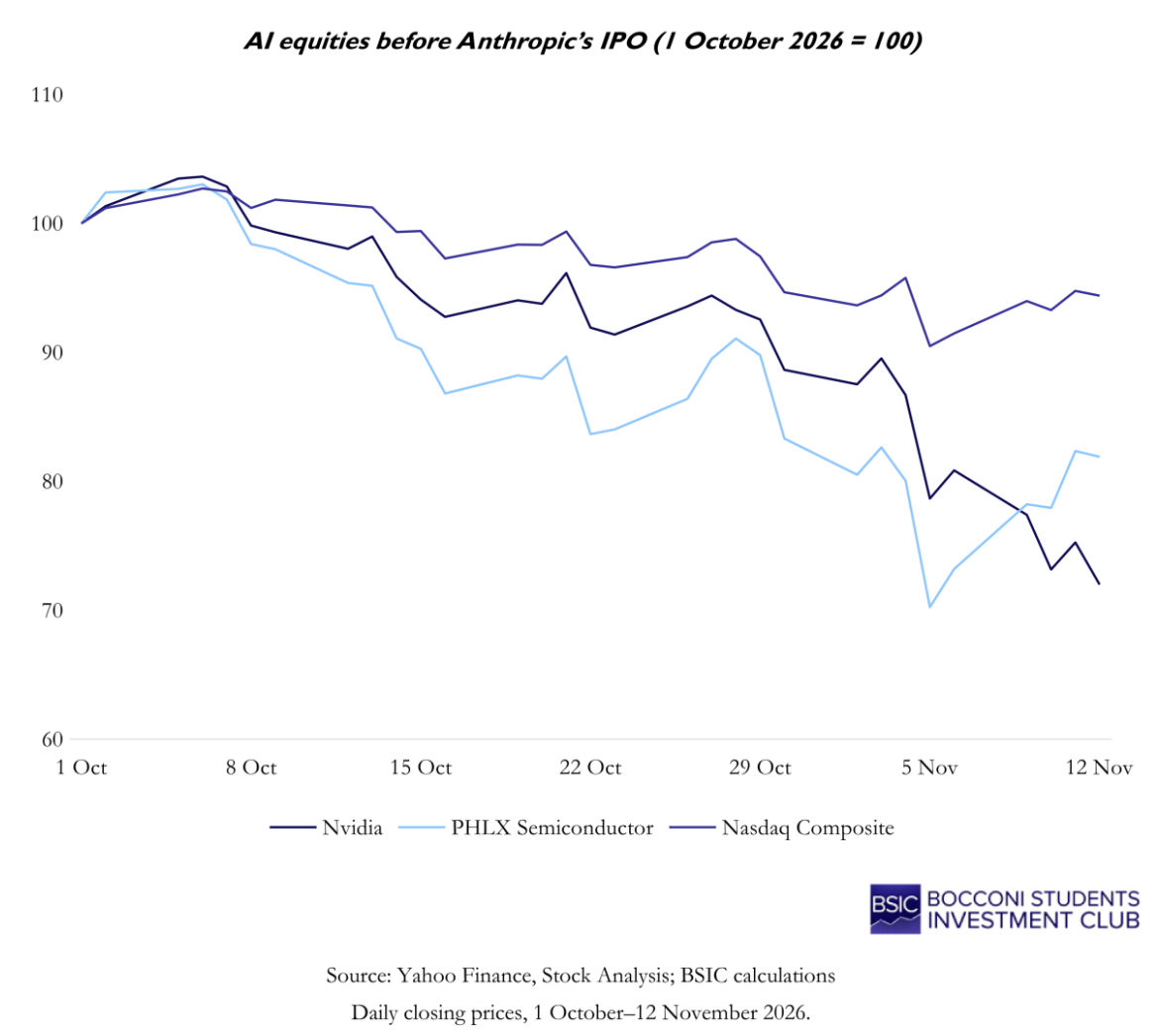
The sharper decline in AI-related equities illustrates the risk that weaker investor sentiment reduces the valuation Anthropic can secure at its IPO.
Competition for capital provides further constraint. The initial $75bn June IPO of SpaceX [NASDAQ: SPCX] demonstrated substantial fundraising capacity, while OpenAI reportedly secured an initial $11bn at a $1.25tn valuation on 6 November. Investors participating across both transactions must consider their combined exposure to AI and infrastructure risks, potentially limiting further allocations. Nevertheless, Anthropic’s offering was reportedly approximately six times oversubscribed on 12 November, indicating considerable demand despite the volatility. Those orders remain subject to change. The risk is therefore that renewed uncertainty reduces investors’ willingness to pay, leaving Anthropic with lower capital for a given number of shares, or greater dilution to raise the same amount.
Conclusion
Between Series F and H, the revenue growth of Anthropic [proposed NASDAQ: ANT] outpaced the increase in its valuation, reducing the implied multiple of annualised sales. The S-1 subsequently disclosed rapid customer expansion and approximately $132bn in cash and short-term investments, providing a clearer basis for assessing both the company’s commercial progress and its capacity to finance further growth.
These resources must nevertheless be considered alongside the cost of continued model development and long-term infrastructure commitments. The central uncertainty is whether broader adoption will translate into sustained customer spending and sufficient cash generation as payments fall due. Current growth demonstrates demand, but does not establish how much expansion remains or which valuation future cash flows can support.
Attention now turns to Nvidia’s results on 17 November and Anthropic’s expected pricing on 18 November, ahead of its planned trading debut on 19 November. The final offer price and proceeds will show the financing terms Anthropic can secure under current market conditions. A stronger reception could support investor confidence in subsequent AI offerings, while weaker demand could encourage more conservative valuations. Anthropic’s public valuation may also become a reference for OpenAI’s future fundraising. Beyond the initial market reaction, subsequent financial results will test whether customer spending and cash generation develop in line with the expectations reflected in the offer price.


0 Comments