The 2026 midterms shifted control of Congress to Democrats, giving the party majorities in both the House and Senate. The elections delivered a historic blue wave as Democrats swept to victory in Republican strongholds across the country, with voters punishing the Trump administration for soaring gas prices stoked by the president’s war in Iran. Despite internal divisions, Democrats managed to present a broadly united front. Democratic candidates made affordability and wealth inequality a key part of their platforms during the midterms to contrast with the skyrocketing fuel prices and inflation wrought by Trump’s tariffs and the Iran war. Whether these political priorities translate into material economic changes remains uncertain. Major legislation could still face a presidential veto, but Democratic control of both chambers could increase pressure on the administration, slow nominations, and give Congress more influence in negotiations over must-pass legislation. This article examines the initial market response and the implications for capital allocation, regulation and selected industries, distinguishing changes in investor expectations from developments capable of altering corporate cash flows.
The Election Outcome and the New Balance of Power
US presidents have suffered stinging midterm setbacks before, from George W Bush’s dual-chamber loss over the Iraq war in 2006 to Barack Obama’s “shellacking” in 2010. But the sweep of both houses, coupled with the depth of Democratic gains even in decades-long Republican bastions such as Texas and Kansas, is the most comprehensive repudiation of a sitting president since at least 1994. The elections held on November 3rd delivered Democratic control of both the House of Representatives and the Senate, ending the Republican Party’s unified control of Washington. The new Congress takes office in January 2027, establishing divided government for the remaining two years of Trump’s presidency.
Above all, this was an election defined by the cost of living. Crucial was the widespread dissatisfaction with living costs, tariffs and the economic consequences of the Iran war. The latter was considered to be a major factor behind the Republican defeat, while Democrats campaigned on affordability and accountability. These priorities connect the political result directly to business: energy bills, healthcare costs and corporate pricing practices, among many others, are likely to remain prominent subjects of congressional debate.
However, we must understand what this midterm win means. Controlling Congress is different from controlling the executive branch. When Democrats take office in January, their majorities will gain influence over legislation, appropriations and congressional investigations, while Senate control provides leverage over appointments requiring confirmation. These powers could strengthen their negotiating position on government funding and other essential legislation. Donald Trump nevertheless retains the presidential veto, and his administration continues to direct executive policy and federal regulatory agencies. Significant policy reversals would therefore require negotiation, sufficient bipartisan support or changes beyond congressional control alone, resulting in lengthy and continuous debates.
The result has a similar meaning for companies. For them it points towards greater political scrutiny alongside substantial policy continuity. Hearings and investigations can affect businesses even when proposals fail to become law, while executive action and state-level decisions remain important sources of change. Which political developments are likely to alter operating conditions, investment returns and financing decisions?
Market Reaction: From Relief to Reassessment
The Democratic victory triggered a divided reaction in how markets priced the midterm result. On November 4th, investors were initially pleased with the result. They expected the divided government to make major policy changes harder to pass, and falling oil prices supported the gains in broad equity indices. The reaction spread across different markets: the yield on the 10-year Treasury note fell around 6 basis points, to roughly 4.9%, as bond investors welcomed the prospect of slower fiscal expansion and less pressure on government borrowing. The US Dollar Index fell 0.4% to around 101.5. This reaction held even though Democrats won more widely than anticipated, including historically Republican states, such as Texas and Georgia, two important data centre hubs.
Some sectors performed better than others. Renewable-energy shares rallied, with First Solar [NASDAQ: FSLR] up 8.4%, Enphase [NASDAQ: ENPH] up 8.8% and NextEra [NYSE: NEE] up 4.6%, as investors expected that Democratic control would protect government support for renewables and resist weaker emissions rules. Healthcare providers and insurers also rose, as investors expected Democrats to renew efforts to expand healthcare coverage. HCA Healthcare [NYSE: HCA] rose 8.5% and Centene [NYSE: CNC] gained 7.3%. Defence stocks declined, as stocks fell due to investors reconsidering how much proposed spending would go ahead under a proposed $1.5tn budget. Northrop Grumman [NYSE: NOC] lost 3.7%, while RTX Corporation [NYSE: RTX], Lockheed Martin [NYSE: LMT] and L3Harris [NYSE: LHX] each fell between 3% and 6%. Data-centre and power stocks declined sharply: Cipher Digital [NASDAQ: CIFR] fell 21%, CoreWeave [NASDAQ: CRWV] fell 9.5% and Vistra [NYSE: VST] declined 15.4%.
Technology stocks showed a mixed performance. US hyperscalers rose, with Amazon [NASDAQ: AMZN] and Microsoft [NASDAQ: MSFT] each up 6% and Alphabet [NASDAQ: GOOGL] up 4.6%, as investors reasoned that companies already owning large data-centre networks would benefit if construction slowed: the risk of building more capacity than needed would decrease and pressure to spend heavily on AI would ease. Art Hogan, of B. Riley Wealth, summarised this idea: existing assets become more valuable when fewer new data centres are built. Smaller developers missed out on the rally, as their dependence on external financing makes them vulnerable to a tougher funding environment and so the market treated them as the more exposed group.
The mood then reversed the following day. On November 5th, the Nasdaq Composite fell 5.5%, its biggest daily drop since the April 2025 “Liberation Day” sell-off, and the Nasdaq 100 lost 6.4%, erasing $2.5tn in market value. It was the second consecutive session of heavy selling in AI-linked stocks and the fifth decline of more than 500 points in the Nasdaq Composite since mid-October. It was nearly 12% below its October 6th peak, putting it in what investors call a correction.
Semiconductors felt it the most: the Philadelphia semiconductor index fell 12%, Nvidia [NASDAQ: NVDA] dropped 9% and AMD [NASDAQ: AMD] slumped 17%. The VIX, which measures expected equity-market volatility, had its biggest single-day rise since December 2024. Neocloud providers were hit especially hard, as they rely heavily on borrowing. CoreWeave fell 10% and Nebius [NASDAQ: NBIS] 15%, and both stocks had already lost half or more of their value since the October record. CoreWeave’s five-year CDS spreads increased to a record 1,267.9 basis points, while spreads on Intel’s [NASDAQ: INTC] five-year swaps reached a record 149.7 basis points. Hyperscalers, which had initially led, also declined. Amazon and Alphabet each fell 2.2% and Microsoft lost 3.6% after Bloomberg reported that it was increasing scrutiny of some data-centre projects with smaller cloud partners, including Nebius, IREN [NASDAQ: IREN] and Nscale, with IREN falling more than 14%. Analysts at UBS estimated that 30% of expected US data-centre capacity additions in 2028 could be at risk from potential construction delays or even pauses, which puts the industry’s growth assumptions into question.
The week’s selling, however, had started well before November 5th. By November 2nd, the Nasdaq 100 had closed 10.4% below its October 6th record. Some concerns were raised regarding the Fed’s interest rate outlook, as employment data was stronger than expected. On November 9th, the Nasdaq 100 rose 3.3%, and on November 11th CoreWeave’s shares jumped 24.7%, their biggest daily percentage increase in three months. The November 5th sell-off was triggered by concerns following the Democrats’ victory. The rebound came from dip-buying after the selling made investors reach peak pessimism, and falling oil prices, despite concerns about a government shutdown.
The selling combined two types of concern. The first was specific to the election results. Democrats are expected to hold more hearings and investigations into the expansion of AI infrastructure. Local opposition to data centres, which use large amounts of water and electricity, could also make it more difficult to get building permits, even without the potentially new laws. Analysts noted that markets have not yet fully priced the costs data centres impose on the communities near them. The other type of worry predates the elections and weighed on prices independently. Concerns about returns on enormous AI spending, interest rates and volatile oil prices had already started in the summer and increased since. The election intensified this repricing and exposed how fragile confidence in AI stocks had become.
Regulation and Oversight: Implications for Corporate America
When Democrats take over both chambers in January 2027, businesses are likely to face more investigations, while major new legislation remains difficult. President Trump can veto legislation, and it’s unlikely the chambers will have enough votes to override his veto. However, it is important to take into consideration that a Democratic-led Congress can hold more hearings and investigations into AI build-out, along with the compliance work, management time and reputational exposure that comes with them.
Banks are a good example of this: executives and analysts expect Congress to examine consumer fees, unfair lending practices, mortgage and credit-card charges. Elizabeth Warren, a longtime critic of Wall Street, is considered the leading candidate to chair the Senate Banking Committee, while Maxine Waters is expected to lead the House Financial Services Committee. When Maxine Waters led the House panel previously, she called chief executives of the largest banks to testify, and so TD Cowen analysts expect similar hearings in the future, along with increased scrutiny of large bank mergers and growing exposure to private credit. Limits on credit card interest rates could gain support as members of both parties favour them. The banking industry has enjoyed “favourable” treatment and policy wins from Trump’s regulators over the past two years, even though the President himself has attacked some banks and personally sued JPMorgan Chase. Banks are already responding to this potential shift by reviewing dealings with the administration, identifying areas likely to draw attention and building relationships with senior Democrats. Their lawyers expect more requests for information and more hearing preparation, and Mayer Brown’s Tom Perez warned that a request for information today could become a legally binding demand in January.
Banks also see an opening: several want technology and social-media companies to do more to shut down accounts used for AI-driven fraud, an issue that could attract bipartisan support and some are considering seeking changes to wire-transfer rules. TD Cowen believes that the period of favourable legislation for banks is most likely coming to an end, however Democratic control of Congress wouldn’t necessarily directly change Federal Reserve monetary policy or undo regulatory changes.
Looking at AI more broadly, we can expect more attention to transparency, safety and human oversight. This scrutiny can extend to companies that use AI, as well as those that develop it. Any new reporting or safety requirements could add costs to the businesses and affect how they operate.
Multi-state companies face further complications, as states are developing their own rules on AI, privacy and environmental disclosures, so they can face overlapping requirements. For example, Texas’s governor-elect reportedly wants to pause data centre construction. If introduced, this can delay projects and increase costs for developers. Businesses may need to adjust their investment plans and compliance procedures state by state, adding uncertainty even without major changes in federal law.
Taking all this together, the likely outcome is a period of more questioning, rising compliance costs and more fragmented requirements, where financial consequences will depend on whether scrutiny will affect products, pricing and regulatory requirements.
Capital Allocation and M&A Under Divided Government
The divided government definition is when different political parties control different branches of government. Since 1857, the United States government has been divided 37 times. Divided governments can reshape how companies allocate capital and approach potential mergers. The main effects are likely to be negative: higher costs, longer delays and higher uncertainty. Data centre spending, undeniably the driver of the AI boom, now carries more uncertainty. Siebert Financial’s Mark Malek argues that build-out will become more expensive if tax incentives become less generous and developers take on more of the cost of electricity and water. Companies that borrow heavily may also face greater risks. This links to what was mentioned before: CoreWeave’s five-year CDS spreads reached a record on November 5th, indicating increased perceived credit risk. Companies carrying large amounts of debt will need to preserve liquidity and plan projects that depend on policy support, and those funding from internal cash flow need to preserve financial flexibility to keep investing. Still, companies may decide to split large investments into smaller stages, committing additional capital only when demand, permits and power supply are secured.
Democratic control of Congress doesn’t reverse the administration’s approach to merger review, and Congress does not directly approve or reject individual mergers. However, hearings and requests for certain documents, as well as public pressure, can complicate the process, adding time and expense. XTB’s Kathleen Brooks has suggested that this scrutiny can complicate the SpaceX-Tesla merger, which is an example of how political attention can alter deal timelines without a legal veto. Large bank mergers are likely to attract attention, as well as companies pursuing politically sensitive deals, and so they will need to account for extra time for scrutiny and delays when negotiating terms.
The electoral calendar gives companies an incentive to complete mergers sooner: some companies have stated that the incentive to close transactions earlier is impacted more by the 2028 elections, not the midterms necessarily. BNP Paribas Fortis argues that markets would begin pricing in tax increases and new regulation during 2028 if a Democrat wins the 2028 presidential election and takes office in 2029. This would give companies a window in 2027 and 2028 to complete transactions under the current regime and would make early execution more valuable. As the 10-year Treasury yield fell to 4.85% on November 5th and the 2-year yield dropped 13 basis points over the week, this can make debt-funded acquisitions more attractive and help transactions move forward. This, combined with uncertainty over taxation and policy, can encourage companies to complete deals now rather than later.
Tax completes this picture. Existing tax rules will most likely not change under divided government, however specific provisions and incentives could still become targets for change. American Banker reports that Democratic control can increase corporate taxes, however legislation still faces presidential veto, so major changes are harder to achieve. Companies should distinguish between possible policy changes and likely ones and should prepare for risks without assuming that each proposal can become law. Looking at mergers, a potential change in corporate taxation raises the question of whether a target’s projected cash flow will still remain attractive following changes.
Divided government can complicate investment planning, while wider credit spreads may offset the benefit of lower Treasury yields for heavily indebted companies.
Energy, Utilities and AI Infrastructure
Republican energy policy generally favours expanding US oil and gas production through lighter regulation and faster project approvals. On the other hand, a Democratic-led policy would generally focus on spending to strengthen the grid to accommodate more renewable energy, mainly focusing on the environmental impact of new projects. Even under a Democrat-led Congress, Trump’s energy policies would likely not be immediately reversed because he would still significantly have a say in how these are executed, and he could veto any policies aimed at reversing these initiatives, limiting their ability to change before 2029.
Somehow this would likely impact investment because Democrats would likely attempt to continue currently available incentives for clean energy through their ability to approve spending, as well as potentially influence how energy policies are executed through influence over various federal agencies. For companies such as NextEra Energy and First Solar, greater protection for existing incentives could support investment planning, although the election result alone does not guarantee policy continuity. Because many clean energy projects require substantial initial investment and often pay off only years later, being able to reduce the initial cost through tax incentives can make people willing to invest even if they would not otherwise do so due to the lack of support.
For oil and gas producers, there is some other information to consider. While people anticipate that the current policy will continue to support the creation of American oil and natural gas, due to the long-term nature of many of these potential investments, a potential shift in policy following the 2028 presidential election may impact how people choose to invest. Due to the potential uncertainty, companies may find it more appealing to delay certain investments because it would be costly to reverse. Because of this, people may choose to avoid certain borderline investments even despite the fact that the new policy has yet to be implemented because of the potential for stricter environmental laws in the future. It is important to note that due to much of their profit being based primarily on commodity prices, output, and operational costs, individuals in this sector do not necessarily have to see their profits decrease.
One area where both parties could potentially collaborate would be through reform regarding permitting. In September 2026, both sides approved the Bipartisan American Affordability and Jobs Act, which aimed to both speed up approval for infrastructure and environmental matters. On November 9th, 73 to 25 passed to use cloture to move towards passing this bill (although it was not ultimately passed). Faster approvals could benefit renewable and conventional energy projects by reducing development delays and associated financing costs, while bringing forward operating cash flows.
Apart from the electricity-generating aspect, there is also a significant opportunity for regulated utilities to invest. According to S&P Global Market Intelligence, investor-owned utilities in the United States will spend around $1.3tn from 2026 until 2030 to meet increasing demand and upgrade infrastructure. Dominion Energy [NYSE: D], which operates in the Northern Virginia data centre market, have announced they will spend $64.7bn between 2026 and 2030 compared to their earlier five-year goal of $50.1bn. Much of this will be to expand transmission, distribution and generation capacity.
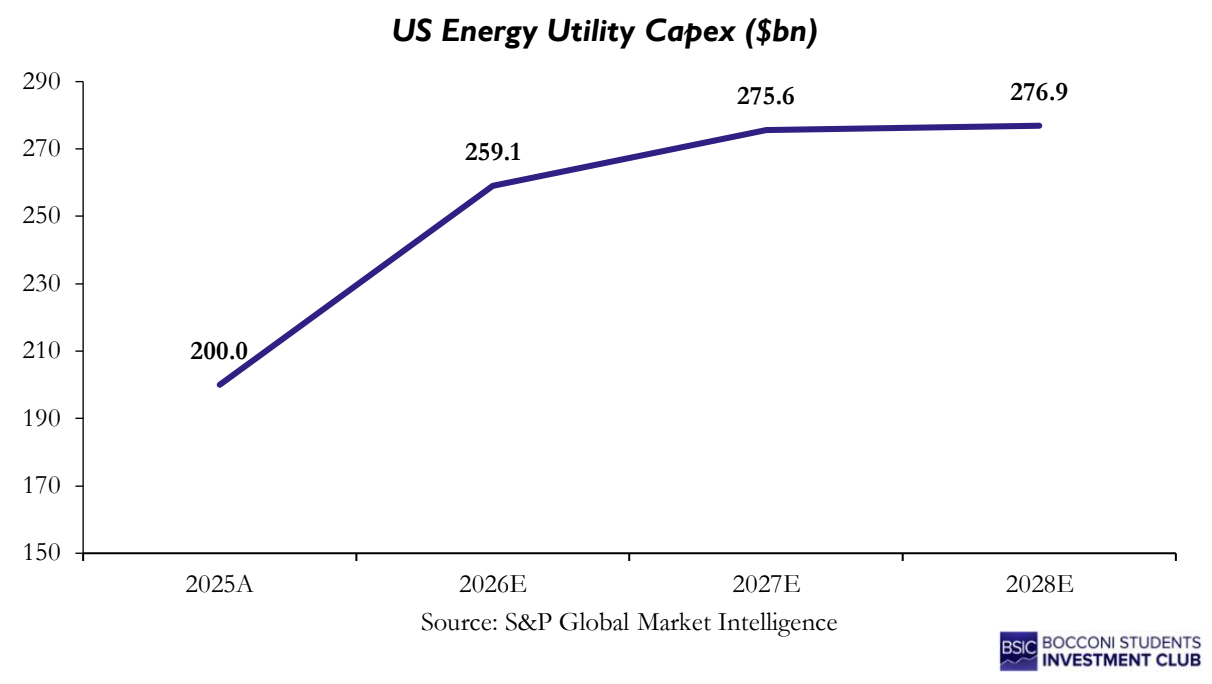
One reason this is attractive is due to how regulated utilities operate compared to other electricity generating companies. Because they are regulated, they are typically allowed to make a (regulated) return on assets that are outlined in their approved rate base. By investing in new infrastructure, they can boost their potential future profits as long as they are allowed to pass on those costs to consumers by being deemed to engage in a prudent investment. Because these capital investments must be made before fully realising the associated revenue, there is also the issue of not necessarily aligning capital spending and revenue generation. Due to the significant increase in demand for electricity by data centres, there is also an issue of how to distribute the cost of these investments: should it be the responsibility of the tech companies causing this increased demand or all other consumers of electricity?
One example to examine is Virginia. In November 2025, the State Corporation Commission voted to create a separate rate for those who request at least 25 MW, starting in January 2027. Individuals or businesses who qualify under the new GS-5 rate will be required to pay at least 60% of their requested generation demand and at least 85% of their requested transmission and distribution demand (even if they do not actually use that much). This is intended to minimise passing these costs onto residential consumers (through cross-subsidisation). Overall, this would benefit regulated utilities as it will make their revenue more predictable and limit their need to invest in infrastructure for individuals who ultimately use less than they requested. Conversely, data centre companies may suffer due to paying more in fixed costs leading to lower overall expected returns on their projects.
This is not solely related to electricity costs alone; due to concerns regarding their water usage, their impact on the local communities and their high usage of electricity, many local and state governments are questioning or limiting the ability to create new data centres. Some proposed limitations include putting a moratorium on new builds, implementing stricter zoning laws, and eliminating tax benefits for building new data centres. Recently (September 22nd), in Virginia, Prince William County reduced the data centre development overlay to only allow most requests to be approved within the remaining district (requiring a special-use permit otherwise).
One example includes CoreWeave, which announced a $1.8bn data centre to be built in Kenilworth, New Jersey. While this has not yet been cancelled, new limitations could prevent or limit the actual installation of this technology and delay the receipt of contracted revenue. This is especially problematic for leveraged developers who may end up accumulating financial obligations like interest before being able to operate. Large, diversified companies such as Microsoft and Amazon may be better placed to absorb delays than developers heavily dependent on external financing.
Beyond the usual debate between spending on renewable vs. fossil fuel infrastructure, growing electricity demand means that both utility and infrastructure companies could benefit – however, whether they ultimately are profitable will largely depend on things like construction/access permits and being able to recoup costs through regulation. To conclude, it is not just about building more infrastructure but also how the costs/risks are ultimately spread between consumers, utilities and technology firms.
Healthcare: Coverage, Funding and Pricing
Due to the Democratic win, one of the main effects related to healthcare will be related to the distinction between coverage versus funding. Generally speaking, Democrats have typically championed expanding who can receive Medicaid, providing more consumer protections and using ACA subsidies, while Republicans have generally focused on being more fiscally conservative, focusing on verifying people’s eligibility and eventually using more market-based solutions. According to the Congressional Budget Office, one major aspect of the reconciliation bill passed in 2025 would ultimately cut around $911bn from federal Medicaid spending from 2025 to 2034. Because Democrats will take control of Congress in January 2027, there is some potential to delay or limit some of these measures – however, because of the presidential veto, a complete reversal would remain politically difficult.
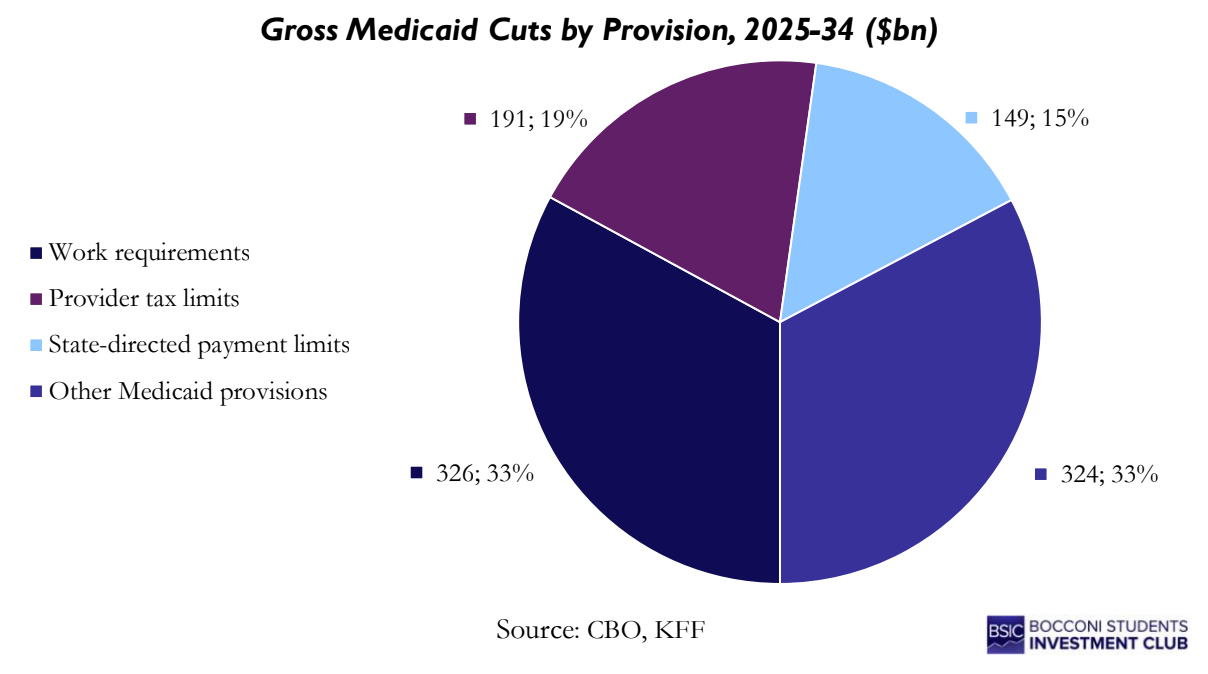
One of the main focuses will be around both the new ACA premium tax credits (which expired at the end of 2025) and the new Medicaid work requirements. Individuals who receive certain coverage are now required to meet additional criteria due to the latter, while the former (until their expiration in late 2025) ultimately limited how much people paid for private health insurance through ACA markets. Reducing eligibility would lead to less spending from the government, but this does not necessarily mean that overall healthcare spending would be cut by the same amount – individuals who lose coverage may still need to receive care, ultimately leading to some of that cost being passed back to hospitals, families and others who pay for healthcare.
One major example of how this matters includes organisations like HCA Healthcare. According to their third-quarter 2026 earnings report, same-facility uninsured admissions increased by 27.4% compared to the previous year due to several factors, including the expiration of the expanded ACA premium tax credits and changes that ultimately impacted how people can enrol in those plans. Leadership estimates that overall changes to their payer mix in the long run cost them around $400m in pretax profits each quarter. This demonstrates how having more patients is not necessarily synonymous with having higher-quality revenue – even if individuals still receive care, their ability to pay may decrease, leading to more uninsured care and less overall profit. Restoring coverage could reduce uncompensated care and support earnings, although the benefit would depend on reimbursement rates, payer mix and treatment costs.
With health insurance providers, the other main influence is generally due to the fact that Centene Corporation reported that in September 2026 it had around 11.9m people on Medicaid compared to 12.7m in September of the prior year. Lower enrolment can reduce premium income, although rate increases and other payments may offset the decline; Centene’s quarterly Medicaid premium and service revenues increased 4% despite lower membership. Additionally, there would also be fewer medical claims because those individuals are no longer covered by the insurer. Because this depends on how medical expenses relate to premium income rather than just being based on being enrolled, the overall impact on profits will consequently differ.
To explain this, the health benefits ratio can be explained as dividing medical costs and claims by premium income. According to information published in the third quarter of 2026, Centene’s overall health benefits ratio is 92.7% and its Medicaid-specific health benefits ratio is 93.6%. This means that, specifically for those on Medicaid, around 93.6 cents of every dollar collected as a premium would ultimately be spent on medical expenses (before other costs). Because of this, having more people enrolled would ultimately have limited benefit without being made up by being paid more to offset the growth in medical expenses.
Drug pricing may attract greater congressional scrutiny, but existing policy implementation should be distinguished from new proposals. Negotiated Medicare prices for the first ten selected drugs took effect in January 2026 under the Inflation Reduction Act of 2022. Further rounds are already scheduled under existing law, including negotiated prices for 15 additional drugs taking effect in 2027. These developments can affect manufacturers’ revenues, particularly where sales are concentrated in selected products; changes beyond the programme’s existing statutory scope may require further legislation.
Another area that might see further oversight relates to vertical integration. For example, UnitedHealth Group [NYSE: UNH] combines the UnitedHealthcare insurance business with Optum’s healthcare delivery, pharmacy and other health services. By integrating these services, individuals may benefit from being able to streamline their healthcare services to become more effective overall, limiting some costs and the need to contract with multiple different organisations individually. Additionally, one downside to vertical integration is that it can lead to both conflicts of interest and preferential treatment, leading to further potential oversight related to insurance, pharmacy benefit managers, and drug prices. Limiting these may ultimately lead to changes in both administrative costs and the overall profitability of integrated services.
Ultimately, this shows how one cannot generally determine the impact based solely on political commitments because, for hospitals, the main concerns are being underpaid or not paid at all, while for insurers, the main concerns are whether people enrol, whether the premiums are sufficient, and whether they file claims for medical care. Based on this, the impact of Democratic control of Congress will also depend significantly on how both coverage and funding ultimately change.
Tariffs, Consumer Demand and Defence Spending
Democratic control of Congress is unlikely to provide immediate, broad tariff relief. Although Congress has constitutional authority over trade, existing legislation delegates substantial tariff powers to the executive branch. That said, Democrats could pass laws to limit this influence or use further investigation (within Congress) to put additional pressure on the issue. One major limitation would be due to the presidential veto preventing the elimination of current tariffs.
For manufacturers, being impacted by tariffs mainly means having to pay higher costs for inputs, leading to potentially lower profits based on whether they are able to raise prices, change how they operate, or change their supply chain. One example of this would be Caterpillar [NYSE: CAT], which in its third-quarter 2026 report estimated that they would still have around $2.2bn in overall costs related to tariffs for the year (this does not include roughly $520m in tariff recoveries). Additionally, the company also stated that its quarterly revenue has increased by 17% to $20.7bn due to both increased sales and favourable pricing. This shows that being impacted by tariffs does not always mean experiencing lower profits because ultimately, it will rely significantly on their ability to pass along costs, how effectively they can become more efficient, and overall how strong demand is.
There are several ways that manufacturers can ultimately react to this issue: they can spread their sourcing to other companies who do not face as much of a barrier to being used as a supplier, even if this leads to additional coordination or shipping costs due to their desire to limit their reliance on any one country; they can also choose to stock up in the meantime to overcome the anticipated cost increases, although this would require some working capital and more financing; finally, companies can choose to move operations or invest more in automation to limit their reliance on imported goods, because relative to other operations, they may feel more inclined to invest in processes and technology to limit their exposure to more expensive options. Relocation is attractive only where tariff savings and efficiency gains outweigh additional capital and operating costs.
For those who primarily serve consumers, one of the main challenges will relate directly to both companies’ ability to pass on costs and how much of that extra cost can ultimately be passed along without significantly losing customers. If people are significantly affected by increased costs by choosing to switch to other options, being able to pass along these costs could ultimately lead to lower overall profits and revenue. This would mainly be a significant issue during periods of low overall consumer financial capabilities, as individuals would be more inclined to switch to more affordable alternatives.
One example of the impact of pricing is Walmart [NASDAQ: WMT]. According to the company, less than one-third of its sales in the United States was imported, so its reliance on international sourcing is less than that of some other companies in the sector. In the quarter ended July 2026, Walmart was granted around $2.9bn in refunds for previously paid tariffs through a US Customs and Border Protection process after a lawsuit concerning tariffs paid under the International Emergency Economic Powers Act. While some of this would have been additional profit, much of it was reportedly being reinvested into customer-related priorities, including cheaper prices. In a low-margin retail business where keeping customers is important alongside scale, competitive pricing can both enable sales and market share.
For defence contractors, one of their constraints stems from the fact that Congress controls how much is allocated in the budget. For fiscal year 2027, the White House requested around $1.5tn across the overall defence budget compared to around $1tn for 2026 (this includes different budget items). Because securing this would still ultimately require Congress to fund, people can never be sure exactly when or how much future purchases will be – under a Democratic-controlled Congress, for instance, this could impact how many contracts are expected to be awarded even if there is still strong demand for defence products.
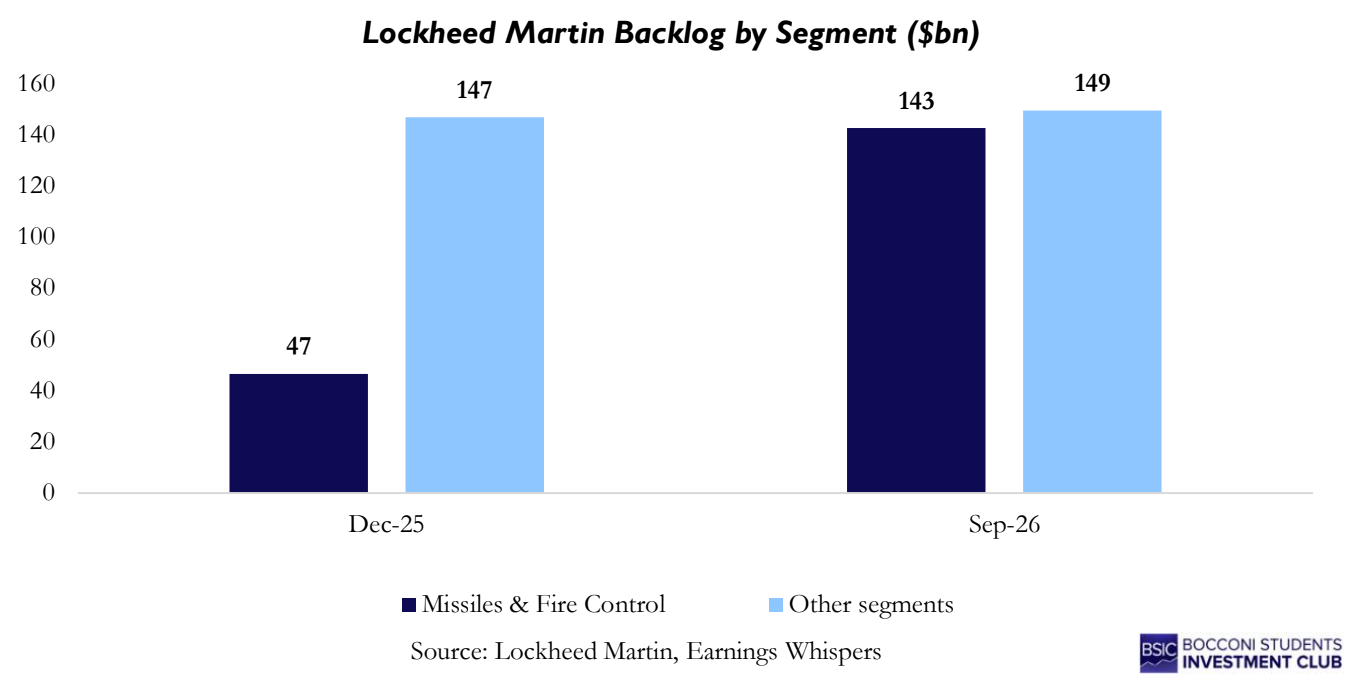
Specifically for Lockheed Martin, it’s important to note the difference between already awarded contracts versus future funding. As of the end of the third quarter of 2026, the company had a record $292bn of backlog, of which roughly $52.5bn related to the recent multiyear award for PAC-3 missile interceptors. Because this is a significant amount of information regarding the company’s future, it’s important to note this would not be viewed as guaranteed or fully funded revenue. Due to the nature of this data – as tied to actual contracts, funding, and project development – future defence budgets would mainly impact the likelihood and timing of further contracts.
Conclusion
Can Democrats turn their electoral victory into tangible economic change? The corporate implications of the 2026 midterms will depend on how political priorities translate into actual decisions, involving funding decisions, regulatory action and changes to operating conditions. Divided government certainly limits the scope for widespread legislation, but it does not fully eliminate the influence of congressional scrutiny or state-level policy. Exposure and implications also vary across industries: for energy and infrastructure companies, the opportunity from rising electricity demand depends on various factors (project approvals, investment incentives, allocation of expansion costs); in healthcare, on one hand wider coverage could reduce hospitals’ uncompensated care, while on the other insurers’ profitability depends on payments keeping pace with medical costs; manufacturers and retailers remain exposed to tariffs; for defence contractors, congressional funding decisions may alter expectations for future awards without causing an equivalent deterioration in existing operations.



0 Comments