Introduction
On 14 October 2026, the Portuguese Government picked Lufthansa [ETR: LHA] (market cap as of 06/11/26: €10.1bn) to buy 44.9% of TAP Air Portugal, in a deal worth up to €1.2bn for up to 49.9% of the airline (€1.0bn for the initial 44.9%, per the contract signed on 3 November), implying a total valuation of about €2.6bn. The only other bidder was Air France-KLM [EPA: AF], whose offer fell short in comparison to Lufthansa’s and carried more uncertainty. The state keeps 50.1% of TAP, with the remaining 5% reserved for the employees (Lufthansa can buy any of the employee shares not taken up). The completion of the deal is expected in 2028, after EU approval, and Lufthansa has stated that it will run TAP operationally, thus taking on an active role rather than a passive stake.
Six years ago, both sides of this deal were rescued by their states. Lufthansa received a pledge of up to €9bn in 2020 (having drawn c.€3.8bn, and repaid everything by November 2021), and the state sold its 20% stake by 2022 with a profit of around €760m. TAP, on the other hand, was renationalised in 2020 and received €3.2bn of restructuring aid approved by the European Commission in December 2021. Today, the rescued carrier is the consolidator, having acquired SWISS, Austrian Airlines, Brussels Airlines and, more recently, agreed to buy ITA Airways and TAP Air Portugal.
When assessing the latest deal even further, Lufthansa valued TAP at €2.55bn of equity value, with the price implying c.€1.9bn of net debt (2.6x its 2025 recurring EBITDA of €743m), implying an enterprise value near €4.5bn, roughly 6x EBITDA on our estimate (6.4x on the government’s) and about 18x recurring EBIT. Lufthansa itself trades at 4x EBITDA and 8.9x EBIT, i.e., Lufthansa pays around 50-60% more per euro of EBITDA than investors pay for the company.
In 2026, the Iran war and the Gulf airspace closures pushed up jet fuel prices, with Lufthansa now expecting a 2026 fuel bill of €9.3bn, about €2bn more than 2025, and reduced adjusted EBIT guidance to €1.7-2.0bn. Nevertheless, demand held, with Q3 revenue rising 9%, adjusted EBIT 6% and network-airline yields rising around 7% on premium and long-haul demand.
Given Lufthansa’s recent push for inorganic growth, together with the recent geopolitical and macroeconomic scenario, is Lufthansa’s expansion creating value, and why does the market still value it below peers such as Ryanair [ISE: RYA] despite its premium positioning?
Collecting Hubs: Two Decades of Lufthansa M&A
An important consideration has to do with the fact that Lufthansa does not merge the airlines it buys, i.e., the acquired players keep their brand, management and hub, sharing only procurement, the Miles & More loyalty programme, Star Alliance and the group’s joint ventures (the transatlantic JV with United [NASDAQ: UAL] and Air Canada [TSX: AC], for instance, and the one with ANA [TYO: 9202] in Japan). In its 2025 annual report, Lufthansa highlights the plan to deepen integration. A key example is ITA, which replaced its own loyalty scheme with Miles & More and joined Star Alliance on 1 April 2026, while Lufthansa Cargo now sells its belly capacity.
When it comes to the deals, SWISS brought Zurich and a wealthy Swiss business-travel market, Austrian brought Vienna and Central and Eastern Europe, Brussels deepened Lufthansa’s exposure to Africa, ITA offers the Italian market, and TAP gives Lisbon and its routes to Brazil, Africa and the US. Besides these core airlines, Lufthansa also acquired 10% of airBaltic for €14m (alongside a board seat and a wet-lease agreement), and it co-owns SunExpress, its leisure joint venture with Turkish Airlines [IST: THYAO].
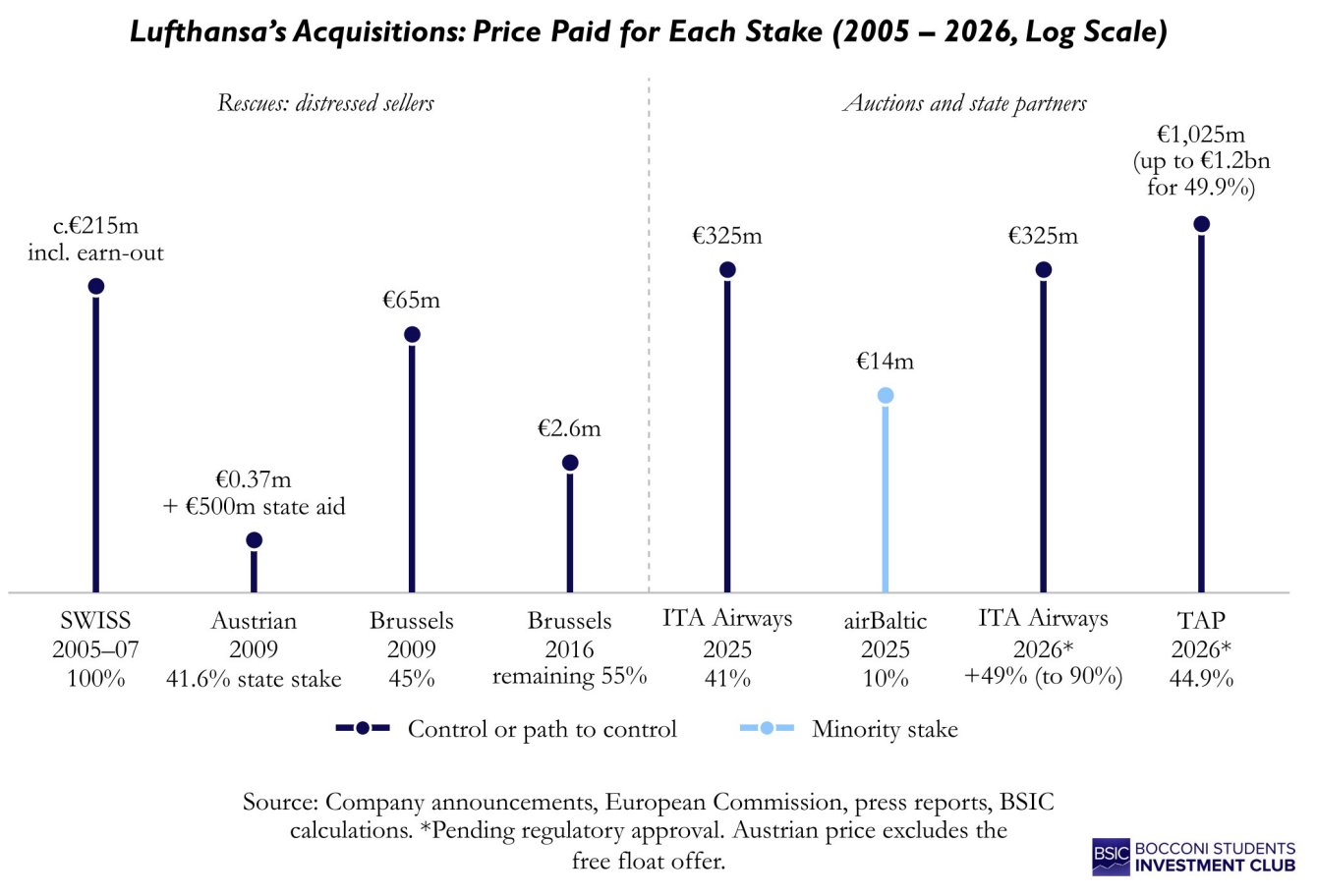
Lufthansa went from acquiring distressed companies and governments paying to exit (Austria sold its 41.56% stake for c.€0.37m and injected €500m of restructuring aid, which the Commission described as a “negative price”; SWISS cost about €45m upfront plus a performance-linked earn-out, which in the end brought the total to c.€215m; and Brussels cost €65m for 45%, then €2.6m for the rest), to participating in competitive processes with rival groups and state sellers who keep their stakes. The other two big European groups are consolidating too: Air France-KLM is in the process of taking majority control of SAS, and IAG [LON: IAG] abandoned Air Europa in 2024 under EU pressure.
Zooming in on the most recent deals (ITA Airways and TAP Air Portugal), neither target earns much more than Lufthansa’s own thin margin, so value creation depends on synergies rather than buying high-margin businesses. ITA recorded, in 2025, revenue of €3.2bn, EBITDA of €404m, EBIT of €25m (under 1% margin), and registered its first-ever net profit of €209m (helped by currency, lower fuel and early synergies, while EBIT portrayed a barely profitable core business), with Lufthansa reporting a €90m contribution to its 2025 results coming from its 41% stake in ITA. Regarding TAP, the Portuguese airline reported, in 2025, revenue of €4.31bn, recurring EBITDA of €743m, recurring EBIT of €243m (5.6%, close to Lufthansa’s group margin), net profit of €4m after a €42m tax charge, and net debt/EBITDA of 2.6x. In H1 2026, TAP recorded a net loss of €99m.
Neither of the latest targets comes free of conditions. To clear ITA’s deal, the Commission required both Lufthansa and the Italian Treasury to hand over short-haul routes and slots at Milan Linate Airport to easyJet [LON: EZJ], which opened hubs both at Linate and Fiumicino, and to help IAG and Air France-KLM compete between Italy and North America through interline agreements and slot swaps. The Italian state will keep a 10% stake in ITA Airways after the second tranche. In Portugal, the state keeps 50.1% of TAP, with Lufthansa committing to invest c.€500m in projects ranging from a pilot school to a corporate services centre, while also creating 3,000 jobs. The conditions themselves are nothing new for Lufthansa: as the price of the Austrian deal, the Commission capped the airline’s capacity growth at the European average until 2015. What has changed is who sits across the table: Lufthansa now shares its newest airlines with governments that remain largely invested and expect their national interests to be met by their national carrier.
Taken together, the deals pursued over the last 20 years have made Lufthansa Europe’s largest airline group by revenue, with seven hubs feeding one network once Rome and Lisbon are fully in. Their value lies mostly in long-haul connections, which is exactly where the 2026 shock landed.
Strong Demand, Rising Costs: The 2026 Long-Haul Shock
Demand: Premium Long-Haul Holds Up
So far, 2026 has shown that Lufthansa’s long-haul problem is not a lack of customers. Despite the war, passengers kept purchasing long-haul tickets, and even paid more for them. In the third quarter, Lufthansa’s network airlines added only 1.6% more seats, mostly on long-haul, yet the average fare per kilometre (the yield) rose 6.8%. Load factor fell 1.3 points, so slightly fewer seats were filled, but because each passenger paid more, unit revenue still rose 5.2%. Management credited demand for premium cabins and for routes to Asia and North America. On the Atlantic, CEO Carsten Spohr said premium demand more than covered rising fuel costs; Lufthansa was not alone in this. IAG raised North Atlantic unit revenue by 11% on flat capacity, and Air France-KLM raised passenger unit revenue by 6.9%. Across Europe’s network carriers, the pattern was the same, with passengers paying more per seat, increasing unit revenue.
Indeed, the strength came from premium long-haul seats, which is exactly where network carriers yield most of their returns. The first reason is the cabin itself. Business seats take the floor space of several economy seats, but on long-haul flights, business and first-class seats sell for far higher multiples of the economy fare. The second is the customer, with business travellers being the least price-sensitive buyers in the market, as they value flexibility over price, and this demand held up this year. The third is the market structure of the North Atlantic. Lufthansa, United and Air Canada run a joint venture with antitrust immunity, enabling them to share revenue and set schedules and fares together, acting as if they were one. With fewer independent competitors, it is easier to hold fares up.
Given 2026’s pricing strength, it is essential to ask how long this will last. The permanent source is a shift in who buys premium seats, with a growing proportion of leisure travellers paying for the business class themselves rather than relying on a company expense account. The temporary source is the gap Gulf carriers left in the market. In the second quarter, Air France-KLM said its unit-revenue growth partially stemmed from the industry capacity removed by the Middle East conflict. However, this gap is already closing, with Qatar Airways and Emirates having restored almost all of their pre-war networks by September. For Lufthansa, the strong Asia yields should not be treated as a new baseline.
Costs: Fuel and Airspace Closures
While demand held, costs jumped during 2026, with US-Israeli strikes on Iran at the end of February closing airspace across the Gulf, and tanker traffic through the Strait of Hormuz slowing. Jet fuel prices drastically increased, driving up airline costs. For European long-haul carriers, the war made flights longer, especially for flights to India and Southeast Asia, due to Western airlines being barred from Russian airspace since 2022. Longer flights burn more fuel, at a time when fuel is far more expensive, as well as requiring more crew hours per trip, while the number of trips per week falls, all driving up costs. Chinese airlines have a cost advantage, as they are able to fly over Russia, saving a couple of hours on a typical Europe-Asia flight, with their savings increasing disproportionately given the spiked fuel costs.
For Lufthansa, the result is a fuel bill of €9.3bn in 2026, around €2bn more than in 2025. This cost equals almost a quarter of the group’s 2025 revenue of €39.6bn. The hit was worst in the second quarter, with fuel costs at the network airlines rising more than €600m, with adjusted EBIT dropping significantly despite elevated load factors and yields. Management has cut guidance twice, but by far less than the rise in fuel costs, because higher fares and cost control are absorbing most of it.
Cost controls include hedging, which has contained a large part of the damage. Lufthansa has hedged c.86% of its passenger airlines’ 2026 fuel and more than 60% of 2027, by fixing the price of future fuel at an agreed-upon level. As these contracts expire, they are replaced at today’s much higher prices, so if prices stay high, the 2027 fuel bill could exceed 2026’s. Management’s response to this fuel shock is mainly focused on flying less, but more efficiently, keeping its 2026 capacity relatively flat, and retiring and grounding a few models to reduce how much fuel it must buy unhedged.
Winners and Losers: Gulf Hubs vs. European Carriers
European network carriers absorbed a cost shock, but Gulf hub carriers took a cost shock and a volume shock at once. Their business model depends on connecting the global continents through a single hub, a hub which sat inside a war zone in March. With declining capacity and passengers, Emirates’ profit before tax fell 68% in the six months to September, with fuel costs before hedging rising c.60% despite the airline burning 12% less fuel. AED 7.1bn of hedging gains reduced the net fuel cost increase to 13%, and Qatar Airways’ CEO called it “our single largest crisis” in the airline’s 30-year history.
Traffic which could not connect through Dubai or Doha went elsewhere, with some taking non-stop flights from Europe to Asia, and Lufthansa added flights to Asia and Africa in the first quarter to match that demand. Air France-KLM did the same in the first half. Turkish Airlines was a winner, as its Istanbul hub lies outside the Gulf, giving it a safer route between Europe and Asia, and as a result, revenue grew 19% in the third quarter. However, it was unable to escape the fuel shock, with its fuel bill rising 93% in the second quarter, producing a $64m operating loss. Among European network groups, the hit varied in size, with IAG’s third-quarter margin falling from 22.0% to 17.7%, while Air France-KLM was the only one of the three to raise its margin.
Therefore, 2026 has been more of a cost problem than a demand problem, with passengers paying more and network groups recovering most of the fuel shock through these prices. However, as Gulf capacity returns and hedges fade, if fuel prices remain high, the margin pressure could worsen.

Short Haul Is the Real Problem
Long haul handed Lufthansa a cost shock in 2026. Short haul gives it something worse: a business whose economics fail even in a good year. A flight of an hour or two inside Europe sells at a low fare, and most of the charges attached to it, from airport and security fees to air traffic control, are levied per departure or per passenger rather than per kilometre flown. Germany has made the problem worse. Carsten Spohr says the state-imposed part of these costs has doubled since 2019, and the aviation tax cut of July 2026 only undoes the increase of 2024. Elsewhere, higher Eurocontrol rates pushed Ryanair’s route charges up 13% last year, and the end of free emission allowances will lift its environmental costs from €1.1bn to about €1.4bn. And in most large European markets, the fare is set by a low-cost carrier.
The cleanest way to see who wins is to split unit profit into revenue per available seat kilometre (RASK) and cost per available seat kilometre (CASK):
Unit profit = RASK minus CASK
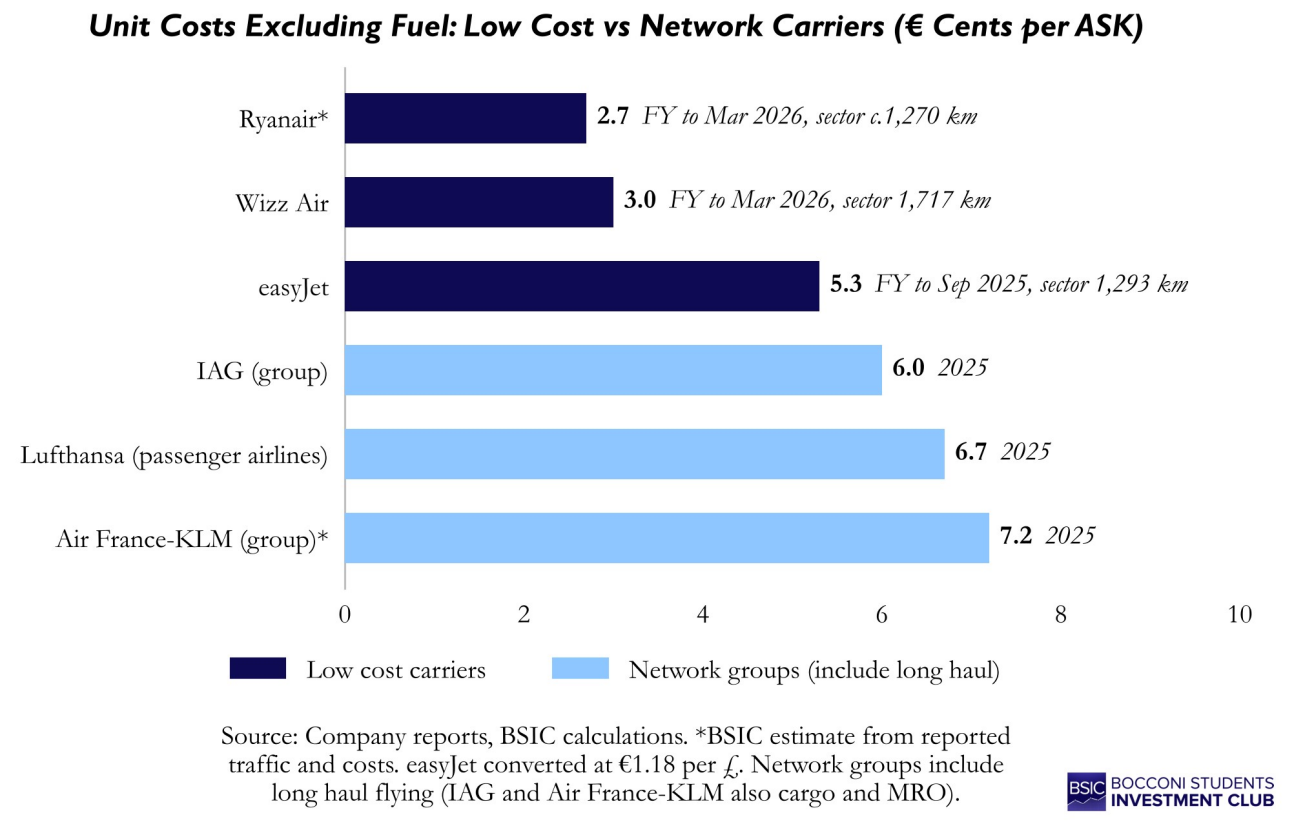
Network carriers and low-cost carriers attack this equation from opposite ends. Network airlines go after RASK. They want full premium cabins and as many passengers as possible connecting onto long-haul, because one business class seat to Chicago is worth a lot of economy seats to Palma. A low-cost carrier accepts a low RASK and pushes CASK down further still. In 2025, Lufthansa’s passenger airlines took in about 9.0 euro cents of revenue for every seat kilometre they flew (8.3 cents on Lufthansa’s narrower reported RASK) and spent 6.7 cents on costs other than fuel and emissions, which left roughly 2.3 cents to buy fuel. Fuel took almost all of it, and the segment closed the year with a 3.6% margin. Ryanair, on our estimate, earned only about 5.5 cents per seat kilometre in its year to March 2026, yet its costs excluding fuel came to just 2.7 cents, and it kept an operating margin of 15.3% (15.8% before an €85m Italian fine). Since Lufthansa’s figures include long-haul, which pushes cost per kilometre down, the real short-haul gap is wider still.
The group does not publish profit by haul, but the pieces line up. Lufthansa Airlines, which flies most of the feeders into Frankfurt and Munich, made a margin of 0.9% in 2025. SWISS barely flies domestically and lives off long-haul from Zurich. It made 9.3%. CityLine, the regional feeder subsidiary, lost €97m (coming from Lufthansa’s parent-company accounts under German accounting rules, not the group figure). The response has been to fly fewer short-haul flights and to move what remains onto cheaper platforms. In mid-April, the group pulled CityLine’s entire fleet from the schedule and cancelled 20,000 short-haul flights through October, and by 2028, 80 jets of the A320 family will have moved from the mainline to subsidiaries such as Lufthansa City Airlines. The early signs suggest the discipline pays. In the third quarter, Eurowings cut capacity by 3.5% and lifted unit revenue by 10.0%, although part of that cut came from suspending Middle East flights.
Leaving altogether is not an option, because for a hub carrier the short flight is rarely the product. Think of someone flying Münster to Munich at six in the morning to make a Chicago connection. Most of what that ticket earns gets booked to the long-haul leg. On paper, the feeder loses money; the trip as a whole does not. Corporate contracts and scarce slots tie Lufthansa to short-haul as well. The pattern repeats at the other legacy groups: Transavia, owned by Air France-KLM, lost €42m in the first nine months of 2026, and only Vueling, which IAG owns and which is protected by its grip on Barcelona, earns a decent short-haul margin.
One airline does make European short-haul pay, at scale, and there is nothing magic about how. Its costs excluding fuel are roughly half of the 5.3 cents we calculate for easyJet on a similar average sector length, and Ryanair’s own figures, which are hardly neutral, suggest the gap is bigger now than before Covid. Of its Boeing 737s, 620 are owned outright with no debt against them, and the group had €2.1bn of net cash at the end of March 2026, so rising lease rates pass it by. Hedging bought time rather than immunity. With 80% of this year’s fuel covered at about $668 a tonne, profit after tax still fell 15% in the six months to September, and only a quarter of next year is hedged. Scale does the rest: with 208.4m passengers a year, Ryanair can pull capacity out of high tax markets such as Germany and send it wherever airports cut their charges.
Being a low-cost airline, it turns out, does not make you Ryanair. easyJet’s profit before tax for the third quarter dropped 70% to £85m, and by August the board was recommending Apollo’s [NYSE: APO] offer of 715p a share. Wizz Air [LON: WIZZ] made a net profit of a mere €1.3m in its year to March 2026, against €4.9bn of net debt. So “premium versus low cost” is the wrong way to divide the industry; the useful line runs between long haul and short haul. On long haul, premium cabins and transatlantic joint ventures give network carriers pricing power. On short haul, only the lowest cost producer earns its cost of capital, and in Europe that producer is Ryanair. Lufthansa’s problem is that its short haul is what fills its long haul.
Why Lufthansa Looks Cheap
At €8.44 at the close on 6 November 2026, Lufthansa was worth €10.1bn on the stock market, well under half of Ryanair’s €25.4bn, even though it generated two and a half times Ryanair’s revenue in the last financial year. On consensus forecasts for 2026, it trades at 9.0x earnings and 4.0x EV/EBITDA, against 14.5x and 6.8x for Ryanair, which puts it around 40% below on either screen.
Those figures rest on enterprise values built the same way for every airline, which is harder than it sounds. Since IFRS 16, lease payments sit below EBITDA, so lease liabilities must be in enterprise value, or carriers that lease heavily look artificially cheap. Pensions behave like debt too, and Lufthansa had €1.9bn of net obligations at the end of 2025. Hybrid capital is where the comparison most easily goes wrong. Lufthansa reports its roughly €1bn of hybrid bonds inside net debt, while Air France-KLM books about €2.8bn of perpetual instruments as equity and non-controlling interests. Leave them out and, on last year’s earnings, Air France-KLM looks like the cheapest of the five at 2.4x EBITDA; put them in, together with pensions, and the multiple rises to the 3.3x shown in the chart. Fiscal years add noise, since Ryanair closes its books in March and easyJet in September. Do all of that, and Lufthansa comes out at €17.4bn of enterprise value: €10.1bn of shares plus €7.3bn of net debt and pensions as of 30 September.
Forecasts for 2026 are distorted by fuel, so the chart below uses each company’s last full financial year. On those numbers, Lufthansa is 35% cheaper than Ryanair on EV/EBITDA and 37% cheaper on P/E. Switch to EV/EBIT, though, and the gap nearly disappears (8.9x against 9.5x). Next to IAG, the picture flips: on EV/EBIT, Lufthansa is 57% more expensive, and it is no cheaper on the other two multiples either.
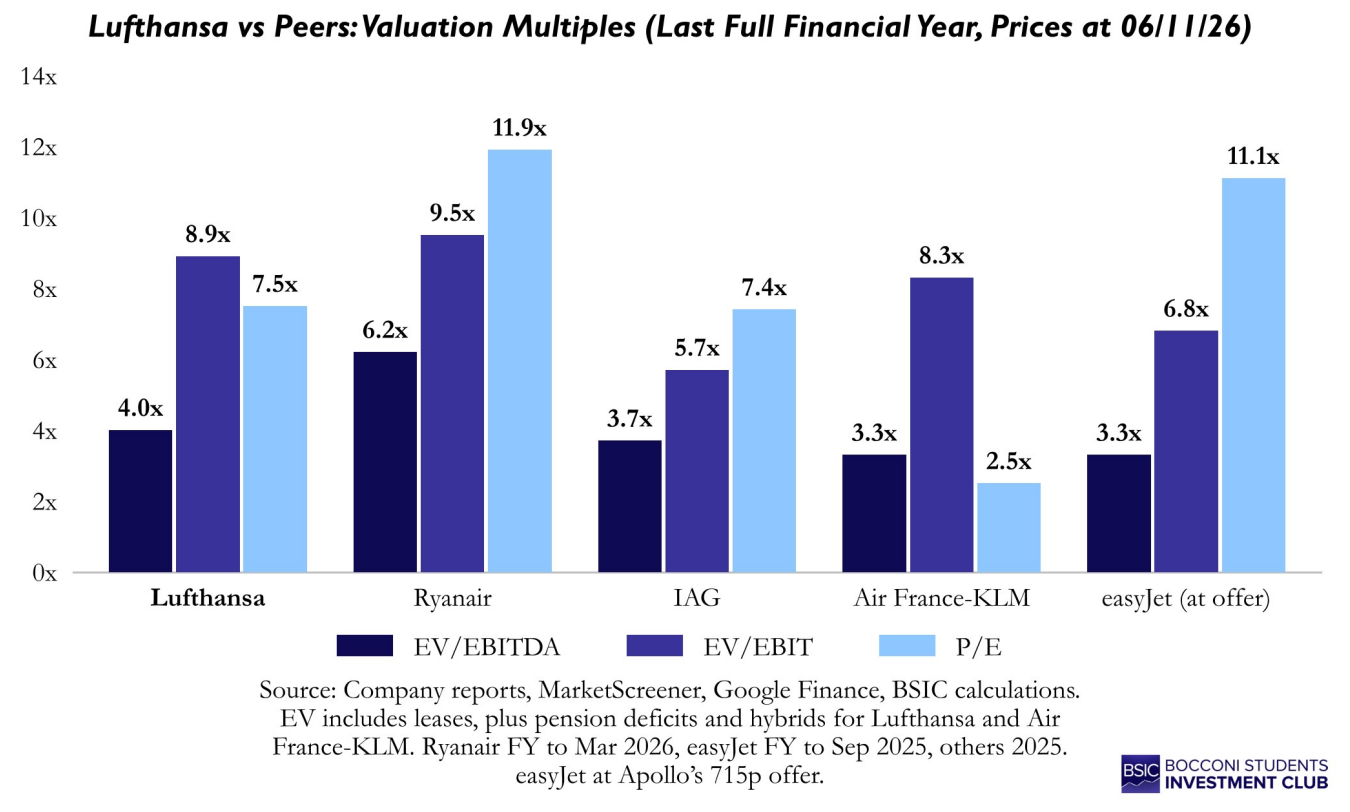
Why would a discount be big on two multiples and small on the third? We think there are two specific reasons, and neither is that investors have simply forgotten about the stock. The first sits between EBITDA and EBIT. Lufthansa converted only 45% of its 2025 EBITDA into EBIT, against 66% at both Ryanair and IAG, because its EBITDA margin is so thin, 10.9% against 24.1% at Ryanair, that renewing the fleet eats most of it (and not because it depreciates more per euro of revenue). The second cause is leverage. Lufthansa’s enterprise value is 1.7 times its market capitalisation, while Ryanair’s sits below its market value thanks to net cash, and levered equity deserves a lower P/E. Behind both sits the margin gap. Last year Lufthansa kept 4.9 cents of adjusted EBIT from every euro it sold; IAG and Ryanair each kept more than 15.
Business mix cuts the other way. Almost half of last year’s €1.96bn adjusted EBIT, €927m, came from Lufthansa Technik and Lufthansa Cargo rather than from flying passengers. Lufthansa spent much of 2023 talking to Bain Capital about selling a minority stake in Technik, and the price reportedly discussed was about €8bn ($8.7bn) for the whole business, roughly 13x its 2025 adjusted EBIT. Add Cargo at a deliberately low 6x, and the two are worth €9.7bn, which leaves roughly €7.7bn for the passenger airlines, or 7.1x their 2025 adjusted EBIT against 5.7x for IAG as a whole. Per euro of airline profit, the market already pays more for Lufthansa than for IAG. Try it another way. Give Lufthansa an 8% margin, the bottom of its own target range, on 2025 revenue, then value it like IAG on EV/EBIT. You get an enterprise value of about €18bn, which is more or less what the market pays today. A good part of the turnaround is already in the price.
Nor is legacy status the explanation. IAG trades at 3.7x EV/EBITDA, a touch below Lufthansa, yet it is worth €22.4bn, more than twice as much, because it earns €5.0bn of operating profit against Lufthansa’s €2.0bn. easyJet is the low-cost test. At its undisturbed price of 394p in May, it traded at about 1.6x EBITDA, cheaper than Lufthansa despite its model, and even Apollo’s 715p offer, an 81% premium, works out at about 3.3x EBITDA and 6.8x EV/EBIT, below Lufthansa’s 4.0x and 8.9x. If anything is out of line, it is Ryanair. Its multiples pay for a cost base and a balance sheet that no one else in Europe has managed to copy.
The comparison has limits. Earnings for 2026 are badly distorted by fuel, and easyJet’s price is now anchored to Apollo’s offer rather than to its own fundamentals. None of this changes the central finding. Lufthansa looks cheap on the multiples that ignore what it costs to keep a fleet flying and who has the first claim on its cash. On EV/EBIT, it is priced close to Ryanair and well above IAG, which suggests the market is not overlooking Lufthansa so much as waiting to see its margins.
Landing the Deal: Will ITA and TAP Close the Gap?
What Rome and Lisbon Provide
ITA brings Lufthansa its sixth hub, Rome Fiumicino, plus a limited slot portfolio at the busy Milan Linate airport. At the end of 2025, ITA’s fleet consisted of 106 aircraft, 24 of them widebodies. Rome gives Lufthansa better access to long-haul traffic between Italy and the US, while Linate attracts passengers from the economically stronger north of the country. The commercial opportunity is to connect these markets more effectively through Lufthansa’s existing network, both in Europe and abroad.
Lisbon would become the seventh hub, providing access to Brazil, Portuguese-speaking Africa and, through connections, North America. By Lufthansa’s own estimate, TAP would lift its share of Europe-South America traffic from about 9% to 20%, and OAG data put the combined group at 36% of Europe-Brazil seat capacity. TAP already belongs to Star Alliance, so the deal should deepen existing cooperation in network planning and operations. The case rests on established South Atlantic flows, not on the temporary 2026 boost to Europe-Asia fares.
Both networks need short-haul feed and further fleet investment. In 2025, ITA earned €25m of EBIT on revenue of €3.2bn, a margin of about 0.8%. In the first nine months of 2026, its EBIT rose 65% to €98m, although third-quarter EBIT was flat at €94m. TAP converted €743m of recurring EBITDA into €243m of recurring EBIT in 2025, and in H1 2026 it swung to a recurring EBIT loss of €84m (net loss €99m) as fuel costs rose 18.7%. So Lufthansa is adding long-haul exposure that already carries the same cost pressure as its own network.
Requirements from the Deals
Lufthansa first paid €325m for a 41% stake in ITA in January 2025, and another €325m would increase its ownership to 90%, with completion expected in the first quarter of 2027. TAP’s contract, signed on 3 November, sets a price of €1.0bn for 44.9%, which could rise to about €1.2bn for up to 49.9% including a ticking fee and any employee shares Lufthansa takes up. The government puts the deal at 6.4x 2025 EV/EBITDA, against about 4.0x for Lufthansa itself on our numbers in the previous section. A fair comparison needs debt, leases and pensions treated the same way, and Lufthansa’s group multiple also includes Technik and Cargo. For the deal to create value, TAP must eventually earn more than its cost of capital on the full outlay, including the fleet investment it needs.
There are several ways the deals could lift earnings. Better coordination of connections and distribution would win passengers who would otherwise fly with competitors. Joint procurement and maintenance agreements could improve terms with suppliers. Shared IT and back-office functions would remove duplication, net of migration costs and staffing commitments. One integration step is already visible: Lufthansa Cargo sells ITA’s belly capacity, which management says is equivalent to three Boeing 777 freighters. That measures capacity, not profit. Cheaper financing and leasing would also help, although interest savings show up below EBIT.
Lufthansa expects ITA synergies worth 10-15% of its 2024 revenue, with 20-30% realised by the end of 2025 and 70-80% by 2026-27. For TAP, it estimates annual net synergies of up to €450m. These figures are not the extra net profit attributable to Lufthansa: benefits generated inside TAP should be kept apart from direct benefits to the existing group, and as a minority shareholder Lufthansa only sees TAP’s cash through dividends. The full benefit also depends on execution and on cooperation with the Portuguese state.
Lufthansa plans to pay in cash. Including the second ITA tranche, the outlay comes to €1.35-1.53bn. Lufthansa had €11.8bn of liquidity at the end of September, but €2.6bn of that was undrawn credit lines, and the group targets a minimum of €8-10bn, so the true excess is far smaller. According to Moody’s, TAP alone would raise adjusted net leverage by c.0.2x from about 2.1x on a June 2026 basis, with the rating unchanged but limited headroom (Moody’s measures leverage differently from Lufthansa). The combined effect will depend on ITA’s cash, debt and leases once it is consolidated.
Beyond the purchase price, the deals will need further investment. Portugal’s industrial plan foresees €3-4bn of investment in TAP’s fleet over time. This is a multi-year programme for TAP rather than an immediate payment by Lufthansa. Any later purchase of the state’s remaining stake would be a separate transaction, with its own financing and dilution questions. Even with the purchase price fully funded, extra fleet spending would compete with debt reduction and shareholder payouts.
Governance and approvals will also shape execution. Portugal would keep a 50.1% stake in TAP and appoint five of nine directors, while Lufthansa runs executive management. Employment and national connectivity commitments would limit restructuring options. Both the majority acquisition of ITA and the TAP investment still need regulatory approval, and TAP’s Star Alliance membership does not automatically allow joint pricing and revenue sharing within Lufthansa’s joint ventures. Lufthansa would account for TAP using the equity method, while ITA would be fully consolidated once Lufthansa owns 90%. Additional reported revenue does not prove higher returns.
Three Outcomes for the Stock Price
Successful integration of both airlines would lift profitability and cash generation once the larger network is funded. ITA’s nine-month results are encouraging, but its flat third quarter shows the improvement is not yet secure. To give a sense of scale: every extra €100m of annual net profit, valued at Lufthansa’s 7.5x trailing P/E, adds about €750m of equity value, or roughly €0.62 per share, holding the multiple and share count constant. This is not an upside estimate; the contribution has not yet been established, and some of the improvement may already be in the share price.
Scale without returns would mean more passengers and higher reported revenue, but too little cash once feed costs, depreciation and investment are paid for. Delivering only half of TAP’s €450m synergy target, for example, would mean €225m a year. That outcome would confirm the concerns already behind Lufthansa’s valuation.
Overextension would combine poor delivery with continued earnings pressure or new capital demands. For scale, a one-percentage-point fall in group operating margin on 2025 revenue of €39.6bn would remove c.€396m of EBIT a year. This is an operating sensitivity, not a forecast of the acquisitions’ impact. Combined with delayed integration or losses at the targets, it would make fleet spending, debt reduction and shareholder payouts harder to balance. Higher debt and lower liquidity would make the group more vulnerable to further downturns.
The strategic case looks convincing, but a rerating will only come once the returns show up. Investors need rising operating margins, synergies that turn into cash, and a balance sheet that can finance the investment. Lufthansa’s 2028-30 targets of an 8-10% adjusted EBIT margin and more than €2.5bn of adjusted free cash flow a year give useful benchmarks. Hitting them on a sustainable basis would strengthen the valuation case. Higher revenue alone will not prove the deals were worth the price.
Conclusion
Lufthansa’s strategy over the years is defensible. Yet, it has not been shown to create value. Lufthansa’s approach to inorganic growth has evolved, going from rescues bought for almost nothing to contested auctions at a higher multiple than Lufthansa’s own, with governments staying on as co-owners and setting conditions.
In 2026, demand for premium long-haul held up, with the factor hurting margins having to do with costs. The Gulf disruption, although partly temporary, was a key reason for the pricing boost. Nevertheless, it became clear that the structural weakness is in short-haul, which still feeds the long-haul network.
When it comes to valuation (and especially the comparison between Lufthansa and, for example, Ryanair), the discount is not random. It is the byproduct of thin margins and leverage and pensions. On EV/EBIT and on a sum-of-the-parts basis, Lufthansa cannot be seen as cheap and, thus, the market is waiting for margins to improve rather than overlooking the stock.
In order to close the gap, ITA Airways and TAP Air Portugal need synergies turning into cash, fixing the economics of short-haul feed, and working with state partners. Overall, the deals clearly aim to improve the network, but solving the margin problem remains a distant fix, so a rerating depends on execution.
The fundamental question posed in the article is likely to be answered soon, as ITA’s first full year as a consolidated subsidiary, once the acquisition is completed in early 2027, will reveal whether the thin EBIT margin will approach that of the group, with TAP’s investment still having to go through Brussels before the deal is completed in 2028. Meanwhile, the fuel hedges which shielded Lufthansa from the spike in fuel prices in 2026 expire in 2027, and Gulf carriers return to nearly full utilisation, making any hope of another pricing tailwind unrealistic. Under such circumstances, it is expected that the performance of Lufthansa will be judged more by its progress towards the 8-10% adjusted EBIT margin target and over €2.5bn of annual free cash flow set for 2028-30.
Should it achieve these goals, the gap with Ryanair will start narrowing on its own, making the case for acquiring the Portuguese government’s remaining stake in TAP a much more convincing one. Should it fail, then Lufthansa will have paid auction prices for a bigger and more complicated group with even greater exposure to the agendas of government entities, but no margin to show for it. Two decades ago, Lufthansa was acquiring airlines which other carriers were reluctant to buy. Six years ago, it needed an injection of cash to survive. Today, it wins bidding wars. Whether this makes it Europe’s consolidator or merely its largest airline group remains to be seen.
References
[1] Governo de Portugal, “Governo seleciona a Lufthansa para aquisição de até 49,9% do capital social da TAP”, 14 October 2026
[2] Lufthansa Group, “Lufthansa Group and Portuguese Government Sign Agreement for Acquisition of a Minority Stake in TAP Air Portugal”, 3 November 2026
[3] AeroTime, “TAP Air Portugal reports fourth consecutive profit despite tax hit”, April 2026
[4] Euronews, “Lufthansa faces €2 billion extra fuel bill as Iran war keeps prices high”, 3 November 2026
[5] Lufthansa Group, “Lufthansa Group increases operating profit: strong demand and cost discipline more than offset higher fuel costs”, 3 November 2026
[6] Lufthansa Group, “Annual Report 2025”, March 2026
[7] Lufthansa Group, “Lufthansa exercises option to acquire a majority stake in ITA Airways”, 12 May 2026
[8] Business Travel News Europe, “Lufthansa wins Austrian approval”, 2009
[9] ANSA, “ITA closes 2025 with first net profit of €209 million”, 26 March 2026
[10] ECO News, “TAP first-half loss widens to €99.2 million”, 31 August 2026
[11] European Commission, “Commission approves acquisition of ITA Airways by Lufthansa and MEF, subject to conditions” (IP/24/3604), 3 July 2024
[12] Il Sole 24 Ore, “IAG: BA and Iberia revenue growth, but high fuel costs are holding back profits”, November 2026
[13] Air France-KLM, “Q3 2026 Results”, 5 November 2026
[14] Qatar Tribune, “Qatar Airways calls Iran conflict its biggest crisis in 30 years”, 21 September 2026
[15] Ryanair Holdings, “FY26 Results”, 18 May 2026
[16] Aviation Business News, “The easyJet private equity takeover: the full deal details”, August 2026
[17] MarketScreener, Deutsche Lufthansa AG and peer quotes and consensus estimates, accessed 6 November 2026
[18] AviationPros (dpa), “Germany’s Lufthansa Scraps Plans to Sell Stake in Maintenance Firm”, 30 November 2023
[19] CAPA Centre for Aviation, “Lufthansa expects EUR450m synergies from TAP investment”, 16 October 2026
[20] Lufthansa Group, “Lufthansa Group is consistently pursuing its strategy and aims to significantly increase profitability”, 29 September 2025


0 Comments