Introduction
Credit investors are increasingly hedging their exposure to the AI boom. Weekly CDS trading volumes across seven AI-exposed companies rose from less than $2bn in July to over $9bn in September, reflecting growing scrutiny of the sector’s financing risks. Yet, rising demand for default protection does not necessarily signal deteriorating creditworthiness. With AI investment increasingly supported by debt, leases and complex financing structures, the question is whether credit markets are pricing genuine financial vulnerabilities or simply responding to greater demand for hedging. This article examines the financing behind the AI boom, the creditworthiness of its principal borrowers and the potential for financial stress to spread across the ecosystem.
Financing the AI Buildout
The rapid expansion of artificial intelligence has created an increasingly capital-intensive investment cycle. Unlike traditional software businesses, where incremental customers can often be served at relatively low marginal cost, AI infrastructure requires substantial upfront expenditure on graphics processing units (GPUs), data centres, networking equipment and power infrastructure. These investments must be made before the capacity generates revenue, creating a fundamental financing challenge: capital needs to be committed today against cash flows that depend on future utilisation, pricing and customer demand. While this dynamic is familiar from capital-intensive industries such as telecommunications, the AI buildout introduces additional complexity through the rapid technological obsolescence of computing equipment and the concentration of demand among a relatively small number of customers.
The companies undertaking these investments broadly fall into two categories. Hyperscalers, such as Microsoft, Alphabet and Amazon, operate diversified technology businesses and can fund significant portions of their infrastructure expansion through internally generated cash flows. Their established profitability, liquidity reserves and access to investment-grade debt markets provide considerable financial flexibility, allowing them to absorb periods of negative returns on new investments without necessarily threatening their ability to service debt. Neoclouds, such as CoreWeave, operate a different model, specialising in providing GPU computing capacity to customers through multi-year contracts. Without the same diversified earnings base, these companies are more dependent on external capital and contractual commitments from customers to finance infrastructure development. The distinction is not simply one of scale, but of whether debt repayment is supported by a diversified existing business or relies predominantly on the cash flows generated by the infrastructure being financed.
The most straightforward funding sources are corporate cash flow, debt and equity. Internally generated cash flow allows hyperscalers to expand without creating additional contractual obligations to creditors, although it reduces the capital available for distributions and alternative investments. Corporate bonds and bank loans provide funding while preserving shareholder ownership, but introduce interest payments and refinancing requirements regardless of whether the investments generate their expected returns. Equity issuance avoids mandatory debt service but dilutes existing shareholders, while customer prepayments provide funding in exchange for future services rather than an immediate financial repayment obligation. The latter can be particularly attractive to infrastructure providers because it reduces upfront financing needs, although it also creates delivery obligations and may bring forward cash receipts that would otherwise have been collected in future periods.
Beyond conventional corporate financing, AI infrastructure increasingly relies on asset-backed lending, project-financing vehicles and private credit. Under these arrangements, financing can be raised through special-purpose vehicles (SPVs) that own or finance specific infrastructure assets. Lenders may receive security over GPUs, data-centre equipment and contractual cash flows, with scheduled debt repayments funded by payments from customers using the computing capacity. By securing debt against specific infrastructure assets and contractual cash flows, companies can obtain more favourable financing terms than they would through unsecured borrowing at the corporate level. Lenders benefit from claims on identifiable collateral, such as GPUs, and revenues generated under long-term customer contracts, while SPV structures can provide additional protections by ring-fencing assets and restricting their use for other purposes. Consequently, the same infrastructure provider may face significantly lower borrowing costs when financing assets through a secured SPV than when issuing unsecured bonds at the parent-company level. The strength of the underlying customer contract can further improve financing terms, particularly when the counterparty is investment grade. Private credit funds, banks and infrastructure investors can participate in these structures, taking exposure to assets and contractual cash flows with varying levels of security and recourse. Importantly, the separation of debt into a financing vehicle does not necessarily eliminate risk for the parent company: guarantees, additional funding commitments and other contractual support may transmit losses back to the sponsor.
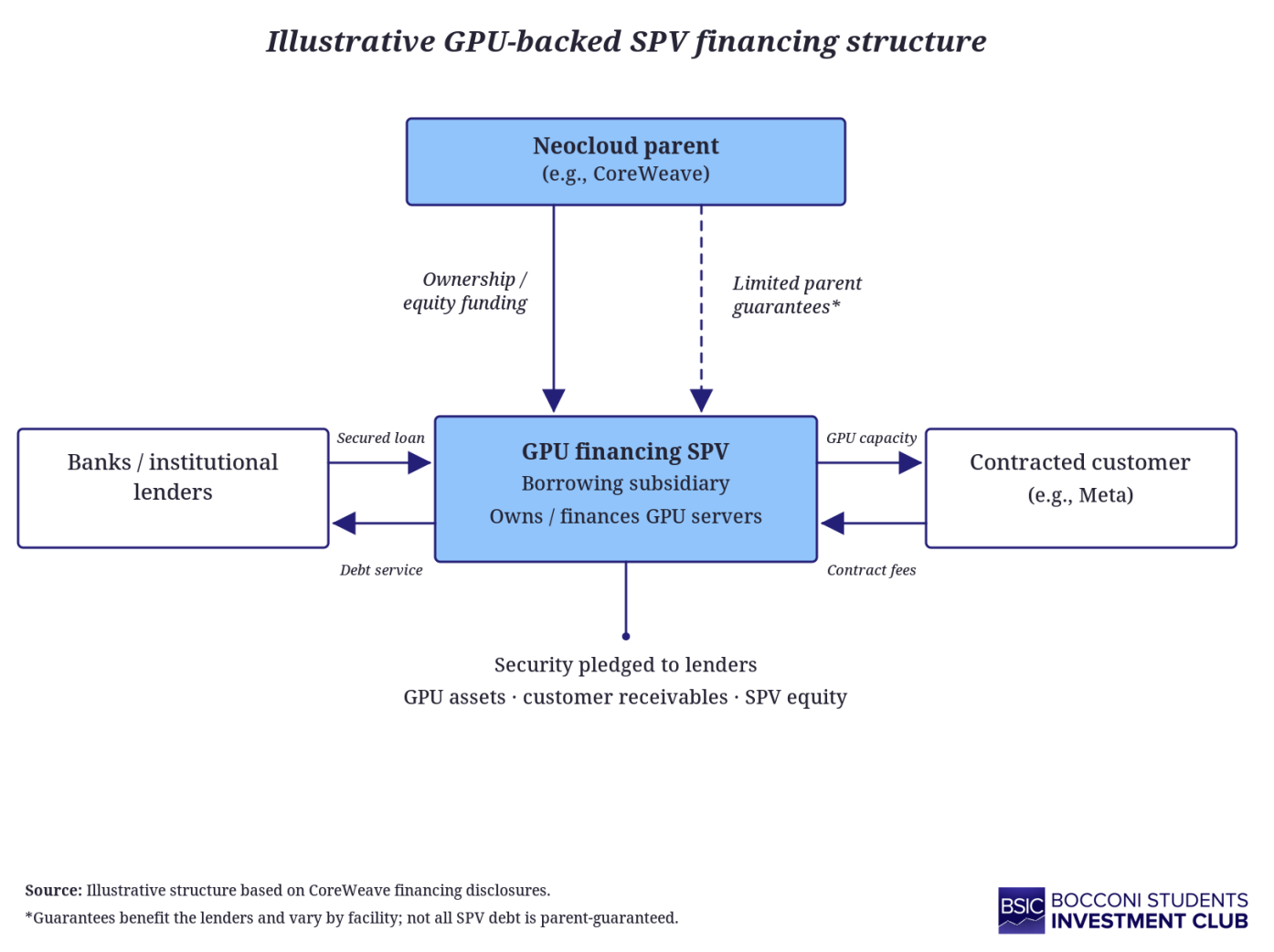
Leasing arrangements represent another important source of infrastructure capacity. Rather than owning and financing an entire data centre, a technology company can enter into long-term agreements to lease facilities and, in some cases, equipment from third-party operators. This can reduce the immediate capital expenditure required to secure capacity, but replaces upfront investment with fixed payment obligations extending over many years. Under current accounting standards, many leases give rise to recognised liabilities, while significant commitments for leases that have been signed but have not yet commenced may remain outside reported lease liabilities. Consequently, headline corporate debt figures may substantially understate a company’s broader financial commitments. The distinction becomes particularly relevant when long-term lease obligations are supported by customer contracts of shorter duration, exposing the infrastructure provider to renewal, pricing and counterparty risks after the original agreement expires.
Across these financing structures, the central vulnerability is a potential mismatch between the timing and certainty of financial obligations and the cash flows expected to meet them. Debt service and lease payments follow contractual schedules, whereas infrastructure revenues depend on construction completion, sufficient power availability, customer demand and computing prices. A delay in bringing capacity online may postpone revenues without delaying interest payments, while a decline in GPU rental rates or technological obsolescence may reduce both operating cash flows and the value of the collateral securing loans. Long-term customer contracts can mitigate these risks by providing visibility over future revenues, but their effectiveness depends on the creditworthiness of the counterparty, enforceability of the agreement and allocation of costs in the event of delays or termination. Ultimately, financing structures determine how these risks are distributed among shareholders, lenders, infrastructure operators and customers. Understanding this allocation is essential to assessing the contrasting credit profiles of Microsoft, Oracle and CoreWeave.
Different Business Models, Different Credit Risks
Capacity build-up associated with the implementation of an AI strategy is an expensive proposition, which is driven by several factors: cash generation, the company’s size and stability, liability profile, and the availability of financially capable counterparties who should pay for the capacity. There are three companies representing different strategies regarding implementation of the strategy: Microsoft [NASDAQ: MSFT], Oracle [NYSE: ORCL], and CoreWeave [NASDAQ: CRWV]. The first company bets on AI technology and its development using cash flows. Oracle uses the company’s software business and commits more than what can be covered with current funding, and CoreWeave is relying mostly on outside financing using its customers’ contracts as collateral. The comparison and assessment may be done through four key metrics: how much of the investment is covered by the companies’ own cash flows, the obligations both on and off the balance sheet, the ratio of liquidity to debt maturity, and how concentrated the company’s backlog is. All the figures are based on the companies’ latest reported quarter (Microsoft Q1 FY27 ending September 2026, Oracle Q1 FY27 ending August 2026, CoreWeave Q2 FY26 ending June 2026) and last-twelve-month figures.
Microsoft: Cash-Generating Hyperscaler
Microsoft stands out as the company which provides the rest of the borrowers with an example of credit strength. In Q1 FY27, it generated $58.0bn in operating cash flow, rising by 29% compared to the same period in FY26, spending $39.4bn of cash on PP&E acquisitions and creating positive free cash flow of $18.6bn. Together with $7.4bn of assets acquired under finance leases, capex for the quarter reached $45.2bn, of which approximately three-quarters were related to short-lived assets (servers, GPUs and CPUs). At the same time, management expects calendar-2026 capex of around $170bn. The trend is obviously downward: LTM free cash flow fell from $77.4bn over the year to December 2025 to $60.0bn, while capex increased from $83.1bn to $135.9bn. Nevertheless, cash flow generation remains positive, and the company guided that FY27 will bring positive free cash flow. Funded debt plays almost no role in the picture: at the end of Q1 FY27, Microsoft had bonds totalling $35.5bn, against cash and short-term investments of $64.5bn, LTM interest expense of $3.2bn covered more than 60 times with EBITDA of $205bn, and it still returned $10.2bn to its stockholders in the form of dividend payments and buybacks during the quarter. The AAA credit rating assigned by S&P, unchanged since 2008, does not appear as a risk factor in this case.
It is actually lease obligations that are critical here. Finance lease liabilities for Microsoft stand at $71.0bn and operating lease liabilities total $27.5bn, so that recorded leases alone are almost 3 times higher than bonds. In addition, the company disclosed leases totalling $364.6bn, which have not started their term, most of them related to data centres from FY27 to FY34, with terms up to 20 years. These kinds of commitments have become a major tool for adding capacity without increasing a debt burden for the leading tech companies, as well as a portion of the capacity is now acquired from third parties for rent, including neoclouds. In turn, those commitments are collateral for debt of other companies, as discussed later when addressing the ecosystem risk. None of this makes the solvency of Microsoft doubtful, yet it reduces its financial flexibility: capex programmes could be slowed within a quarter, while committed leases should be settled with the payment irrespective of their use.
For Microsoft, the credit situation is mainly about its ability to earn money on its investments rather than a default potential, and this information appears mixed at the moment. Azure revenue rose by 48%, and the company’s commercial remaining performance obligation (contracted backlog) rose by 73% to $677bn. Yet, only about 30% of this backlog will be recognised in the next 12 months, and Microsoft Cloud gross margin dropped to 66%, as low-margin infrastructure became a greater part of its portfolio. Moreover, concentration risk is much greater than it seems from the numbers. At the beginning of the year, Microsoft disclosed that approximately 45% of its commercial backlog is related to OpenAI, which in Q1 brought $10.0bn in revenue, or approximately 11% of total revenue, with $7.2bn in accounts receivable at the end of the quarter. A diversified company of Microsoft’s size might handle such a shock easily. The risk is a slow erosion of its returns rather than a liquidity shock. So, in credit terms, the risk is mainly an equity question, with leases as the channel through which it reaches creditors.
Oracle: Established Cash Flows and Infrastructure Expansion Commitments
Oracle has to be placed somewhere between the previous companies. It is an established and reliable company when it comes to cash flow generation. However, the company’s expansion commitments make its financial position more complicated. First of all, the company is demonstrating good, reliable cash flow generation, which helps it to operate and invest. At the same time, the scale of expansion commitments, leases and other project commitments, which allow it to build capacity without incurring reported debt, makes it possible for the company to become vulnerable to its obligations, which might become a credit burden for Oracle in the future. Thus, although Oracle’s core business seems to be sound, financial flexibility is constrained by these obligations, and the company will have to make financing decisions wisely while building up projects. Meanwhile, despite robust and continuous recurring cash flows from databases and applications products ($30.5bn LTM funds from operations before working capital changes until August 2026), the company chose to make a lot of expenditures on expanding AI capacity. Capital expenditures for the past 12 months amounted to $75.7bn, which is more than twice as much as $35.5bn in the 12 months to November 2025, and the company expects to spend $90bn to $95bn on capex for FY27. The LTM period demonstrated strong operating cash flows of $46.9bn, with $23.1bn of cash flow in Q1 FY27, of which $11.4bn came from advances, and increasing long-term deferred revenue on the balance sheet from $1.3bn to $16.1bn during the period of six months. Despite additional funding from advances, free cash flow decreased to negative $28.7bn LTM and negative $5.4bn in Q1 ($17bn negative free cash flow in Q1 excluding prepayments).
All the gaps are already being filled using any available capital resources. In 12 months period the company issued $49.4bn of long-term debt, and $25.2bn of common equity, and in addition to that, including an at-the-market offering of $20bn in Q1, and filed in early November for the issuance of another $10bn of equity together with $10bn of bond issuances. Gross borrowings now amount to $125.3bn against a cash balance of $37.1bn. While there are no problems with short-term maturities, as there are $10bn of bonds and term loans that mature till end of 2027 (and less than $5bn in 2028, fully covered by cash), the problem is in the pace of new borrowings. The interest expense in the 12 months increased from $3.9bn (12 months to November 2025) to $5.1bn (12 months to August 2026), although EBITDA of $35.5bn is still covering this cost seven times. Total gross debt amount is growing and currently equals about $169bn, including recorded leases, or 4.8x EBITDA. In July, S&P downgraded the company to BBB-, one notch above the high-yield sector, citing leverage above 4.5x and no positive free cash flow by FY29 as possible reasons for further downgrades. Moody’s assigned a Baa2 rating with a negative outlook to Oracle.
Backlog is the best defence for the company and a danger for the creditors at the same time. RPO increased to $664bn in August, which is more than nine times the annual revenue, and of which only 13% is expected to be recognised in the next 12 months, 37% within 13 to 36 months, and 34% in years 4 and 5. For Oracle, recognition of backlog is difficult, because the company needs to build up infrastructure and acquire hardware in order to recognise a new contract. Backlog is highly concentrated, according to S&P estimates: roughly half of it is related to OpenAI, a company which is losing money and relying on third parties for its financing. From a creditor’s viewpoint, there is one key factor here: terms mismatching. Oracle entered $288bn in data centre lease commitments that are not in place yet, and run for 15 to 19 years, largely to support one contract of OpenAI reported to run for five years. Renegotiation or default on this key counterparty will decrease revenue, but keep all remaining obligations untouched, as noted by S&P.
Equity issuance changes this picture somewhat. As company management disclosed at its October Investor Day event, Oracle plans to largely support one contract of OpenAI reported to run for five years, equally split between debt and equity (refinancing is excluded). This will protect the rating in the short term, but in case the company has a deficit in free cash flow of $42bn estimated by S&P for FY27, the rest of the financing has to come from channels outside reported debt, such as advance payments by clients, provision of hardware and leases.
CoreWeave: External Capital-Funded Infrastructure Growth
CoreWeave is an example of an AI buildout that doesn’t include a traditional business model. The company provides multi-year access to GPU computing capacity for a fee, and mostly finances such purchases through outside funding. In the period of year ended June 2026, CoreWeave generated revenue of $7.6bn, and $6.9bn of operating cash flow boosted by advance payments of clients against the capex of $20.6bn, producing negative free cash flow of $13.7bn. With forecasted annual capex in the range of $35bn to $39bn, it might be worse in future. On an adjusted basis, the company is extremely profitable right now, having in the second quarter an adjusted EBITDA of $1.5bn with margin approaching 60%. However, this adjusted EBITDA is calculated with the exception of depreciation charges of GPUs purchased in order to produce the revenue. Depreciation charges in the last 12 months amounted to $4.0bn, producing negative operating income in general. Interest expenses of $1.9bn (one quarter of revenues in Q2) produced negative LTM net income of $1.9bn with $5.0bn of book equity and $77bn of assets. The debt structure is built mainly around customer contracts. The company’s borrowings are mostly made as delayed-draw term loans (DDTLs) raised by special purpose subsidiaries and secured by GPUs and contracts. DDTLs are repaid by incoming payments from customers. The cost of DDTLs depends on the counterparty: DDTL 4.0 with an $8.5bn limit, backed by a contract with Meta, gets an A3 rating from Moody’s and is charged at a fixed interest rate of 5.9%, while earlier facilities had margins of up to 13% over SOFR. Bonds of CoreWeave represent a completely different picture: unsecured dollar notes with coupons of 9.0% to 9.75% trade around 80 cents as of mid-October, producing a yield of about 15% for 2032 notes. In other words, the counterparties are valued more than the company. Exposure to Meta as a counterparty, through CoreWeave’s special purpose subsidiary, is significantly cheaper than exposure to the company itself: the former is rated investment grade and priced accordingly, while the latter is priced as high yield with a rating of B+ by S&P but a positive outlook.
The vulnerability of the company is in timing issues. According to the 10-Q, the company should pay in the second half of 2026 $4.4bn, and in 2027 another $6.2bn (total $10.6bn within 18 months), in contrast to $5.5bn of unrestricted cash at the end of June. Mostly, this is planned DDTL repayment from the revenue stream, but if there is a slight delay in data centre delivery or payments by customers, there will be little margin. Since June 2026, CoreWeave took additional $1.2bn in its revolver and raised another $4.2bn through issuing convertible notes, and Goldman Sachs still estimates a funding requirement of $19.5 to $23.0bn. The problem is also in concentration. According to the 10-Q, the three largest customers accounted for 36%, 26%, and 10% of Q2 revenues, and the $104bn backlog depends on counterparties, OpenAI among them, which themselves rely heavily on external financing. About 41% of the backlog is expected to be recognised in two years, with the remainder to 2032.
Lastly, the problem is connected with collateral. CoreWeave depreciates its GPUs over six years, while the data centres and power infrastructure in which these GPUs work have lifetimes in decades. In case of faster-than-expected technological obsolescence of chips, rental prices will fall on contract expiration, and the resale value of the GPUs securing the DDTLs will fall as well. Goldman Sachs increases funding requirement in this case by $3.5bn assuming 4.5 years lifetime of the GPUs, while some credit investors expect GPU lifetime to be only 3 to 4 years.
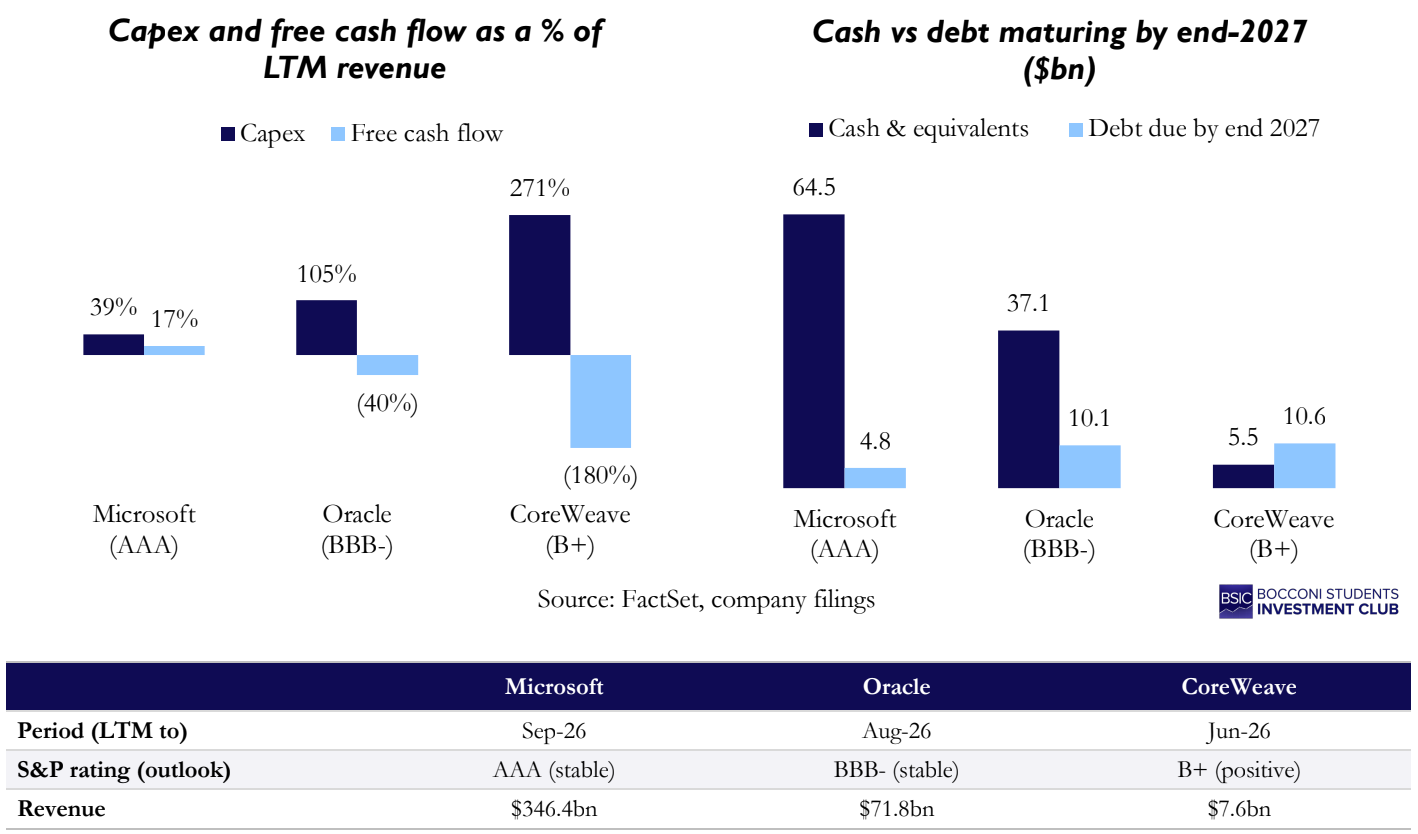
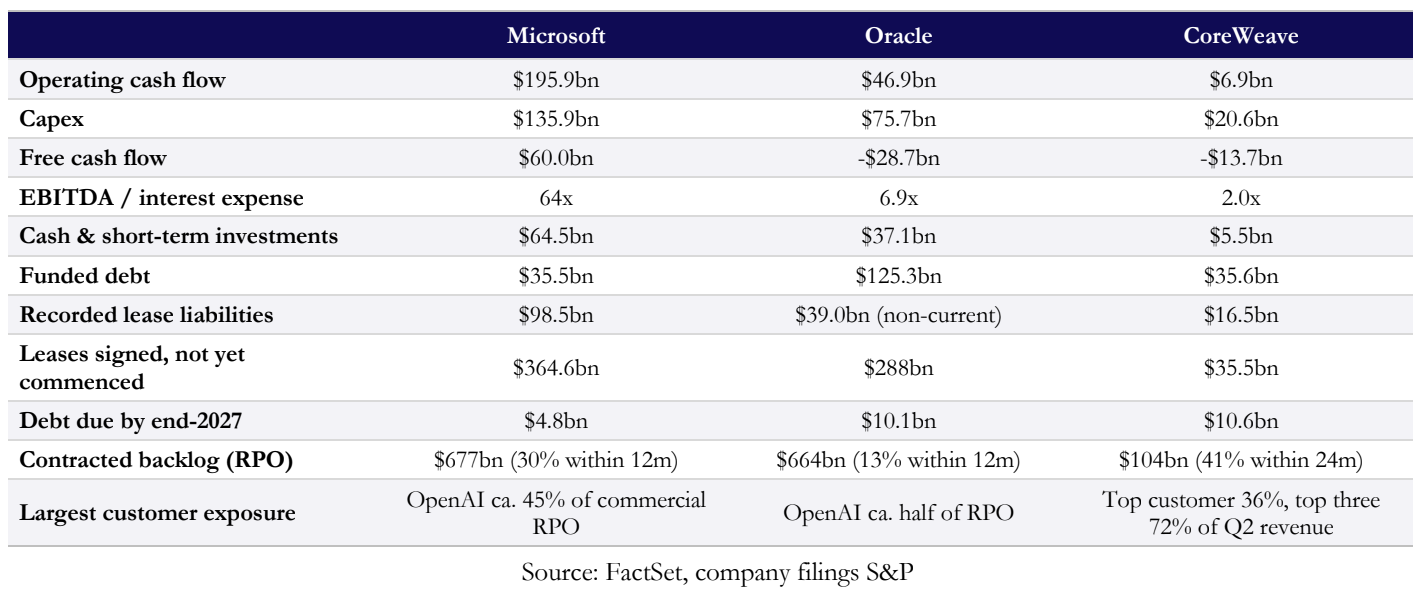
Taken together, the three cases form a clear ranking. Microsoft funds its buildout with its own cash and faces a question about returns. Oracle has turned a strong franchise into a leveraged and concentrated bet, with long-dated leases set against shorter contracts. CoreWeave depends on continuous access to credit markets and on the value of rapidly depreciating collateral. A common point also affects all three cases: OpenAI accounts for a large share of the backlog at both Microsoft and Oracle and is among CoreWeave’s largest contracted customers, so the three credit profiles are less independent than they first appear.
Reading the Signals: Credit Markets and Borrowing Costs
The differences between AI borrowers are becoming more evident in the price of their debt. However, it is important to note that an increase in bond yields does not automatically mean that a company has become less creditworthy. The yield on corporate debt can be approximated by taking the yield on a government bond of comparable maturity and adding a credit spread, with the former reflecting the wider interest-rate environment and the latter compensating investors for a number of different factors, including default risk and liquidity. Therefore, borrowers can face higher financing costs without an increase in credit spreads and falling government yields can mask a deterioration in credit pricing.
Recent CDS quotations highlight the dispersion in AI credit. LSEG and FactSet recently reported five-year protection on Oracle at 331 basis points and CoreWeave at 1,066 basis points, respectively. This gap shows that exposure to the same investment cycle can be viewed very differently with regard to repayment capacity.
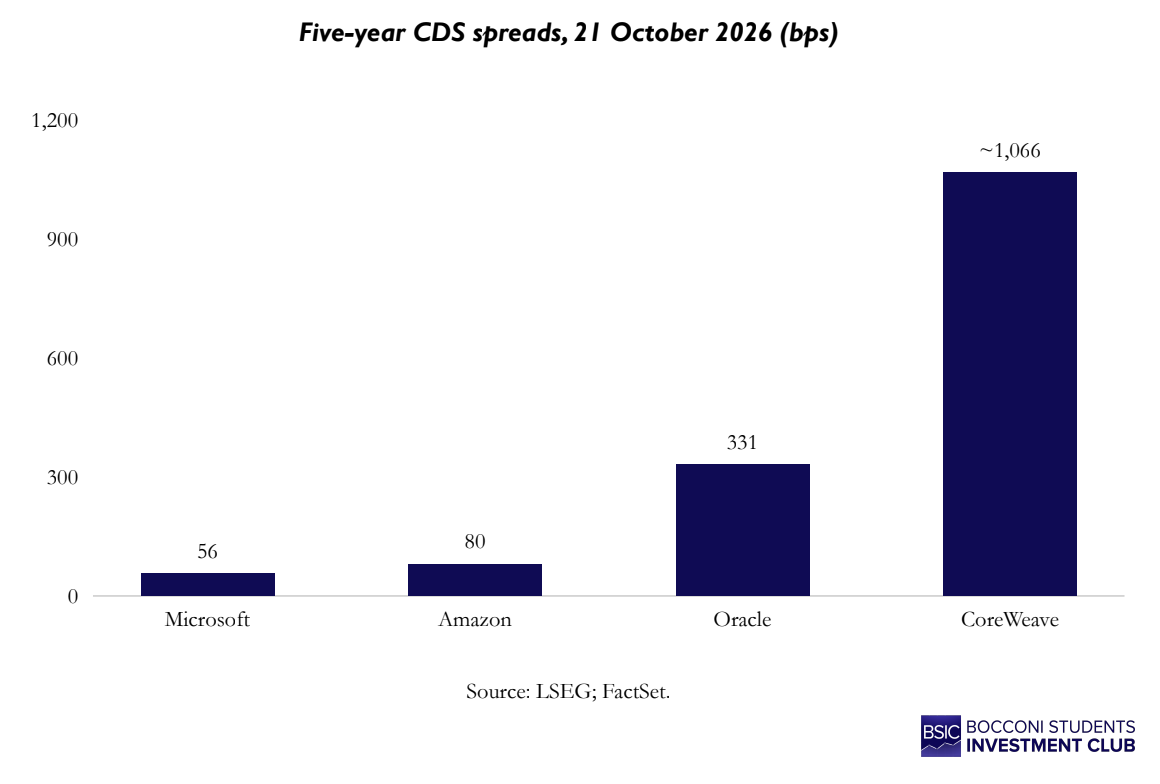
A credit default swap transfers the credit risk of a specified reference entity. The protection buyer conducts payments to the protection seller in exchange for compensation in the event of a certain credit event, such as bankruptcy or failure to pay. Settlement is associated with the difference between the protected value and the value of eligible debt after the credit event. Quoted spreads should also be distinguished from actual cash payments as your typical CDS contract includes a fixed running coupon in addition to an upfront payment that reconciles the coupon with the price of the protection in the market.
When interpreting wider CDS, a separation between deteriorating fundamentals and market technicals is required. An increase in borrowing, lower cash generation or uncertainty over contractual obligations could lead to a higher level of compensation required by creditors. Protection against credit risk could also become more expensive due to investors seeking to hedge concentrated portfolios. As seen in the FT, average weekly CDS trading volume associated with seven AI-exposed companies exceeded $9bn in September this year, versus less than $2bn in July. This, however, doesn’t necessarily imply a net bearish position, as each transaction includes both a protection buyer and seller and could include hedging, speculation or portfolio rebalancing.
Not only are investors holding the underlying bonds attracted to CDS. For example, an equity manager can buy CDS on a financing-exposed AI company with the expectation that a downturn in the sector will lead to a deterioration in its credit. If the protection then becomes more expensive, the existing contract’s value will increase and can be monetised before default. This provides a hedge against a funding shock but is an imperfect hedge against an equity downturn since reduced expected growth can significantly lower a company’s share price while leaving its debt service capacity largely intact.
Therefore, the relevant comparison with equity puts is the loss being hedged and the premium. A put gives protection below a specific share price threshold, while CDS respond to credit deterioration and to defined credit events. Credit-index protection spreads exposure among a number of borrowers, leading to a further mismatch with regard to a concentrated AI portfolio. Factors like contract maturity, trading liquidity and the requirements regarding collateral also impact the effective cost. Therefore, a lower quoted premium doesn’t establish cheaper protection against the same portfolio loss.
Spreads also price both the likelihood of default and the expected loss after default, meaning that they can widen due to deteriorating recovery prospects. CDS-implied probabilities of default depend on assumptions surrounding recovery and incorporate risk premia. Transfers of collateral or changes in the priority of creditors could lead to damage to a bond without immediately triggering its holder’s CDS.
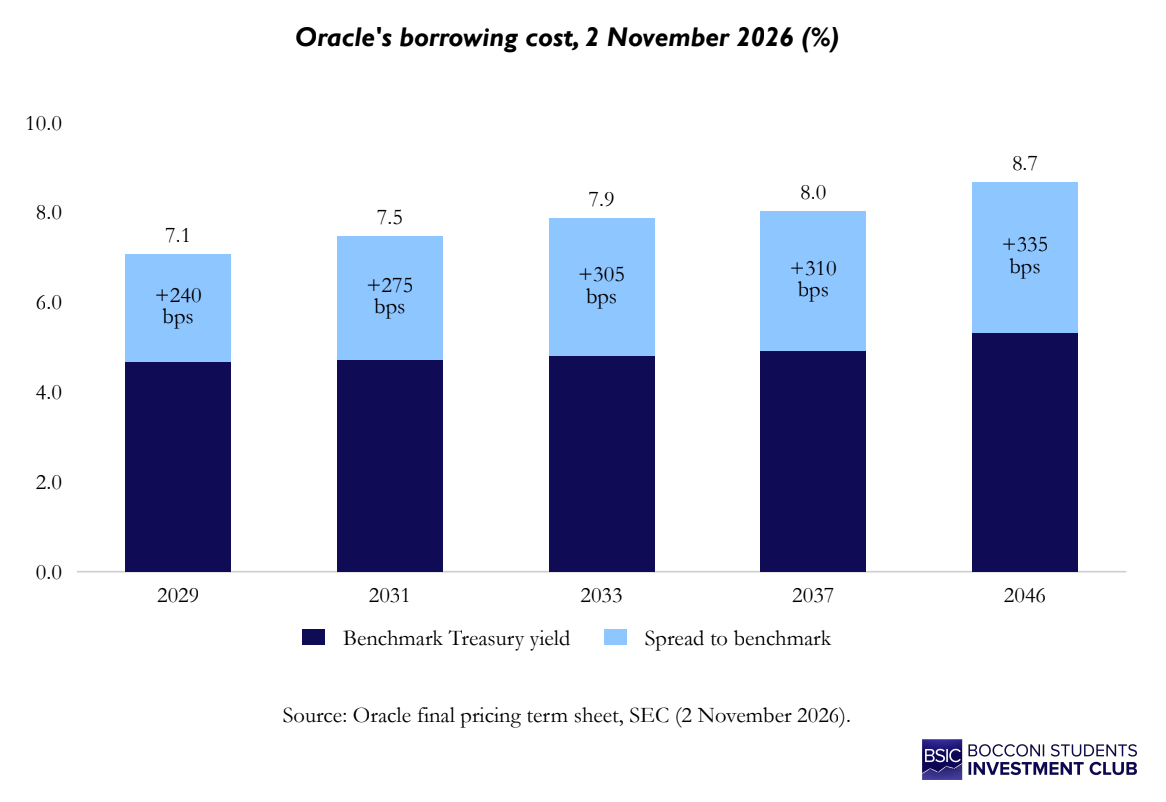
Primary issuance provides a more direct test of financing conditions. As reported by the FT, Oracle has sold $10bn of bonds with coupons ranging from 7% to over 8.5%. Alphabet’s [NASDAQ: GOOG] 19-year euro issue has a coupon above 5.2% compared to 4.5% in May. When comparing coupons, it is important to take into account issue prices and terms, but they demonstrate the larger financing burdens facing even some of the most established borrowers. A mere one-percentage-point increase on $10bn of new debt leads to an increase in annual interest expense of $100m. The chart below decomposes Oracle’s yields to maturity into the benchmark Treasury yields and credit spreads.
Government finances are part of this backdrop. The IMF has identified inflation and fiscal pressures as part of the reason for higher long-term yields, with new government issuance and uncertainty over future debt resulting in an increase in the compensation required by investors. The bond sell-off in France last month goes to show how fiscal concerns can be transmitted to bank equities and wider asset pricing. Therefore, the funding conditions faced by AI borrowers are partly dependent on forces not included in their operating performance. Floating-rate borrowing translates to higher benchmark rates very fast, while existing fixed-rate debt only reprices through new issuance or refinancing, so rising secondary-market yields won’t immediately increase its coupon.
The burden also differs depending on the credit quality of the company. According to the FT, yields are above 21% on European CCC-rated debt and 18% on its US counterparts. These levels shouldn’t be extrapolated to the highly diversified hyperscalers. This highlights how financing conditions can become particularly difficult for weaker borrowers, with stronger issuers, on the other hand, maintaining market access. Attractive yields on higher-quality debt can also result in investors becoming less willing to accept further default risk. For AI infrastructure companies, the important tests are interest coverage, available liquidity and the maturities of debt compared to the expected cash receipts.
Another result of higher financing costs is an increase in the returns required from new infrastructure, which can potentially lead to new projects being economically unviable. A slowdown in AI could lead to lower yields, while inflation or fiscal shock could depress both bonds and technology assets. The biggest signal of rising AI credit stress would be a continued widening of the credit spread, while at the same time, worse cash generation, more restrictive financing terms and a reduction in access to capital. The CDS activity on its own can’t prove that the AI buildout is becoming financially unsustainable.
From Individual Borrowers to Ecosystem Risk
The broader risk comes from the overlap between the companies responsible for funding AI development and those supplying the infrastructure for it. The BIS estimates that 55.2% of investment in AI firms between 2021 and 2025 by deal value came from other AI firms. These relationships can support innovation but also call into question whether demand is independently financed. For example, an investment in a developer can aid in funding purchases from the investor’s cloud platform, but these purchases remain partly dependent on continued access to investment capital.
Consider a developer that struggles to raise its next funding round. If they reduce computing purchases, the infrastructure provider could face lower usage while still being responsible for the financing of equipment and operating costs. Contractual protections could delay that impact, making their enforceability crucial. Construction or power delays offer a different problem where cash receipts are postponed, but financing costs still continue. A decline in GPU rental fees or the value of collateral could lead to weaker cash generation and lenders’ recovery prospects. These potential transmission mechanisms depend on each individual contract.
Separate financing vehicles distribute these exposures across a wider investor base. A data centre lender might depend on income from rent, collateral and a customer’s guarantees while a bank provides the financing to the vehicle or investors with insurers and private credit funds potentially holding the debt. However, the separation of legal entities doesn’t remove the economic exposure from the sponsoring firms for certain. The strength of the structure relies on who is obligated to keep paying after a delay, who takes on the cost overruns and whether the guarantees are able to survive termination or counterparty distress.
Recovery risk also depends on creditor protections. Transfers of assets can move valuable collateral beyond the reach of lenders, while transactions that change priority can make existing claims fall behind new debt. These liability management exercises can lead to an extension of liquidity for a borrower while simultaneously redistributing potential losses among creditors. Aston Martin and Altice are two good examples that show how asset access and documentation matter alongside repayment forecasts. With regard to AI financing, this calls for scrutiny of permitted transfers, security packages and guarantees instead of an assumption that similar transactions have already taken place. A secured claim only offers protection if its collateral and priority remain effective.
Investor behaviour can also amplify the initial shock. Concentrated positions can become hard to exit when other holders are trying to reduce risk at the same time. Open-ended funds could face redemptions while leveraged investors could face margin calls. Sales in less liquid markets will lower prices, which could create further losses and risk-limit reductions. According to the FT, distressed-credit investors have been forced to unwind some positions in the recent sell-off. These mechanisms could even transfer pressure between portfolios where issuers have no direct commercial connection.
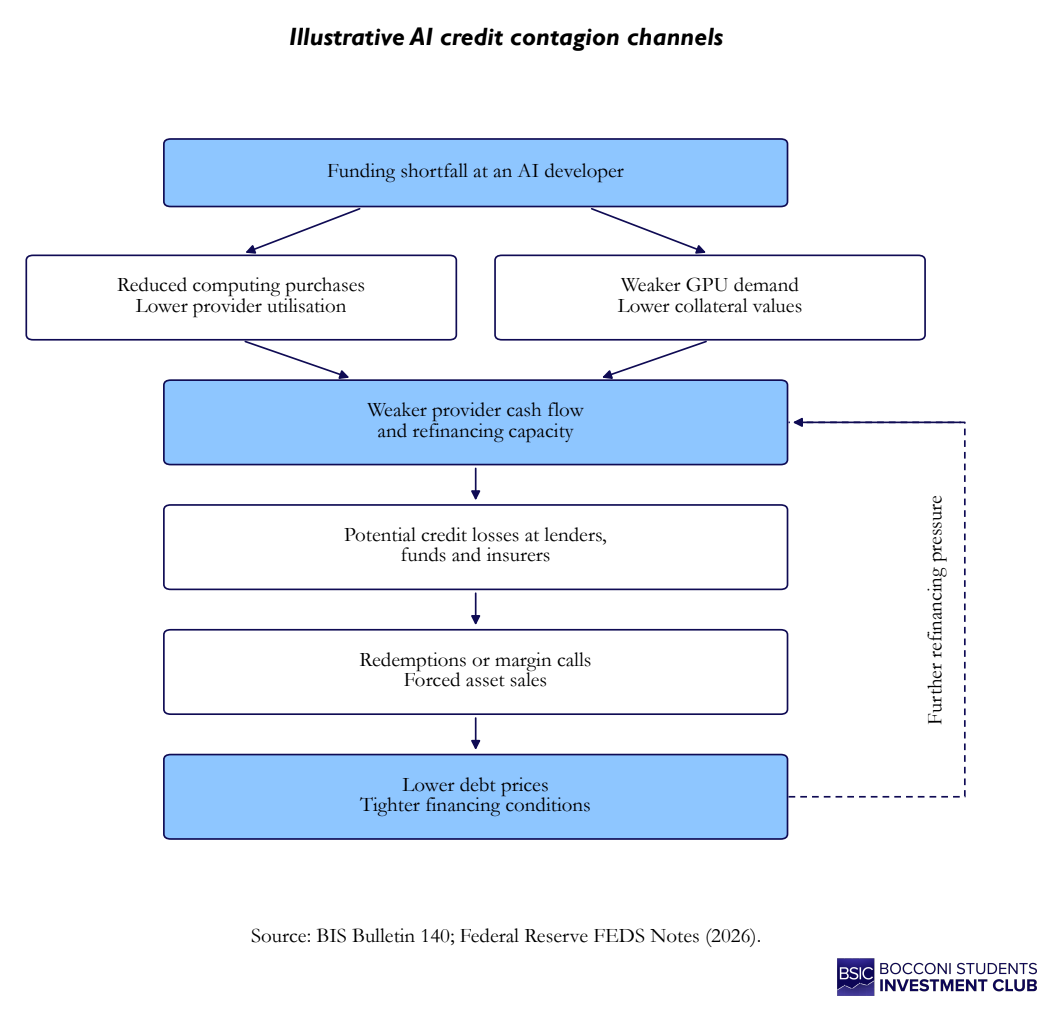
The existence of these channels doesn’t mean that broad contagion has materialised. As seen in a recent BIS study, between January and September, small, short-lived Treasury-market responses and no meaningful change in investment-grade spreads around the AI-financing news events it examined were found. This provides evidence that contradicts claims that AI borrowing has already destabilised the wider bond market. However, the consequences of continued issuance and concentrated exposures must be continuously assessed.
Three outcomes are possible. Strong demand and on-time deployment could enable utilisation and cash generation to catch up with investment, leading to debt service being supported. Another potential outcome is that AI adoption could grow with fierce competition causing a reduction in computing prices and infrastructure returns, leading to consolidation and losses for less efficient providers. A more severe outcome is one where a combination of delayed revenue and restricted refinancing leaves useful assets in financially distressed structures. Which outcome prevails depends on cash receipts, enforceability of contracts and access to replacement capital. Financial stress could lead to an acceleration in the transfer of capacity to better-funded operators even while the underlying technology continues to develop.
Conclusion
The AI infrastructure boom presents significant but unevenly distributed credit risks. While diversified hyperscalers retain considerable financial flexibility, more leveraged infrastructure providers face greater exposure to refinancing conditions, customer concentration and the uncertain returns on their investments. Recent credit-market developments suggest selective deterioration in creditworthiness alongside increased demand for protection, rather than evidence of systemic distress. Ultimately, the sustainability of the buildout will depend on whether cash generation catches up with investment commitments and whether financing structures can withstand delays, weaker pricing and changing market conditions. Even if AI adoption continues to expand, this does not guarantee attractive returns for every company financing its infrastructure.
References
[1] Microsoft Corporation, “Form 10-Q for the quarterly period ended September 30, 2026”, 2026.
[2] Oracle Corporation, “Form 10-Q for the quarterly period ended August 31, 2026”, 2026.
[3] Oracle Corporation, “Oracle Investor Day 2026: Accelerating Value Creation”, 2026.
[4] CoreWeave, Inc., “Form 10-Q for the quarterly period ended June 30, 2026”, 2026.
[5] Hamill, Lydia, and Amery, Paul, “AI’s borrowing boom: What it means for bond indices”, FTSE Russell, LSEG, 2026.
[6] Hodgson, Ramsay, and Healy, Euan, “AI debt worries spark surge in default insurance trading”, Financial Times, 2026.
[7] Dabla-Norris, Era, and Valdés, Rodrigo, “Rising Sovereign Yields Raise the Fiscal Stakes”, International Monetary Fund, 2026.
[8] Healy, Euan, “Junk debt rout sparks ‘bloodbath’ for credit investors”, Financial Times, 2026.
[9] Frost, Jon, et al., “Circular relationships among AI firms”, BIS Bulletin No. 137, Bank for International Settlements, 2026.
[10] Drehmann, Mathias, and Eren, Egemen, “Building AI on credit: structures and spillovers”, BIS Bulletin No. 140, Bank for International Settlements, 2026.



0 Comments