Germany’s chemical industry, long the backbone of the country’s industrial base, is going through its deepest crisis in decades. Sales have fallen by around a fifth since 2022, and Germany accounts for the largest share of Europe’s announced plant closures. In this article, we first look at the structural squeeze from high energy costs, Chinese overcapacity and years of underinvestment, then at the deals and restructurings reshaping the sector, from BASF’s carve-outs to its bid for Evonik, and finally at the policy response from Brussels and Berlin.
The Squeeze: Energy Costs and Chinese Overcapacity
Market Share Shift: Europe’s Share of Global Chemical Sales has Fallen; China’s has Risen
Europe, and Germany in particular, is losing market share in the chemicals industry it has long dominated, while China is taking it.
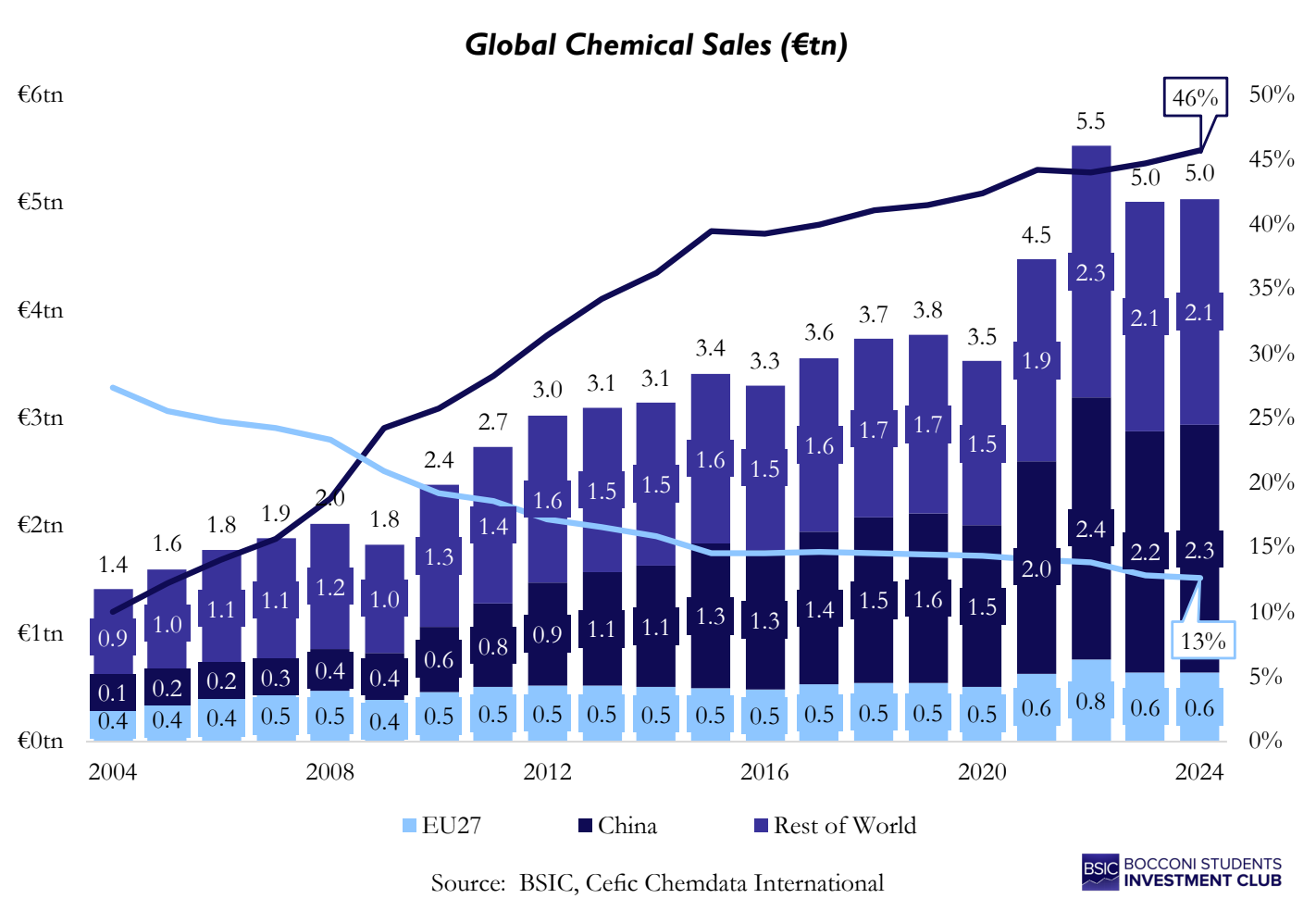
The European Union’s (and Germany’s) global share of chemical sales has experienced negative growth over time, while that of China has consistently increased, from 10 to 46 percent between 2004 and 2024, while the European Union’s share fell from 27 to 13 percent over the same two decades.
Using sales data does not distinguish between exports and domestic consumption. Hence, it is worth noting that on an export basis the shift has not been as dramatic. The immense growth of the Chinese economy has boosted domestic consumption and sales, driving up not only global totals, but also China’s share thereof. The corollary is, however, that, while Europe and Germany maintained and at times moderately grew their production bases, China has been able to establish itself as increasingly globally competitive.
We can allocate the key drivers behind this shift into two buckets: a cost basis (energy), and a volume basis (Chinese overcapacity).
Energy Costs: Why Europe Sits at the Top of the Energy Curve
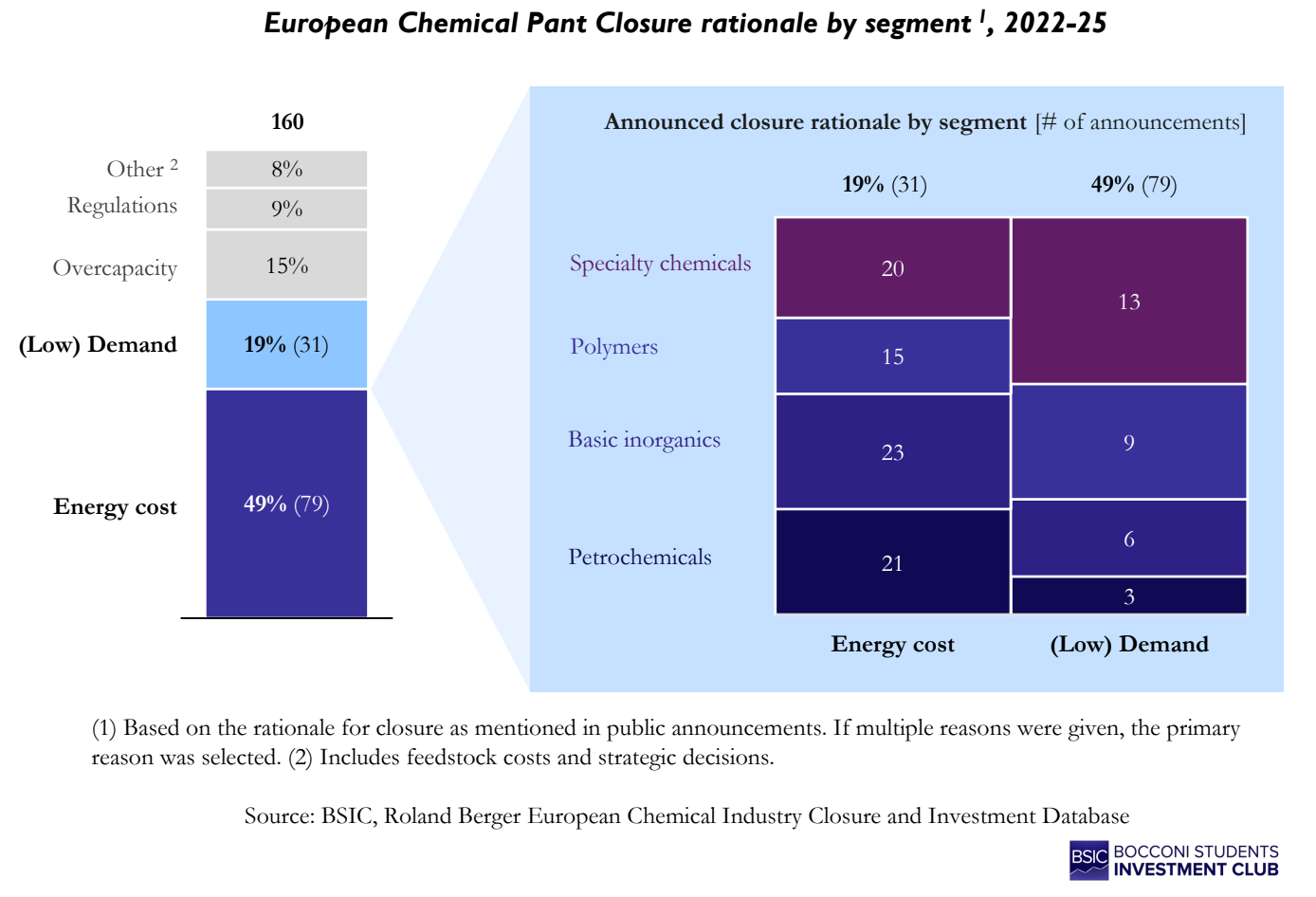
Energy is the primary cost gap between the Chinese and European production bases, and the reason for half of all European chemical plant closures over the 2022-2025 period. By virtue of the Iranian war, the current figure is likely higher.
Since 2022 alone there have been two seriously major developments driving the spread. The first came with the start of the Russia-Ukraine war, in which Europe, and in particular Germany, was faced with the reality of its energy reliance on Russia, and the resulting effects that sanctions had on domestic energy prices. China on the other hand, with little incentive to sanction Russia, and a tremendous incentive to take advantage of the situation, became, and has continued to be, the largest importer of Russian oil.
As European energy prices began stabilizing, and the spread narrowed, the United States and Israel launched Operation Epic Fury, marking the start of the Iranian war, famously leading to the closure of the Strait of Hormuz, disrupting the global oil supply and once again severely raising energy inflation. In contrast to the 2022 disruption, China’s energy cost base has also suffered from the Strait closure. Critically however, China’s reliance on domestic coal and expanding renewables has effectively decoupled its manufacturing engine from the global energy panic.
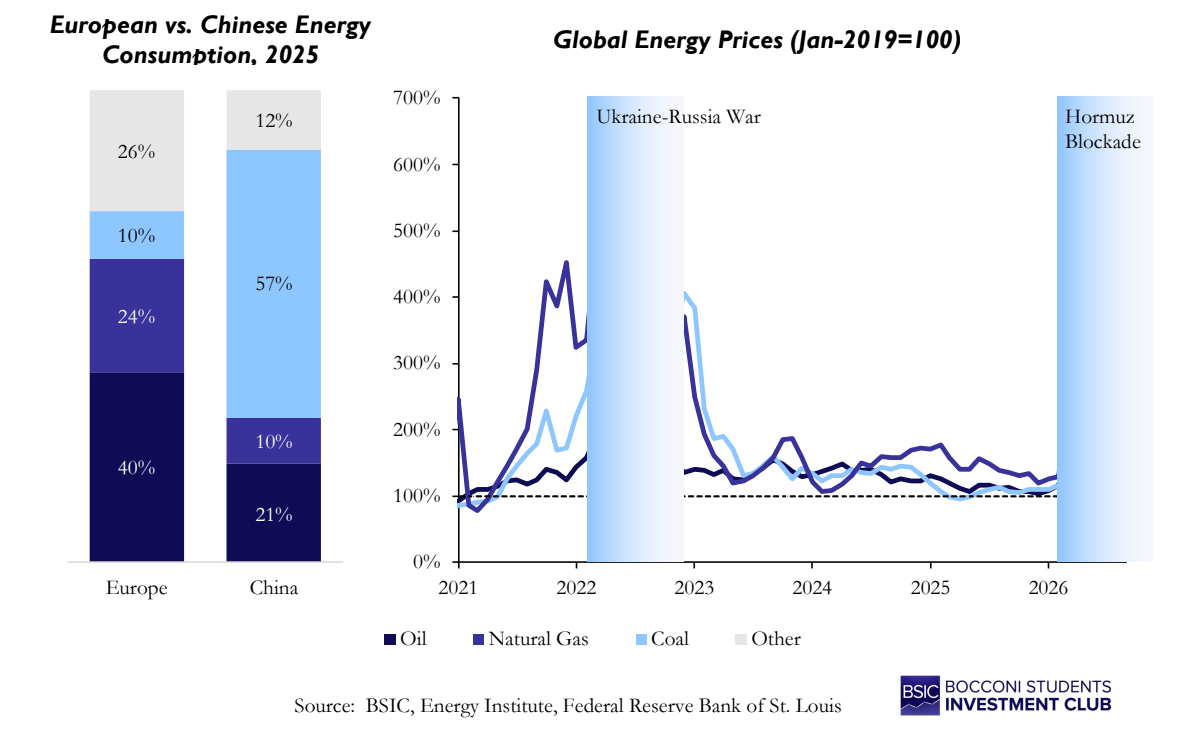
In chemical production energy is not just an operational expense, but it is a raw material. Ammonia for instance is made using nitrogen and hydrogen gas, in which the hydrogen gas is derived from natural gas. Hence, chemical producers are uniquely sensitive to changes in energy prices. Due to the competitive nature of the industry, higher energy costs also cannot be passed on to consumers – basic chemicals are inherently identical regardless of producer. It is for this reason that German chemical firms are opting to close basic chemical plants and maintain specialized facilities, as customers of the latter are more willing to accept higher prices.
High costs alone are survivable in a tight market; Europe’s problem is that the market is flooded.
Chinese Overcapacity
China’s surplus comes from a subsidised build-out that ran ahead of demand. When its property market collapsed, the extra output went abroad and dragged world prices down to Chinese costs.
“Between 2019 and 2024, China installed more new ethylene and propylene capacity than the entire existing base of Europe, Japan, and South Korea combined.” As with the automotive and photovoltaic industries, China applied its playbook of local governments and their application of cheap land and tax perks to drive the chemical buildout. When Chinese domestic demand growth fell from ~9% per annum between 2010 and 2020 to ~2%, as the property slump hit construction, extra output was exported. Furthermore, producers kept running despite “persistent low or negative profit margins” to hold market share, and China became a net exporter of polypropylene, PVC and PET.
We can take these closures back to first principles economics. Chinese plants are built for self-sufficiency, not returns. As long as they cover running costs, they keep producing and export the rest. That sets a marginal cost, which, assuming perfect market competition, will eventually equal the price of goods sold. Due to Europe’s higher cost base, chemical plants there exhibit a higher marginal cost than their Chinese counterparts, which inevitably drives European plant closures.
Another angle worth mentioning is US tariffs. As of October 2026, the US tariff rate on Chinese chemical imports lies at 40.5%. Meanwhile, less any one-off anti-dumping interventions, there exists no EU tariff against Chinese chemical imports. As a result, a disproportionate amount of Chinese chemicals is imported into the union, worsening the effects on domestic chemical producers.
German Underinvestment
Germany’s struggles are however partly self-inflicted. Years of underinvestment in its chemical base meant that when the energy shocks hit, basic chemical plants were already uncompetitive.
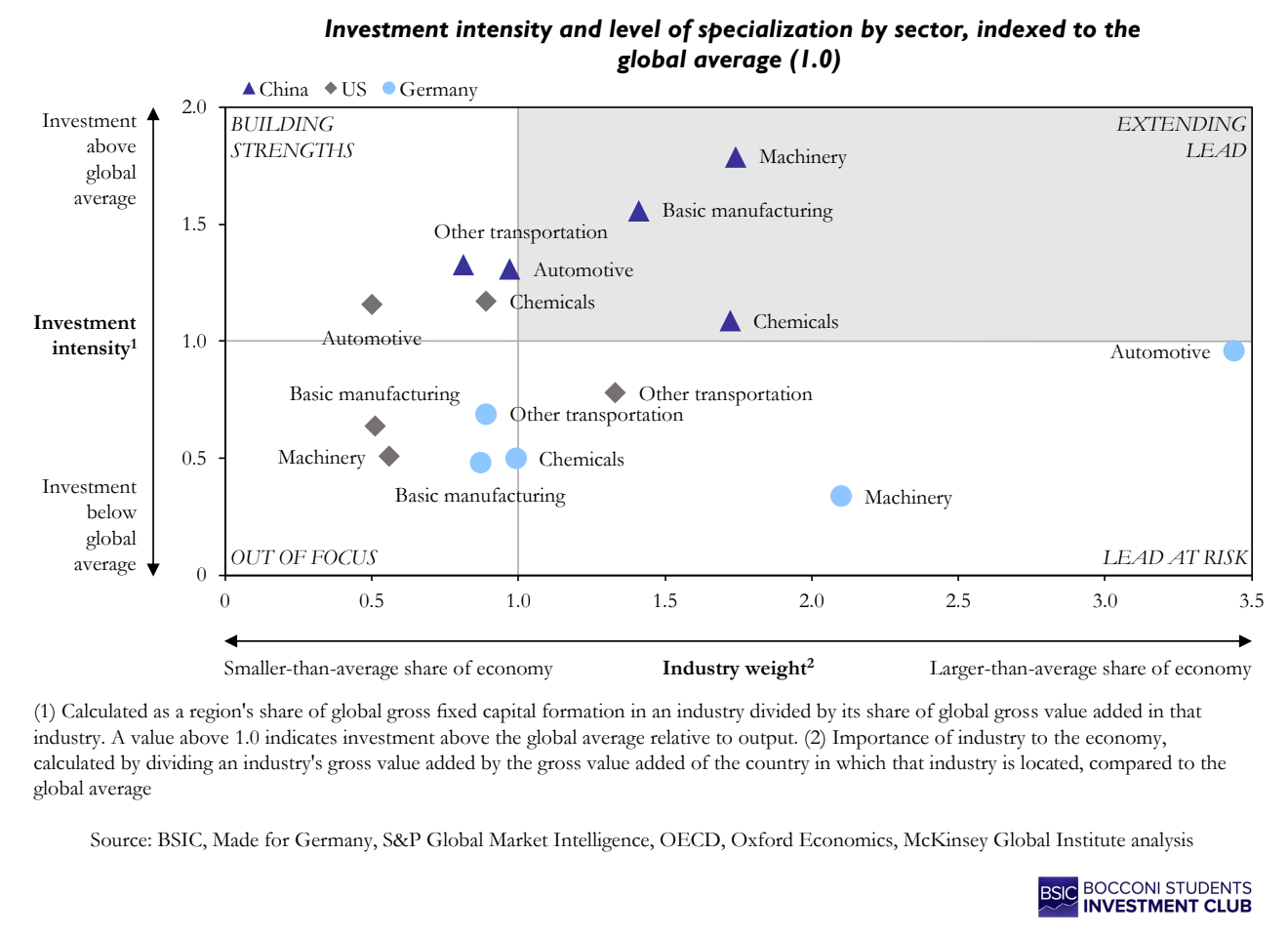
The above graph illustrates the underinvestment of German industries over the last decades, compared to the intense investment of its Chinese counterpart. Germany’s chemicals sector has underinvested (c.0.5x the global average) while China’s invests above average (c.1.1x). In fact, Germany makes 33% of EU chemical sales but received only 10% of new investment in 2022–25. Instead, much of Germany’s and the EU’s capital has been allocated abroad. For instance, BASF invested €8.7bn into its new Zhanjiang site in China rather than into home turf: Germany.
The issue of underinvestment in Germany and, to some extent, Europe as a whole is not chemical-specific. The good news is that the issue has become increasingly recognized. Germany’s 2025 debt-brake reform and €500bn infrastructure fund provide a real starting point to catch up on decades of fiscal hawkishness, but many argue the package is “too weak and too slow” for the chemicals industry to make a recovery.
On a positive note, while industries may shift, and perhaps Germany and Europe may never regain their lead in the global chemicals industry, Germany specifically is becoming an increasingly attractive place to invest, including for foreign capital. The aforementioned fiscal underinvestment means that there is not only an opportunity to invest in renewing and emerging infrastructure and developing technologies, but also that the country’s sovereign credit burden is far below that of many of its European peers. Against the backdrop of globally leading rule of law and stability, Germany has an opportunity to, in the long run, successfully compensate for the current loss of its basic chemicals industry.
Deals and Consolidation
Overview of the core trends and the chemical sector’s state
Germany’s chemical industry is facing structural cost pressures, stemming from expensive energy (war between Ukraine and Russia and that in the Middle East), needed both as feedstock and used for powering the production process, as well as Chinese oversupply and imports. To remain competitive compared to alternatives in China, the US and the Middle East, German chemical producers have adopted a strategy centred around focusing on core assets and businesses and divesting from standalone units. This tendency appears in the strategic plans of both BASF [ETR:BAS; market cap as of 06/11/2026: €48.4bn] (Winning Ways) and Evonik [ETR:EVK; market cap as of 06/11/2026: €9.8bn] (Tailor Made Restructuring Programme), which are, respectively, the biggest and second biggest firms in Germany’s chemical industry.
Winning Ways was first presented by BASF’s CEO Markus Kamieth during September 2024’s Capital Markets Day hosted at BASF’s headquarters in Ludwigshafen, which is also the home of the firm’s Verbund sites (a term that BASF uses to describe their integrated system, essentially production of one plant becomes feedstock for the next). The plan splits the assets controlled by the firm into two categories, which are the centrepiece assets tied to the integrated site of the company and the standalone business units, which compete directly with pure play producers. The two groups are run differently, with focus shifting towards growth initiatives in the centrepiece assets, while some of the standalone businesses, such as BASF Coatings and Agricultural Solutions (planned sale of a stake in an IPO), are being exited due to the belief that they are worth more on their own than under the BASF umbrella.
As for Evonik’s strategy, it is defined by the firm’s RX programme named Tailor Made and its sharpened growth approach. It plans to set up the portfolio of the firm according to roles and assign site-specific tasks and objectives to each major site that Evonik owns in Germany. In addition, the firm has established target growth projects set to improve the company’s geostrategic balance. Examples of these are two started in Canada and Slovakia (total volume announced to be in the nine-figure euro range), focusing on the healthcare and biotechnology businesses. The move reflects the growing focus of Evonik towards the speciality chemicals business. Evonik is also set to discontinue its polyester and other large businesses in its portfolio, namely Oxeno GmbH and Syneqt GmbH. Additionally, Tailor Made includes 3,200 job cuts worldwide, 2,150 of which will be in Germany until 2029.
The trend towards focusing on core businesses to remain globally competitive is clearly illustrated in the approaches adopted by the industry’s two biggest players. Their assets are usually taken over by private equity, Gulf capital or large consolidators. To gain a deeper perspective of the picture, consider the following recent transactions.
BASF Coatings’ 60% stake sale to Carlyle and QIA
This transaction illustrates BASF’s commitment to unlocking the value of its standalone units. On Oct 10th, 2025, the firm announced that it entered into a definitive agreement to sell a 60% stake in its automotive coating business to Carlyle [NASDAQ: CG] and QIA (Qatar Investment Authority). The deal closed on July 1, 2026. The firm was renamed Surventis, with BASF holding a 40% stake, allowing it to participate in potential upsides of the new entity, driven by Carlyle’s extensive experience and successful track record pursuing industrial and chemical carve-outs. The unit was sold at an EV of €7.7 bn. When the sale of its decorative coatings division is also factored into the equation, the total value of the coatings business of BASF comes to €8.7 bn, or roughly 13x 2024 EV/EBITDA (before special items). BASF received a total of €5.8 bn in pre-tax proceeds from the transactions. The deal represented a key milestone of the Winning Ways plan and is a prime example of the ongoing M&A trends in the German chemicals industry.
Evonik’s planned sale of C4 Chemicals (Oxeno) and Syneqt
Oxeno GmbH is a chemical producer that processes C4 streams (the four-carbon fraction that comes out of crude oil refining and steam cracking). Then it turns that stream into a range of large-volume intermediates, mainly at Marl (Germany) and Antwerp. Among the products it sells are Butadiene, 1-butene, Oxo Alcohols and more. In its Q3 (Nov 4th 2026) presentation, Evonik indicated that the sale of Oxeno is going as planned and it’s aiming to sign the deal in a few months. As for Syneqt, which is an infrastructure services spin-off that operates chemical parks, Evonik intends to launch the best owner process immediately after signing the deal for Oxeno. The planned sales reflect the trend of greater focus on core businesses in German chemicals.
BASF’s bid for Evonik
Now that the two biggest players in the German chemicals industry and their strategies have been properly introduced, it’s time to dive into the development of the potential acquisition of Evonik by BASF. BASF’s initial proposal was announced at the end of September and came to €22.15 per share, representing a 29% premium to the share price of Evonik prior to the announcement. The offer valued Evonik’s equity at €10.3 bn. The firm rejected the offer on the 28th of September, describing it as too low to warrant any official negotiations or allow BASF to conduct any due diligence. Following this, BASF increased its bid to €24 per share, resulting in an equity valuation of Evonik at €11 bn, after which Evonik still insisted that the offer undervalues the assets of the company. Evonik left the door to potential discussion open, though, expressing willingness to participate in purely informal negotiations and to remain fully confidential. Rejection comes even after BASF’s CEO Markus Kamieth outlined that job guarantees made by Evonik that extend until 2032 will be upheld in the case of completion. A very important factor in the feasibility of the transaction is the RAG Foundation, which holds a 44% stake in Evonik. Under German law, a 25% stake is a blocking minority, so the entity’s approval must be received for the deal to happen.
Besides the fact that the transaction involves the number one and number two players in the German chemical industry, making it the largest possible merger in the sector, with the combined entity having €74 bn of annual sales for 2025, this deal is also interesting for another reason. Evonik is interesting to BASF since its portfolio is more specialised than that of BASF, including positions in speciality chemicals, additives, performance materials and intermediates, which creates several areas of potential strategic fit. The proposed transaction faced criticism, though, as expressed in a report by ION Analytics. A source familiar with the matter argued that the transaction, which is set to align the European chemical market, which already suffers from weak demand and increasing threats from Chinese rivals, makes no sense. Furthermore, the source in question went on to say that this deal goes against everything that BASF’s CEO has been doing from 2024 up until now and goes against the Winning Ways strategy. The report went further to state that the rationale behind the deal is far from clear and goes contrary to the entire value creation plan that the acquirer has been employing. The lack of clarity is also supported by the lack of engagement by BASF with the market on what the rationale behind the transaction is. Were the deal to progress, the best strategy would be to conduct a large number of carve-outs. BASF would have to exit several units immediately, given the size of the deal and the strict regulation in Germany; this is likely to face significant backlash, further complicating the transaction.
Overlooking the potential issues related to the deal, it provides a clear reflection of the appetite for consolidation of key players in the sector, in a further attempt to strengthen the position of the German chemicals sector globally.
ADNOC (XRG)’s acquisition of Covestro
ADNOC (Abu Dhabi National Oil Company) acquired Covestro, a leading manufacturer of high-performance polymer materials, via its international subsidiary XRG. The deal closed in December 2025, and ADNOC paid €14.7 bn for Covestro. It reflected ADNOC’s ambition to diversify its holdings as the world is increasingly moving away from fossil fuels. At the time, this was the largest takeover a Gulf country had done in the EU, and it is a clear example of the interest of capital from the region in European markets.
LANXESS – Envalior, and Advent passing on acquiring a 41% stake in 2026
LANXESS is a German speciality chemical group, which owns a stake in Envalior that was formed after a merger between LANXESS’s high-performance materials business and that of DSM. Advent International holds a majority. Advent eventually backed out, but it does represent the interest of private equity capital in the chemicals sector in Germany. The deal did not go through as planned due to the rising costs stemming from the supply chain disruptions and geopolitical conflict in the Middle East. This deal highlights the fact that PE has capital ready, but it is increasingly more selective about transactions and valuations as it factors in the geopolitical risks currently present.
Outlook
The future outlook of the chemicals industry in Germany is characterised by structural headwinds. High energy and carbon costs, geopolitical tensions around the world, overcapacity in China, and only a modest recovery in downstream demand for chemical products continue to put pressure on margins. Given the approach undertaken by firms to focus on core assets, as illustrated by the strategies of BASF and Evonik to address the current environment and poor competitiveness of the sector with greater focus, deals such as the sale of BASF Coatings and the planned divestments of Oxeno GmbH and Syneqt are expected to continue, especially if large deals such as the potential purchase of Evonik by BASF occur. The feasibility of such deals largely depends on the availability of buyers willing to pursue carve-outs, as Carlyle did with the purchase of BASF’s automotive coatings unit. Private equity has availability of capital, but with Advent passing on the purchase of a stake in Envalior, it was clearly shown that the industry is cautious and selective about how it invests its resources. The completion of such deals will largely depend on the willingness of sellers to take lower valuations and that of investors to hold for prolonged time periods until the cycle turns around.
The Policy Response: Subsidies, Deregulation and Trade Defence
The Commission’s Chemicals Industry Action Plan of 8 July 2025 marked a shift in European chemicals policy from stricter regulation towards industrial competitiveness, in response to high energy costs and global competition. Brussels now concentrates on bringing down energy costs, easing regulation and defending the market against imports. Berlin followed with its National Chemicals Agenda in March 2026, developed with the chemical industry association VCI, which sets out similar priorities for the German industry. Each of these measures offers only temporary or limited protection compared with the cost gap European producers face against international competitors, especially because of higher energy prices.
One of these measures is easing regulation, as the Commission has set aside the full REACH revision it had planned since 2020. REACH is the EU’s central chemicals regulation, and in April 2026 Environment Commissioner Jessika Roswall confirmed that its revision would not be pursued during the current mandate. The Commission will instead check imports more closely, since the European Chemicals Agency (ECHA) found that one in three substances in imported mixtures lacked the required registration, which puts producers that comply at a disadvantage. The main exception to this easing is the universal restriction of PFAS, a group of more than 10,000 synthetic chemicals with very persistent carbon–fluorine bonds. The restriction was proposed in January 2023 and poses the largest remaining regulatory risk for the German chemical industry. Although ECHA’s assessment should be completed by the end of 2026, a binding rule may take until 2029 or 2030, as the Commission still has to draft a legal text and member states have to vote on it. German chemical producers will therefore remain uncertain about which of their products and processes will be affected until the restriction is adopted. Elsewhere, Omnibus VI, the Commission’s bundle of changes to chemicals, cosmetics and fertiliser rules, reached a provisional deal on 17 June, when Council and Parliament agreed to ease labelling rules. The Commission estimates the savings from Omnibus VI at no less than €363m a year. Although this lowers compliance costs, the relief is small for an industry with annual sales of several hundred billion euros and offers little protection against the energy cost gap.
Easing regulation also does little about high energy prices, which are one of the main reasons for European plant closures. Germany has responded by subsidising cheaper electricity for energy-intensive industries, including chemicals. Its main instrument is the Industriestrompreis, which sets a target price of 5 cents per kWh and was approved by the Commission on 16 April 2026. In practice, however, the support covers just half of a site’s electricity consumption and runs only until 2028, while grid fees, taxes and levies are not reduced. Because of these limits, the VCI estimates that for most companies the relief amounts to less than 10% of their electricity purchase costs. The cost gap therefore remains large, as the European Chemical Industry Council (Cefic) reports that gas in Europe still cost 3.3 times as much as in the US in early 2026, while EU chemical output in April was 16% below its 2014 to 2019 average.
Alongside these subsidies, the EU is increasingly relying on trade defence measures to protect its chemical producers from imports. According to the Financial Times, chemicals now account for almost half of the EU’s new trade defence cases, with 24 dumping investigations on chemicals over two years. Several investigations have already ended in duties, with adipic acid from China, for example, facing rates of 29.1% to 42.3% since May 2026. In September 2026, the Commission then opened a new investigation into polyvinyl chloride (PVC) imports from China, South Korea, Taiwan and Mexico. Yet this protection is small compared with the problem, since the adipic acid duties cover approximately €130m of Chinese imports, whereas the EU imported €34.1bn of organic chemicals from China in 2025 alone. Duties also come with a cost for the industry’s own customers, as converters and distributors have warned that duties on PVC would raise resin prices. The same logic applies to foreign takeovers, as the Commission cleared ADNOC’s purchase of Covestro under the Foreign Subsidies Regulation only after ADNOC, a state-owned company, committed to remove an unlimited state guarantee and to give EU companies access to Covestro’s sustainability patents. These commitments address the advantage that state backing could give ADNOC, but they cannot narrow the cost gap that puts European producers under pressure.
China has now also turned to trade defence against EU chemicals, with its commerce ministry opening a dumping investigation on 3 October 2026 into imports of p-nitrotoluene, a chemical intermediate used in dyes and pesticides. The investigation follows a request from two Chinese producers, who argued that low-priced EU imports were undercutting them, with prices falling by almost 60% between 2022 and 2025. It also came days after the EU opened its PVC investigation, which points to possible retaliation, although China has not described the move that way. For an export-oriented industry like Germany’s, such retaliation would be a real risk, because duties that protect the domestic market could cost its producers access to markets abroad. And even without retaliation, duties cannot give German producers the lower energy costs they need to compete, either domestically or abroad.
Taken together, the subsidies, the regulatory relief and the trade defence measures give German chemical producers only temporary or limited protection from higher energy costs, because none of them closes the energy cost gap itself. The Industriestrompreis reaches only part of a site’s electricity use and ends in 2028, the regulatory savings are small next to the size of the industry, and duties protect individual products while raising costs for customers. Policy has therefore bought time without changing the position of German producers, so companies must still decide which plants are worth keeping. These decisions will significantly affect future deals in this sector, from sales of the plants that companies give up to takeovers by foreign buyers such as ADNOC.
Conclusion
Germany’s chemical industry is not facing a passing downturn but a structural shift. Energy costs, driven up first by the loss of Russian gas and then by the closure of the Strait of Hormuz, keep European producers at the top of the global cost curve, while China’s subsidised overcapacity has pushed world prices down towards Chinese costs. Years of underinvestment at home meant that many basic chemical plants were already uncompetitive when these shocks hit.
The industry’s response has been to narrow its focus. BASF and Evonik are concentrating on their core and speciality businesses and selling or closing the rest, with private equity, Gulf capital and large consolidators as the main buyers, as the sale of BASF Coatings to Carlyle and QIA and ADNOC’s takeover of Covestro show. BASF’s bid for Evonik points to consolidation as a possible next step, although Evonik’s rejections, the RAG Foundation’s blocking stake and doubts over the strategic rationale make its outcome uncertain. At the same time, Advent’s withdrawal from Envalior shows that buyers remain selective and that sellers may have to accept lower valuations.
Policy has eased some of the pressure without removing its cause. Lighter regulation, the subsidised industrial electricity price and a growing number of anti-dumping duties offer relief, but this relief is temporary, limited in scale and partly offset by higher costs for downstream customers and the risk of Chinese retaliation. None of these measures closes the energy cost gap itself.
The likely result is a smaller German chemical industry, built around speciality chemicals and integrated sites rather than commodity volumes. For investors, this means continued carve-outs, restructurings and consolidation in the years ahead, with the BASF–Evonik talks, Evonik’s sales of Oxeno and Syneqt and the planned IPO of BASF Agricultural Solutions as the deals to watch. Whether Germany can turn its fiscal room and renewed investment push into a new competitive advantage will decide how much of its chemical base remains.
References
- CNBC, “China defies sanctions to make Russia its biggest oil supplier in 2023”, 2024
- Oliver Wyman, “Rebound for Europe’s commodity chemicals may come in 2035”, 2026
- Daily Maverick, “China’s plastics boom is set to create another trade headache”, 2024
- Tariffs Tool, “Tariffs on chemicals from China”, 2026
- Financial Times, “EU anti-dumping complaints against Chinese chemicals at record high”, 2026
- Cefic, “Chemical plant closures surge six-fold in Europe since 2022, reaching 37Mt, new report finds”, 2026
- EY, “Deutsche Chemieindustrie mit Umsatz- und Beschäftigungsrückgang”, 2026
- CHEManager, “BASF CEO Markus Kamieth presents new strategy”, 2024
- Evonik, “Evonik sharpens growth strategy”, 2026
- Carlyle, “BASF and Carlyle reach binding transaction agreement on Coatings business”, 2025
- BASF, “BASF and Carlyle complete Coatings transaction”, 2026
- Evonik, “Q3 2026 Conference Call Presentation”, 2026
- Reuters, “Evonik rejects $11.7 billion BASF takeover bid, FT reports”, 2026
- Börsen-Zeitung, “Evonik weist BASF-Offerte zurück”, 2026
- ION Analytics, “Evonik-BASF outlook clouded by strategic confusion, political pitfalls”, 2026
- Prismane Consulting, “BASF and Evonik: Can consolidation solve Europe’s chemical asset competitiveness problem?”, 2026
- LANXESS, “LANXESS: Update on ENVALIOR Stake”, 2026
- FTI Consulting, “The Chemistry of Uncertainty”, 2026
- European Commission, “A plan for a stronger EU chemical industry”, 2025
- Bundesministerium für Wirtschaft und Energie, “Nationale Chemieagenda vorgelegt”, 2026
- Council of the European Union, “REACH Regulation: the way forward”, 2026
- Keller and Heckman, “Second public consultation on PFAS EU restriction just started”, 2026
- Eunews, “EU Council and Parliament agree to simplify rules on chemicals”, 2026
- International Trade Administration, “EU introduces chemicals simplification omnibus”, 2025
- Bundesministerium für Wirtschaft und Energie, “Industriestrompreis wird eingeführt”, 2026
- SteelOrbis, “EU approves €3.8 billion Germany aid scheme for energy-intensive industries”, 2026
- Verbandsbüro, “Industriestrompreis genehmigt: EU-Kommission gibt grünes Licht, doch Entlastung bleibt gering”, 2026
- Bundesministerium für Wirtschaft und Energie, “2026 wird Energie spürbar günstiger”, 2026
- Cefic, “Cefic’s Chemical Trends Report Q1 2026 is out”, 2026
- European Commission, “Commission acts against unfairly traded imports of adipic acid”, 2026
- Argus Media, “EU PVC anti-dumping duties to be applied retroactively”, 2026
- INEOS, “INEOS welcomes European Commission investigation into unfair PVC imports and calls for urgent reform of EU trade defence”, 2026
- Macfarlanes, “European Commission conditionally approves ADNOC/Covestro deal”, 2025
- Outlook India, “Days before EU talks, China opens probe into European chemical imports”, 2026
0 Comments