USA
US markets ended the week with a relief rally after September’s employment report on Friday weakened the probability for another immediate Federal Reserve rate increase later in October. Nonfarm payrolls rose by just 29,000, while the unemployment rate rose up to 4.2%. July and August employment gains were revised down by a combined 60,000. Wage growth also fell to its lowest annual level since May 2021, with average hourly earnings increasing by 0.1% on the month and 3.0% over the year. Together, these figures suggested that labour-market conditions were cooling, giving the Fed more room to assess the effects of its September tightening.
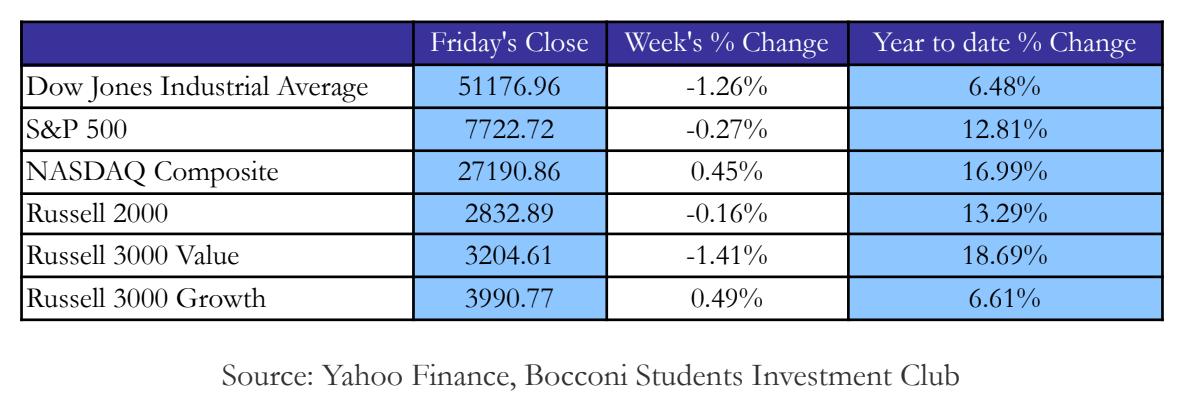
Technology shares led Friday’s recovery. The Nasdaq Composite gained 1.19%, the S&P 500 rose 0.73%, and the Dow Jones added 0.49%. However, the rebound did not fully reverse the losses accumulated earlier in the week. The S&P 500 finished approximately 0.27% lower, while the Dow declined 1.26%. The Nasdaq outperformed with a weekly gain of 0.45%, whereas the Russell 2000 slipped around 0.16%.
The divergence highlighted a selective appetite for risk. Investors welcomed the prospect of less immediate monetary tightening, but the recovery remained stronger in technology than in the broader market. Weaker employment can support valuations by reducing interest-rate expectations, although a sustained slowdown would also raise concerns about consumer spending and corporate earnings.
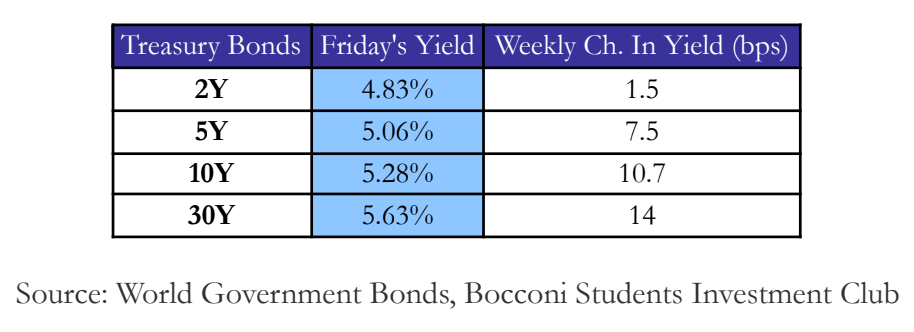
US Treasuries experienced another volatile week. Friday’s weaker employment report initially triggered a bond rally, but yields subsequently reversed higher as investors continued to weigh the longer-term inflation and interest-rate outlook. The 10-year Treasury yield ended around 5.28%, despite the reduced prospect of an immediate Fed hike. Reported Treasury par yields stood at approximately 4.83% for the two-year maturity, 5.06% for the five-year, and 5.63% for the 30-year. The greater yield increase at the long end steepened the curve over the comparison period. The market’s message was that less hiring could delay further policy tightening without necessarily bringing long-term borrowing costs down. Expectations for the next Fed meeting and the compensation investors demand for holding longer-dated bonds remained distinct influences.
Europe and UK
European equities had a similar difficult week with rising borrowing costs, inflation concerns and uncertainty over France’s public finances. Selling pressure pushed the STOXX 600 to its lowest level in more than three months on Thursday, before markets recovered on Friday. The rebound provided some relief, but was not enough to erase the week’s losses. Friday’s inflation release showed why investors remained cautious. Eurostat estimated September euro-area inflation at 3.8%, with energy prices rising 18.8% from a year earlier and services inflation at 3.2%. Higher energy costs put pressure on both company margins and household spending. This complicates the ECB’s task: policymakers had to consider whether the energy shock would lead to wider price increases, while recognising that further rate hikes could weaken economic activity.
France was the main source of concern within the region. On Thursday, the government presented its 2027 budget, aiming to reduce the deficit from an expected 5.4% of GDP in 2026 to 5.0% through tax increases and spending restraint. However, doubts over political support for the measures and the country’s growing debt burden continued to unsettle investors. Friday’s recovery was supported by falling oil prices during European trading and the US employment release, which reduced expectations of an immediate Fed rate hike. Technology shares led the rebound, with Infineon gaining around 9% and Aixtron and Soitec each rising approximately 7.6%.
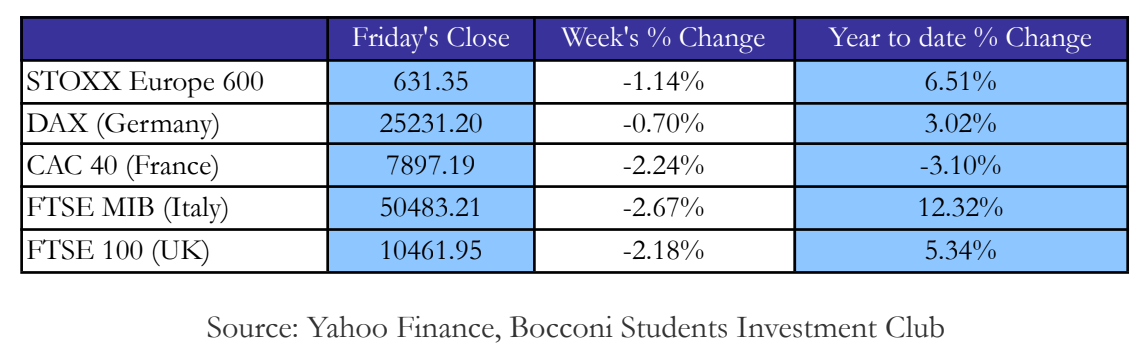
The DAX rose 1.17% on Friday, the CAC 40 gained 0.79%, and the FTSE 100 added 0.32%. Over the full week, however, the DAX fell approximately 0.70%, while the CAC 40 and FTSE 100 lost 2.24% and 2.18%, respectively. Italy’s FTSE MIB declined around 2.67% to 50,483.21. Germany therefore held up better, although the overall picture remained weak: Friday’s recovery eased some immediate pressure without resolving the concerns over inflation, government debt and financing costs.
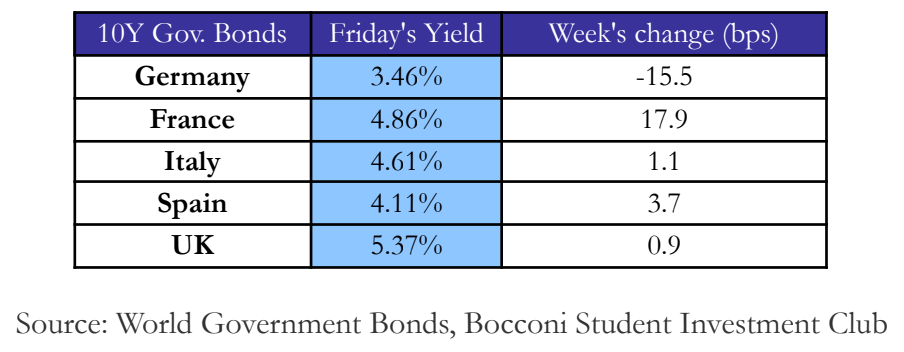
European government bonds showed substantial divergence. On Friday Germany’s 10-year Bund yield was reported at 3.46%, France’s equivalent at 4.86%, Italy’s at 4.61%, and Spain’s at 4.11%. The German yield was around 15 basis points lower, while the French yield was around 18 basis points higher. The French-German spread stood at approximately 140 basis points. The gap between French and German government bond yields widened, because investors demanded a higher return for holding French debt. Higher borrowing costs, in turn, makes the government’s efforts to control its finances more difficult.
Rest of the World
Japan outperformed the other major Asian markets in the weekly comparison. Nikkei 225 gained approximately 3.69% to 68,309.46, supported by semiconductor stocks after Micron’s strong outlook reinforced expectations for AI-related demand. Meanwhile, Bank of Japan communications and stronger Tokyo inflation kept further rate hikes in focus. The 10-year Japanese government bond yield finished around 3.10%, roughly 3 basis points higher over the week, showing that the equity rally continued despite rising borrowing costs.
China announced further support for its economy, including mortgage-interest subsidies and a 25-basis-point cut to the central bank’s pledged supplementary lending rate, bringing it to 1.50%. This facility provides funding to policy banks for investment projects. Manufacturing also improved, with September’s official PMI rising to 50.1 from 49.8. Nevertheless, concerns about weak domestic demand and the property sector persisted. The CSI 300 and Shanghai Composite fell approximately 1.84% and 1.19%, before mainland markets closed for a shortened week. China’s 10-year government yield remained near 1.68%, broadly unchanged from the previous week. Hong Kong’s Hang Seng declined approximately 3.19%, with financial shares leading Friday’s losses as elevated US yields weighed on sentiment.
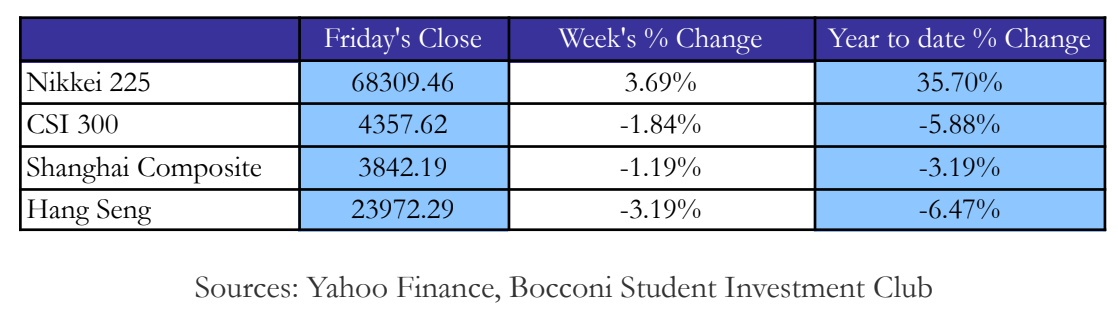
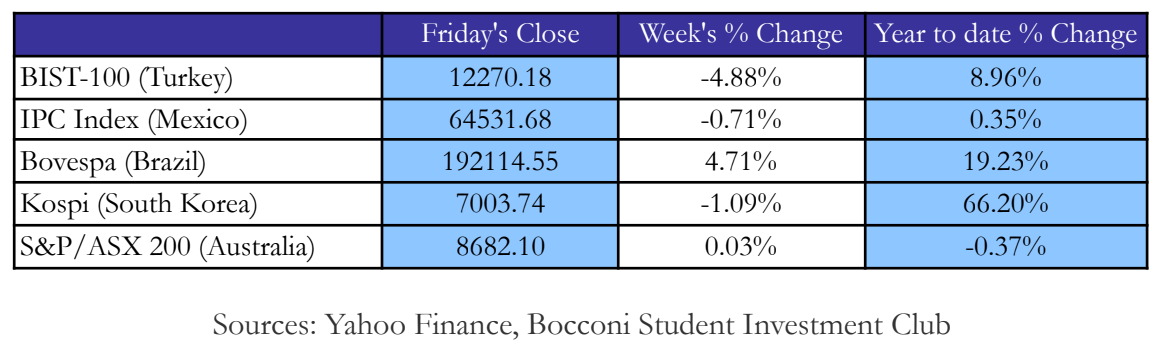
South Korea’s Kospi fell around 1.09% over the week, although strong semiconductor exports and Micron’s results supported a recovery in Samsung Electronics and SK Hynix on Thursday. Australia’s ASX 200 finished the week slightly higher at 8,682.10, despite the RBA raising its cash rate by 25 basis points to 4.60% on Tuesday. The index reached its weekly closing high of 8,789.30 on Wednesday as lower than expected inflation eased fears of further rate hikes, before giving back part of those gains later in the week.
Brazil’s Bovespa rose approximately 4.71% to 192,114.55 ahead of Sunday’s presidential election. Petrobras, Vale and major banks supported the rally, while investors closing short positions added buying pressure. Friday’s weaker US jobs report also reduced expectations of an immediate Fed hike, helping sentiment. Mexico’s IPC, however, finished approximately 0.71% lower at 64,531.68. Turkey’s BIST 100 fell approximately 4.88% over the week to 12,270.18. The market remained overshadowed by the investment-fund crisis, as forced asset sales added pressure and authorities widened their investigation into suspected market manipulation.
FX and Commodities
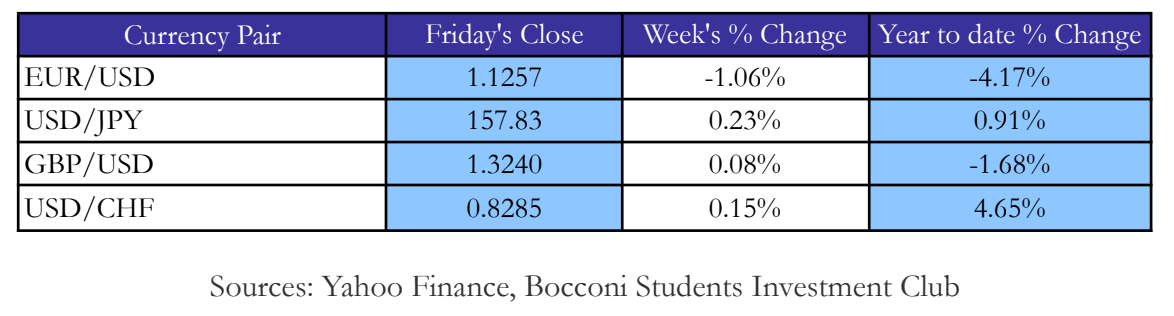
The euro weakened over the week, ending at approximately 1.1257 with a decline of around 1.06%. Sterling and the Swiss Franc were broadly unchanged at 1.3240 and 0.8285. USD/JPY rose approximately 0.23% to 157.83. The figures pointed to more pronounced weakness in the euro than a uniform decline across all major currencies against the dollar. Elevated US yields remained a potential source of support for the dollar, while France’s fiscal uncertainty added a separate challenge for the euro. However, Friday’s weaker US jobs report gave the Fed less reason to raise interest rates immediately.
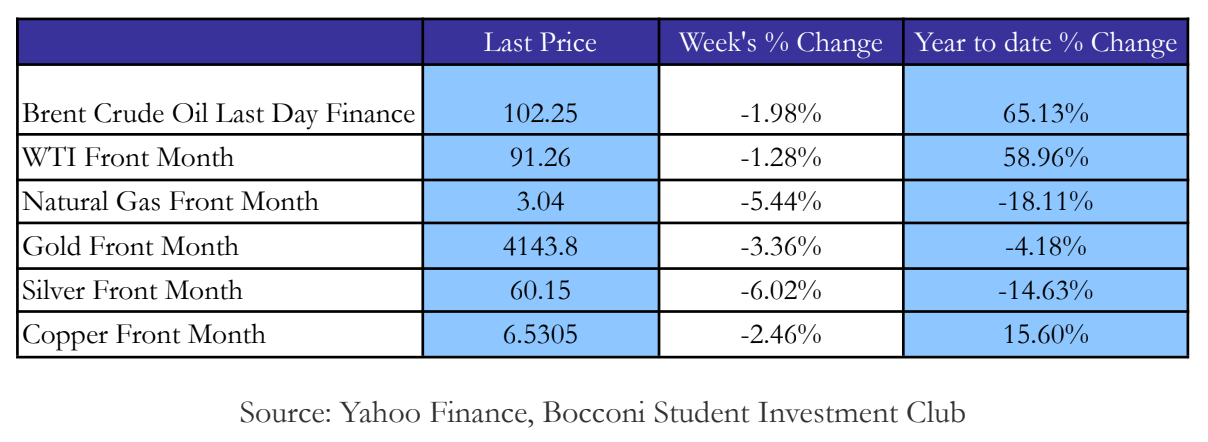
Oil remained volatile as supply concerns competed with efforts to ease shortages. On Friday, the G7 announced plans to release 100 million barrels of crude oil and petroleum products over four months, including an early release of diesel. The announcement pushed prices lower during the session, although shipping risks and supply uncertainty remained unresolved. Precious metals also came under pressure. October-delivery Comex gold was priced at 4,143.8, down 3.36% for the week, while the reported front-month silver price fell -6.02% to 60.15. Elevated yields increased the opportunity cost of holding non-interest-bearing assets. Contract selection remained important when comparing prices, as front-month settlements and active-contract quotes were not necessarily the same.
Next Week Main Events
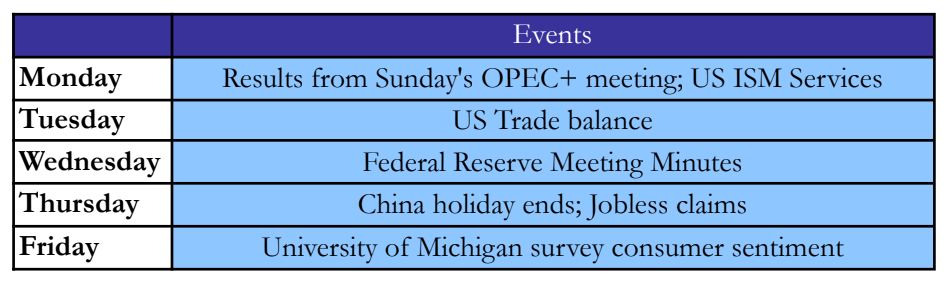
Next week begins with investors assessing Brazil’s election results and developments from the scheduled OPEC+ meeting on Sunday. Monday’s US ISM Services survey will provide an important check on whether activity in the economy’s largest sector is consistent with the softer employment picture. Tuesday brings the US trade balance. Wednesday’s Federal Reserve minutes will offer more detail on the September policy debate, although they will predate the latest employment report. Investors will examine how policymakers assessed inflation persistence and the conditions that could justify further tightening. Thursday brings weekly US jobless claims and the reopening of mainland Chinese markets after Golden Week. Friday’s preliminary University of Michigan survey will put consumer sentiment and inflation expectations in focus. The central question is whether cooling labour demand can ease inflation concerns while energy costs remain elevated.
Brain Teaser #55
A pen and a notebook cost €11 in total. The notebook costs €10 more than the pen. How much does the pen cost?
Brain Teaser #56
You have eight identical-looking balls. One is slightly heavier; the other seven weigh exactly the same. Using a balance scale, how can you guarantee finding the heavier ball in just two weighings?



0 Comments