USA
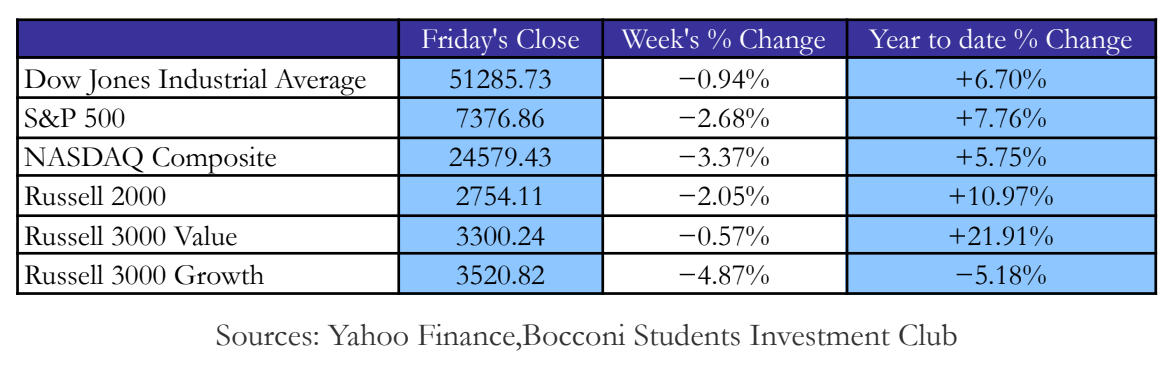
US equities had their worst week since June as a clear Democratic sweep in Tuesday’s midterms turned from a relief rally into a sharp unwind of the AI trade. The S&P 500 fell 2.68% over the week, the Nasdaq Composite 3.37% and the Russell 2000 2.05%, while the Dow lost only 0.94% as investors rotated away from AI hardware; the VIX rose 32.03% to 25.64. The result was first read as good news, since a decisive outcome removed the risk of a disputed election and divided government means little new legislation: on Wednesday the Dow jumped 3.03%, its best day since April 2025, although Nvidia and Micron already fell as Microsoft and Amazon rose on hopes of slower capex.
The mood turned on Thursday. With rising power prices having made data centres a political issue, investors began to price the risk that a Democratic Congress pushes for AI regulation and limits on new data-centre construction. The S&P 500 dropped 4.36% and the Nasdaq 5.52%, its worst day since April 2025, leaving it in correction more than 10% below its 6 October record, while the Philadelphia Semiconductor Index lost about 12% and Nvidia 9.26%. Nomura’s Charlie McElligott blamed positioning, with hedge funds locking in 2026 gains, more than fundamentals, and Friday brought only a partial repair. Over the week technology fell 8.23% and energy 12.00% on the oil collapse. Earnings beats were frequent but thin: per FactSet, 84% of reporting S&P 500 companies have beaten EPS estimates, yet the aggregate surprise of 2.7% is the smallest since Q4 2022.
The data gave no sign of a growth scare. October payrolls rose 165k against a consensus of around 60k, unemployment fell to 4.1% and average hourly earnings rose 0.4% m/m; ISM manufacturing rose to 55.5 (54.6 expected). With Hammack, Barkin and Daly all leaning hawkish, CME FedWatch now prices about a 77% probability of a 25bp hike at the 8–9 December FOMC, up from roughly 67% on Thursday. Looking ahead, October CPI on Tuesday decides whether that pricing holds.
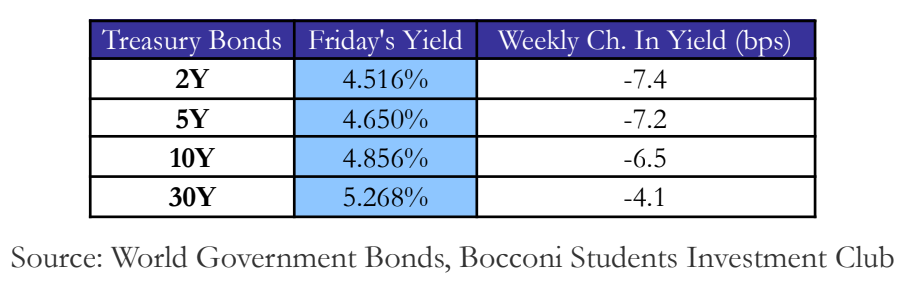
Treasuries rallied as haven demand and cheaper oil outweighed a hawkish Fed. The 2-year yield fell 7.4bp to 4.52%, the 5-year 7.2bp to 4.65%, the 10-year 6.5bp to 4.86% and the 30-year 4.1bp to 5.27%, a mild bull steepening that left 2s10s little changed at 34bp. On Wednesday strategists at UBS and Deutsche Bank read divided government as fiscal gridlock, and so less issuance pressure; on Thursday the equity rout pulled the 2-year 12bp lower in a single session. Friday’s payrolls then lifted the front end again, and markets now price a December hike plus only one more after it. Supply also eased, as Wednesday’s quarterly refunding kept coupon sizes unchanged “for the next several quarters” and expanded buybacks. The watch points are next week’s $125bn of Treasury auctions alongside Tuesday’s CPI release, and the 11 December funding deadline, after Kalshi shutdown odds jumped to 45% from about 30% on the election result, according to Fortune.
Europe and UK
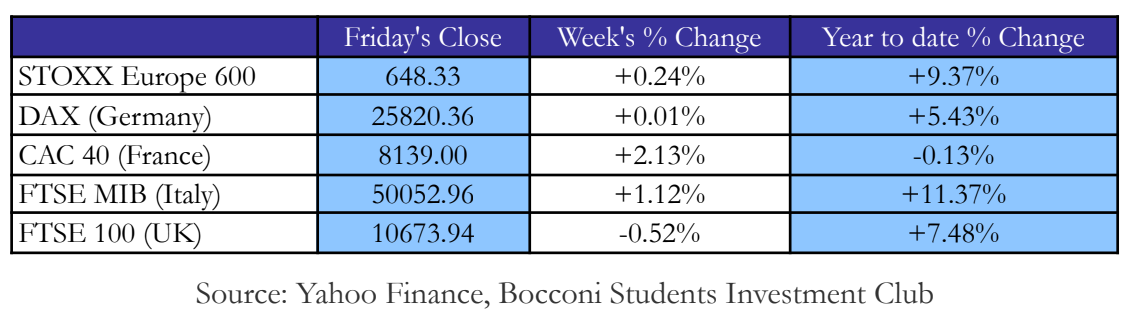
European equities finished roughly flat and outperformed the US, as falling oil and a bank rally offset the AI spill-over. The STOXX 600 closed at 648.33 after nearing a record on Thursday and is now ahead of the S&P 500 year to date. Dispersion was wide: Spain’s IBEX 35 gained 3.84%, the CAC 40 2.1% and the FTSE MIB 1.1%, while the DAX was flat and the FTSE 100 lost 0.5%, held back by its energy, defence and mining heavyweights.
The US election lifted the region first: on Wednesday the STOXX 600 rose 1.82%, its best day since 12 June, as euro-area banks jumped 4.6%, their best day since early April, on a rotation into domestically focused lenders; Morningstar’s Michael Field added that a Democratic Congress limits Washington’s ability to impose requirements or sanctions on European banks. The AI unwind then reached Europe’s chipmakers, with Soitec, Infineon and ASML down 16.7%, 8.5% and 6.6% on Thursday, and Friday’s 1.00% fall, the worst day since July, added US rate-hike fears. Oil set the sector split, with BP down 10.84% and Shell 7.83% over the week while IAG rose 7.72%.
On the corporate side, Rheinmetall fell 16.1% after cutting 2026 sales guidance as a Boxer order slipped to 2027, but the season overall is strong: with 75% of the STOXX 600 reported, Q3 earnings have beaten estimates by 8%, the widest margin since Q1 2024.
Policy moved in the hawkish direction. The Bank of England raised Bank Rate 25bp to 4.00%, its first hike since August 2023, on an 8–1 vote in which Catherine Mann wanted 50bp, so the whole committee voted to tighten. The reason is energy: the Bank sees CPI rising from 3.5% in September to around 5% in Q2 2027. Guidance stayed two-sided, with the Bank saying it is “not on a pre-set path” and Bailey adding that the hike is unlikely to be the last unless the Middle East conflict ends; markets now price about 76bp more by end-2027. In the euro area, October flash HICP rose to 4.0% (core 2.5%) and September PPI to 11.1% y/y, the highest since February 2023. Bundesbank President Nagel called a December hike very likely necessary, while Lagarde stressed that inflation is predominantly energy-driven; pricing for a 17 December hike reached about 90% on Thursday before easing on Friday. In France, the National Assembly rejected the 2027 budget’s revenue section 458–0, sending it to the Senate from 20 November.
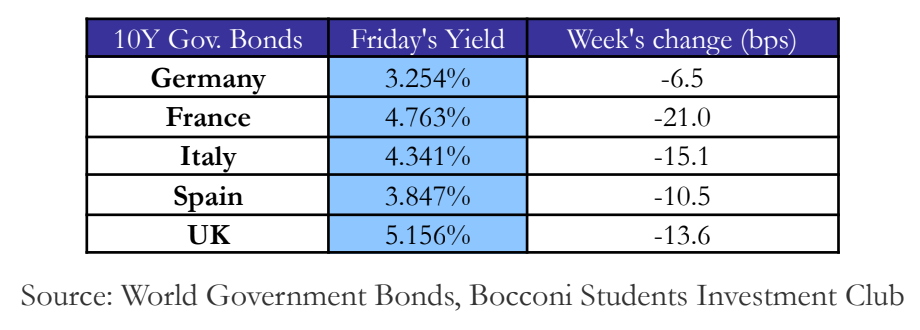
European government bonds followed Treasuries higher as investors sought safety from the tech sell-off and cheaper oil eased inflation worries, although 4% euro-area inflation and Friday’s US payrolls capped the move. The 10-year Bund yield ended at 3.25% after touching 3.22%, its lowest since 26 August. The periphery did better: the BTP yield fell 15bp to 4.34%, narrowing the BTP–Bund spread by 9bp to 108.7bp, and the OAT yield fell to 4.76%. Notably, the OAT–Bund spread also tightened despite the budget defeat, though at above 150bp it remains far wider than Italy’s, a reminder that France now trades as the riskier credit. In the UK, the 10-year gilt touched 5.10% on Friday, a two-month low, and closed around 5.16%, as cheaper energy weakened the case for follow-up hikes and sterling barely reacted to the decision. Looking ahead, UK Q3 GDP on Thursday and Lagarde’s appearances will test December pricing for both the BoE and the ECB.
Rest of the World
Asia’s chip-heavy markets took the brunt of the AI unwind, while markets with little AI exposure and large oil import bills rallied. Japan’s Nikkei 225 fell 9.25% to 57,434.77, its worst week since March 2020, and entered a bear market as AI names collapsed: Kioxia lost 36.8%, SoftBank Group 20.8% and Advantest 19.6%. JGBs rallied, with the 10-year yield down to around 2.64%, a four-month low, even though September nominal wages grew 4.6% y/y, the fastest since January 1997, and the BoJ’s September minutes showed one member open to faster hikes, firming bets on a December move.
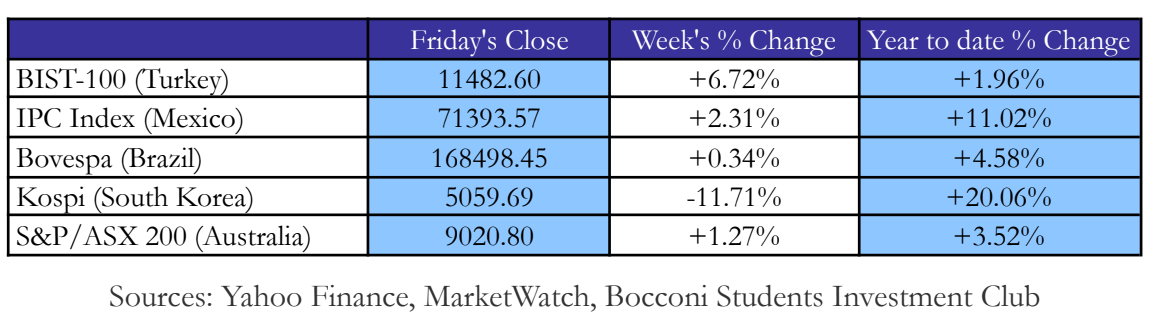
Korea and Taiwan fared worse. The KOSPI fell 11.71%, with a circuit breaker triggered on Friday as foreign investors sold KRW2.77tn in a single day; Seoul suspended a margin-collateral rule for three months. Taiwan’s TAIEX dropped 12.19% into a bear market after TSMC opened limit-down on Friday, prompting regulators to cap intraday short sales at 3% of volume and put an NT$500bn stabilisation fund on standby.
By contrast, Hong Kong’s Hang Seng rose 5.10%, its best week since March 2025, as money rotated out of US, Korean and Taiwanese hardware into Chinese internet platforms; Thursday’s 3.7% gain, led by Alibaba and Tencent, was the biggest in 21 months. Mainland indices rose more modestly (CSI 300 +1.7%, Shanghai Composite +1.39%), ending long losing streaks even as the official manufacturing PMI slipped back into contraction at 49.3. India was the standout: the Nifty 50 gained 8.58%, its best week since early 2021, helped by low AI exposure and Brent falling below $100, with HDFC Bank and Reliance both up more than 13%. In Australia, the RBA raised rates 25bp to 4.85% on a 6–3 vote, its fifth hike of 2026 and the highest level since 2008; the move was largely priced and the ASX 200 still rose 1.3%.
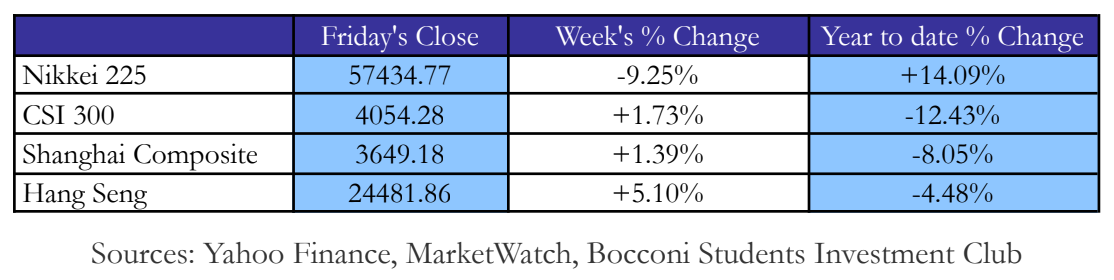
In Latin America, Banxico surprised with a 25bp cut to 6.25% when a hold was expected and signalled a pause, helping Mexico’s IPC gain 2.31%. Brazil’s Copom held the Selic at 13.75%, ending its run of cuts with inflation above the 4.5% ceiling, and the Ibovespa edged up 0.34% as investors wait for Lula’s new economic team and fiscal plan. Turkey’s BIST 100 rose 6.72% even as October CPI edged up to 29.77%, slightly above forecasts. In South Africa, partial municipal results put the ANC at around 32%, with final results due on Sunday. Looking ahead, China’s inflation and trade data, and whether the new short-selling curbs steady Asia’s chip stocks, are the key tests.
FX and Commodities
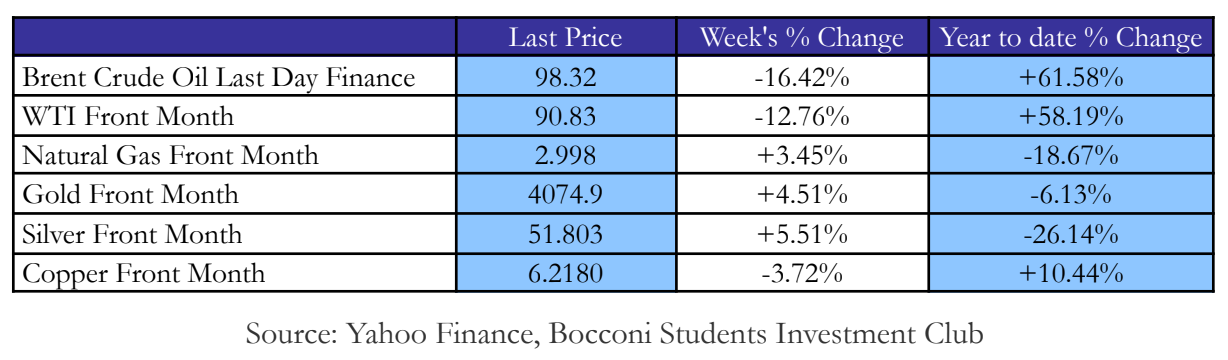
Oil was the week’s biggest cross-asset move as the market stripped out much of the war premium. Front-month Brent fell 16.42% to $98.32 a barrel (about 13% like-for-like after the December contract expired) and WTI 12.8% to $90.83. Two steps did the damage: on Monday, Qatari mediation on a two-stage plan, in which the US lifts its blockade of Iranian ports and Iran reopens Hormuz, knocked around 8% off Brent, and on Wednesday the midterm result was read as raising the odds of a deal. OPEC+ keeping December output unchanged and an unexpected draw in US crude stocks were not enough to offset this, and with tanker attacks continuing, the market is pricing a peace that has not yet been signed. European gas followed, with TTF down more than 15%, its worst week since early 2025.
Front-month gold rebounded 4.51% to $4,074.90 an ounce from 12-month lows, silver 5.51% and platinum 7.97%, as lower oil eased inflation fears and the dollar and yields dipped midweek, before payrolls trimmed the gains. Copper slid to its lowest since July on the LME as, in TD Securities’ reading, Democratic control of Congress made aggressive US refined-copper tariffs less likely and clouded the data-centre demand story, weakening the incentive to stockpile metal in the US.
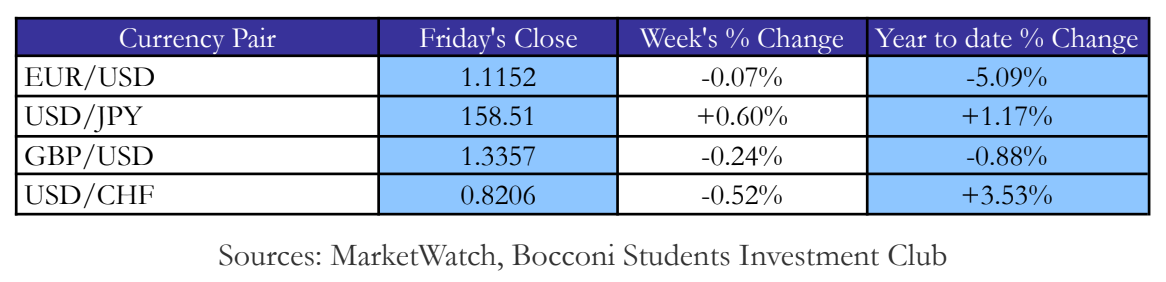
In FX, the path mattered more than the weekly change. The DXY fell to a one-month low on Wednesday on election relief and AI-regulation fears, then jumped 0.77% on Friday, its best day since June, on payrolls, ending 0.39% higher. EURUSD slipped to 1.1152 for a third weekly fall and GBPUSD to 1.3357, with sterling ignoring a BoE hike that was already priced. USDJPY rose to 158.51 despite Thursday’s haven buying of the yen, while Finance Minister Katayama repeated that Tokyo is ready to act on disorderly moves. The Australian dollar was the weakest major on risk-off. Bitcoin fell roughly 2% to around $75,800 after touching its lowest level since August, as spot ETFs lost $1.28bn, their worst week since June, leaving 2026 flows negative.
Next Week Main Events
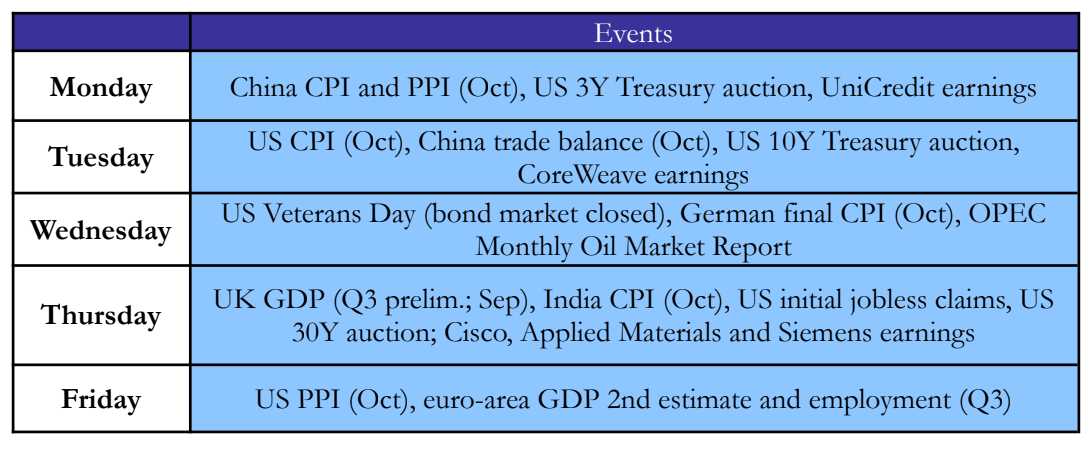
US CPI (Oct) is the main test for the roughly 77% probability of a December Fed hike, with next week’s $125bn of Treasury auctions alongside Tuesday’s CPI release and the bond market shut on Wednesday for Veterans Day. UK GDP (Q3) on Thursday and euro-area GDP (Q3) on Friday follow last week’s BoE hike and ECB signalling, while results from CoreWeave, Cisco and Applied Materials will show whether the AI sell-off was positioning or the start of a re-rating. Iran and Hormuz headlines remain the wildcard for oil.



0 Comments