USA
US equities had their worst week since April 2025 as the unwind of the AI trade turned into a rout that neither a blowout Nvidia quarter nor the largest IPO in history could stop. The S&P 500 fell 8.61% to 6,910.39, the Nasdaq Composite 10.02% to 22,617.73, the Dow 8.02% to 48,147.33 and the Russell 2000 7.48% to 2,581.79, while the VIX rose 85.96% to 35.89. The S&P 500 lost ground every day of the week, a seven-session losing streak that left it 11.62% below its 6 October record of 7,818.93 and in correction alongside the Dow. The Nasdaq is now down 2.7% for 2026, and the Wall Street Journal estimated that Nasdaq stocks lost more than $4tn in market value over the five sessions. Every sector fell: technology lost 12.49%, while consumer staples (−2.05%) and utilities (−3.07%) held up best.
The week’s two big catalysts both disappointed. On Tuesday, Nvidia reported its first quarter since Jensen Huang’s resignation. Revenue was $115.8bn (+103% y/y) against about $109bn expected, data-centre revenue $107.6bn, and Q4 guidance $130bn against $125.1bn consensus. Interim CEO Colette Kress cited a $2.5tn cloud revenue backlog, but the board said Huang would not return. The stock fell 2.89% on Wednesday. On Friday it dropped another 14.01% to $125.53 on reports of an SEC accounting probe and a congressional inquiry linked to a chip-export case; these reports are not confirmed by the company. That left Nvidia down 22.9% on the week, with the Philadelphia Semiconductor Index down 10.7% on Friday alone. On Thursday, Anthropic listed on Nasdaq as ANT after raising $81.3bn by selling about 980m shares at $83, above the $70–78 range. It opened at $111.50 and closed its first day at $97.17, up 17%, but the S&P 500 had already reversed below its 5 November low, and the Dow ended Thursday down 1,101 points. ANT gave back about 8.5% on Friday. Elsewhere in earnings, Walmart raised full-year sales guidance to +4.9–5.2% on US comparable sales up 2.9%, Palo Alto rose 6% on Thursday after fiscal Q1 revenue of $3.44bn beat estimates and it announced a $4.5bn all-stock purchase of Applied Compute, and Intuit fell 12.8% after trimming its outlook and announcing the sale of Mailchimp.
Policy offered no relief. The minutes of the 27–28 October FOMC, released Wednesday, showed that “almost all” participants judged further hikes “would likely be appropriate”. Holding at 3.75–4.00% was described as “a close call”, and a couple of officials floated a move larger than 25bp in December. Initial jobless claims rose to 203k (198k expected) and continuing claims jumped 70k to 1.763m. Kalshi priced about a 91% probability of a 25bp hike on 9 December after the minutes, and CME FedWatch showed 91.8% late on Friday. Looking ahead, Wednesday’s October PCE release decides whether markets start to price a 50bp move.
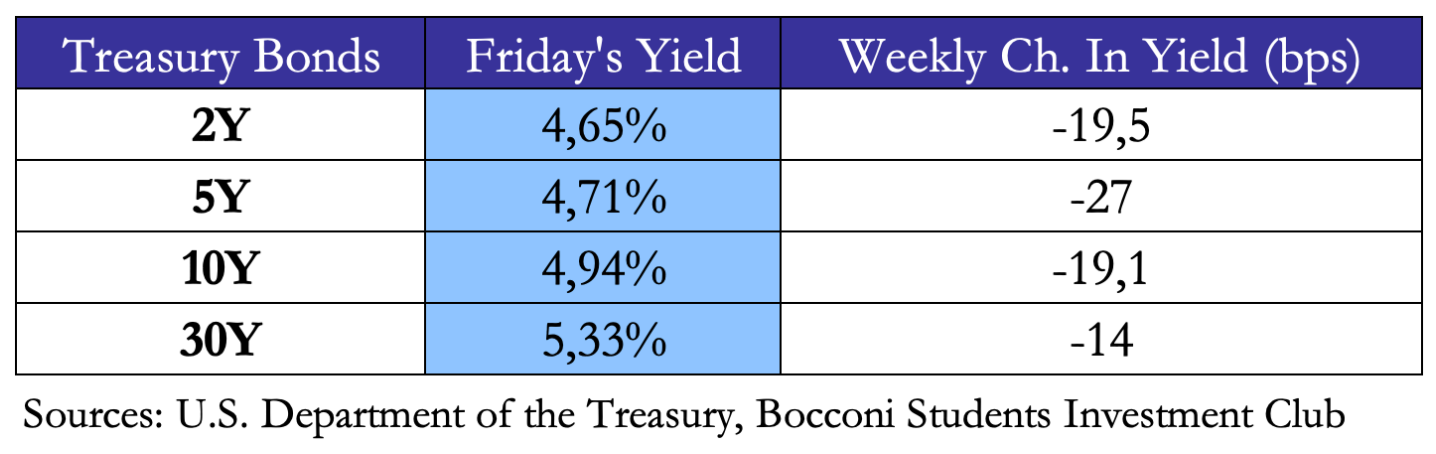
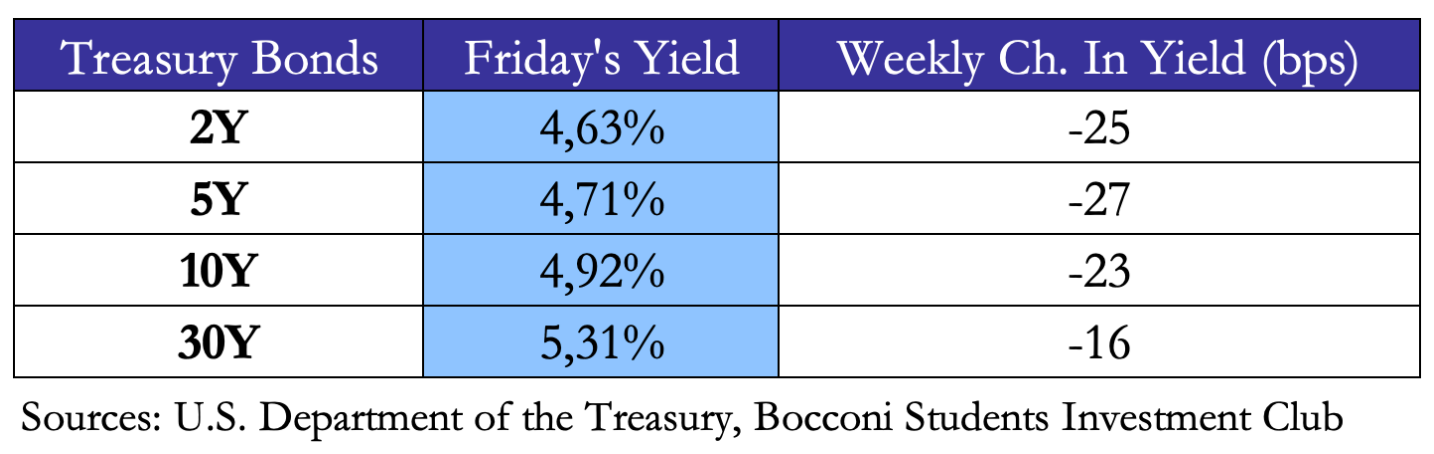
Treasuries were the one haven that worked. The 10-year yield fell 19.1bp to 4.94%, its fifth straight daily decline, and moved back below 5% after a 4.90–5.15% range. The 2-year fell 19.5bp to 4.65%, its steepest weekly drop since August 2025, almost fully reversing the 10–12 November rise. The 30-year fell about 14bp to 5.33%. With the front end and the belly moving about equally, 2s10s held near 30bp. The paradox is that the curve rallied even as the market moved towards a certain December hike: flight-to-quality flows and the drop in oil outweighed the hawkish minutes, so hike pricing and yields fell together. The risk is that the rally depends on equities staying weak. A firm PCE print on Wednesday, in a thin holiday week, could push the 10-year back towards 5%.
Europe and UK
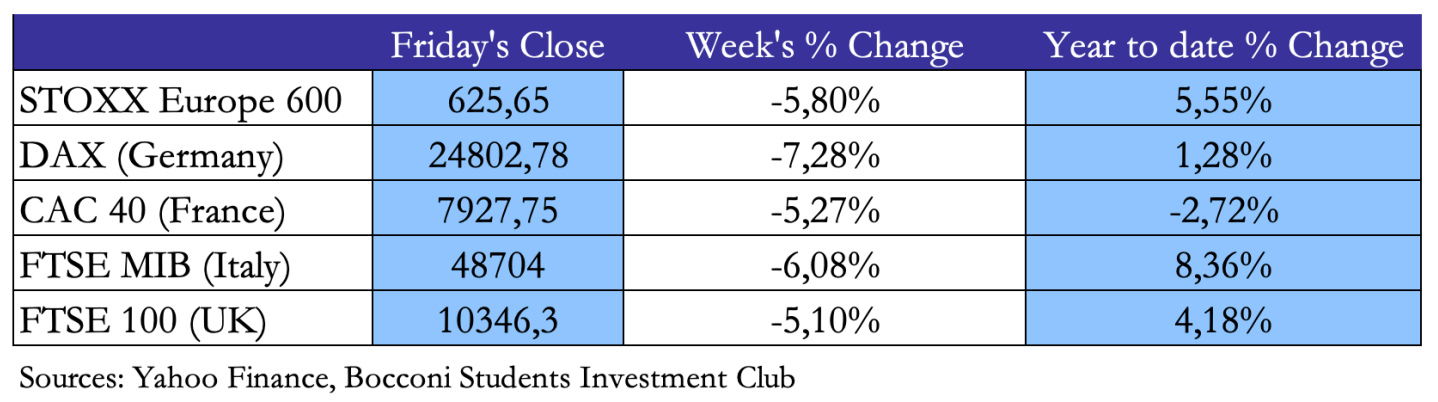
European equities had their worst week since early April 2025, falling for five straight sessions as the AI unwind spread to Europe’s chip names and then to the wider market. The STOXX 600 lost 5.80% to 625.65, a six-week low barely a week after a record high. The Euro Stoxx 50 fell about 7% to 5,941.95, the DAX about 7.3% to 24,802.78 (its sixth straight daily loss), the CAC 40 5.3% to 7,927.75 and the FTSE 100 5.10% to 10,346.34. Italy’s FTSE MIB ended at 48,703.72 after a 2.48% fall on Friday. Even so, the STOXX 600 was still about 5.5% up for the year on Friday morning, ahead of the S&P 500.
Friday’s 2.00% fall was broad. ASML, ASM International and Infineon each lost more than 4%, Vallourec fell 12.5% on a 26% drop in Q3 core profit it blamed on the Iran conflict, and Ubisoft lost 8.9% on weak bookings. Luxury also fell on fears that the tech sell-off will hurt wealthy US consumers: Hermès dropped more than 4%, and Moncler hit a four-year low after a Morgan Stanley downgrade.
The macro data kept the hawkish pressure on. UK October CPI rose to 3.6% from 3.5%, its fourth straight increase and a 12-month high, driven by motor fuel (+33.2% y/y) and a tobacco duty rise; core held at 2.8% and services at 3.7%, so the inflation is energy-led rather than broad. After the BoE’s November hike, that keeps a December move live. In the euro area, ECB Governing Council member Simkus said he sees signs of second-round effects and that a December hike “may not be the last”.
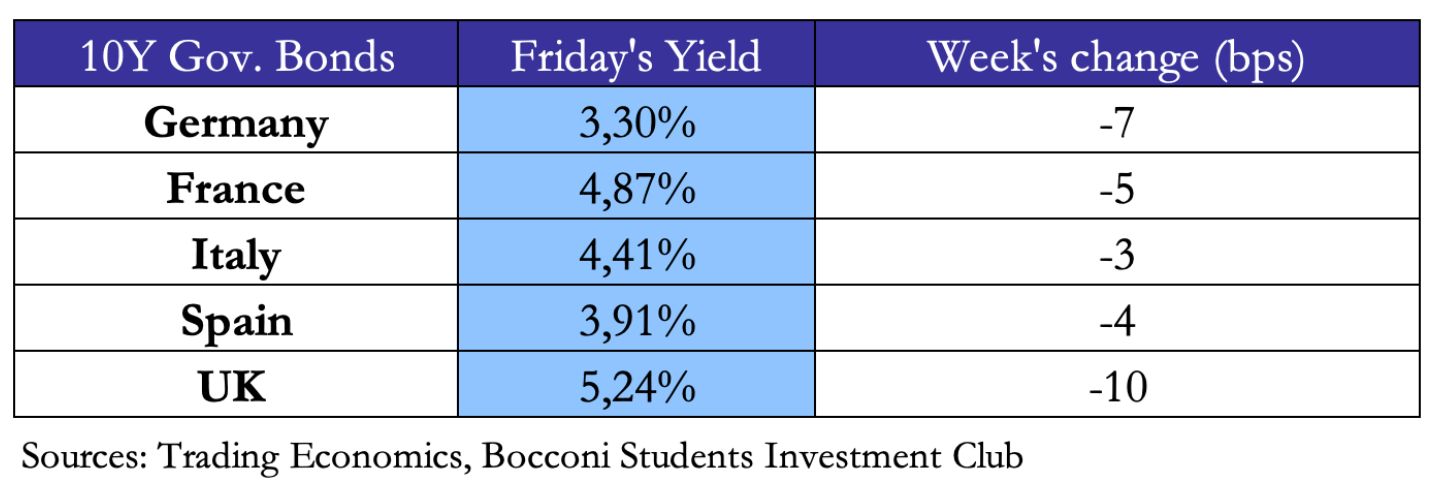
European government bonds rallied with Treasuries, but the periphery lagged as risk-off widened spreads. The 10-year Bund yield fell about 10bp on Friday alone to 3.30%, having touched a four-week high of 3.40% earlier in the week. The BTP yield ended near 4.40%, but the BTP–Bund spread widened from 103bp at Friday’s open to close at 109.9bp, as investors cut risk. France remains the weak link, with the OAT at about 4.87% and the OAT–Bund spread near 157bp, as the Senate began debating the 2027 budget from 20 November after the Assembly rejected its revenue section. Gilts outperformed late in the week, with the 10-year falling from 5.32% on Thursday to 5.23% on Friday. Looking ahead, next week’s flash PMIs will test whether the ECB and BoE can hike in December into a market sell-off.
Rest of the World
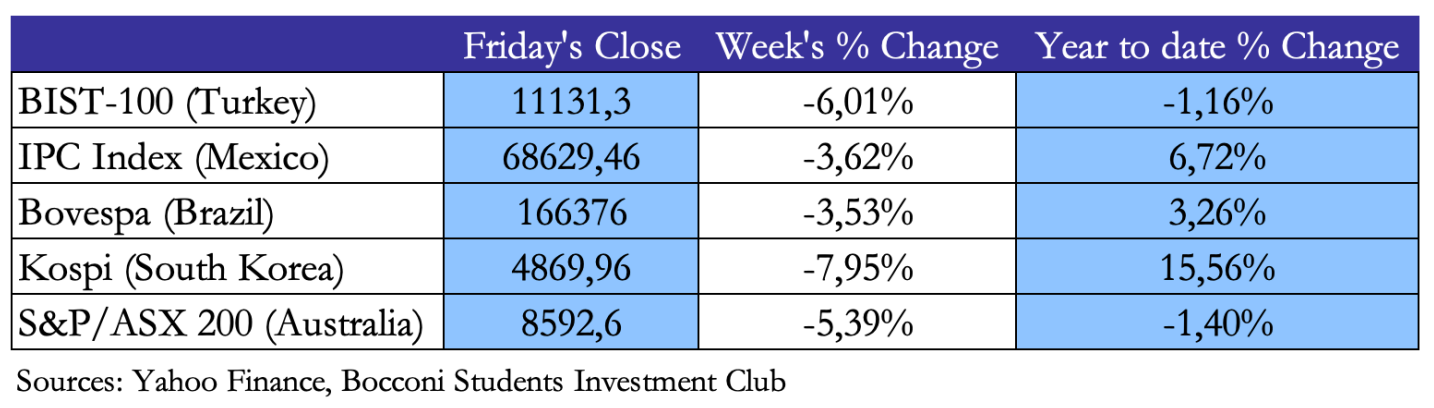
Asia’s chip-heavy markets took the worst of the sell-off for a second time in three weeks. Taiwan’s Taiex lost 17.5%, one of its worst weeks on record, after a 6.2% fall on Friday. Japan’s Nikkei 225 fell 7.70% to 56,436.65, including a 5.06% drop on Friday as SoftBank Group lost 14.48% and Kioxia and Ibiden each fell more than 10%; the Topix fell 3.88% that day. Korea’s KOSPI fell about 7.9% to 4,869.96, closing below 5,000 for the first time since June, as foreign investors sold a net $466m of Korean stocks on Thursday alone. The MSCI Asia Pacific index fell for seven straight sessions. On the data side, Japan’s October core CPI slowed to 2.2% against 2.3% expected, but a December BoJ hike from 1.25% remains the base case. UBP’s Carlos Casanova described the moves as a “collapse in confidence in the AI investment thesis”.
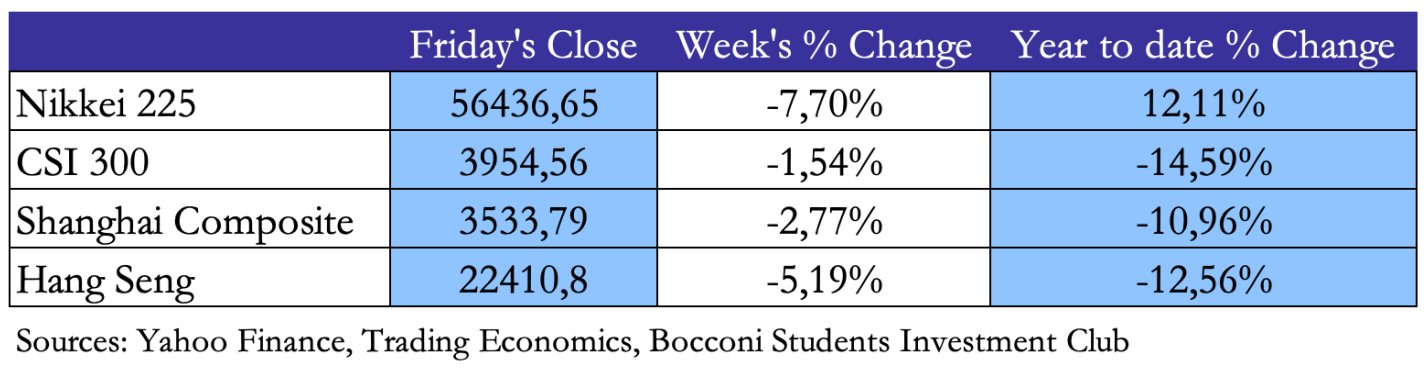
China and India showed the same split as earlier in November. The Hang Seng fell 5.19% to 22,410.80 and is now roughly 20% below its 29 January peak, while the Shanghai Composite fell about 2.8% to 3,533.79. India was the clear exception: the Nifty 50 gained 2.61% to 25,800.60 and the Sensex 2.85% to a nine-month high, as low AI exposure and Brent near $90 made the country a haven again. No major central bank in the region changed rates this week; the RBA (4.85%) next meets on 8 December.
FX and Commodities
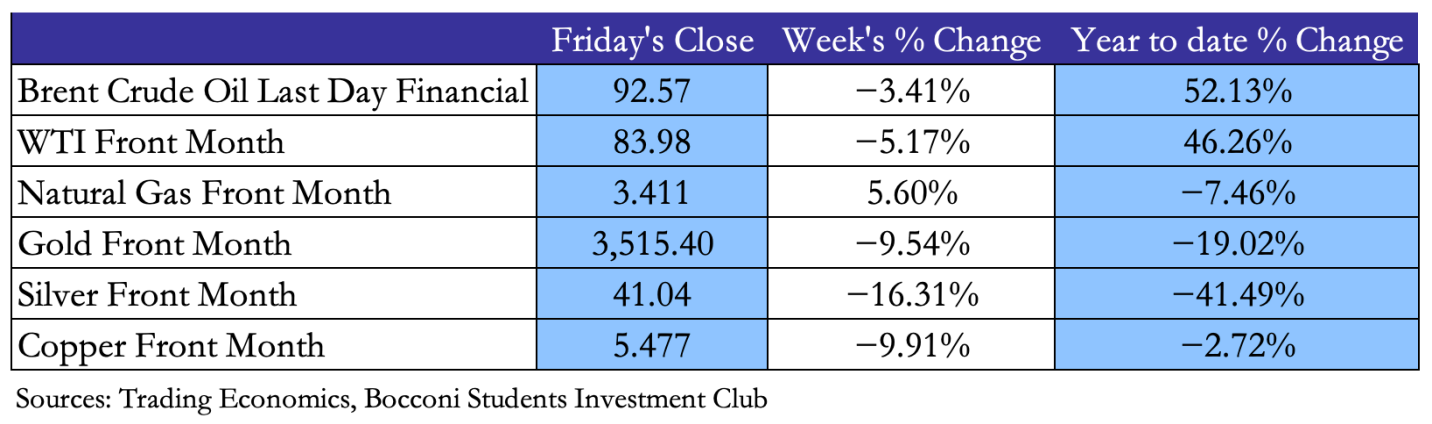
Commodities offered no refuge. Oil fell for a third straight week as tanker flows through the Strait of Hormuz returned to roughly pre-war levels, outweighing Houthi attacks on Riyadh and tanker incidents in the Gulf. January Brent settled at $92.57 on Friday, down 3.41% from $95.84, and December WTI at $83.98 on expiry, down 5.17%. A 3.38m-barrel build in US crude stocks against a 58k forecast added to the supply-glut story. The bigger surprise was precious metals. Spot gold fell 2.7% on Friday to $3,525.25, a 9.2% weekly drop and its worst week in eight months, and silver fell about 15.5% to around $41. Rather than a haven, both were sold to raise cash alongside equities, against a firm dollar and a near-certain Fed hike. US natural gas rallied, with December Henry Hub futures up 4.4% on Friday to $3.411, close to an 11-month high.
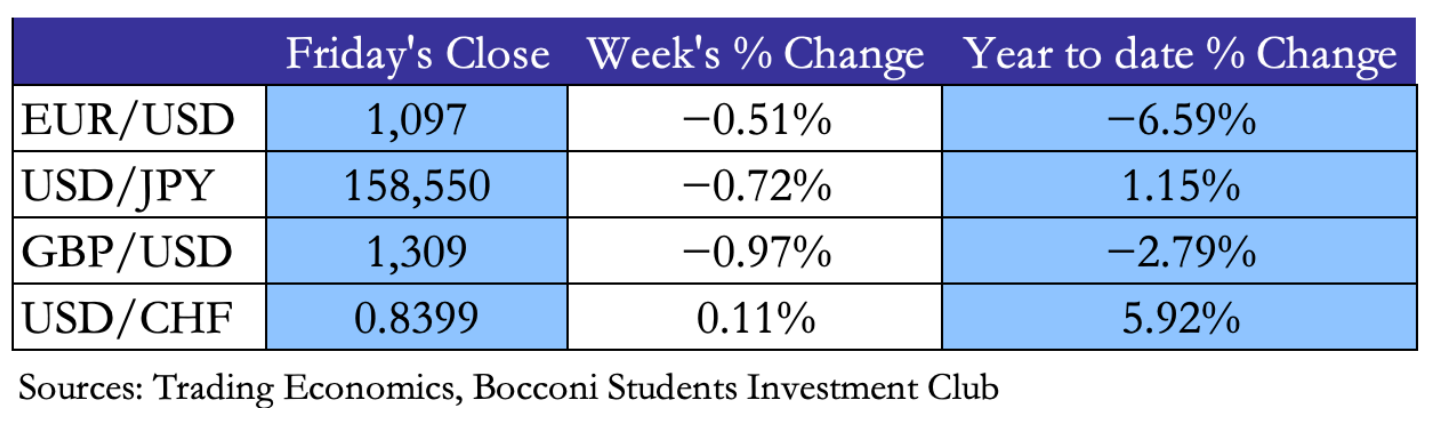
In FX, the dollar rose for a fourth straight week. The DXY gained about 0.42% to 103.84, near its strongest level since April 2025, as safe-haven demand and Fed hike pricing outweighed lower US yields. EURUSD fell 0.51% to 1.0967, its lowest since April 2025 (ECB reference rate 1.0990), and GBPUSD fell about 0.97% to around 1.3085 after touching a one-year low of 1.3078 on Friday. Over the week the dollar gained against most currencies. The exceptions were the yen and franc on Friday: USDJPY failed at 159.97 on Thursday, just short of 160, and fell to around 158.6 as risk-off flows lifted the yen, and both currencies gained about 0.6% on the day. Bitcoin slipped below $60,000, its lowest since June 30, and was on course for a seventh straight weekly loss for the first time since May 2022, taking crypto stocks down with it.
Next Week Main Events
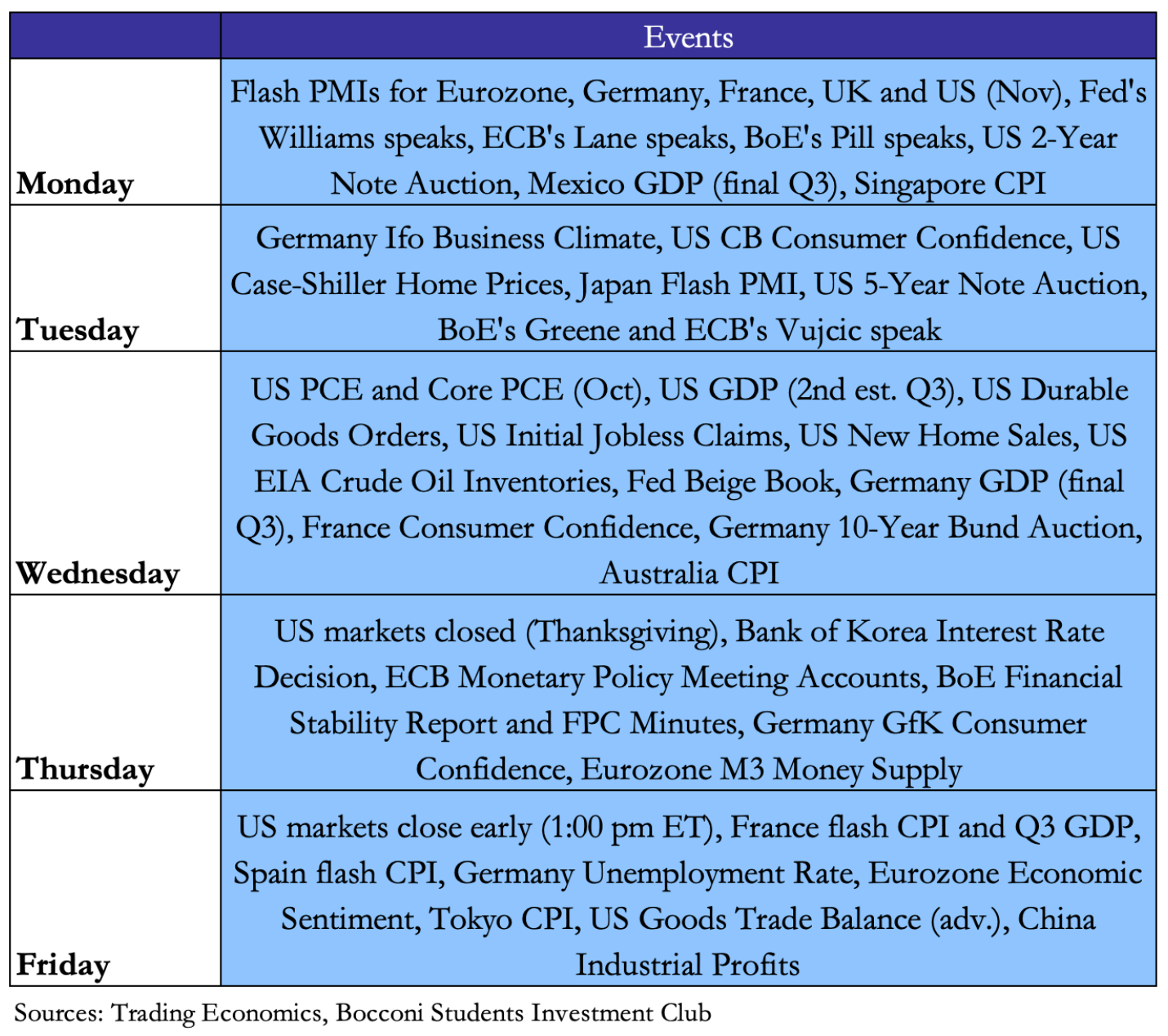
US markets are shut for Thanksgiving on Thursday and close at 1:00 pm ET on Friday, so liquidity will be thin after a week of record volatility. Monday’s flash PMIs open the week. Wednesday then carries most of the risk, with October PCE, the second Q3 GDP estimate, durable goods and jobless claims all released together ahead of the 8–9 December FOMC. Dell and Workday report on Tuesday and Deere on Wednesday; Dell’s AI-server orders are the next test for the hardware trade. Outside the US, the euro-area and UK flash PMIs, the French budget debate in the Senate and Iran–Hormuz headlines remain the main risks.
Brain Teaser #22
You have 1000 wine bottles, exactly one of which is poisoned. The poison takes 24 hours to show effect. You have 10 prisoners and 24 hours. How do you identify the poisoned bottle?
Brain Teaser #23
You have a 100-floor building and 2 identical eggs. There exists a critical floor F such that eggs break when dropped from floor F or above. Find F using the minimum number of drops in the worst case.



0 Comments