USA
US equities set new records early in the week and spent the rest of it testing them, against a volatile macro backdrop driven by oil prices and yields. Brent traded between about $99 and $105 a barrel, and the 10-year Treasury yield touched about 5.35% intraday, its highest level since 2002. The ISM Services prices-paid index rose to 74.0 in September from 72.6, while the preliminary University of Michigan sentiment index for October fell to 46.3, the lowest since May’s record low, with one-year inflation expectations at 4.7%. Coming a week after payrolls showed only 29,000 jobs added in September, the releases describe an economy in which growth is cooling while price pressure is not.
Policy pointed in the same direction. The minutes of the September FOMC meeting, published on Wednesday, showed that the hike to 3.75-4.00% was unanimous and that most participants expected another increase before year-end. Markets now price a hold at the 27-28 October meeting at around 80%, and a hike in December at 70-85%. The other policy input came from the White House: President Trump said on Thursday that the US would not attack Iran before the 3 November midterm elections, which helped support Friday’s rebound.
At the company level, AI set the tone in both directions. The Nasdaq and the S&P 500 reached records on Monday and Tuesday, in a week in which the Financial Times reported that SpaceX is seeking about $40bn of debt financing to buy Nvidia chips, a sign of how much capital is still flowing into AI hardware. Sentiment changed on Thursday when it was reported that OpenAI’s annualised revenue was about $50bn in September, roughly $20bn below the figure previously indicated to investors, and the Nasdaq fell 1.25%. On Friday, SpaceX’s $8bn purchase of mobile spectrum sent T-Mobile, AT&T and Verizon down about 9-13%.
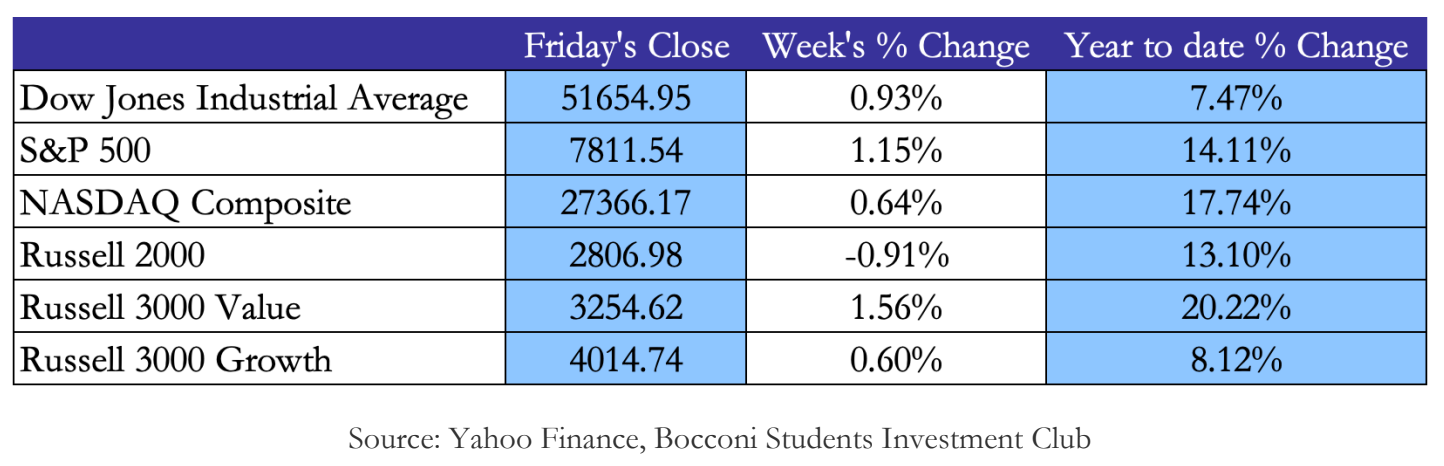
The S&P 500 closed the week up 1.15%, as Friday’s rebound offset the mid-week losses and left it just below Tuesday’s record. The Dow Jones gained 0.93%, since its lower exposure to AI names cushioned the impact of Thursday’s sell-off. The Nasdaq Composite and the Russell 3000 Growth rose only 0.64% and 0.60% respectively. The Russell 3000 Value advanced 1.56%, as financials and energy stocks benefited from higher rates and oil prices; year-to-date it is up 20.22% against 8.12% for Growth. The Russell 2000 was the only one of the six to fall, losing 0.91%, as small caps carry more floating-rate debt and are more exposed to weak consumer demand.
In the US fixed income market, the small weekly changes do not show how eventful the week was. Yields rose at the start of the week, as oil above $100 and the hawkish FOMC minutes kept inflation fears alive: the 10-year touched 5.35% intraday and the 30-year reached 5.67% on Wednesday. This reversed on Thursday when Trump’s comments took part of the risk premium out of oil. The 2-year yield ended the week 4.6bps lower at 4.79%, as markets scaled back expectations of a hike at the October meeting. The 5-year fell 4.1bps to 5.03% and the 10-year fell 3.4bps to 5.25%, about 10bps below this week’s peak. The 30-year yield saw the smallest move, down 2.8bps to 5.60%, as long-term inflation uncertainty keeps the term premium high.

Europe and UK
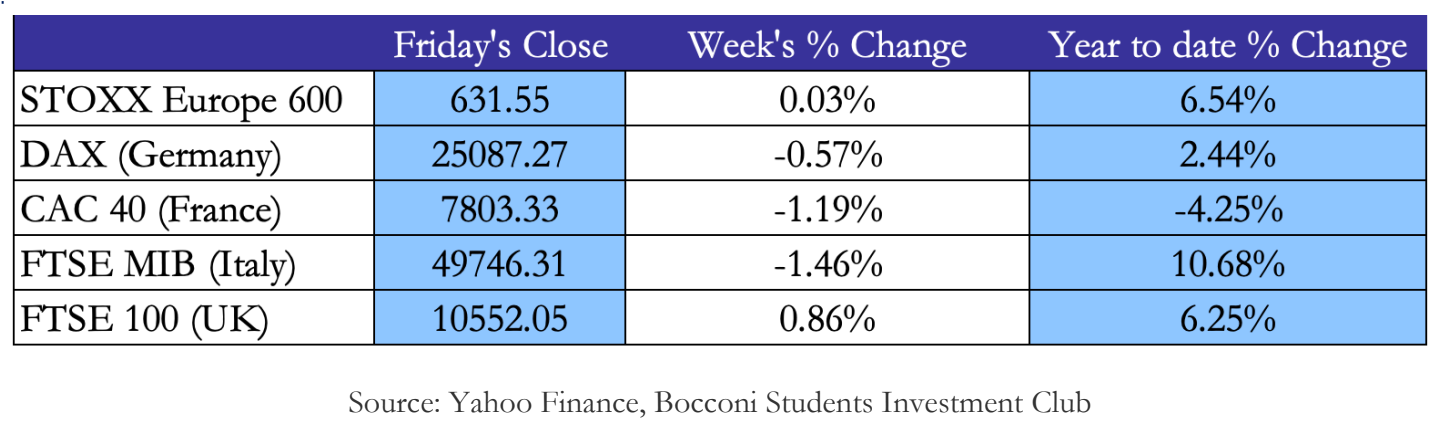
European equities had a weaker week than Wall Street, as the region’s dependence on imported energy leaves it more exposed to fluctuations in energy prices. With euro-area inflation at 3.8% in September, the accounts of the ECB’s September meeting showed the Governing Council focused on upside inflation risks, and markets now price close to one full 25bp hike by December. The combination of higher expected rates and higher energy costs pushed the STOXX Europe 600 to 625.5 on Thursday, its lowest level since mid-June, with banks among the weakest sectors. A 0.97% rebound on Friday allowed the index to close the week almost unchanged, up 0.03%. Telecoms missed the rebound, as SpaceX’s purchase of mobile spectrum hit the sector on both sides of the Atlantic.
At the national level, performance depended on sector composition and domestic politics. The FTSE 100 was the outperformer, gaining 0.86%, as its large weight in oil majors and miners benefits from higher Brent and copper prices. The DAX lost 0.57%; among its constituents, Deutsche Telekom, the controlling shareholder of T-Mobile US, fell about 8% on Friday after the SpaceX news. The CAC 40 declined 1.19% amid doubts that the 2027 budget, which reaches the floor of parliament next week without a stable majority, can pass, and it is the only one of the five indices in negative territory for the year, at -4.25%. The FTSE MIB was the weakest, down 1.46% and back below 50,000 after the Italian government opened talks with banks and energy companies, two of its largest sectors, on a contribution to the budget. Even so, it remains the best performer of the five year-to-date, at +10.68%.
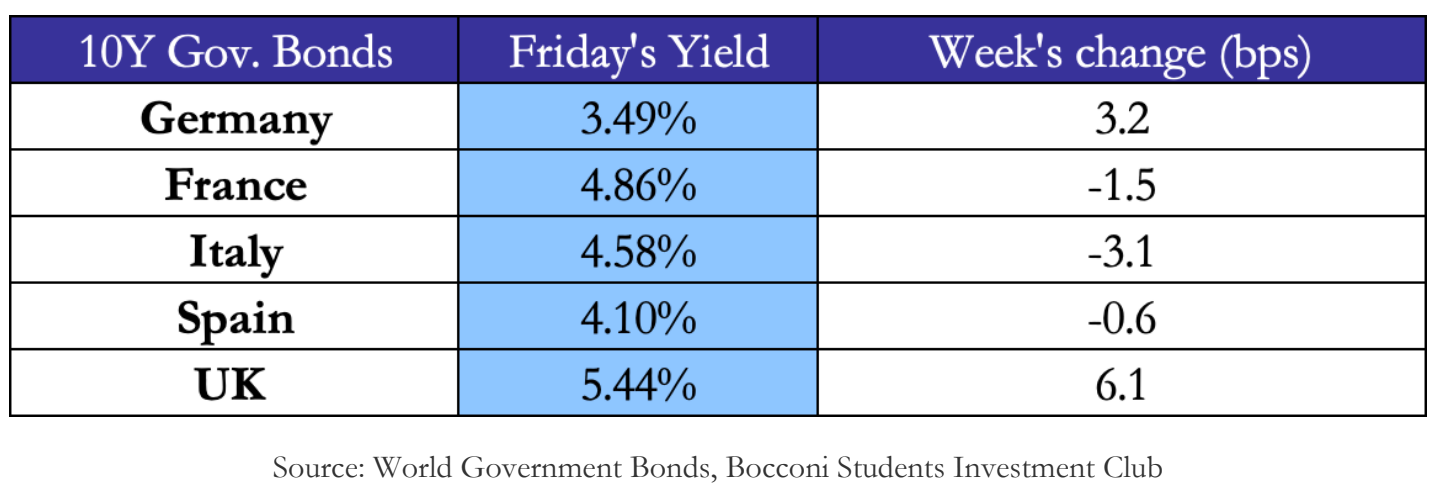
In European fixed income, the moves differed by country. The German 10-year Bund yield rose 3.2bps to 3.49%, partly reversing the previous week’s safe-haven rally as ECB hike expectations stayed in place. French and Italian yields fell slightly despite the political noise: the OAT closed 1.5bps lower at 4.86% and the BTP 3.1bps lower at 4.58%, so Italy’s spread over Germany narrowed to about 109bps from 115bps and Italy now borrows 28bps more cheaply than France. Spain’s 10-year yield was almost unchanged, down 0.6bps to 4.10%, even though Prime Minister Sánchez called a snap election for 29 November after Congress rejected two housing decrees; the yield rose briefly to 4.13% on Monday before investors looked through the news. UK gilts were the clear underperformer. The 10-year yield rose 6.1bps to 5.44% and reached 5.51% on Thursday, its highest since July 2007, after hawkish comments from Bank of England officials, including Governor Bailey, led markets to price more than 100bps of hikes by the end of 2027, with the fiscal statement of 28 October adding to the nervousness.
Rest of the World
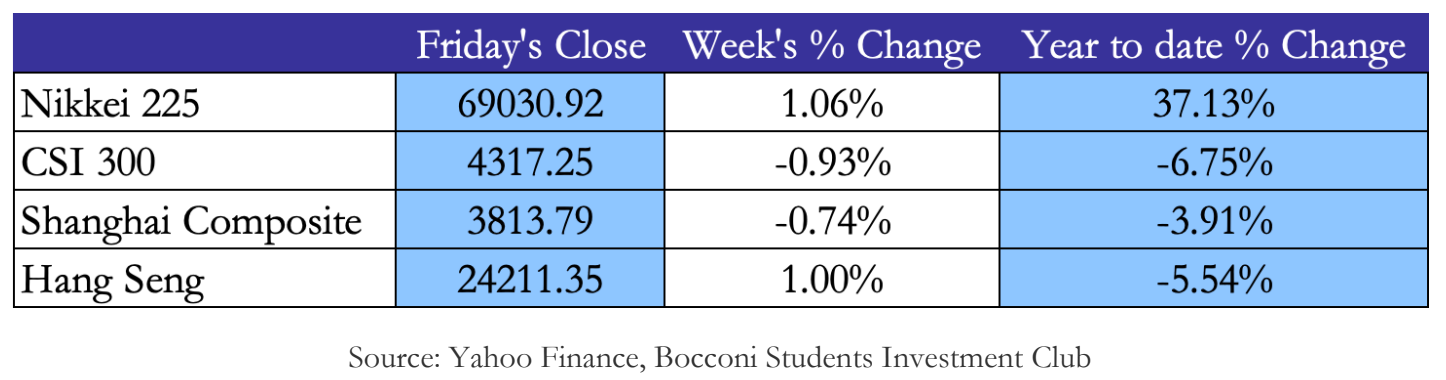
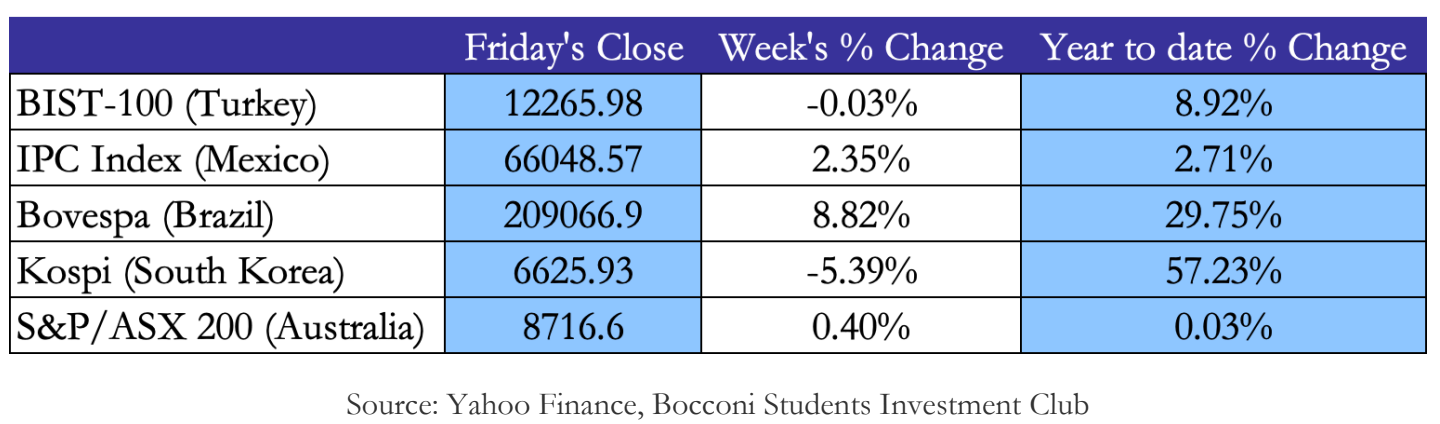
In Japan, the Nikkei 225 gained 1.06%, pulled in two directions. Prime Minister Takaichi’s fiscal expansion plans lifted equities early in the week, while pushing the 10-year JGB yield to about 3.12%, close to a three-decade high. Concerns about AI then weighed on the index for three sessions, with SoftBank falling as much as 7.1% on Friday after the OpenAI report. The index is still up 37.13% year-to-date.
Mainland China reopened on Thursday after the Golden Week holiday, so its weekly figures reflect only two sessions. The stimulus measures announced before the holiday failed to impress investors and chip stocks lagged, leaving the CSI 300 down 0.93% and the Shanghai Composite down 0.74%. In Hong Kong, the Hang Seng rose 1.00%, as a 1.79% rebound on Friday, led by a 9.7% jump in Xiaomi, offset two days of losses. All three indices remain negative for the year, in sharp contrast with Japan.
Brazil delivered the largest move of any equity market in this recap. In the first round of the presidential election, Flávio Bolsonaro took 47.03% of the vote against 45.16% for President Lula, sending the contest to a runoff on 25 October. Investors priced a higher probability of fiscal consolidation, and the Bovespa jumped 7.70% on Monday, its biggest one-day gain in more than six years and its first close above 200,000. The repricing went beyond equities, with the real strengthening to about 4.98 per dollar and the 10-year yield falling towards 13%. The index ended the week up 8.82% at a record, although a lead of less than two percentage points leaves the runoff open, so part of the move could reverse.
South Korea was the mirror image: in a holiday-shortened week of three sessions, the Kospi lost 5.39%. Doubts about the memory-chip upcycle triggered foreign selling, a sharp reversal for an index that is still up 57.23% year-to-date on the strength of its chipmakers.
In Mexico, the IPC rose 2.35%, led by the miner Grupo México as copper rallied, although September inflation accelerated to 3.45% and the peso weakened to near a one-year low. Turkey’s BIST-100 was flat, down 0.03%, as support from slowing inflation (29.73%, the lowest since November 2021) was offset by the continuing liquidation of investment funds. Australia’s S&P/ASX 200 gained 0.40% and is essentially unchanged for the year.
FX and Commodities
The dollar strengthened for a fourth consecutive week, with the DXY index near 102.1, its highest level since April 2025. A 10-year Treasury yield above 5% keeps the rate differential in its favour, and in this energy shock the dollar has attracted safe-haven demand. EUR/USD fell 0.44% to 1.1207, after a 17-month low of 1.1161 on Monday, and USD/JPY rose 0.26% to 158.24, the yen’s fourth weekly loss, which brings the pair close to the 160 area that markets associate with past intervention. GBP/USD was flat, up 0.01% at 1.3242: the rise in gilt yields did not support sterling, because it reflects fiscal risk as much as expected rate hikes. USD/CHF edged up 0.17% to 0.8299, as the gap between US rates and a Swiss policy rate of 0% continues to favour the dollar, which is now up 4.82% against the franc this year.

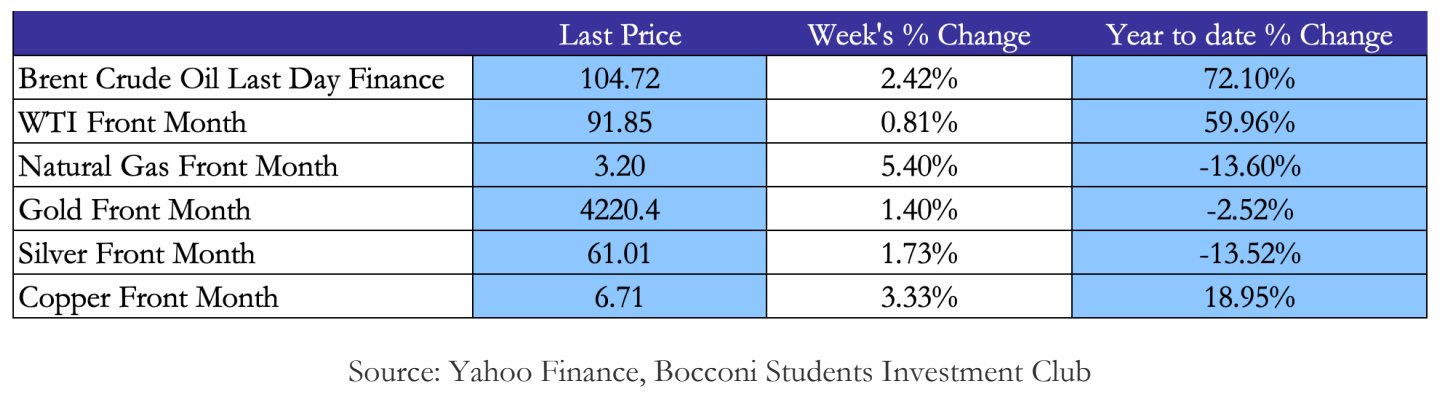
In commodities, oil remained the central variable. Brent dropped below $99 on Tuesday, as Middle East exports recovered and the G7’s release of 100 million barrels of crude and diesel, agreed the previous Friday, eased supply concerns, then jumped as much as 5.7% intraday on Thursday on fears of a US strike on Iran and reports of new tanker attacks, and ended the week 2.42% higher at $104.72; WTI rose only 0.81% to $91.85. Copper was the standout among metals, up 3.33% to $6.71/lb and close to its record, on the strike at the Centinela mine in Chile and the front-loading of shipments ahead of possible US tariffs. Natural gas had the largest gain, about 5% to $3.20/MMBtu, as Hurricane Isaias disrupted US Gulf production. Gold rose 1.40% to $4,220.40/troy ounce and silver 1.73% to $61.01/troy ounce, both rebounding from their mid-week lows.
Next Week Main Events
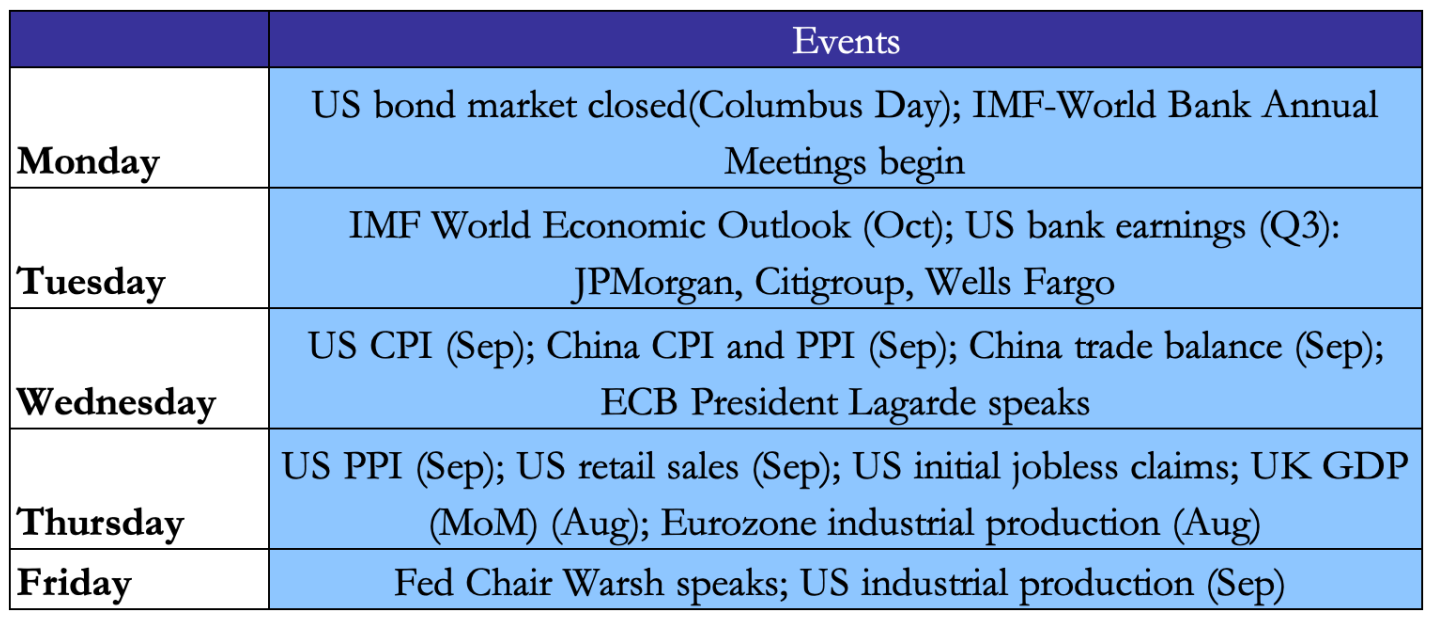
Next week, the focus is on US inflation and the start of the earnings season. September CPI on Wednesday is expected to accelerate to about 3.6–3.7% year-on-year from 3.4%, and will shape expectations for a December hike; PPI and retail sales follow on Thursday. JPMorgan, Citigroup and Wells Fargo open the bank earnings season on Tuesday, the day the IMF publishes its World Economic Outlook. China releases September CPI, PPI and trade data on Wednesday, the UK publishes August GDP on Thursday, and Fed Chair Warsh speaks on Friday. The US bond market is closed on Monday for Columbus Day.
Brain Teaser #57
You are in a completely dark room with a deck of 52 cards. Exactly 10 cards are face up, and the remaining 42 are face down. You cannot tell which way a card is facing, either by sight or by touch, but you may move cards and turn them over.
How can you divide all the cards into two piles containing the same number of face-up cards? The piles do not need to contain the same total number of cards.
Brain Teaser #58
What is the expected number of cards that need to be turned over in a regular, uniformly shuffled 52-card deck in order to see the first ace?


0 Comments