USA
US equities staged a broad-based rebound this week, reversing nearly all of the prior week’s post-midterm losses as implied volatility subsided, with the VIX falling 24.73%, and corporate earnings calmed fears of an immediate unwind in the AI trade. Crucially, the market rallied despite sticky inflation data that cemented expectations for another Federal Reserve rate hike in December. October CPI rose 0.3% MoM from September, pushing consumer prices to a new record level, while October PPI climbed 0.5% MoM. Following the data, money markets completely priced out a December pause: CME FedWatch now assigns a 100% probability to a rate hike at the December 8 to 9 FOMC meeting (up from roughly 77% last week), split between a 91.3% probability of a 25bp hike and an 8.7% chance of a 50bp move. Because a December hike was already largely priced in after last week’s strong payrolls report, equities looked past the rate repricing and focused instead on dip-buying after last week’s positioning-driven rout.
At the corporate level, earnings helped stabilise sentiment around AI infrastructure, though investors remained selective. Cloud provider CoreWeave surged 24.7% on Wednesday after reporting a narrower-than-expected loss alongside strong revenue growth and higher guidance, easing concerns over debt-funded data-centre capital expenditure. By contrast, both Cisco and Applied Materials beat consensus quarterly estimates on Thursday, with Applied Materials seeing its semiconductor systems revenue expand by roughly 64% to $7.996bn, yet their shares pulled back 6.24% and 2.74% respectively on Friday as earnings calls highlighted lingering gross-margin pressures and slowing order growth.
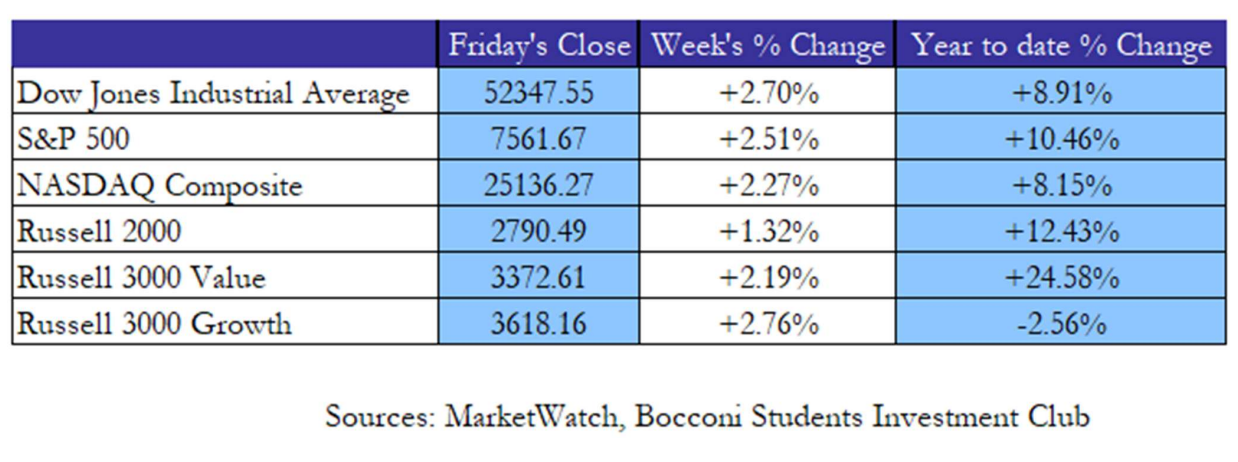
All six major US benchmarks finished the week in positive territory. The Dow Jones Industrial Average led the headline indices with a 2.70% gain, while the S&P 500 rose 2.51% to reclaim the 7,500 level (+10.46% YTD). Stabilising sentiment in technology lifted the Nasdaq Composite by 2.27% and the Russell 3000 Growth index by 2.76%, making Growth the week’s best performer after last week’s 4.87% drop. Meanwhile, the Russell 3000 Value index advanced 2.19%, supported by financials and cyclicals that benefit from a higher-for-longer rate environment. Looking at the broader 2026 picture, the rotation from growth into value remains stark: year-to-date, the Russell 3000 Value is up 24.58%, whereas the Russell 3000 Growth remains down 2.56% for the year. Finally, the small-cap Russell 2000 lagged its large-cap peers with a 1.32% gain, as the certainty of further Fed tightening continues to weigh on smaller companies that carry a higher share of floating-rate debt.
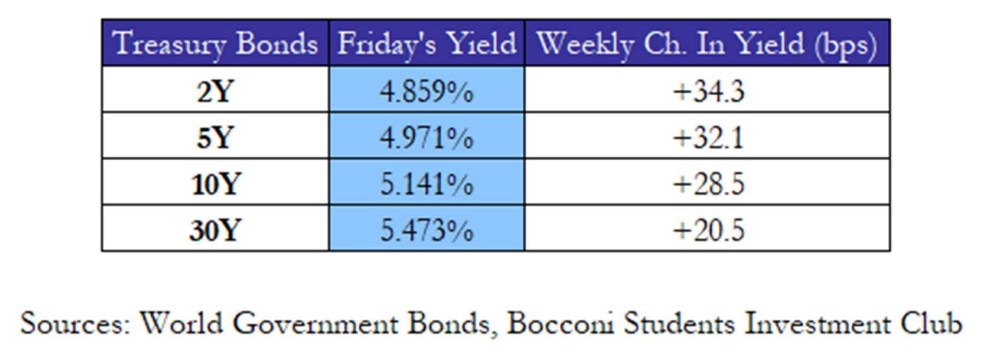
US Treasuries sold off sharply over the week as hotter-than-expected October consumer inflation reinforced expectations of tighter Federal Reserve policy. With money markets fully pricing in a December rate hike, yields rose across the curve, with shorter maturities recording the largest increases. The policy-sensitive 2-year Treasury yield climbed 34.3 basis points to 4.859%, while the 5-year yield rose 32.1 basis points to 4.971%. Further out the curve, the benchmark 10-year yield increased 28.5 basis points to 5.141%, and the 30-year yield advanced 20.5 basis points to 5.473%. These moves left the curve flatter, with the spread between 2-year and 10-year yields narrowing by 5.8 basis points, consistent with a stronger repricing of near-term policy expectations.
Europe and UK
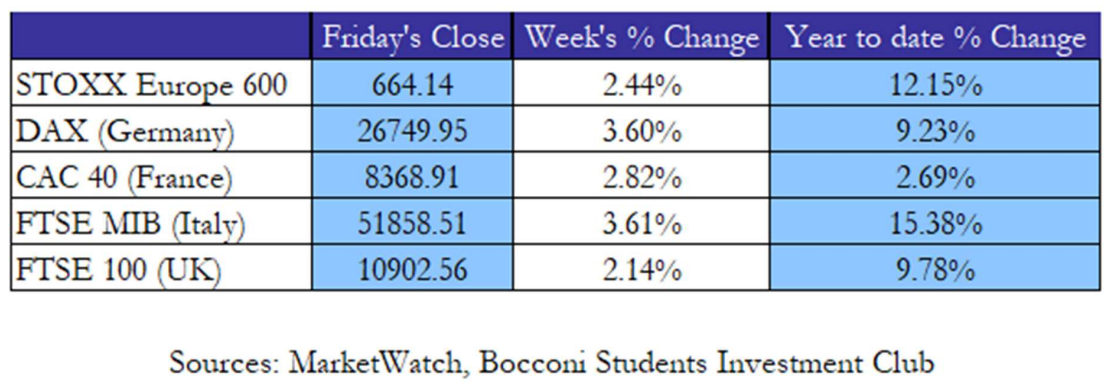
European equities advanced strongly over the week, supported by corporate earnings, lower oil prices earlier in the week and a rotation away from AI-linked stocks. The STOXX Europe 600 gained 2.44% to 664.14, taking its year-to-date advance to 12.15%. Italy and Germany led gains among the benchmarks tracked, with the FTSE MIB rising 3.61% and the DAX 3.60%, while the CAC 40 and FTSE 100 added 2.82% and 2.14%, respectively.
Corporate results provided concrete support. Siemens rose 1.7% on Thursday after reporting better-than-expected quarterly results and raising its medium-term growth outlook, with orders supported by demand for trains and AI-related data centres. UniCredit reported a 24% year-on-year increase in quarterly net profit to €3.3bn and improved its full-year profit ambition. The broader earnings backdrop also remained strong, while Europe’s smaller exposure to technology helped cushion the region from renewed volatility in the US AI trade.
Economic releases painted a mixed but resilient picture. Euro-area GDP grew 0.4% quarter on quarter in Q3, slowing from 0.6%, while UK growth accelerated to 0.7% from 0.5%. Germany’s final October inflation reading confirmed an easing to 2.8% from 3.3% in September. However, continued growth did not remove the prospect of further monetary tightening: by Friday, traders were pricing in a probability above 84% of another December Bank of England hike. The FTSE 100 nevertheless finished the week higher, with energy and defensive stocks supporting Friday’s advance.
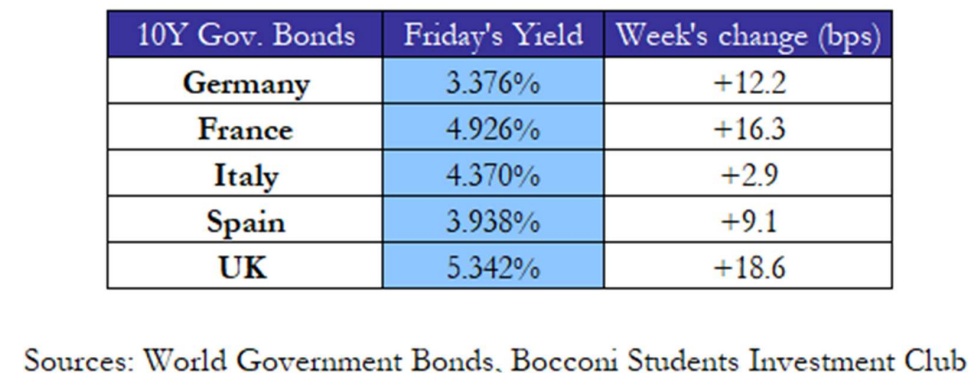
European government bonds sold off alongside US Treasuries, reversing the previous week’s gains. Germany’s 10-year Bund yield rose 12.2 basis points to 3.376%, while France’s 10-year OAT yield increased 16.3 basis points to 4.926%. French debt underperformed Bunds, widening the OAT-Bund spread by 4.1 basis points to 155 and reversing the previous week’s narrowing.
Italian debt proved more resilient, with the 10-year BTP yield rising just 2.9 basis points to 4.370%. Its spread over Bunds narrowed by 9.3 basis points to 99.4, extending the previous week’s compression and falling below 100 basis points. Spain also outperformed Bunds, with its 10-year yield increasing 9.1 basis points to 3.938% and its spread narrowing by 3.1 basis points to 56.2.
UK gilts recorded the largest yield increase among the markets tracked, with the 10-year yield climbing 18.6 basis points to 5.342%. Domestic data showed continued economic resilience: Q3 GDP growth accelerated to 0.7% from 0.5%, matching expectations, while September’s 0.2% monthly expansion exceeded forecasts of no growth. Further tightening remained in view, with Central Bank Watch indicating a 78.4% probability of a 25 basis point Bank of England hike at its December meeting.
Rest of the World
Japanese equities rebounded sharply, while Chinese and Hong Kong benchmarks gave back some of the previous week’s gains. The Nikkei 225 rose 6.46% to 61,142.35, recovering part of its previous 9.25% weekly decline and taking its year-to-date gain to 21.46%. The rebound did not signal a uniform recovery across Asian technology stocks, however, as uncertainty over access to advanced US chips continued to divide the sector.
The Hang Seng fell 3.45% to 23,637.60, leaving it down 7.78% year to date. Chinese cloud and internet companies faced pressure late in the week amid concerns about potentially tighter US chip restrictions, while some mainland semiconductor suppliers benefited from expectations of greater demand for domestic alternatives. Mainland benchmarks recorded smaller weekly losses, with the CSI 300 declining 0.94% to 4,016.29 and the Shanghai Composite slipping 0.41% to 3,634.35.
China’s October releases showed a mixed economic backdrop. Consumer inflation eased to 0.7% year on year from 0.9%, while producer-price inflation accelerated to 5.7% from 5.0%, with energy-related industries contributing to the increase. Trade remained strong: dollar-denominated exports rose 35.2% and imports increased 41.6% year on year, both exceeding the Reuters poll forecasts. The data therefore showed subdued consumer-price inflation alongside rising factory-gate prices and robust trade, rather than the factory-sector deflation described in the original draft.

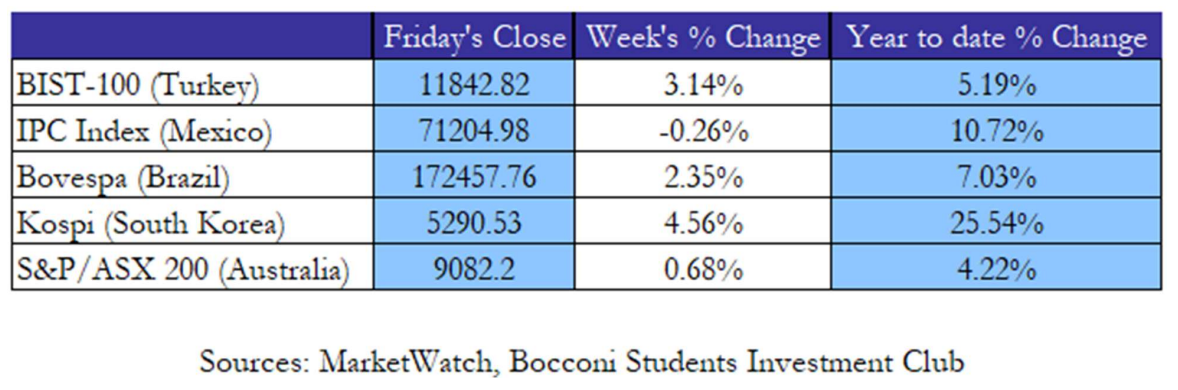
Latin American equities diverged. Mexico’s IPC slipped 0.26% to 71,204.98, giving back a small portion of the previous week’s gain. Brazil’s Ibovespa extended its advance, rising 2.35% to 172,457.76. Petrobras and major banks supported Friday’s gains as investors assessed a fiscal package that had received initial Senate approval, although concerns remained about its scale and implementation. In Turkey, the BIST 100 gained 3.14% to 11,842.82, extending the previous week’s rally.
In Asia-Pacific, South Korea’s KOSPI rebounded 4.56% to 5,290.53, recovering part of the previous week’s sharp decline. Semiconductor shares participated in the recovery, but the index fell over the final two sessions, with foreign selling contributing to Friday’s decline. Australia’s S&P/ASX 200 rose 0.68% to 9,082.20, retaining a modest weekly gain despite late-week weakness in banks and miners.
FX and Commodities
Precious metals reversed last week’s gains as dollar strength and expectations of further Federal Reserve tightening weighed on prices. Gold futures fell 4.70% to $3,887.60 per troy ounce, while silver declined 6.38% to $48.65. COMEX copper futures fell 3.14% to $6.0635 per pound. Oil extended its weekly decline, with Brent down 1.71% to $96.29 a barrel and WTI falling 1.57% to $88.92. Concerns about a growing global supply surplus weighed on the market, although continuing tensions in the Middle East kept the geopolitical outlook uncertain.
US Henry Hub natural-gas futures gained 7.96% to $3.242 per million British thermal units. Colder weather forecasts and expectations of stronger heating demand supported the rally, alongside strong demand from LNG export facilities and a recent decline in production. Prices nevertheless pulled back on Friday, trimming the weekly advance.

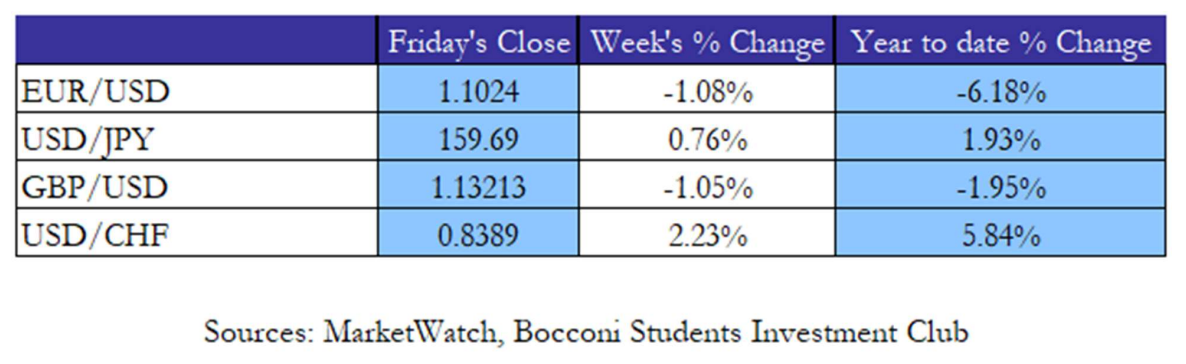
The US dollar strengthened broadly as hotter-than-expected October consumer inflation and hawkish Federal Reserve commentary reinforced expectations of further tightening, lifting Treasury yields. EUR/USD fell 1.08% over the week to 1.1024, while GBP/USD declined 1.05% to 1.3213 despite rising UK gilt yields.
USD/JPY advanced 0.76% to 159.69, ending the week below 160 after briefly crossing that level. Renewed warnings from Japanese officials about rapid, one-sided currency moves kept the risk of intervention in focus. The Swiss franc recorded the largest decline against the dollar among the currencies tracked, with USD/CHF rising 2.23% to 0.8389.
Next Week Main Events
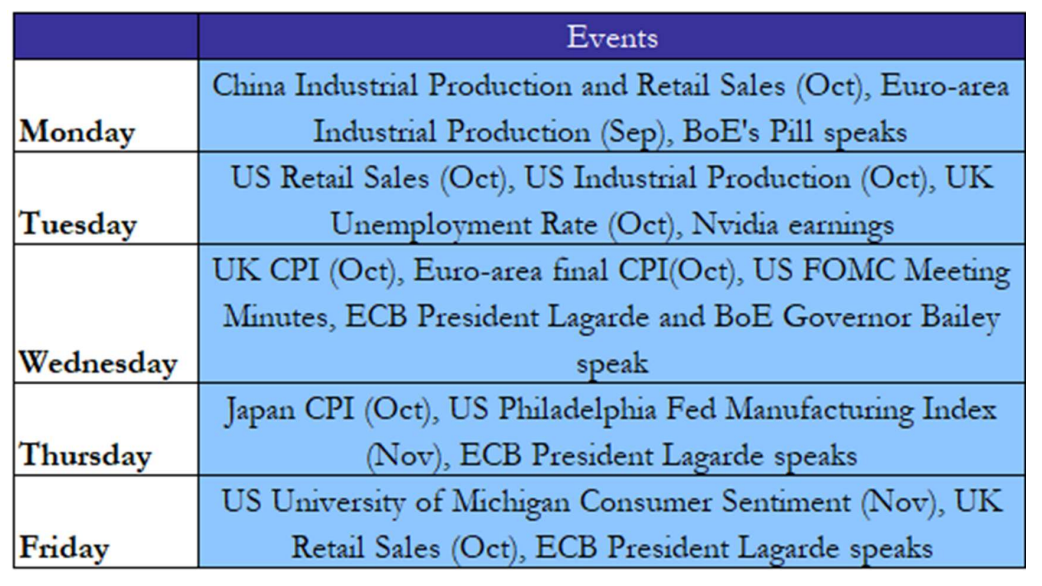
Nvidia’s earnings and October US retail sales on Tuesday are the main tests for whether the AI rebound and consumer demand can withstand a fully priced December Fed hike. Wednesday’s FOMC minutes and Friday’s University of Michigan sentiment survey will show how policymakers and households view sticky price pressures. In Europe, Wednesday’s UK and final euro-area October CPI prints, alongside appearances by ECB President Lagarde and BoE Governor Bailey, will test current rate expectations. Monday’s Chinese October activity data and Thursday’s Japanese CPI round out the macro calendar.



0 Comments