What happens to a large, advanced economy when it enters a full-scale military conflict? In 2022, Russia turned that theoretical question into a live case study of how a modern nation with vast natural resources and a demographic decline can sustain war. As we will see in this comprehensive overview, the cost of bearing a wartime economy primarily comes down to a loss of monetary control via fiscal dominance and a lack of macroeconomic development, all to be tackled through a peculiar policy mix.
First, we saw that Russia’s war economy moved from overheating into stagnation, with the government budget now heavily dependent on bank-intermediated central bank liquidity. The Bank of Russia (CBR) maintains a tight policy rate of 14%, holding the price of money firm, but it is increasingly losing control over quantity. Every additional year of war requires more spending that currently seems to be reaching its limits, as the government is struggling to collect enough revenues or borrow internally. Consequently, in its 5th year of war, Russia is facing near-zero GDP growth, sticky inflation of around 7% and a large budget deficit that is progressively more difficult to finance for the state. The country’s financial markets are beginning to price in this strain, as long-term government bond yields sit 2.8 points above the policy rate and corporate defaults doubled in 2025. All of this is happening in a market largely closed off from foreign capital, which leaves the state borrowing from a limited base of state-controlled banks funded by the central bank. Oil revenue could potentially buy time, but at under a fifth of federal revenue it is unlikely to be able to close the gap, and without credible fiscal consolidation Russia dangerously risks sliding from the current stagnation into stagflation.
Our country of study arguably remains a hidden mystery for many external observers, so in this article we attempt to untangle the particularities of Russia’s “economic health” under wartime conditions. We will look at the broad macroeconomic indicators, the nature and intricacies of current fiscal and monetary policy, as well as the state of the country’s financial markets, focusing above all on debt and commodities. We will then try and use our analysis in drawing up careful projections for where the country’s economy may be headed.
The Real Economy: Stagnation, a “Two-Circuit” Structure and Inflation
In 2026, Russia’s GDP growth is close to zero and is primarily carried by war-linked industry, not investment which is shrinking. According to Rosstat, in 2026 GDP fell 0.2% YoY in Q1 and rebounded 1.3% in Q2, with overall growth forecasts for the year, both domestic and international, clustering in the range of 0.5-1%. However, headline figures alone hide a crucial sectoral split – manufacturing grows, but mining and non-manufacturing industries are progressively contracting. In H1, fixed investment fell 9.9% and total industrial output was revised to zero growth, while manufacturing alone grew 0.5%. We thus see a so-called “two-circuit” structure, where output in branches that are not directly war-related is in decline, while manufacturing and state-directed lending expand. The government continues pouring money into the economy – in the first years of war, aggressive expansionary fiscal policy artificially supported demand, leading to high growth in 2023 (3.6%) and 2024 (4.3%). But wartime pressures are clearly putting an end to this apparent miracle, as in 2025 GDP grew by 1% only and the downward trend is expected to continue. Overall, Russia’s real economy is now stagnant, not yet recessionary, and a key point for the rest of our analysis is that stagnation is the cost of the current policy mix that we discuss below.
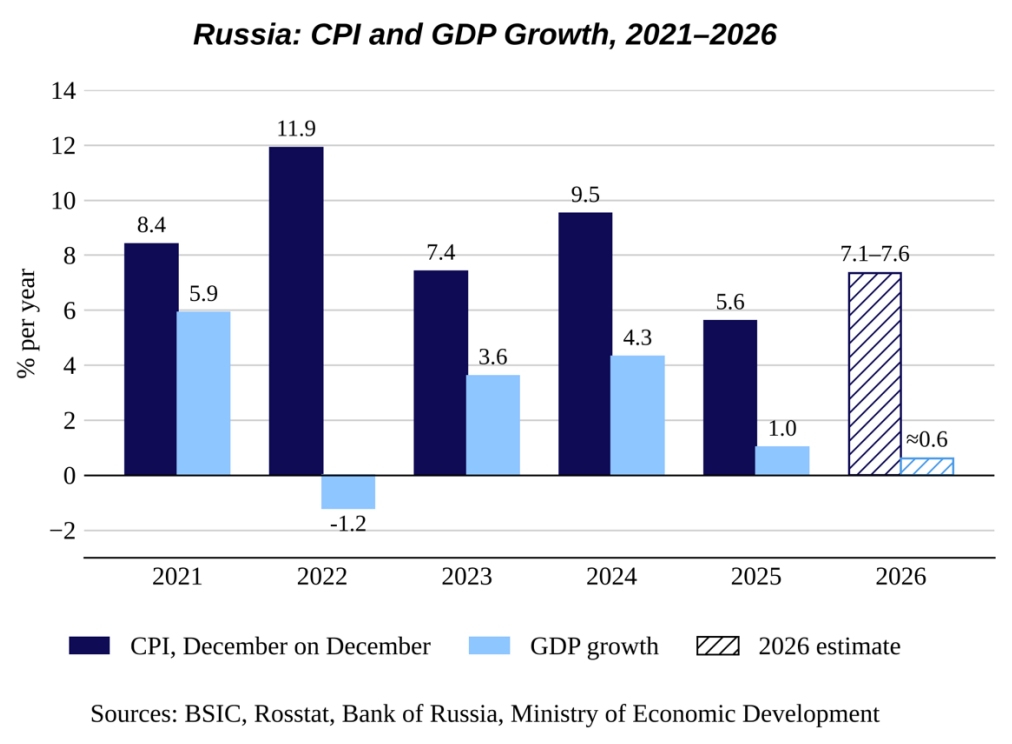
Regarding inflation, it has undergone a significant structural transformation since the beginning of war. In 2023-2024, it was primarily driven by demand in an overheating economy, which in 2025 was finally brought down to 5.6% by the CBR’s prohibitive policy rate of 21%. While monetary policy was effective in combatting this demand-driven inflation, its transmission became increasingly impaired in 2026, because inflation became supply-driven.
The central bank maintains a high policy rate of 14%, but inflation projections for 2026 remain high at around 7%, as prices are now growing due to supply-side factors rather than demand-side ones. The principal four are:
- Rising fuel prices and reduced production capacity. Intensified refinery strikes since 2025 and shortages push up transport and goods costs across the country, as the CBR points to a temporary loss of production capacity in its September release.
- Increased administered tariffs. Utility and housing tariffs rose by about 10% on October 1st, with a further 11% increase planned for July 2027. These prices are set by the state, not by demand, so they shift the price level by a one-time amount.
- Weakening of the ruble against foreign currencies. The exchange rate weakened from 70 rubles per dollar in May to a high of 87 in early September, slightly regaining through autumn to 82.14 as of November 7th. The CBR attributed the weakening to lower export volumes and higher fuel imports – a paradoxical situation considering oil prices have been on a high, in certain periods reaching above $100 per barrel. The weaker exchange rate raises import costs, but because these pass on with a lag, the summer fall added to inflation in autumn. The recovery should ease by the end of the year, and this factor is likely to fade.
- Unanchored inflation expectations and wages. Household inflation has fluctuated around 14% throughout since the summer; wage growth is slowing but still outpaces productivity, in a labor market with 2.2% unemployment and real wages up 6.5% in H1. This is a factor that by itself does not cause price rises but rather makes them persistent. When firms and households expect 14% inflation, one-off shocks are transmitted into wages and price decisions, and the likelihood of second-round effects that the central bank fears increases. Importantly, unlike the other three factors, the central bank is able to influence this one through its policy rate.
Fiscal versus Monetary Policies: a Quiet Conflict?
The single most peculiar fact about the Russian economy today is that, to one, fiscal and monetary policies may seem to have effectively been working in opposite directions. The 2022 budget, originally planned at 23.7trn rubles, exceeded 31trn, and all the subsequent years have followed the very same trend of growing spending that exceeded the original budget laws. In 2019, federal spending as a percentage of GDP stood at just about 17%, rising to almost 21% by 2026. Since 2022, the state has been artificially fuelling demand via subsidies and direct financing of war-related industries, which in turn led to an overheating of the economy and output growth in 2023 and 2024 that was surprising to many external observers.
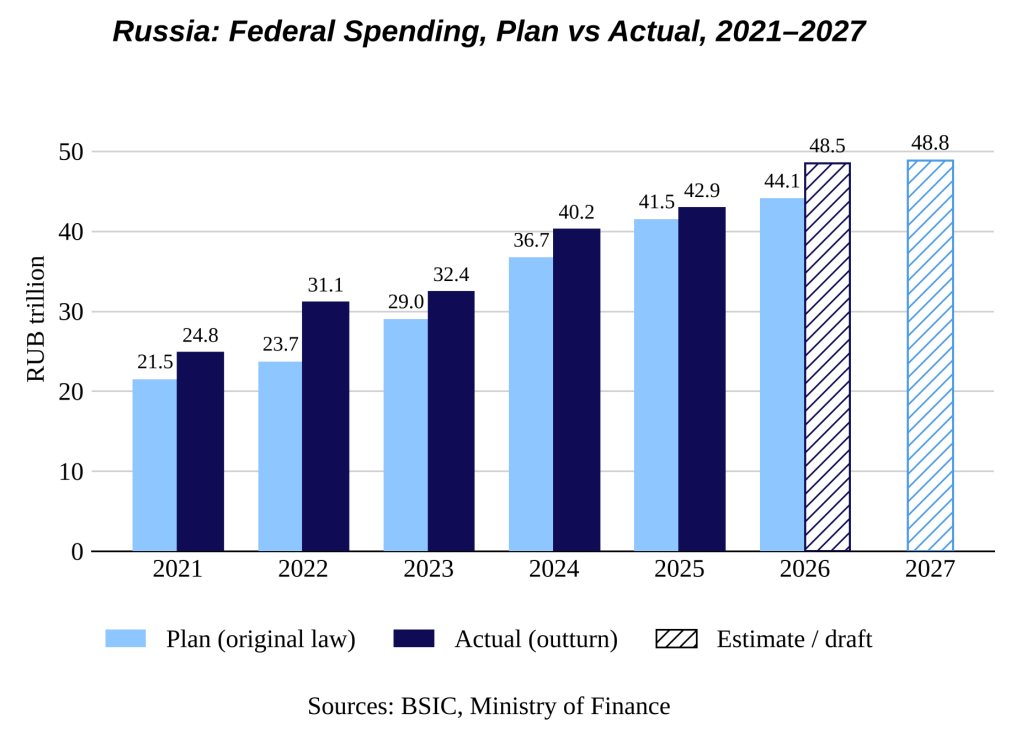
Not only has federal spending exceeded the original budget laws every year since 2021, but its base has also been changing. In 2022, oil and gas made up 41.6% of federal revenues, falling to 18.5% in the first nine months of 2026, with receipts down 17%. This year’s budget now largely rests on the domestic economy, via a VAT increase to 22% and, from 2027, higher taxes on dividends, income and business, as well as a proposed higher tax on deposit interests from 2027. Russians hold a record 67.4trn rubles in retail bank liabilities and savings accounts, so as the government is struggling to borrow, it has begun looking for sources of filling its budget gaps with the citizens’ savings – something that was previously considered politically dangerous. Another concern that some economists express regarding increased taxation is the possibility of entering the prohibitive range of the Laffer curve, that is, the government reaching a point of being unable to collect more revenues through tax increases. This possibility has not been confirmed by reality yet – government spending is on the rise and the war is increasingly financed by the same households, firms and banks whose liquidity is managed by the central bank.
Meanwhile, monetary policy has followed its own independent path. Under Article 75 of the Constitution of the Russian Federation, the Bank of Russia’s main mandate is protecting the ruble which it does through inflation targeting at about 4% and a floating exchange rate. Contrary to what one may expect of Russia’s consolidated political system, the central bank maintains a high degree of autonomy in its decisions, allowing it to pursue relatively independent interventions in the economy that at times go against the interests of other institutions. Concretely, the Russian central bank led by Elvira Nabiullina has stuck to a contractionary monetary policy for most of 2022-2026. In that period, the policy rate fluctuated heavily between 7.50% and 21.00%, with aggressive interventions aiming to stabilize the ruble and domestic inflationary pressures caused by the fiscal expansion.
However, we are now witnessing a reversal of this trend. Sticky inflation is now supply- and not demand-driven, and thus difficult to manage through the policy rate, all while output growth has become largely stagnant. Fiscal policy remains expansionary in its level but is claimed to be contractionary in its impulse in the future. The new 2027-2029 budget passed by the Duma in first reading on October 29th is meant to cut real spending by 4%, with the planned deficit falling from 3.2% to 2.2%. The Bank of Russia cannot verify that promise and is thus forced to make decisions on the policy rate with respect to the planned budget. Importantly, the two institutions are not openly at odds. Minfin claims to have “done everything on the budget side” to allow the central bank to lower its policy rate, and deputy governor Zabotkin has called a lower structural deficit “an important, although not the only condition” for easing. The bottom line of this “conflict” is thus conditionality: the Bank of Russia sets its rate according to planned budget targets that have been missed every year, while the budget’s own financing depends heavily on banks that are funded by the CBR. Under that uncertainty, the central bank sets the price of money firm, but it is ultimately the budget that decides how much of it there is in the economy.
Internal Borrowing: How is the Deficit Financed?
As of today, total state debt is not an issue as it stands at about 20% of GDP in 2026. The true problem for the budget comes from its increasing difficulties in financing persistent deficits, as debt servicing is now planned at 4.57trn or about 9.4% of all spending in 2027.
We must mention that Russia is currently cut off from foreign capital markets and all meaningful state borrowing must be done internally. The question is thus not how much the state owes to its creditors but rather who will lend to it now and, crucially, at what price. The OFZ (federal government bonds) market was 32.96trn at nominal value in early June, with non-residents holding only 3.0% as of July, meaning the market is truly domestic. In January-September, Minfin placed 4.64trn rubles of OFZ and plans a further 2.45trn in Q4. If that plan is met, total 2026 placements will reach about 7.1trn, roughly 29% above the 5.5trn planned in the original budget for the year. However, nominal volumes are not the real story, as 2025 OFZ placements, for instance, stood higher at 8trn. The real change is in yields that the government pays on new bonds and in the buyers.
This summer has shown how fragile the market had become. Right after a cancelled auction in June and the weakest auction in a year in early July, Minfin suspended its regular auctions in late July after four unsuccessful offerings, with only 9bn raised against a quarterly target of 1.5trn. It then issued new floating-rate OFZ worth 1.5trn rubles, which VTB analysts considered as preparation for pre-agreed placements with major banks. The 1trn floater of September 2nd attracted demand of 1.42trn, and 83.6% of that was bought by the largest banks. On September 30th an auction was declared failed for lack of acceptable bids. Finally, in October, the market cleared again, but only at a price: every auction that month settled at yields of 15.7% to 16.8%.
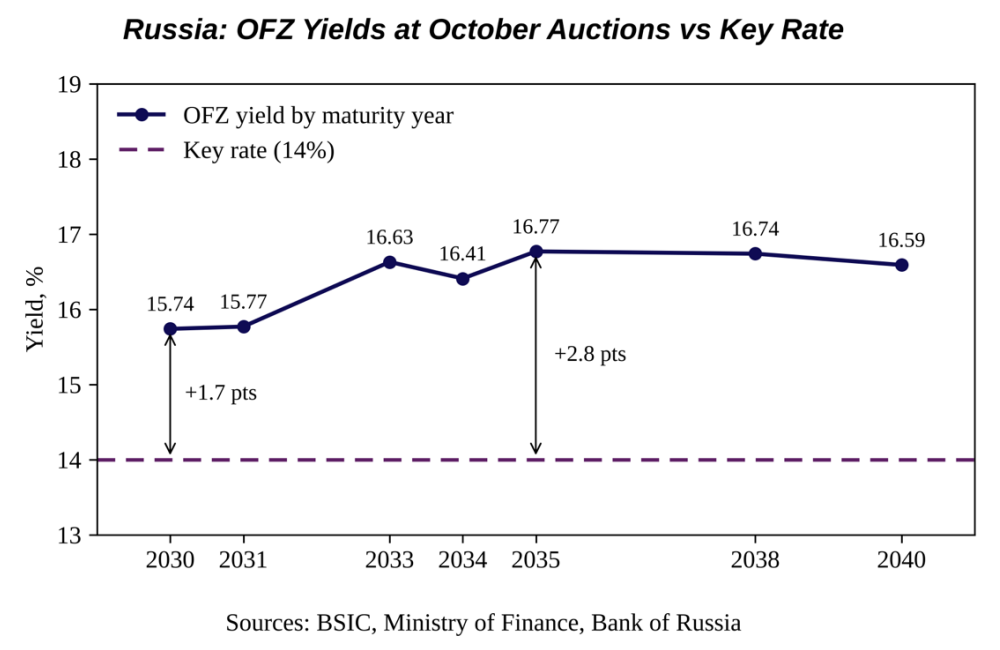
The difference between that price and what the government would like to be paying is the clearest sign of strain. The 10-year yield of 16.8%, for instance, is 2.8 points above the central bank’s current 14% policy rate. This spread essentially evolved from being at a negative premium, when 10-year yields sat below the 21% policy rate, into an ever-widening positive gap. CBR claims the rising spread is due to the persistence of inflation and the size of Minfin’s planned budget. Large state banks – that is, the target buyers of state debt – show where the pressure falls. The largest holder of government bonds, Sber, held 8.2trn of OFZ at the end of September, which made up 67% of its securities portfolio, and its CFO warned in July that banks had no spare liquidity left to buy bonds. According to him, “all hope” lay in central bank support.
Now, this is the moment to demonstrate one of the key ideas behind the current borrowing model – while the central bank is able to hold the price of money firm, its quantity is arguably getting out of its control through fiscal dominance. Banks fund their purchases of the OFZ via repo from the Bank of Russia, presenting those very same bonds as collateral. As argued by former CBR deputy governors Aleksashenko and Vyugin, this effectively creates new money, even though formally banks merely buy debt. In July 2026, repo debt reached 6.2trn, up 2.6trn since the start of the year, and the CBR injected an additional 2.3trn over the same period. Meanwhile, the Bank of Russia defends the mechanism as stable claiming that repo is short-term and collateralized, adding that cash withdrawals can be used in explaining a large portion of the liquidity deficit. Putting the different views together, the reality is arguably that cash demand forces banks to turn to the CBR and once banks depend on its funding, the same channel finances the bonds that finance the deficit.
One of the fixes has been the issuance of floating-rate OFZ-PK. With these, Minfin has been able to place new debt while avoiding high fixed yields and protecting banks from losses in the case that bond yields rise. However, floaters carry significant interest-rate risk for the issuer, because the state budget’s interest bill now tracks the CBR’s policy rate. Keeping in mind that the central bank retains a high degree of independence, a sudden hike decision could thus seriously ramp up the necessary repayments on floaters. These bonds were about 35% of all OFZ in April, which is above Minfin’s own comfort range of 25-30%, and the September 2nd issue pushed that share yet higher.
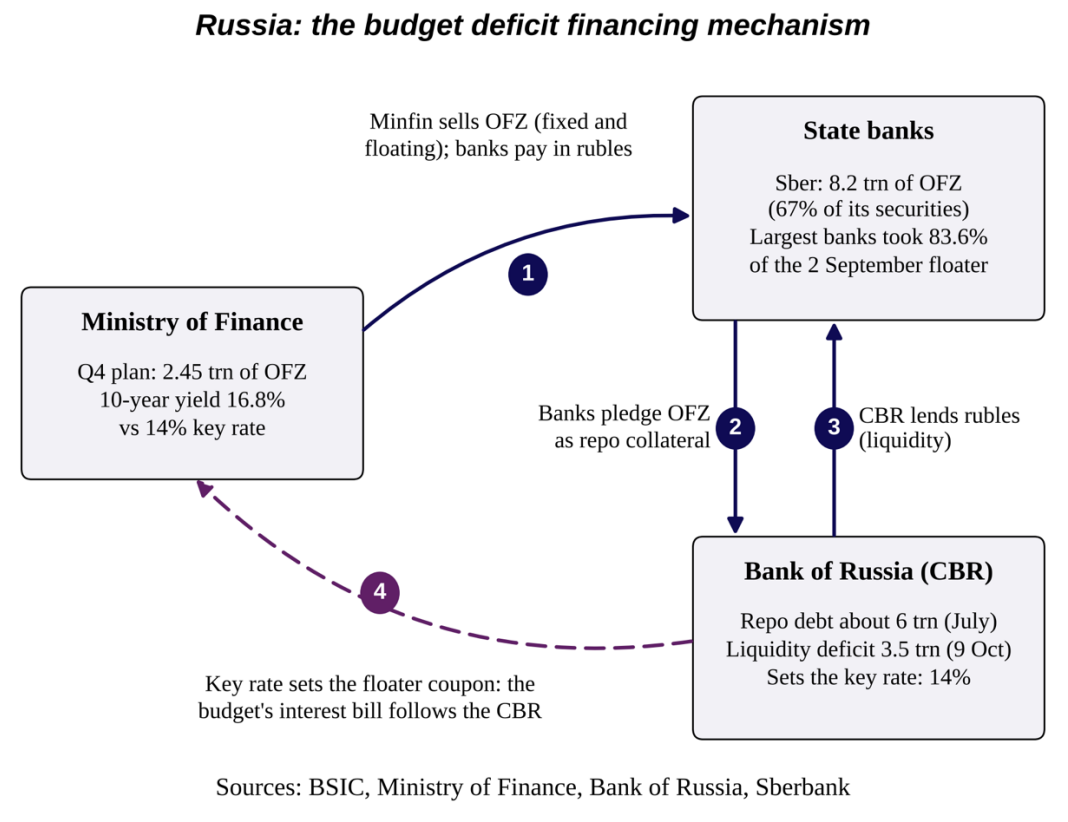
Thus, each additional trillion in government borrowing either needs more central bank funding for the banks or higher yields to attract other buyers. Unfortunately for the Russian government, neither option is free, and the next section examines how markets are pricing in that strain among others.
Financial Markets: Overview
Russian markets certainly do not expect easing, and they are currently pricing in two things at once: rates are expected to stay high for longer with an eventual, although unclear, chance of peace ending the war. The CBR still sets the short rate, but further-out markets – like long bonds, corporate credit, bank funding and where investors are pulling their money – all show signs of strain. Equities are effectively a “casino for the locals” where investors bet on geopolitics rather than any actual growth.
Financial Markets: Bonds and Corporate Credit
Debt markets stand at the centre of our analysis as they are essential in understanding the direction in which the Russian economy and policy are moving. Government bond yields are on the rise as spreads widen and lenders demand increasingly higher rates on the OFZ. To generalize the 2022-2026 trend, the yield curve has been turning from deeply inverted to steeply upward-sloping, which confirms that the term premium is rising – investors are expecting higher compensation for lending to a state whose fiscal discipline they doubt. In recent months, the same two issues that cleared about 14.8-14.9% in June’s auction settled at 16.41% (maturity in 2034) and 16.59% (maturity in 2040) on October 28th, despite the fact that the central bank’s policy rate fell by 25 bps over the same period. The Russian Government Bond Index (RGBI) was at about 112 in October, back at the crisis level of July.
Corporate bonds and credit markets are equally of interest to us. We have seen that in the current macroeconomic conditions and at the 14% CBR rate, private investment has been shrinking. Corporate bonds pay about 150 bps over the government OFZ, with floaters making up over half of October’s corporate placements. This means that companies increasingly borrow short and at floating rates, accepting the interest-rate risk themselves. The longer the central bank maintains its high policy rate, the longer respectively higher rates feed into the companies’ interest bills, meaning investors lend even to solid borrowers at a significant premium. We have summarized the available data on bond defaults and high-yield bond yields below. Figures are compiled from several sources, so definitions of default differ between them and some years are incomplete. The table is thus indicative of the general trend rather than exact series.
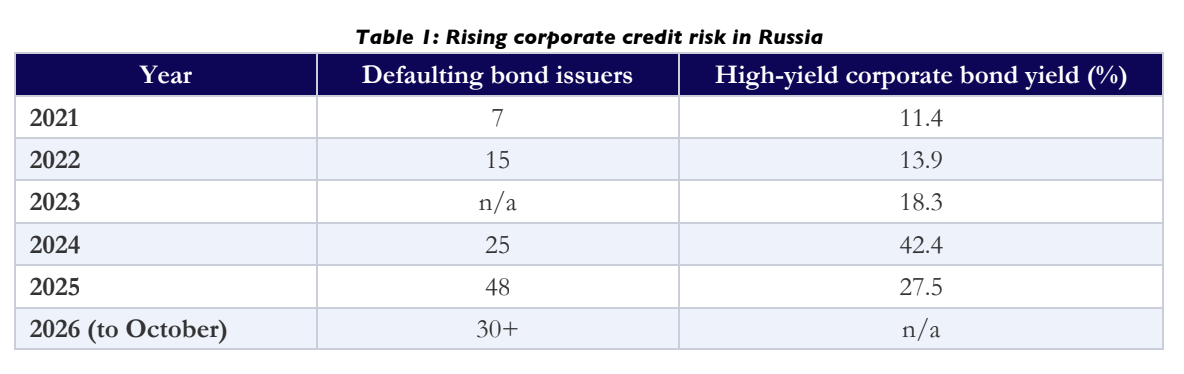
Corporate credit risk in Russia has been on the rise. Putting together average corporate bonds rates and defaults side by side, we can see that defaults kept rising even after yields peaked in 2024. The damage done by the 21% policy rate shows up with a lag, as weaker companies run out of capacity to refinance. As stated before, in Russia’s case, headline figures alone tend to hide important structural changes happening within the economy. Corporate credit in that sense is particularly revealing about the two-circuit structure of the economy, in which state-linked and top-rated borrowers still raise money at 1-1.5 points over OFZ, while smaller civilian firms pay 25% or above, or default. This means that high rates are not just restraining demand by limiting private investment and civilian consumption but also pushing weaker part of the civilian economy toward default. The stress has lately been reaching large listed companies, such as Evraz, Kamaz and Samolet, which were all downgraded in October.
Financial Markets: Equities
Russian equities have become a kind of casino, where local traders gamble on geopolitics rather than invest in growth. The IMOEX index – which tracks the 50 most liquid, largest corporations on the Moscow Exchange – closed at 2,476.70 on November 6th, down about 5% YoY and 24% below its level three years ago.
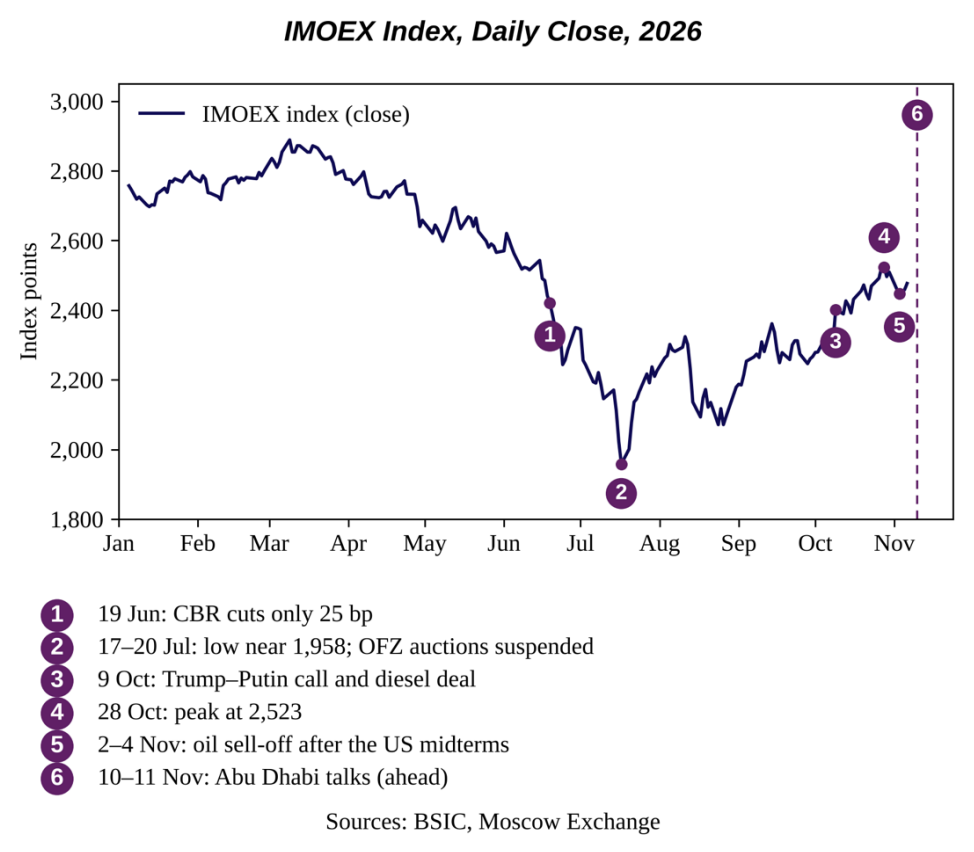
Zooming out, the IMOEX 2026 range is particularly revealing about what drives price fluctuations. The index fell to about 1,958 in mid-July, after the CBR cut the policy rate by less than expected in June, the sell-off of OFZ and the suspension of bond auctions. It then suddenly rallied to a peak of 2,523 on October 28th following a Trump-Putin call of October 9th, as speculation on a peace process renewed and oil prices were high. It then slipped back in early November as Brent fell significantly and investors waited for the US-mediated talks in Abu Dhabi on November 10th-11th. None of these moves was driven by earnings.
Another peculiarity is the disconnect from oil. Brent was up by 60% YTD in early November, yet the IMOEX, which includes Russia’s major oil and gas producers, was lower than a year prior. We may partly attribute this to the domestic channels such as high taxes on the oil sector, refinery subsidies and, above all, a prohibitive 14% policy rate, which is key to valuations, that makes almost any equity look expensive to investors. This means that Russian oil companies are increasingly struggling to capture gains proportional to the rise in oil prices. They sell at a heavy discount to Brent, export volumes are falling, and much of the windfall is taxed away or paid out in subsidies.
The question we should ask ourselves is whether, for an average Russian investor, the equity market remains attractive to invest in. Money-market funds currently pay approximately the policy rate with no risk, and long-maturity OFZ bonds yield over 16%. Brokers’ targets for the IMOEX index that sit in the range of 2,600-2,800 imply 5-13% upside only, so even with dividends, equities offer roughly what cash already pays. Stocks only beat returns on savings if the risk premium falls, which would require a peace deal or lifting of sanctions – something that rate cuts alone will not be able to substitute. As BCS strategist Mikhail Zeltser put it on October 30th, “the driver of an equity rally is a relaunch of the geopolitical settlement process.”
The current Russian stock market can arguably be described as a casino, where individuals make up 67.8% of all share trading volume as of October. Moreover, economist Alexandra Prokopenko highlights that investors are experiencing “extreme pessimism” about growth prospects, which may partly help us in explaining the large number of speculative trades against shrinking interest in genuine value investing. Due to sanctions, foreigners are largely shut off from Russian equities, with most current participants being Russian residents. Market moves are thus speculative and largely disconnected from fundamental factors, leading to a volatile environment in which equities have become a call option on geopolitics.
Financial Markets: Banks
On the surface, Russian banks are not in crisis and remain the most profitable sector. They earn their spread on financing the government deficit and the wartime economy, while the risks rest with their borrowers and in their dependence on funding by the CBR. The banking sector’s ROE is about 23%, with January-September profits alone amounting to 3.7trn rubles, which is equal to roughly all of 2025. Notably, lending is moving at two separate speeds – corporate loans are up 13.5% YoY to 111.7trn, while consumer loans only +5.2%. The CBR attributes this to business’ weak sensitivity to the key rate, although this argument comes in conflict with falling private investment that we mentioned above.
Nonetheless, there is a number of concerns that can potentially undermine the structural integrity of the sector. Banks’ three issues consist in asset quality, funding and dependence on the CBR. On August 4th, problem corporate loans reached 11.7trn rubles (11.6% of the portfolio) and rose by another 0.6trn that same month, mostly from coal and power companies. Moreover, household deposits fell by 0.2% in August and 0.1% in September despite a record total stock, and the proposed tax on deposit interest from 2027 onwards is likely to discourage savings yet further. This means that the banks’ cheapest source of funding is shrinking just in the moment when they are asked to absorb more government debt. Meanwhile, banks owed the CBR about 6.2trn in repo in July, and the structural liquidity deficit stood at 3.5trn as of October 9th. The CBR has also started tightening non-price lending conditions for corporate borrowers, so credit to weaker civilian borrowers is likely to fall further even in the absence of a rate hike. Thus, the banking sector’s weakness is not the capital that it has today, but rather the quality of borrowers and the funding model. Banks that hold OFZ and lend to state-related industry rely heavily on the central bank’s liquidity.
So, for how much longer can banks finance the ever-growing budget deficits? The answer depends less on the banks’ capital, which is evidently ample, than on how much liquidity the Bank of Russia is willing to provide them with. As long as the CBR lends against OFZ, banks can keep buying them; however, the cost of that would be loss of control over the quantity of money with every new round of state borrowing.
Financial Markets: The Ruble
If banks are the channel through which the state is financed, the ruble is the channel through which the fiscal-monetary tension transmits into prices. A weaker ruble suits the budget, because foreign currency revenue from exports is worth more in rubles, but this also raises import prices and accelerates inflation.
The ruble has been falling. Despite reaching a strong exchange rate of 70 per dollar in May 2026, the ruble has been weakening again through fall. As of November 7th, the official CBR rate was 82.14 rubles per dollar and 12.27 per yuan. As the Moscow Exchange is under sanctions since June 2024, the USD/RUB rate is derived from over-the-counter trading. CNY/RUB is the main exchange-traded pair.
Let us examine the main drivers behind the ruble’s weakening trend:
- Oil and volumes. High oil prices naturally bring in more foreign currency, but this year lower export volumes and higher fuel imports have offset much of that, which is how Nabiullina explained the ruble’s weakness since May.
- The rate gap. As the policy rate remains at 14%, holding ruble pays well, and this interest-rate differential has kept the currency from weakening further.
- The budget rule. Under the rule, oil revenue above a cut-off price is used by Minfin to buy foreign currency and gold for the National Wealth Fund. In January, Minfin was selling about 12.8bn rubles of currency a day; the rule was suspended from late February and resumed in May. As the oil windfall arrives, purchases are rising fast: 2.5bn a day in September, 12.7bn in October and 15.6bn from November 9th.
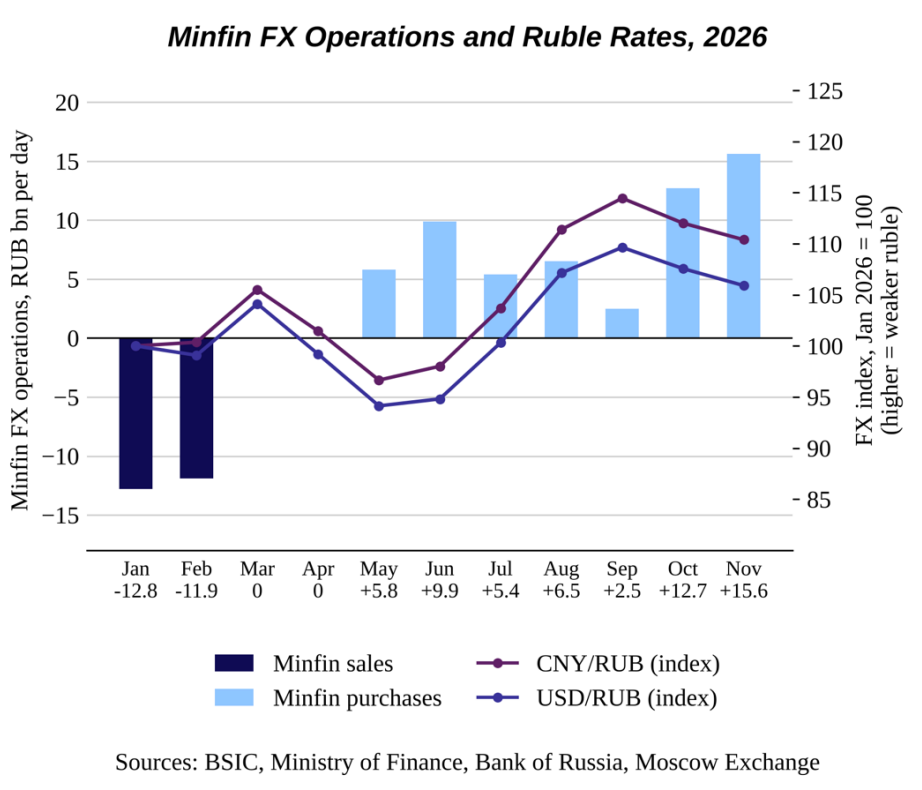
There are two additional factors making further weakening of the ruble likely. First, taxes are calculated on the previous month’s oil price, so the sharp fall in Brent in early November reaches revenue and currency purchases only in December. And in 2027 the cut-off price falls from $59 to $50, which means larger purchases at any given oil price. Early November forecasts range from 78 to 85 rubles per dollar by the end of the year. Most of the oil windfall is thus saved in the National Wealth Fund. A weaker national currency raises the ruble value of each dollar of oil revenue, which is of course good news for Minfin; however, this also raises import prices, complicating the Bank of Russia’s fight against inflation. This is the very same tension as we discussed in the policy section but seen through the exchange rate. Forecasts are split, but the balance of forces points to mild weakening in December.
Financial Markets: How Do Investors Hedge and Where Does Money Sit?
Russian investors have stopped betting on growth, preferring cash-like instruments that pay the key rate. First of all, money-market funds currently dominate. These funds invest in overnight repo and pay close to the key rate with almost zero risk. In retail fund portfolios, the largest of them, LQDT, accounts for 43.9%, followed by SBMM and AKMM at 17.3% each, while funds holding floating-rate bonds make up another 11%. In October, money-market funds paid investors a record monthly income.
Investors also largely prefer bonds over stocks. In October, individuals put 145.7bn rubles into bonds on the Moscow Exchange. In September they bought 158bn of corporate bonds and 28.4bn of OFZ, but only 6.9bn of shares. Interestingly, the largest banks sold 160bn of OFZ on the secondary market that month, while non-bank financial firms and individuals bought – banks keep their buying for new floaters, funded by CBR repo.
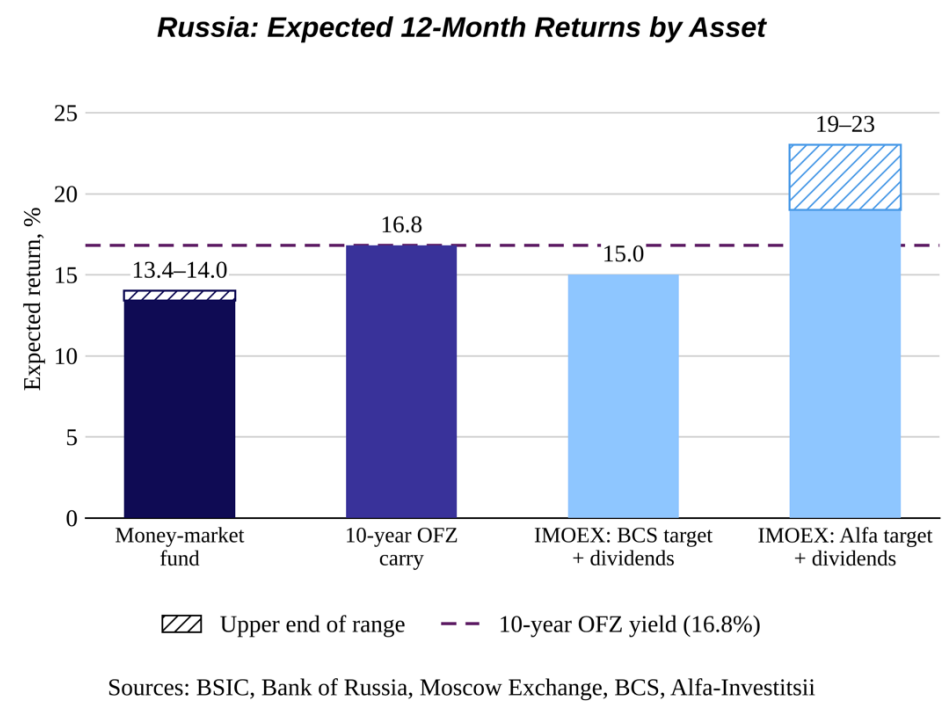
Hedging follows the same logic. Individuals bought 91.5bn rubles of foreign currency in September, gold trading on the Moscow Exchange reached a record 52.2 tonnes in October, and retail investors make up about half of derivatives trading, mostly using index, yuan and Brent futures as directional bets. Brokers’ own advice confirms our analysis of the situation. T-investments says it holds “an increased share of liquid instruments – money-market funds and floating-rate bonds”, and Alfa says it is “cautious on long OFZ” in the short term.
So, the typical Russian portfolio today looks like that of a stagnating economy rather than one that expects growth. Investors are trying to “own the carry and rent the duration”, as most money earns approximately the 14% policy rate in cash-like instruments, while some positions in long bonds or stocks are closer to bets on geopolitics. We must however be cautious in looking at that seemingly huge rate of return. Inflation has been persistently high around 7% and thus eats up at least half of that key rate return, and the government – seeking to increase its revenues – will begin taxing deposit interest from 2027. This means that in reality cash-like instruments’ real gains will be around 5%.
Oil, Sanctions and the External Channel
We would like to begin this section with a commentary on recent developments around the US-Russian oil trade. September 18th, Trump signed the “Sanctioning Russia and Iran Act”, which allowed tariffs of up to 100% on large buyers of Russian oil. Then, after a call with Vladimir Putin on October 9th, he announced Russia would supply the US with 300,000 tonnes of diesel immediately, 500,000 in November and 1,000,000 after that. While bringing in some hard currency for Russia, the move is peculiar for all sides. The diesel revenues are of little significance to the government. By our own estimate, even the full million tonnes a month would be worth roughly $1bn at most, and the announced amounts would certainly not change equilibrium prices globally as President Trump has envisaged. Moreover, Zelensky alongside EU officials have denounced the decision, which potentially strains Western unity over sanctions. The deal is also already falling apart, as the first tanker carried only 40,000 tonnes, and by November 5th two of three US-bound ships had changed course. The curious development has thus hardly benefitted either party.
However, in 2026 Russia has indeed been the beneficiary of an oil windfall, one that is not of domestic origin. It comes from the Iran war and is mostly saved rather than spent. Diplomacy with Washington helped at the margins, but a peace in the Middle East would hurt Russia’s budget more than a peace in Ukraine would help it. The oil price that really matters for Russia today is set in the Gulf. Brent was at $61 at the start of the year, but the US-Israeli war in Iran from late February and the subsequent closure of the Strait of Hormuz pushed it to about $118-121 in the first half of spring. It fell below $74 in June after a ceasefire, then rose yet again above $116 in late October.
Generally, Russia captures only part of the price of oil. The Urals price used for taxes reached $101.46 in October, the first month above $100 since 2014, up from $53.68 a year earlier. But Russia sells at a discount, which was about $21 against Dated Brent in early October and about $28 in February, and in falling volumes: seaborne crude exports averaged 3.65 mb/d in the four weeks to 1 November, and total exports in August were the lowest since 2018. Ukrainian drone strikes on refineries and ports have added further disruptions.
Nonetheless, the windfall from exports of natural resources is certainly arriving but is mostly saved. October oil and gas revenue was 971bn rubles, the best month of 2026, though still below Minfin’s own expectation. Because taxes use the previous month’s price, November revenue will be strong too. But two leaks absorb much of it. The first is the damper, a subsidy paid to oil companies to keep domestic fuel prices down, which rose from 197bn rubles in August to 415bn in October. The second is the budget rule, which channels revenue above the cut-off price into currency purchases for the National Wealth Fund. Over the period of January-October, oil and gas revenue is still about 14% lower than a year earlier, and it now makes up less than a fifth of federal revenue.
Two kinds of peace pull in opposite directions. The unlikely scenario that consensus believes is currently unattainable – a deal in Ukraine, or sanctions relief – would lower the Urals discount, lower freight and insurance costs, and reduce the risk premium on Russian stocks and bonds. But it would not quickly undo the damage to refineries, the spending already planned for 2027 or Europe’s move away from Russian energy. A deal with Iran, on the other hand, would reopen Hormuz and lower both Brent and Urals, cutting Russia’s revenue within a month. The “peace trade” in Russian equities and the “Iran peace” trade in oil therefore point in opposite directions for the Russian budget. Oil buys Russia time. It does not change the financing mechanism described earlier.
What We See “On Balance” and Conclusion
Some observers fear that stagflation is a risk for the near future, however, the real state of the Russian economy does not confirm this thesis yet. Let us diagnostically assess how far the country is from that threshold.
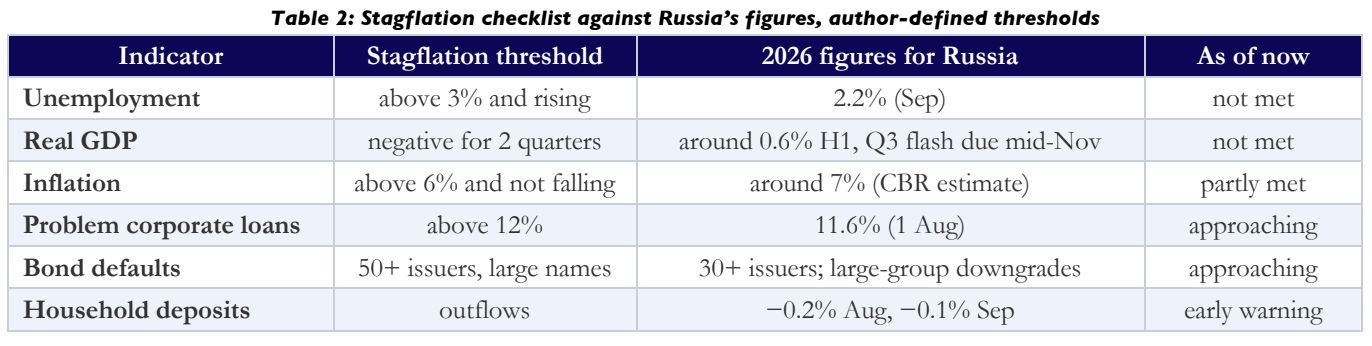
Nearly five years of war with hundreds of thousands of casualties, state-funded unproductive industries and economic isolation under Western sanctions of course cannot go unnoticed. Russia retains vast resources and is not currently heading for a debt crisis, but the government is finding it increasingly difficult to borrow and is quickly burning through its “safety cushion”. Macroeconomic processes are slow, and our country of study is certainly not on the brink of collapse. It is rather drifting into a regime of fiscal dominance, where it is the budget, not the central bank, that decides how much money enters the economy, while the CBR holds its price tight. Oil certainly buys time and peace would lower risk premia, but neither really changes the core mechanism. Much will depend on whether the promised real spending cut is delivered in 2027. If it is, we are likely to continue seeing stagnation with slow easing, but if not, the Bank of Russia will be faced with a choice between weaker lending and higher inflation. The bond market that prices OFZs above 16% is signalling it cannot yet know which one the CBR will choose.
References
[1] Meduza (2026). Russia’s GDP grew 1.3% in the second quarter of 2026, beating Central Bank and government forecasts, 12 August. https://meduza.io/en/news/2026/08/12/russia-s-gdp-grew-1-3-in-the-second-quarter-of-2026-beating-central-bank-and-government-forecasts
[2] Interfax (2026). Russian 0.6% GDP growth in H1 aligns with Central Bank’s 2026 outlook. https://interfax.com/newsroom/top-stories/118915/
[3] Bank of Russia (2026). Statement by Governor Elvira Nabiullina following the Board of Directors meeting on 23 October 2026. https://cbr.ru/eng/press/event/?id=32930
[4] TASS (2026). Bank of Russia has decided to keep its key rate at 14%, 23 October. https://tass.com/economy/2206817
[5] Prokopenko, A. (2026). Who Is Funding Russia’s War in the 2027 Budget? Carnegie Politika, 2 October. https://carnegieendowment.org/russia-eurasia/politika/2026/09/russia-budget-war-overview
[6] Prokopenko, A. (2026). The Kremlin Can No Longer Postpone Hard Economic Decisions. Carnegie Politika, 15 September. https://carnegieendowment.org/russia-eurasia/politika/2026/09/russia-economic-trilemma-collapse
[7] Prokopenko, A. (2026). Why Russian Stock Market is Crashing. YouTube Shorts, 14 July. https://www.youtube.com/shorts/eBr79pZJeXc
[8] Kommersant (2026). Budget-2027: expenditure frozen, revenue falls to 17.4% of GDP. https://www.kommersant.ru/doc/8991699
[9] Pravo.ru (2020). The State Duma considered the report on the 2019 budget execution. https://pravo.ru/news/225972/
[10] Mail.ru Finance (2026). Minfin successfully placed government bonds worth 1 trillion rubles at high demand, 2 September. https://finance.mail.ru/article/minfin-uspeshno-razmestil-gosobligatsii-na-1-trln-pri-vyisokom-sprose-69225715/
[11] The Moscow Times (2026). Sber increased its OFZ holdings since the start of 2026 to 8.2 trn rubles, 28 October. https://ru.themoscowtimes.com/2026/10/28/sber-narastil-vlozheniya-v-ofz-s-nachala-26g-do-82-trln-r-a209820
[12] The Star / Reuters (2026). Russia’s oil, gas revenues fall 17.2% in Jan-Sept, 10 October. https://www.thestar.com.my/news/world/2026/10/10/russia039s-oil-gas-revenues-fall-172-pct-in-jan-sept
[13] Reuters via Devdiscourse (2026). Russia’s oil and gas revenue seen up 10% y/y in October to $12 billion. https://www.devdiscourse.com/article/international/3992950-russias-oil-and-gas-revenue-seen-up-10-yy-in-october-to-12-billion
[14] Moscow Exchange (2026). Individual investors’ activity on the Moscow Exchange in October, 5 November. https://www.moex.com/n105753
[15] VBR (2026). Tax on deposits in 2027 will change: interest to be added to salary and taxed up to 22%, 25 September. https://www.vbr.ru/novosti/nalogi/2026/09/25/nalog-na-vklady-novie-pravila/
[16] Kazanfirst (2026). Tax on deposits up to 22%: who will have to pay more, 8 October. https://kazanfirst.ru/articles/nalog-na-vklady-do-22-komu-pridetsya-platit-bolshe
[17] AKM (2026). Customer funds in banks decreased by 0.2% in September. https://www.akm.ru/eng/news/customer-funds-in-banks-decreased-by-0-2-in-september-/
[18] MyFin (2026). Bank of Russia official USD/RUB rates, September 2026. https://ru.myfin.by/currency/cb-rf-archive/usd/2026-09
[19] Marketpower (2026). Minfin will increase purchases of foreign currency and gold in November, 5 November. https://marketpower.pro/publications/minfin-uvelichit-zakupki-inostrannoi-valiuty-i-zolota-v-noiabre
[20] Expert (2026). Minfin to raise purchases of foreign currency and gold to 9.9 bn rubles a day. https://expert.ru/news/minfin-narastit-pokupku-valyuty-i-zolota-do-99-mlrd-rubley-v-den
[21] Morgan Lewis (2026). President signs the Lindsey O. Graham Sanctioning Russia and Iran Act of 2026, September. https://www.morganlewis.com/pubs/2026/09/president-signs-lindsey-o-graham-sanctioning-russia-and-iran-act-of-2026
[22] Al Jazeera (2026). Trump announces Russian diesel deal amid soaring US fuel prices, 9 October. https://www.aljazeera.com/economy/2026/10/9/trump-announces-russian-diesel-deal-amid-soaring-us-fuel-prices
[23] Axios (2026). Trump announces major diesel deal with Putin, infuriating Ukraine, 9 October. https://www.axios.com/2026/10/09/trump-putin-diesel-agreement-ukraine-war
[24] The Moscow Times (2026). Russian diesel tankers bound for US change course, casting doubt on Trump deal, 5 November. https://www.themoscowtimes.com/2026/11/05/russian-diesel-tankers-bound-for-us-change-course-casting-doubt-on-trump-deal-a94182
[25] Izvestia (2026). History repeats itself: why did Russian oil exceed $100 for the first time since 2014. https://en.iz.ru/en/2195824/dmitrii-migunov/history-repeats-itself-why-did-russian-oil-exceed-100-first-time-2014
[26] Katz, M. (2026). Expensive oil during the war | Petrodollars for Putin. YouTube, 8 October. https://www.youtube.com/watch?v=IGWKaqJCRxk
[27] BOFIT (2026). Russia’s diverging economic trends continue, Weekly Review 35/2026. https://www.bofit.fi/en/monitoring/weekly/2026/vw202635_1/

0 Comments