USA
US markets had a volatile week following higher than expected inflation leading to a large swing in intraweek Fed rate-hike expectations and renewed fears over AI valuations which weighed on market sentiment. US September CPI came in at +3.7% YoY, up from +3.4% in August exceeding expectations. Core inflation for September sits at +2.6% YoY highlighting the fact that the rise in CPI is largely driven by an increase in energy prices with gasoline prices having increased by +9.1% during the month following the continued conflict in Iran. Consumers will bear the costs of this with prices having gone up +0.6% MoM. Retail sales data came in at +0.8% MoM, but only +0.2% excluding gasoline stations therefore highlighting the inflated nominal sales data due to higher prices. Concerns over whether increased energy prices will trickle down into the rest of the economy and create persistent inflation loom over investor sentiment. Fed rate-hike odds rose to over 55% in the middle of the week before stabilising back down to 15%, roughly at the same level as last week, following Warsh’s cautious tone at the IMF annual meeting on Friday. Warsh did not signal further monetary tightening, saying that he would not prejudge upcoming policy decisions and that recent economic developments remained consistent with the Fed’s September outlook.
Against that backdrop, US equities ended the week lower, led mainly by a sell-off in tech and AI stocks. The Nasdaq reported the sharpest drop of the four with only the Dow finishing above last week’s close. Investors increasingly questioned the returns on debt-financed AI infrastructure, with pressure on cloud providers and semiconductor stocks. On Friday, Micron fell 5.6% and Intel 5.8% causing the tech-heavy Nasdaq to record its worst week since June. The Dow Jones Industrial Average gained 0.7%, reflecting investor’s desire to pivot away from high-growth technology stocks and towards more defensive sectors. The Russell 2000’s decline also highlighted broader concerns about companies’ financing costs and economic resilience which are not only limited to AI stocks.
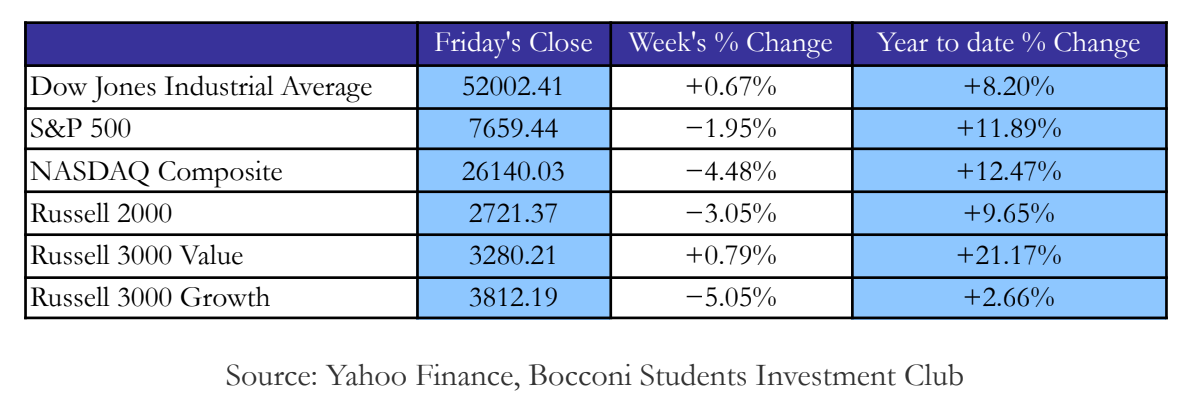
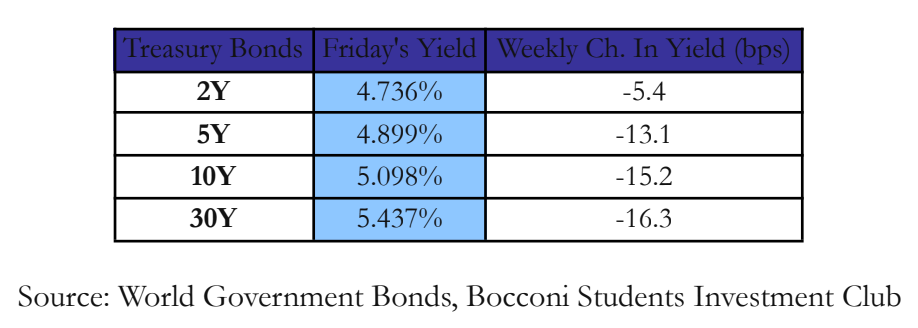
In the US fixed income market, Treasuries rallied over the week, with the 10-year yield declining by approximately 15 basis points to around 5.1% therefore reversing part of the recent bond sell-off. Despite inflation data surpassing the market’s anticipations, investors increased their demand for these safe-haven assets following heightened equity market volatility and diminishing expectations of an October Fed rate hike. The unusual combination between rising inflation and falling Treasury yields highlighted the decrease in risk-appetite of the market and shifting monetary policy expectations. In the coming weeks, the market’s focus will remain on the Fed’s October meeting and upcoming AI earning releases as these could determine whether the Treasury rally can be sustained.
Europe and UK
European markets faced inflationary pressure as rising energy costs pushed euro-zone inflation higher and weighed on the trade balance whilst growth remained very modest. Euro-area inflation data came out to 3.8% YoY in September up from 3.2% in August according to Eurostat’s October 16 release. Energy contributed 1.71 percentage points to annual inflation but the inflationary pressure is not only energy driven with for example services having contributed 1.52 percentage points. The ECB is now faced with the difficult task of controlling inflation without killing growth as many euro-zone economies are currently struggling with low productivity. Markets are strongly expecting the ECB to hold rates at the next meeting but that there will be a hike before the end of the year bringing the deposit rate up to 2.75%. In the UK, UK GDP grew 0.1% MoM in August, after 0.4% in July. The BoE therefore faces the same dilemma between inflation-control and supporting growth. Markets are also looking ahead at the UK’s October 28 Budget which is surrounded by uncertainty around tax increases adding to concerns over the country’s fiscal outlook.
Europe is also struggling with a trade deficit. Indeed, Euro-area trade balance deteriorated sharply in August and the goods trade deficit reached €16.1bn, compared with €1.7bn a year earlier. Most notably, machinery and vehicles shifted from a €7.2bn surplus last year to a €0.7bn deficit this year. The deterioration reflects both higher energy import costs and weakening performance in Europe’s industrial sector which continues to face fierce competition from Chinese manufacturers. The EU is looking into protectionist policies and has announced a new limit on the number of hybrid electric vehicles imported from China to 350,000 cars a year.
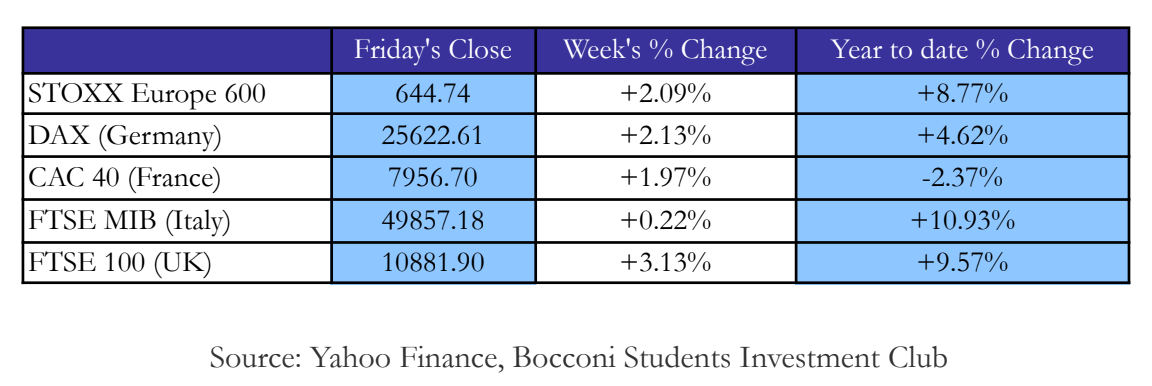
European equities had a good week and proved to be resilient to the sell-off in the US, supported by strong corporate earnings and a lower exposure to AI stocks. STOXX Europe 600 was up +2.09% from last week, closing at 644.74 in its strongest weekly performance since late June. The FTSE 100 had the best performance, rising 3.13%, followed by Germany’s DAX at 2.13% and France’s CAC 40 at 1.97%, while Italy’s FTSE MIB saw a 0.22% increase. Strong earnings results from European companies such as ASML helped support investor sentiment and the region’s higher degree of diversification provided protection against the global tech sell-off. In a new development in UniCredit’s consolidation with Commerzbank, the ECB authorised UniCredit on Thursday to exceed a 30% ownership stake in Germany’s Commerzbank. UniCredit expects to secure approximately 50% of voting rights around year-end, a large step towards a potential acquisition. Meanwhile, UK banking stocks faced pressure following reports that the government was considering increasing the corporation tax surcharge on banks from 3% to 8% ahead of the October 28 Budget although the broader FTSE 100 remained resilient.
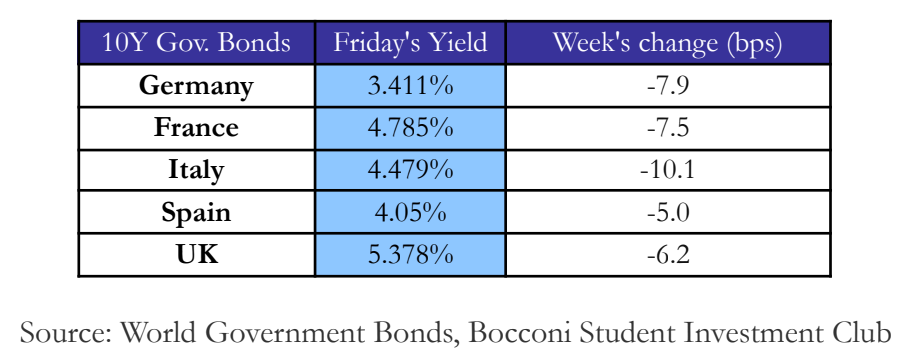
In European fixed-income markets, government bonds experienced a volatile week due to lasting inflation and fiscal concerns. The German 10-year Bund yields fell to a five-week low during Thursday’s session before recovering on Friday revealing the tension between demand for safer assets during periods of volatility in the equity market and concerns over high and persistent inflation. France’s 10-year government bond yield reached 4.79% at Friday’s close, compared with Germany’s 3.41%, causing an OAT–Bund spread of around 137 basis points. This unusually elevated spread highlights the premium the market is now demanding to hold French debt to compensate for political and fiscal risk. Italy’s 10-year yield stood at approximately 4.48%, implying a narrower BTP–Bund spread of around 107 basis points, while Spain’s 10-year yield sat at 4.05%. In the UK, the benchmark 10-year gilt yield stood near 5.38%, as investors continued to assess the Bank of England’s monetary policy outlook and potential fiscal measures ahead of the October 28 Budget. European bond markets are to remain sensitive to inflation, monetary policy expectations and government fiscal decisions.
Rest of the World
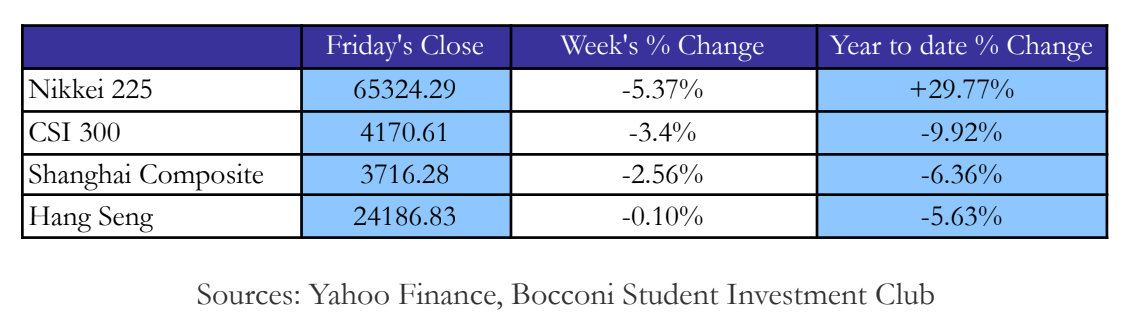
Asian markets experienced a sharp sell-off in equities due to global concerns over AI valuation and financing costs of these companies, harming in particular the Japanese and Korean equity market. South Korea’s KOSPI index fell 14.46% over the week, closing at 5,668.05, making it one of the most heavily impacted equity markets. Its two leading companies, Samsung Electronics and SK Hynix, which make up a large part of the KOSPI index, suffered losses due to their importance in the AI memory-chip supply chain. In Japan, the Nikkei 225 declined 5.37%, closing at 65,324.29. The sell-off affected AI and semiconductor-related companies such as Advantest, Tokyo Electron and SoftBank Group. Moreover, elevated oil prices weighed on sentiment in Japan, which depends heavily on imported energy. Global inflation concerns have increased attention on the pace of further BoJ tightening. Higher interest rates could put additional pressure on Japanese equity valuations, particularly for growth companies but also poses a risk to the unwind of carry-trade positions funded in Yen which could lead to a global equity sell-off.
Chinese equities were also affected by the global sell-off in AI-related stocks which was amplified by weak domestic demand and trade tensions. The CSI 300 fell 3.40% over the week, closing at 4,170.61, while the Shanghai Composite declined 2.56% and Hong Kong’s Hang Seng down by 0.10%. September’s inflation figures highlighted the difficulties facing the Chinese economy, with producer prices rising 5.0% YoY, their fastest pace in more than four years, largely caused by higher energy and commodity costs. Meanwhile, consumer inflation remained low at 0.9% YoY which is below market expectations (1.0%) reflecting weak domestic consumption. This raises concerns about Chinese manufacturers’ ability to pass rising input costs on to consumers without further weakening demand. Trade tensions and restrictions affecting Chinese technology exporters also continued to weigh on market sentiment as the country’s reliance on external demand leaves its industrial sector exposed to protectionist measures. Looking ahead, investors will focus on China’s Q3 GDP release on October 19, alongside industrial production and retail sales figures but also whether the new government stimulus plan will be successful in supporting demand.
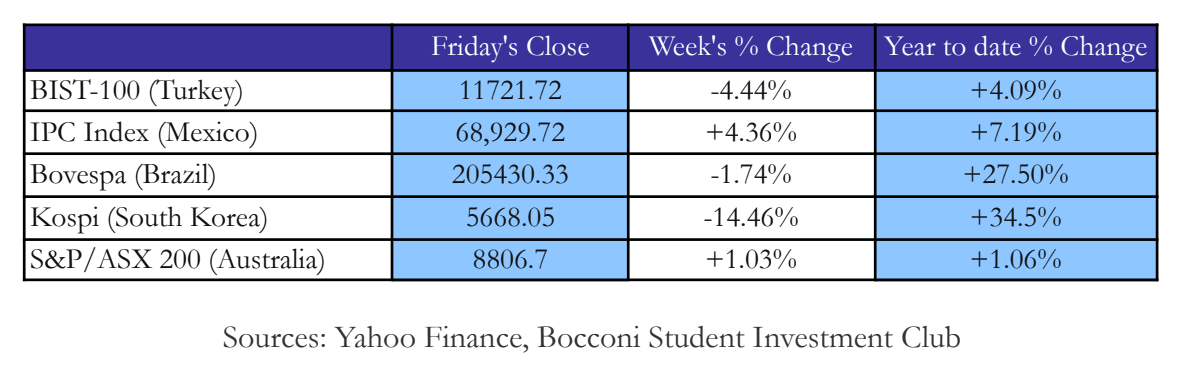
In emerging markets, equities delivered mixed results this week, with Mexico performing well while Brazil and Turkey faced selling pressure. Mexico’s IPC Index gained 4.36%, closing at 68,929.72, supported by positive market sentiment and limited exposure to the global AI sell-off. Meanwhile, Brazil’s Bovespa declined 1.74% due to political uncertainty ahead of the October 25 presidential election opposing Luiz Inácio Lula da Silva and Flávio Bolsonaro in polls indicating a very tight race. In Turkey, the BIST 100 fell 4.44% following MSCI’s decision to freeze certain changes to its Turkish equity indices over concerns about market transparency and coordinated trading. MSCI also warned that insufficient progress by June 2027 could lead to a review of Turkey’s emerging-market classification which could trigger large capital outflows from index-tracking funds.
FX and Commodities
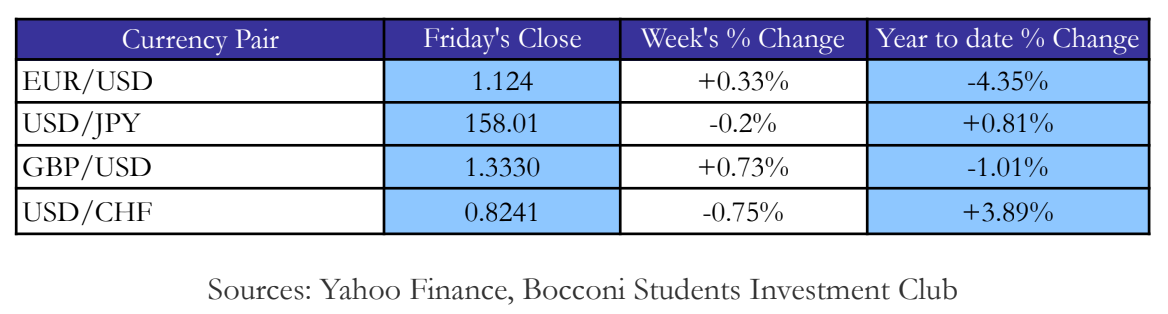
Foreign exchange markets had a volatile week as US inflation came out higher than expected which initially supported the dollar before diminishing Fed rate-hike expectations reversed the trend. The euro gained 0.33% against the dollar, closing at 1.1240. The British pound also appreciated by 0.73% to 1.3330, supported by expectations of further Bank of England tightening, although uncertainty ahead of the October 28 UK Budget remained. The Japanese yen strengthened slightly, with USD/JPY declining 0.20% to 158.01 as investors reassessed the Fed’s monetary policy outlook. The Swiss franc also benefited from safe-haven demand in the context of high equity market volatility, with USD/CHF falling 0.75% to 0.8241.
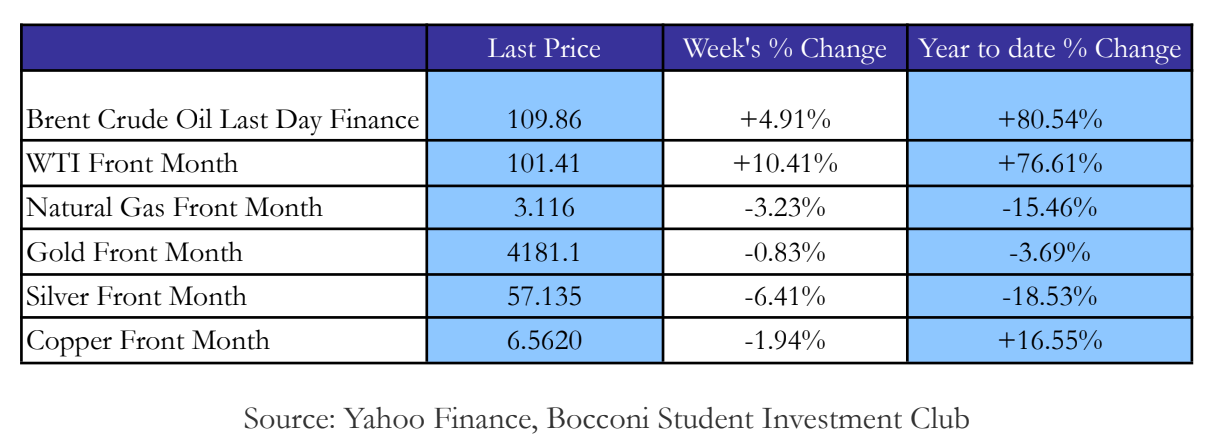
Commodity markets saw mixed performances this week with oil prices remaining high in the context of the Iranian conflict while precious metals faced selling pressure. Brent crude gained 4.91% to $109.86 per barrel, while WTI jumped 10.41% to $101.41 due to fears of disruptions around the Strait of Hormuz and Ukrainian attacks on Russian refineries. The rise in oil prices has increased concerns over inflation globally. Meanwhile, natural gas declined 3.23% to $3.116 thanks to expectations of milder weather. Precious metals also weakened, with gold falling 0.83% to $4,181.10 per ounce and silver declining 6.41%, as chances of a Fed rate-hike increased during the week. Copper fell 1.94%, reflecting concerns over Chinese industrial demand and global economic growth.
Next Week Main Events
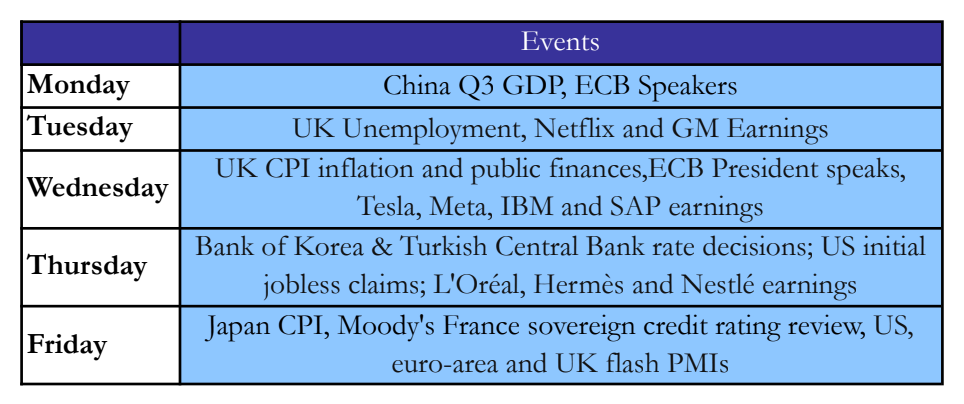
Looking ahead, investors will turn their attention to a week of economic releases and corporate earnings. China’s Q3 GDP figures on Monday will provide insight into the country’s economic resilience and the effectiveness of recent stimulus measures. In Europe, Wednesday’s UK inflation data will be closely watched for its implications for Bank of England policy expectations. Meanwhile, earnings from major technology companies including Tesla and Meta could influence sentiment following the recent AI sell-off. Finally, Friday’s flash PMI releases across the US and Europe will offer an early indication of October’s economic activity ahead of the upcoming Fed and ECB meetings.
Brain Teaser #59
A plane has 100 passengers and 100 assigned seats. The first passenger has lost their boarding pass and chooses a seat completely at random. Every subsequent passenger sits in their assigned seat if it is available. If their seat is already occupied, they choose randomly among the remaining empty seats. What is the probability that the 100th passenger ends up sitting in their assigned seat?
Brain Teaser #60
An investment bank has three folders containing confidential reports: one on Equities, one on Fixed Income, and one on FX. Each folder is labeled with one of these three categories, but all three labels are incorrect. You are allowed to open only one folder and examine its contents. Can you determine the contents of all three folders with certainty? If so, how?



0 Comments