USA
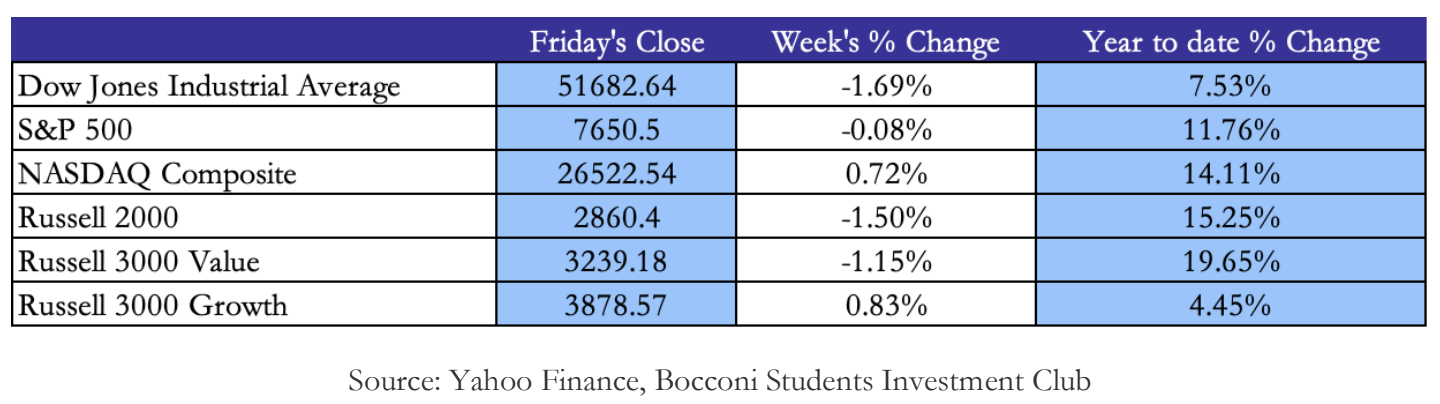
This week, the US equity market experienced considerable volatility, driven by oil prices, the Fed and AI safety concerns. At the start of the week, drone and shipping attacks near the Strait of Hormuz pushed WTI towards $106 per barrel by Tuesday, hitting equities. That revived inflation fears, pushing the 10-year Treasury yield up to near 5%. Additionally, Anthropic CEO Dario Amodei’s essay on AI safety concerns, which urged a deliberate slowdown in development, spooked semiconductor and AI stocks in particular, initially hitting Nasdaq names hardest. In the middle of the week, on Wednesday, the Fed announced its first hike since 2023. The target interest rate was raised by 25bps to 3.75–4%. On top of that, Fed Chair Kevin Warsh called inflation “too high for too long”, signalling at least one more hike this year. The announcement was more hawkish than some had expected, triggering a broad initial sell-off. After a very turbulent first half of the week, the market stabilised on Thursday and Friday. After Saudi export capacity was restored, oil eased back below $100, and the 10-year yield stabilised rather than breaking through the 5% level. That stabilisation allowed mega-cap tech and semis to rebound sharply, recovering most of their early-week losses.
For the S&P 500, that rebound offset the earlier losses in the week, leaving it to close nearly flat with a small loss of 0.08%. The Russell 3000 Growth and the Nasdaq Composite, on the other hand, were sold off the most on early AI headlines, but then fully recovered as yields stabilised. Cybersecurity names in particular were boosted by AI safety concerns, rallying by up to 14% over the week. This stabilisation later in the week thus allowed the Russell 3000 Growth and the Nasdaq Composite to close the week at +0.83% and +0.72% respectively. By contrast, value stocks endured a harsh week. The Dow Jones closed the week down 1.69%. That large loss was primarily caused by the rate hike and the Fed’s more hawkish stance, as industrials, financials and old-economy cyclicals are most exposed to a “higher for longer” rate path. Since small caps carry disproportionately more floating-rate debt, the hawkish stance and the rate hike hit small-cap companies especially hard. That is why the Russell 2000 closed the week 1.50% lower. Like the Dow Jones and the Russell 2000, the Russell 3000 Value includes many cyclical, financial and energy stocks. This resulting rate sensitivity caused it to close down 1.15% week on week.
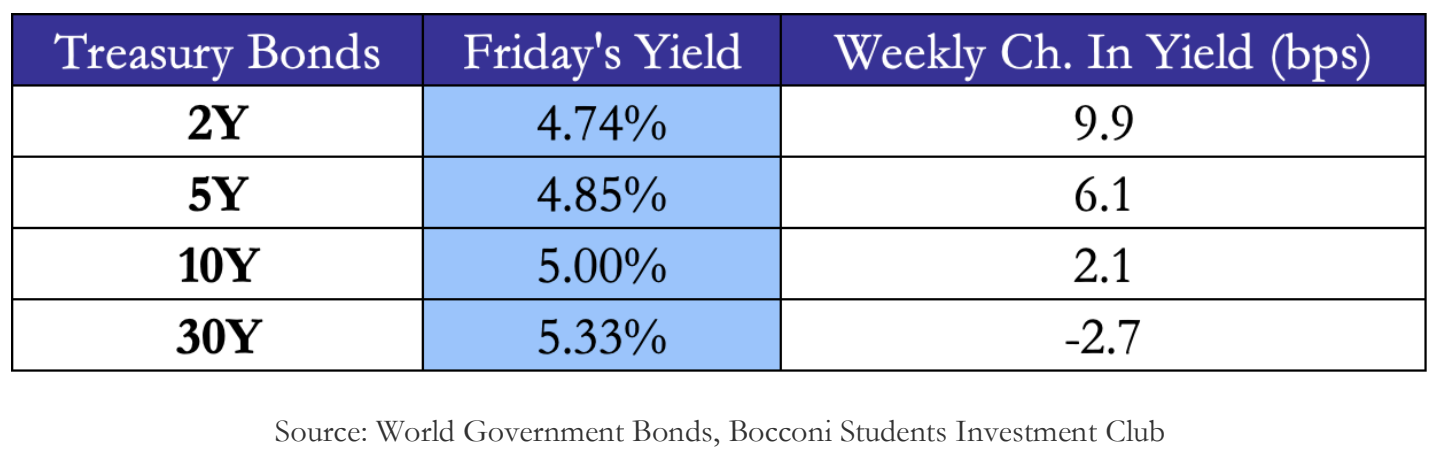
In the US fixed income market, the main drivers were the Fed’s 25bps hike on Wednesday and its hawkish signal of at least one more hike this year. The 2-year yield was the most reactive, directly repricing these changes with a rise of 9.9bps to 4.743%. The 5-year yield also rose, by 6.1bps to 4.852%, reflecting a mix of near-term policy and medium-term growth and inflation expectations. The 10-year Treasury yield saw the smallest move of the four. After spiking towards 5% early in the week, it eventually closed up 2.1bps at 4.996% as the falling oil price eased inflation fears. In contrast to the 2-, 5- and 10-year yields, the 30-year Treasury yield fell by 2.7bps to 5.327%. That decrease was caused by the Fed signalling its inflation-fighting credibility, which reduced the pricing of extra-long-run inflation risk.
Europe and UK
The equity markets of Europe and the UK were driven by the same events as the US this week. That means the Fed’s hike and the oil shock at the start of the week hit European risk appetite too. Coordinated attacks on Saudi Arabia’s East-West pipeline pushed Brent to nearly $110 earlier in the week, before it came back down to $104 by Friday. Rate-sensitive sectors in particular were hit hard by the Fed’s hawkish stance, before enjoying their best single day in two months on Thursday as the shock was digested.
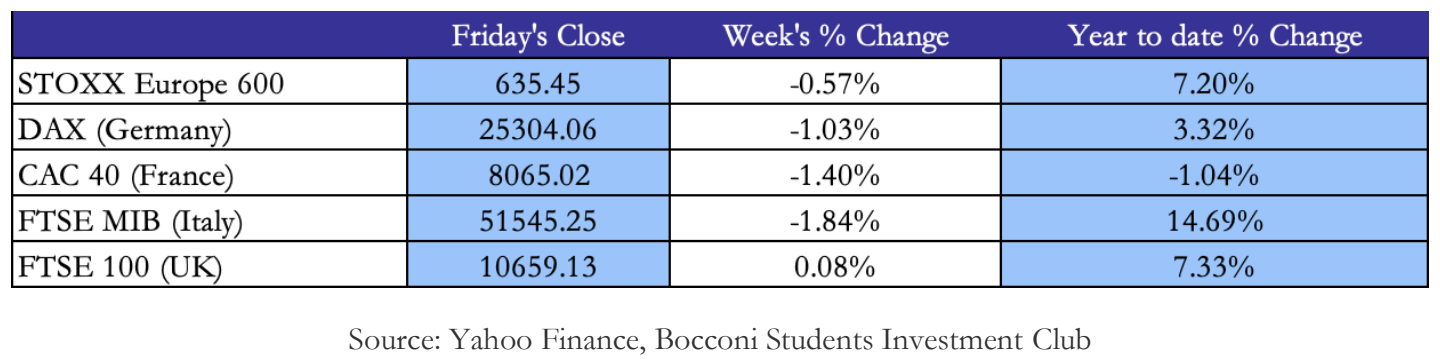
Those events caused most major indices to lose ground this week. Although they partially recovered late in the week, the oil and rate dynamics caused the STOXX Europe 600 to close 0.57% lower than last Friday. The industrial-heavy DAX endured even more difficulties. The highly export-oriented automobile industry was especially exposed to that combination of oil costs, rate uncertainty and geopolitical risk reassessment. As a result, the major automobile stocks lost 4% to over 5% of their market capitalisation this week, which dragged the DAX down by 1.03% week on week. In addition to the factors already described, the French market was also fighting the impact of the chronic budget and political crisis. That caused the French bond risk premium, the OAT-Bund spread, to hit a milestone of 1 percentage point on Friday. This fiscal-risk repricing weighed further on French equities, making the CAC 40 close 1.40% lower than last Friday. Among the major indices in Europe, Italy’s FTSE MIB performed the worst, with a weekly change of -1.84%. France, as the second-largest economy in Europe, normally trades close to German bonds. The repricing and widening of the OAT-Bund spread described above also dragged down Italian bonds. Since Milan’s index is very bank-heavy, and these banks are large domestic holders of sovereign debt, France’s budget crisis hit the FTSE MIB across borders. The only major index to post a small gain was the UK’s FTSE 100, with a weekly rise of 0.08%. That positive variation was mainly caused by its heavy oil and mining weighting, which profited from the Brent spike. At the same time, the UK’s defensive and value stocks held up better than their European growth and automobile counterparts.
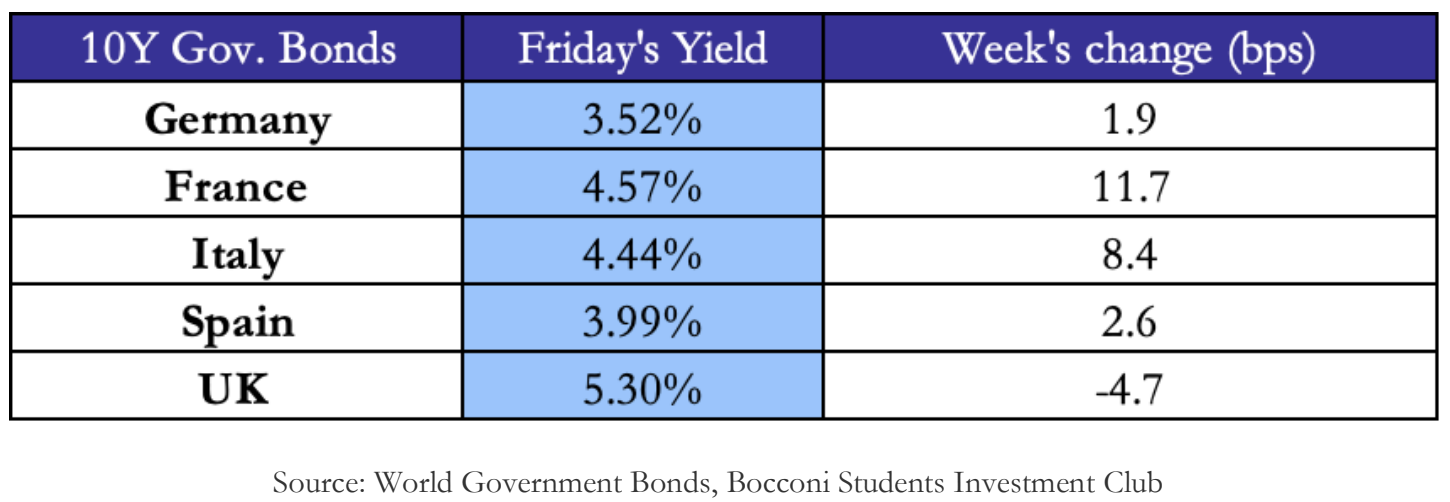
In the European fixed income landscape, German Bunds experienced the smallest move among the major government bonds. As a safe-haven benchmark, they tracked the general global yield backdrop rather than any country-specific stress. As a result, the German 10-year Bund yield moved up by only 1.9bps to 3.522%. As previously explained, the OAT-Bund spread hit roughly 1 percentage point on Friday. That repricing of fiscal risk, on top of the global rate backdrop, caused the French 10-year yield to increase by 11.7bps to 4.565%. In sympathy with France, Italy’s 10-year yield also went up, by 8.4bps to 4.438%. As Italy is the eurozone’s other chronic fiscal-risk case, its debt is often repriced when France’s credibility wobbles. In line with Germany, Spain was not caught up in the France/Italy-specific stress this week. That is why its 10-year yield moved up by only 2.6bps to 3.989%. Unlike the other major European government bonds, gilts actually rallied, bringing the 10-year yield down by 4.7bps to 5.298%. That change was mainly caused by the stance of the Bank of England, which voted 6–3 to keep policy unchanged following the Fed’s hike.
Rest of the World
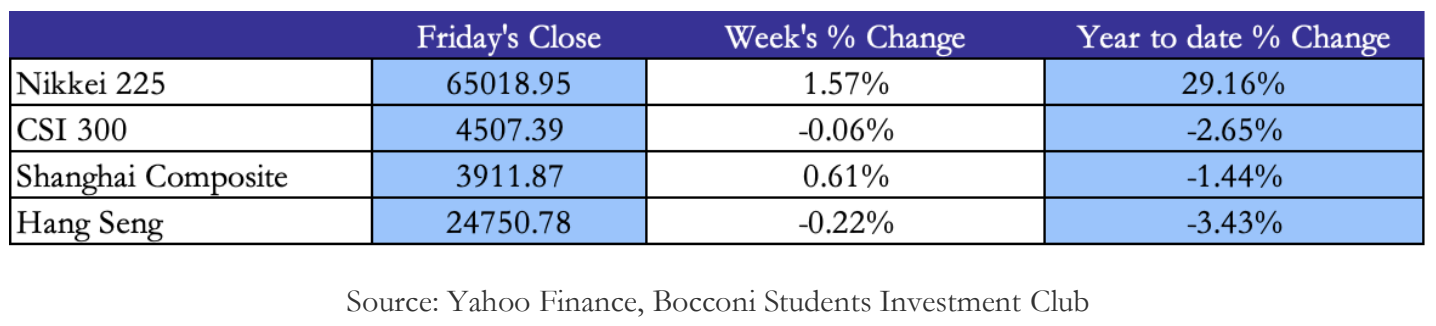
The Bank of Japan hiked rates by 25bps to 1.25% on Friday, the highest level in 31 years. However, the decision had two dissents and was therefore read as less hawkish than feared. The yen also weakened to around 157/USD afterwards, and that currency weakness, together with stabilising US yields, lifted exporters and AI and semiconductor names strongly. All in all, the Nikkei 225 closed this Friday 1.57% higher than last Friday. In China, the Fed’s hike hit rate-sensitive sectors such as property, gold and metals mid-week, but mainland China’s heavier weighting towards AI-hardware and semiconductor supply chains offset those losses. That modestly pushed up the Shanghai Composite, which ended the week 0.61% higher. The same events also affected the CSI 300. However, because a lot of the AI-hardware rally happened in smaller and mid-cap semiconductor suppliers that are not large enough to qualify for the CSI 300, it stayed essentially flat, with a small loss of 0.06%. Since Hong Kong’s index leans more towards domestic-consumption-exposed internet and property names than towards the mainland’s AI-hardware exposure, it lagged the tech-driven recovery through the week. That is essentially why it felt the Fed-hike drag more, and why the Hang Seng closed on Friday with a weekly change of minus 0.22%.
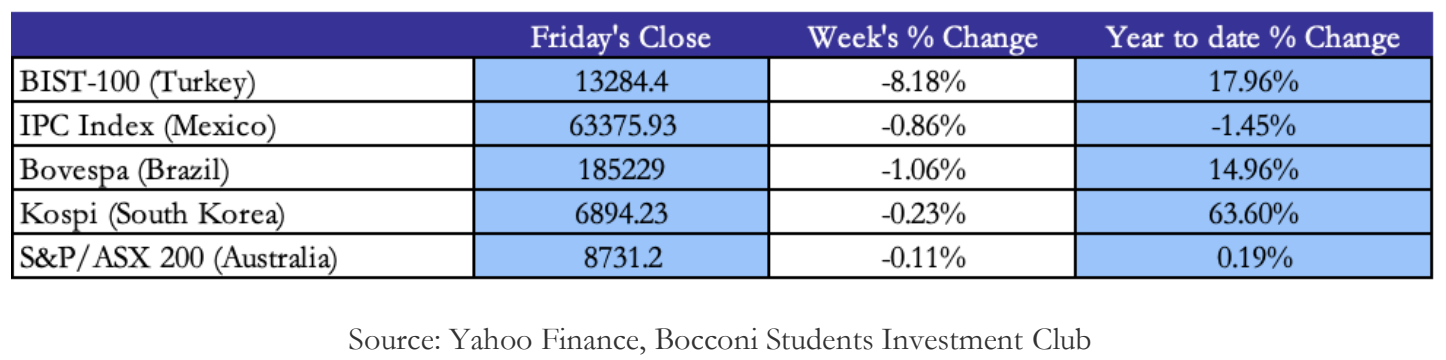
Turkey experienced a huge drawdown this week, with the BIST-100 down 8.18%. This was caused by the fund manager Pusula Portfoy failing to meet around $2.7bn in investor withdrawals. That failure sparked a panic sell-off and made Turkey’s main index crash. In Brazil, on the same day as the Fed’s hike, the central bank cut the Selic rate to 13.75%. That narrowing of the two countries’ policy rates pressures the carry-trade appeal of Brazilian assets, making the Bovespa close 1.06% lower this Friday than the week before. The same mechanism applies to Mexico. Due to the Fed’s hike, the gap between Mexican and US policy rates narrowed to 2.5 percentage points. That again reduces carry-trade attractiveness, leading the IPC to close 0.86% down this week. Korea’s market was hit heavily at the start of the week by the sell-off in global tech. Later in the week, chip stocks rallied, partially offsetting the earlier losses. Overall, the Kospi closed on Friday with a weekly change of -0.23%. In Australia, after the mid-week oil-driven dip, energy and mining/materials stocks rebounded strongly. Citigroup also raised NAB’s price target by over 5% and upgraded it from Neutral to Buy. That helped lift the whole banking sector late in the week, offsetting the earlier losses even further. As a result, the S&P/ASX 200 stayed essentially flat, losing only 0.11% over the week.
FX and Commodities
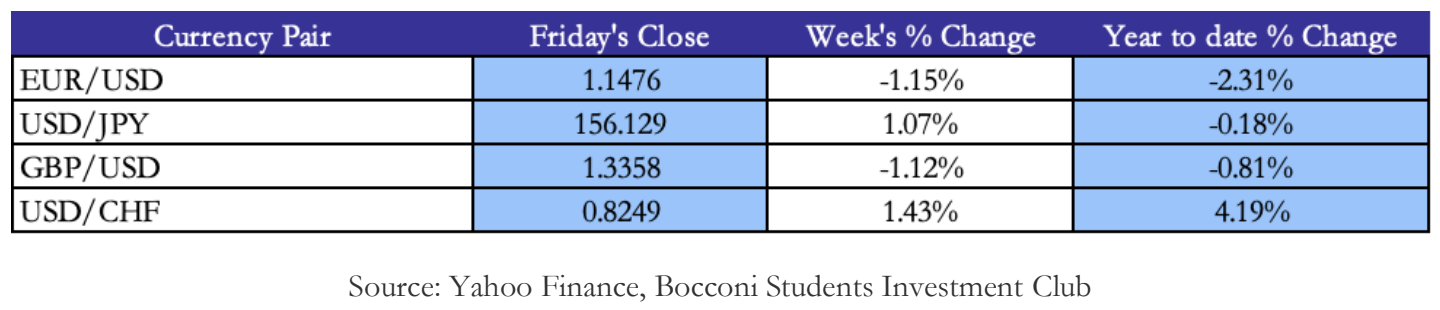
In the currency market, the Fed’s hike this week widened the US-ECB rate gap. France’s budget crisis added further euro-specific pressure. This caused the euro to depreciate by 1.15% against the USD this week. In Japan, the policy rate hike was less hawkish than expected. Moreover, the 2-year yield gap between the US and Japan widened. Those two main factors weakened the yen. Late on Friday, the Bank of Japan conducted a “rate check”, a standard precursor to actual FX intervention. That signal partially offset the earlier depreciation of the yen. The USD, however, still closed the week 1.07% up against the yen. In the UK, the Bank of England, unlike the Fed, held rates the day after the Fed hiked. This more dovish positioning caused the GBP to fall by 1.12% against the USD this week. While the Fed hiked on Wednesday, the SNB is expected to hold its policy rate at 0%. That widened the rate gap and thus made the CHF a cheap carry-trade funding currency. As a result, the USD appreciated against the CHF this week, with a weekly gain of 1.43%.
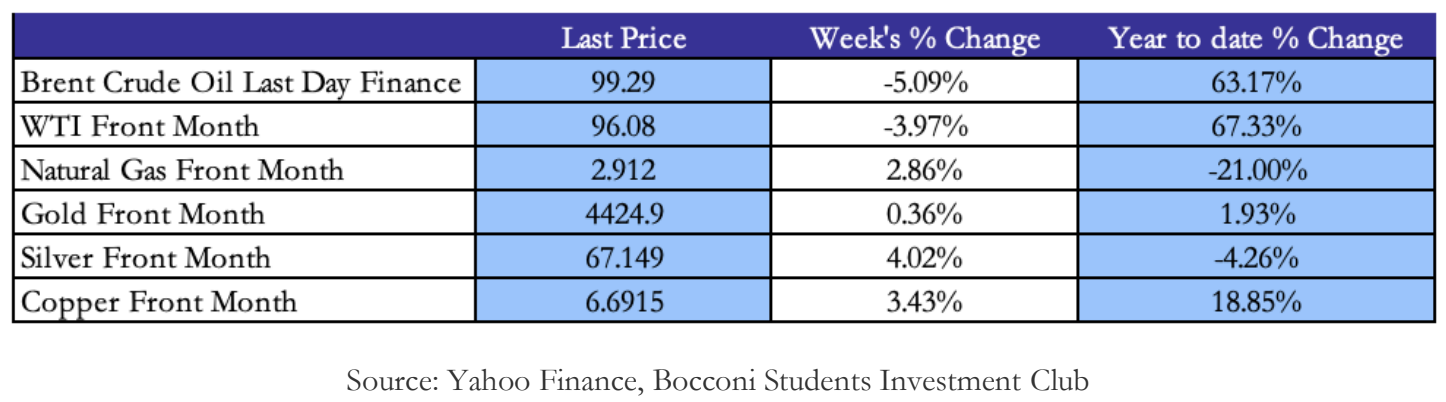
In the commodities market, an attack on the Saudi pipeline and fears regarding the Strait of Hormuz made Brent and WTI spike earlier this week to around $110 and $106 respectively. After Saudi Arabia restored its export capacity, however, prices reversed sharply. That made Brent and WTI close this week 5.09% and 3.97% lower respectively than last week. Gold closed the week nearly flat, up 0.36%. It initially fell on the Fed hike. However, it rebounded afterwards, once the hike was seen as already priced in. Silver, on the other hand, gained mostly before the Fed decision. That is seen as positioning or anticipation ahead of the meeting rather than a reaction to the decision itself. Overall, silver closed the week 4.02% higher. Another reason for that gain could be demand from China, as Chinese buyers restocked. That extra demand made copper close this week up 3.43%. Since silver is also used industrially, it might have profited from that trade. Lastly, natural gas rose by 2.86% this week. That jump was caused by a tight-supply story, driven by below-average storage injections and warmer-than-normal weather early in the week. However, the gains were capped by cooler weather forecasts emerging later in the week.
Next Week Main Events
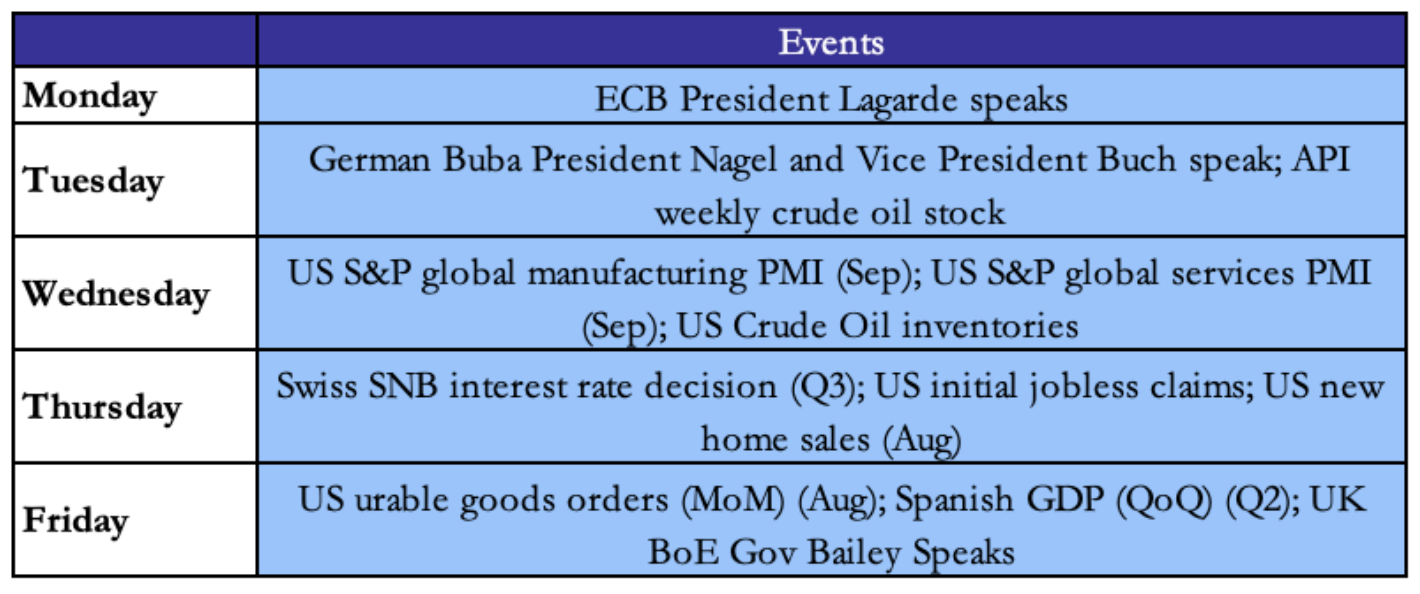
Next week, we get interesting numbers on US crude oil inventories, which are especially relevant at a time when oil prices and reserves are guiding the markets. On top of that, we get the Swiss National Bank’s interest rate decision for Q3, with the policy rate expected to be held at 0.00%. Besides those figures, we also await comments from ECB President Lagarde, the German Bundesbank and Bank of England Governor Bailey.
Brain Teaser #51
You draw cards one at a time from a well-shuffled 52-card deck, without replacement, and stop as soon as you draw a heart. What is the expected number of cards you draw, counting the heart itself? Then, as a follow-up, what changes if you put each non-heart card back and reshuffle before drawing again?
Brain Teaser #52
You roll a fair six-sided die and are paid the face value in dollars. After seeing the first roll, you may either keep it or roll once more, in which case you must take the second result. What is the fair price to play this game, and for which first rolls should you re-roll?



0 Comments