USA
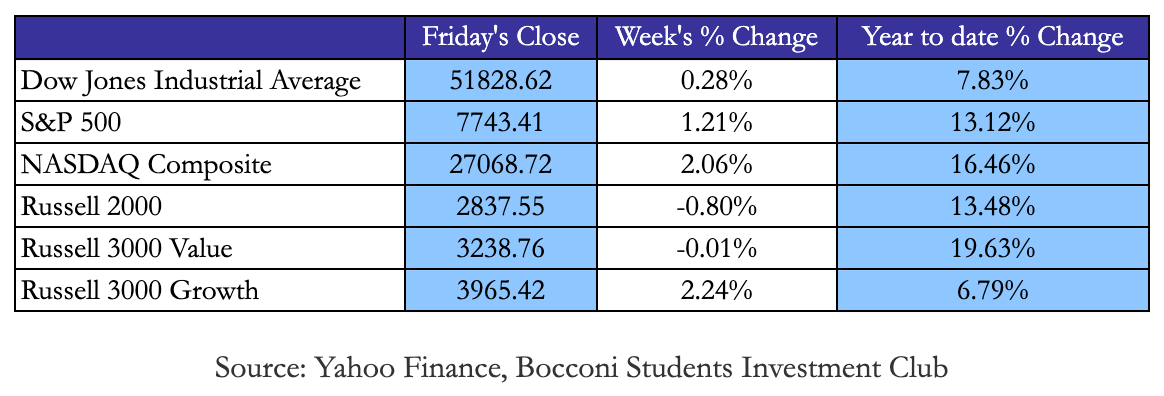
US markets spent the past week caught between a bond-market rout and a fresh AI-driven equity rally, with a de-escalating oil story easing the pressure by Friday. Wednesday, was the week’s real inflation point on the data front: the S&P Global flash PMI’s came in far stronger than expected. Manufacturing jumped to 57.0 from 53.9 (vs. 53.6 expected), Services rose to 58.7 from 56.5 (vs. 56.0 expected), and the Composite climbed to 58.4 from 56.0. This is the strongest private-sector expansion in over five years, with job growth accelerating too. That confirmation that the economy is still running hot landed squarely on top of an already hawkish Fed narrative: the 10-year Treasury yield jumped roughly 15 bps in that single session, a big part of its push toward 5.2% by Friday and its highest level since 2007. The same morning, the EIA’s weekly report showed a surprise 2.97 million-barrel build in US crude inventories, against a draw of roughly 0.6 million barrels expected. However, it was completely swamped by the ongoing Strait of Hormuz risk premium, with Brent and WTI continuing to push toward their weekly highs regardless. Oil only really turned lower on Friday, as reports emerged that US and Iranian negotiators in New York are exploring a phased deal in which Tehran would reopen the Strait in exchange for Washington easing its economic blockade.
Against that backdrop, the Nasdaq Composite was the standout, closing the week up 2.06% as mega-cap AI names ran hard: Meta rallied roughly 13% on the launch of its new AI agent “Muse,” and Akamai jumped after announcing a multiyear AI-infrastructure deal with Anthropic. That enthusiasm pulled the S&P up 1.21% for the week. he Dow Jones, more exposed to cyclicals and rate-sensitive names, lagged with a 0.28% gain, while the small-cap Russell 2000 actually closed the week with a 0.80% loss, squeezed by the surge in real yields. Friday itself was broadly positive across the board as the Dow Jones snapped a three-week losing streak.
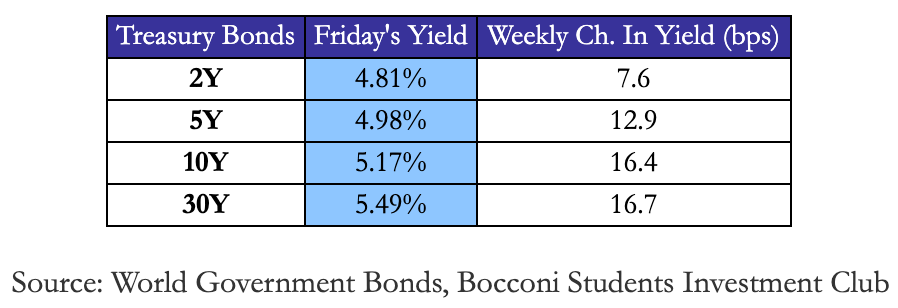
In the US fixed income, the sell-off was broad-based and driven almost entirely by the same forces. Resilient growth data, sticky inflation expectations and rising odds of further Fed tightening. Every maturity on the curve moved up 12–17bps this week, with the long end leading. We must highlight that the 30-year note hit its highest level since 2004.
Europe and UK
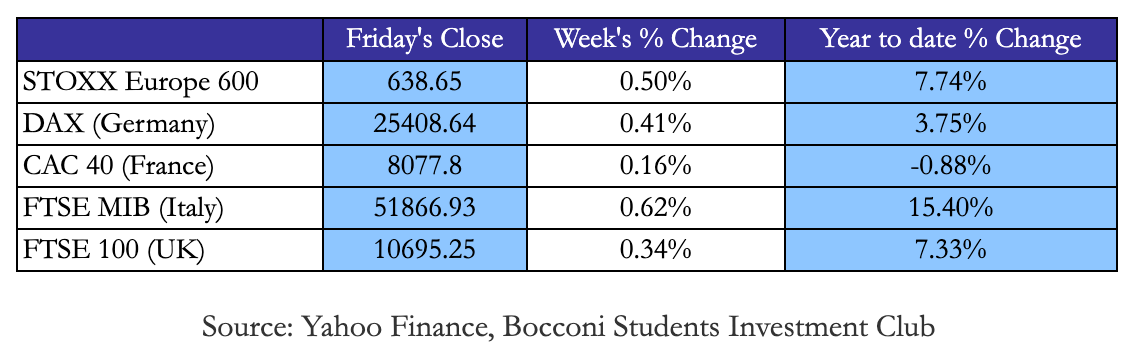
Europe traded through the same global cross-currents as the US this week, but the dominant local story was the French fiscal crisis, which kept deepening. The OAT–Bund spread blew past 110bps at one point this week, its widest since the 2012 eurozone debt crisis, as investors continued to reassess France’s budget trajectory and political fragility ahead of upcoming elections. That kept the CAC 40 the regional laggard, closing barely changed even as most other markets advanced. Germany’s Bund yield also climbed to its highest level since 2009 (around 3.61%) as the broader global bond sell-off caught up with the eurozone.
Equities nonetheless held up reasonably well, and the STOXX 600 in fact snapped a three-week losing streak, after having touched three-month lows mid-week on the Saudi pipeline attack and fresh Houthi strikes. The composition of the rebound was telling: energy shares were actually among the week’s worst performers (-0.7% on Friday alone) as crude retreated, while fuel-cost-sensitive travel names did the opposite, with Ryanair and Lufthansa each up more than 2% on the day as lower jet-fuel costs offset the drag elsewhere.
The FTSE 100 notched its second consecutive weekly gain, but the drivers shifted from earlier in the week: as energy shares faded with the oil pullback, the index was held up by banks and by precious-metals miners, which jumped roughly 2% as gold and silver clawed back some of the sharp losses they’d taken earlier in the week. The mid-cap FTSE 250 did even better, up 0.44%.
The DAX wasn’t driven by one clean narrative between falling energy costs, still-elevated rates, and mixed earnings expectations. That showed up in the dispersion beneath the index: Evonik jumped over 7% on Friday, while BASF fell more than 3.5% and Airbus slipped around 1% the same day. This is a reminder that Germany’s chemicals and industrial names are trading a genuine stagflation worry, driven by energy costs, a weak demand, and still-high rates. Italy’s FTSE MIB remained the best performer among the majors (+0.62%), continuing 2026’s strong run for Italian equities and consistent with the ongoing narrative that Italy’s fiscal credibility has improved relative to France’s.
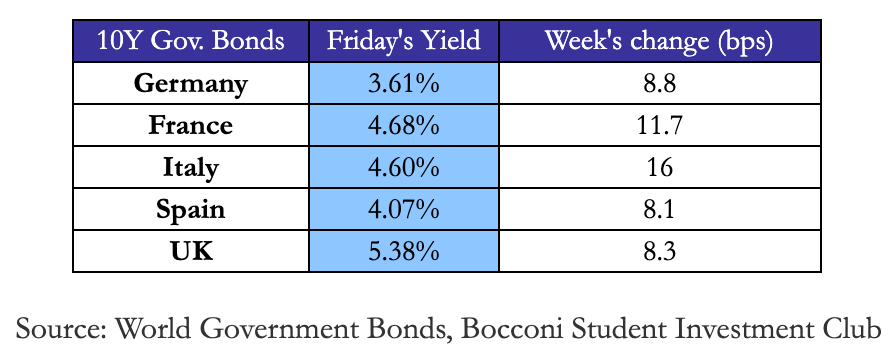
European government bonds moved broadly in line with the global route. German Bunds, the safe-haven benchmark, rose “only” to 3.61% (+8.8bps), tracking the global backdrop rather than any domestic stress. French OATs bore the brunt of idiosyncratic pressure, pushing toward 4.65–4.70% as the fiscal-risk premium widened further. Italian BTPs moved up in a similar range, continuing to trade close to French paper, a reflection of just how much Italy’s relative credibility has improved this year. Spain, without country-specific stress, tracked Germany fairly closely. UK gilts, unlike last week, when they rallied on a dovish BoE hold, gave back ground this week as they got caught in the same global sell-off that hit JGBs and Bunds to fresh multi-year highs.
Rest of the World
Japan was this week’s regional standout on the equity side: the Nikkei 225 closed at 66,174.88, up 1.78% on the week, helped by yen weakness (which lifts exporters) and a broad rebound in AI and semiconductor names alongside Wall Street’s Nasdaq rally. But the more consequential Japan story this week was in rates. The 10-year JGB yield pushed to around 3.05-3.08% on Thursday, its highest level since August 1996, as it got dragged along by the global Treasury sell-off while also digesting genuinely hawkish domestic signals. The 30-year JGB yield rose to 4.134% and the 5-year hit a record 2.345%. Mainland China and South Korea traded a shortened week (China closed Friday for the Mid-Autumn Festival, Korea for Chuseok), but China’s bond market was the week’s real outlier: the 10-year yield actually fell to around 1.67-1.68%, near its lowest since July 2025, decoupling entirely from the global bond rout as the PBOC left its benchmark lending rates unchanged and markets focused on the Trump-Xi summit running September 23-25.
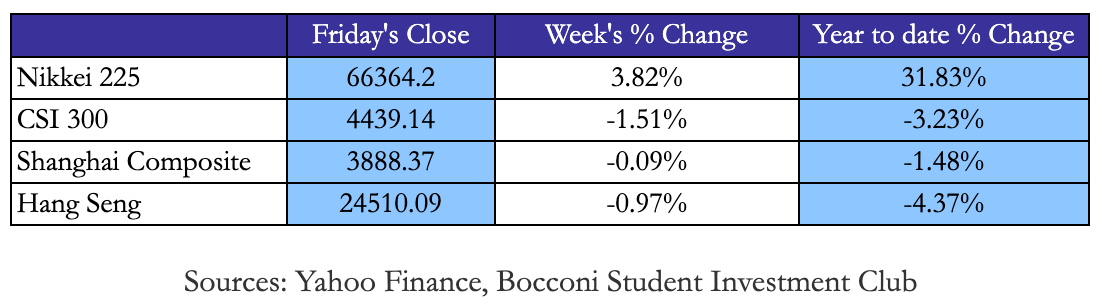
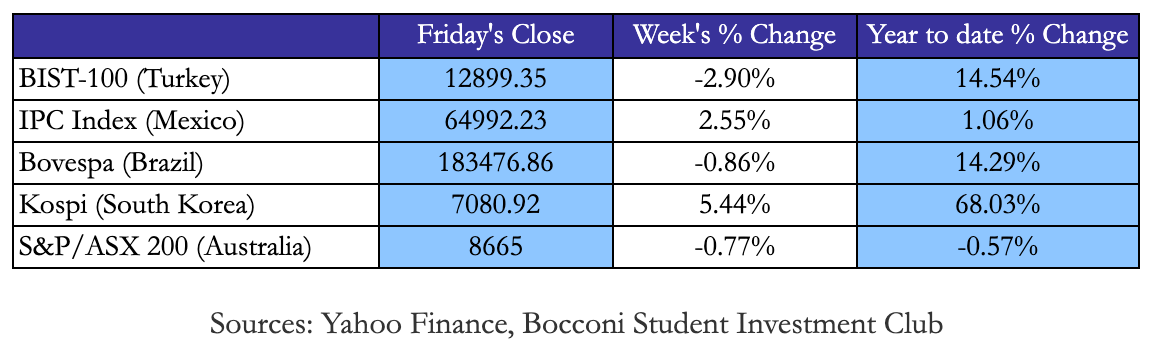
In emerging markets, Mexico’s IPC was the bright spot, snapping a four-week losing streak with a 2.55% weekly gain to 64,992, being now back in positive territory for the year. The rate backdrop mattered directly here: Banxico held its policy rate at 6.5% on Thursday for a third straight meeting, and did so with an unusually pointed statement, telling markets its policy “would not have to react mechanically” to the Fed’s September 16 hike since Mexico and the US “are at different stages of the economic cycle.” That explicit decoupling helped underpin the peso and supported the equity rally alongside strength in airport/infrastructure names. Brazil’s Bovespa slipped 0.68% to 183,965.91; there was no fresh Selic decision this week, so the drag here was purely external. Turkey’s BIST-100 remained a market to watch after last week’s Pusula Portfoy-driven crash, with confidence still hinging on whether the CBRT’s tight policy stance can hold the line; a clean weekly close wasn’t available at the time of writing. Australia’s ASX 200 slipped on Friday (-0.77%) as the broader oil-and-yields story weighed there too.
FX and Commodities
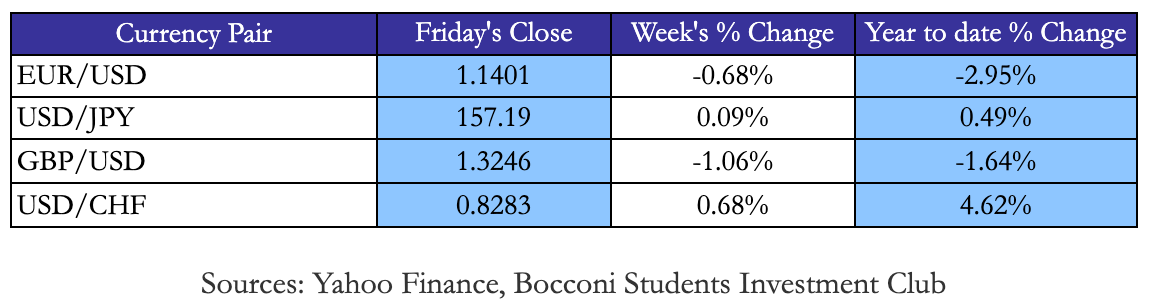
In the currency market, the dollar had a strong week, its second straight weekly gain, powered almost entirely by the relentless rise in US real yields. The euro slid to a two-month low near 1.1370, its third straight weekly decline, as the widening French risk premium added euro-specific pressure on top of the broad dollar bid. Sterling had one of its worst weeks in months, falling toward 1.3220, pressured by the same high-oil/high-yield combination that complicates the BoE’s task. Even after this week’s historic JGB sell-off, the 10-year Treasury (~5.16%) still yields roughly 210bps over the 10-year JGB (~3.07%). This gap is wide enough to keep yen-funded carry trades attractive even as Japanese yields hit 30-year highs. The yen was the one currency to “break ranks”: after a volatile week it firmed back toward 158/USD, helped in part by a Bank of Japan “rate check”, which discouraged aggressive yen-selling.
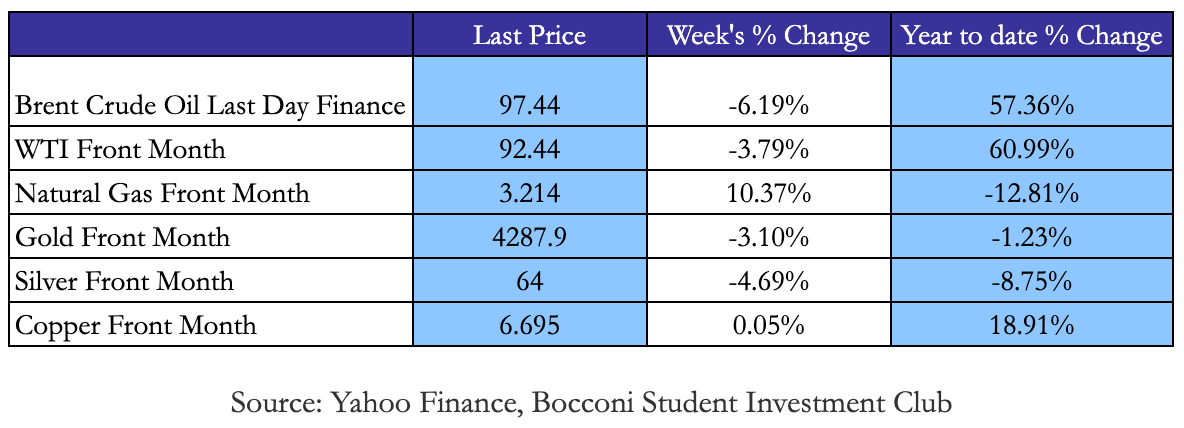
In the commodities market, oil whipsawed hard on Iran headlines: Brent spiked toward $110 mid-week on the Saudi pipeline attack and fresh Houthi strikes before retreating on Friday as diplomatic signals emerged. WTI settled the week at $92.44, down 3.79%, reflecting a similar path. Precious metals had a rough week: with real yields at multi-decade highs and the dollar firm, gold capped a weekly loss, settling near $4,287.90 (-3.10%), while silver fell even harder to around $64.00 (-4.69%). Copper was comparatively resilient, continuing to be supported by tight supply and AI/data-centre-driven demand.
Next Week Main Events
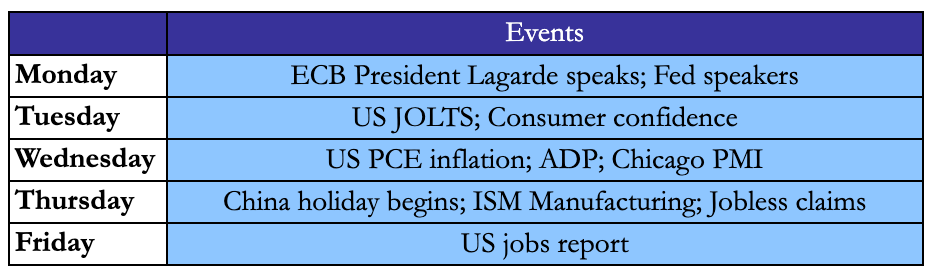
Next week is relatively clean from a scheduling standpoint after two eventful weeks. Tuesday brings US JOLTS and consumer confidence, before Wednesday becomes the anchor day: August PCE inflation (Fed’s preferred gauge) lands alongside ADP private payrolls, the final Q2 GDP estimate, Chicago PMI and China’s official PMI. September 30 also marks the end of the US fiscal year, though there is no shutdown risk after Congress funded the government through December 11. Thursday, mainland Chinese markets close for National Day “Golden Week” through October 7, while September ISM Manufacturing PMI and weekly jobless claims arrive in the US. Friday is the week’s main event, with September nonfarm payrolls, which are a key input ahead of the Fed’s late-October meeting, alongside euro-area flash inflation. Just beyond the week, OPEC+ meets on Sunday, October 4, keeping oil firmly in focus.
Brain Teaser #53
You have 25 horses and a race track with only 5 lanes. You can race only 5 horses at a time, and you do not have a stopwatch (after each race, you only know the finishing order). What is the minimum number of races needed to determine the 3 fastest horses overall?
Brain Teaser #54
Consider 100!
How many zeroes are at the end of the number?



0 Comments