Intro
For much of this year, Meta looked like one of the clear winners of the AI era. Its advertising business kept growing at a pace few companies of its size can match, new AI products gave investors a fresh story to get excited about, and the shares climbed to new records.
The spark was Muse, a personal AI agent Meta launched in September. It quickly topped Apple’s App Store and gave investors something concrete to point to after months of questions about AI spending, helping drive a sharp rally. But Muse also raised new questions about running costs, privacy and access to other companies’ platforms.
Lately the mood has turned. The stock has given back a large part of its gains and has slipped into bear-market territory. Little of this was triggered by news from Meta itself. Instead, the company has been swept up in a broader selloff in technology shares, led by AI-related names.
At the heart of that selloff is a simple question: when will all the money being spent on AI start to pay off? The biggest tech companies are investing at a pace with few precedents, building data centres and buying chips in the hope of future demand. Until the returns are clearer, investors are less willing to pay up for even the strongest businesses.
Meta is a good example of that tension. It is highly profitable and still growing quickly, but it is also spending heavily on AI and had a major legal case to deal with along the way. In this article we look at how the stock got here, what Muse changes for the business, what the court settlement means, and what the AI spending bill could mean for Meta’s valuation in the months ahead.
Meta Stock Recap
Tech stocks have had a rough stretch, and the selloff has been unusually broad. Since mid-November the Nasdaq has been in a period of correction, more than 10% below its October record, and the Dow and S&P 500 later joined it. AI-linked shares led the way, with chipmakers hit hardest and the pressure spreading to the big platform companies.
Several shocks landed within days of each other. Nvidia, the bellwether for AI spending, was rocked by the resignation of its CEO, Jensen Huang, who has since returned, but its strong Q3 results did not lift share prices as the company continues to face uncertainty over the future of its business in Asia. Anthropic’s record IPO was meant to confirm the AI trade but did the opposite, with investors appearing to have sold other AI holdings to fund their allocations, demonstrating the concern of being too concentrated in the sector.
Behind the selloff is a concern that the AI build-out is costly, increasingly debt-funded and may take longer than expected to generate returns. Renewed optimism, including over Huang’s return to Nvidia, faded quickly, leaving Meta’s shares under pressure alongside the wider sector. Earlier in the summer, however, investors had faced a different source of uncertainty: a major court case over the impact of Facebook and Instagram on young users.
The court case centred on allegations that Meta had designed Facebook and Instagram to be addictive for young users and concealed the harm. The lawsuit involved 29 states, including California and New Jersey. Investors feared claims of up to $1.4 trillion. The settlement put a figure on that exposure. Meta agreed to pay up to $17 billion to the states over 10 years, with a separate Texas deal bringing the total to just over $18 billion. Around 70% with approximately $12.7 billion being guaranteed payments with the remaining ~$5.3 billion conditional on YouTube and TikTok adopting comparable protections and making matching payments. For shareholders, the financial cost appears manageable relative to the feared penalties. Meta booked a roughly $9.9 billion charge in Q3, while spreading the $17 billion payment over a decade puts the average annual cost at about 1% of expected annual revenue.
The settlement gave investors a clearer view of Meta’s legal costs, but its AI spending presents a more open-ended question. The company is committing far larger sums to infrastructure whose future returns remain uncertain. That concern extends across the biggest technology companies, bringing Meta back into the wider debate over how much the AI build-out will cost and when it will pay off.
After Q3 earnings, Amazon (~$220 billion), Alphabet ($195-205 billion), Microsoft (~$170 billion) and Meta ($135-145 billion) guide to roughly $730 billion of 2026 capex. In the July-September quarter alone the four spent $201.9 billion, up 108% from a year earlier.
That scale of investment raises a broader valuation question. Advertising, search and software built highly profitable businesses, but AI is making them more capital-intensive. Investors must now weigh the potential for faster growth against the cash absorbed by data centres and chips. Strong earnings alone may be less reassuring if a growing share of operating cash flow is needed to fund that investment.
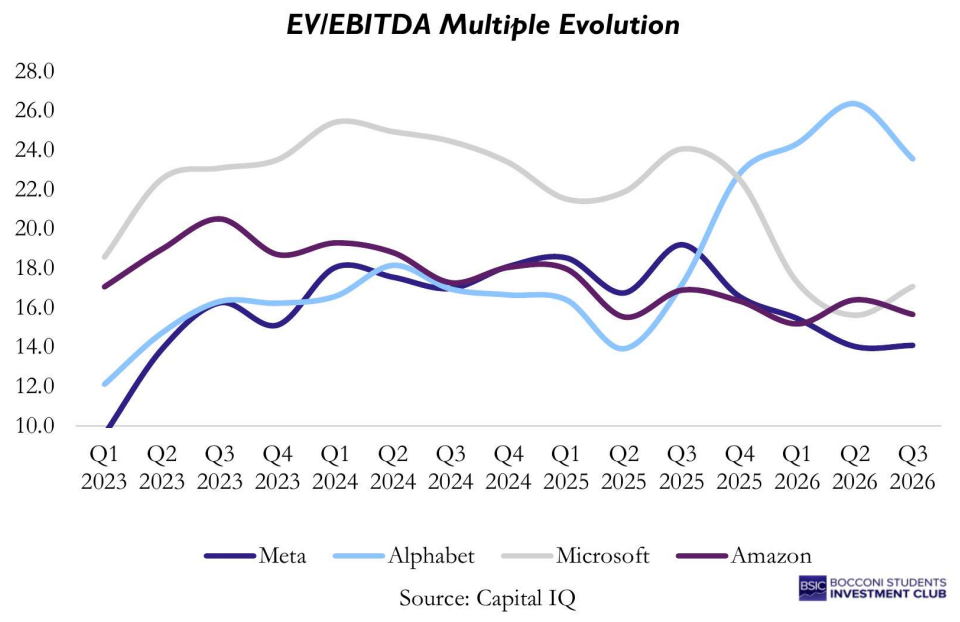
For Meta, the question is whether AI can improve advertising performance and generate enough additional revenue to justify the spending. Its EV/EBITDA multiple over the recent history offers a way to track how the market has valued the business as those expectations have changed. A lower multiple may suggest a more attractive entry point, but it also needs to be assessed against the cost of sustaining future growth.
How is Meta Moving into AI
Meta’s move into AI started with technology that helped select content and match advertisers with potential customers. This project has expanded since and now reaches into developing advanced models and securing the infrastructure needed to train and run them. With 3.64bn people using at least one of its apps each day in September 2026, Meta has a massive TAM when it comes to AI. Its recent investments aim to give it more control over the technology it delivers through that market.
A major step in Meta’s AI development came in June 2025, when the company invested approximately $14.3bn for a 49% stake in Scale AI, valuing the company at more than $29bn. Scale supplies training data and evaluations that help developers improve and test their models. Its work includes creating examples of how particular tasks should be performed and assessing whether a model performs them reliably. The agreement expanded Meta’s commercial relationship with Scale, which remains independent. Meta acquired a non-voting minority interest and disclosed that it did not have significant influence over Scale’s operations. The strategic benefit therefore depends on the closer working relationship and better model development, alongside the value of the equity stake.
The transaction also brought Scale’s founder, Alexandr Wang, to Meta, who has since become the company’s first Chief AI Officer and leads Meta Superintelligence Labs (MSL). His role covers shaping Meta’s AI strategy and taking initiatives from development to execution. This gives the investment an organisational dimension: Meta strengthened its relationship with a major data supplier while bringing its founder into the leadership of its own AI effort. For shareholders, the test of that change is whether it improves the pace and quality of development enough to justify the resources committed.
That effort requires physical capacity across the US. In New Albany, Ohio, Meta had completed the first phase of its gigawatt-scale Prometheus cluster by October 2026, with an eventual target of roughly one million graphics processing units, or GPUs. Hyperion, under construction in Richland Parish, Louisiana, is designed to scale up to 5GW, and further campuses are under way in Texas, Indiana and Oklahoma. This capacity serves Meta’s own development first: training, which builds its models, and inference, which runs them when users make requests. Prometheus gives Meta compute today; Hyperion is the longer-term commitment.
Once that capacity is in place, it could also serve customers outside Meta. Zuckerberg has said the company has received offers to buy compute at a meaningful premium to its own cost, and Meta is evaluating renting capacity to other frontier labs. That would give the build a second use, improving utilisation in the years before Meta’s own demand catches up and turning part of the spending into a source of revenue. Management has given no timetable, and the contribution will depend on prices and on how much capacity Meta needs for its own services.
While these all represent revenue streams, the capital requirement to fund those projects has grown sharply. Meta spent $72.2bn on capital expenditure in 2025 and now guides to $135–145bn for 2026, including principal payments on finance leases. The $140bn midpoint is approximately 94% above last year’s spending. This guidance supports the core business as well as new AI initiatives, so the full amount cannot be attributed to advanced-model development. The Scale investment is also a separate equity investment, rather than infrastructure capex. These distinctions matter when judging the cost of the AI push: annual expenditure and investment consideration measure different uses of capital.
The effect on cash is already visible. In Q3 2026, Meta generated $32.8bn of operating cash flow and spent $34.9bn on capex, leaving free cash flow of negative $2.1bn. Capitalised infrastructure consumes cash before its cost flows through earnings as depreciation, while cloud services and data-centre operations add running expenses. EBITDA therefore gives an incomplete picture of what shareholders must fund. Meta has committed resources to the data, leadership and computing capacity behind its AI strategy. The products built on that foundation will have to generate revenues that cover their running costs and provide an adequate return on the capital committed.
To expand upon its infrastructure investment, Meta recently created its first AI agentic model: Meta Muse. Released on 8 September 2026, the model is described by Meta as a personal AI agent rather than a chatbot: the user sets a task or a goal and the agent carries it out over time, connecting to email, calendars, payments, shopping, health and home services. It runs inside a dedicated secure virtual machine with its own browser, which Meta presents as a way for the agent to act on a user’s behalf without handling passwords or card details directly.
Early adoption has been faster than Meta’s other recent launches. On the third-quarter call, management said more than 10m people in the US and Canada had set up Muse agents in about six weeks, that the app had ranked first in the App Store on almost every day since launch, and that roughly 25% of those who set it up used it on a given day, a rate Zuckerberg described as more than double Threads’ at the same stage. Shopping is the most common use: over 25% of weekly active users engage with it, at an average purchase above $200. Meta One, the unified subscription across Meta’s apps, passed 15m subscriptions and trials. These are adoption figures rather than revenue, but they set the size of the base to which any later monetisation would apply.
The constraint on that base is compute. Zuckerberg said the main reason Muse has not launched globally is that it is expensive to run, and Li told analysts that total serving costs will rise as the user base grows. Meta expects to improve Muse’s compute efficiency by more than tenfold over the next year, through better use of off-peak capacity, smaller models and inference optimisation, and is building capacity to serve more than 1bn people within a few years. Neither figure came with a cost per user, which Li declined to provide. This is where the data-centre programme described above meets a product: the capacity being built is what allows Muse to expand, and the cost of serving it decides whether expansion is profitable.
Meta is extending the same agent beyond consumers. Muse for Small Business, announced at Connect in September, applies it to analysing advertising performance, drafting campaigns, handling customer messages and keeping a website current. Muse Code is a separate terminal-based coding agent sold on its own subscription, and a model API is available to developers. Management also described a longer-term ambition for a network in which consumer and business agents transact with each other directly. Each extension spreads the fixed cost of model development across more uses, although none of them is material to revenue today.
Hardware is the other extension. Muse Charm, shown at Connect, is a small holdable device that lets a user speak to their agent without a phone. The Information reported in November that Meta intends to price it at $300, including up to twelve months of Verizon connectivity, for release before the holidays; Meta has not confirmed the price. Friend’s companion device sells at $250 and Amazon’s Bee Frontier at $75 plus a $99 annual subscription, so Meta is positioning at the premium end of a young category. The glasses line now runs through Muse as well, and management said the agent is central to that business model. At $300 the Charm is an accessory rather than a volume product, so its contribution is more likely to come from the subscriptions and usage it encourages than from the margin on the device.
How does AI become revenue at Meta?
Meta does not report Muse revenue separately, and Li told analysts that the company is not monetising Muse outside subscriptions today. Any estimate of what the agent is worth therefore has to be built from the operating metrics Meta does disclose and the prices it has published. We model revenue from users and revenue per user rather than by growing reported segments, which allows the advertising business and the agent to be judged separately. The build has four parts: core advertising, driven by daily active people and advertising revenue per person; other Family of Apps revenue, which includes paid messaging and Meta One; Reality Labs; and Muse, which we split into subscriptions and commerce.
Advertising remains the business. Family daily active people, or DAP, reached 3.58bn at the end of 2025, and advertising revenue per average DAP was $56 for that year. We assume DAP growth slows from 3% in 2026 to 1.5% by 2030, reflecting a base already close to the connected population, and that advertising revenue per person grows 21% in 2026 before decelerating from 17% to 11% by 2030 as AI ranking and creative tools continue to lift price and conversion. That gives advertising revenue of $249.8bn in 2026 and $454.9bn in 2030, with revenue per person reaching $117. Tech hedge fund, Coatue’s October 2026 update puts Meta’s advertising revenue per DAP at $153 by 2031, which we use as a bull case in our model. Where our bull case draws on Coatue’s estimates, we use them only as inputs for an upside scenario: they are not our view of what Meta is worth, and the resulting figures should not be read as Coatue’s valuation of the company.
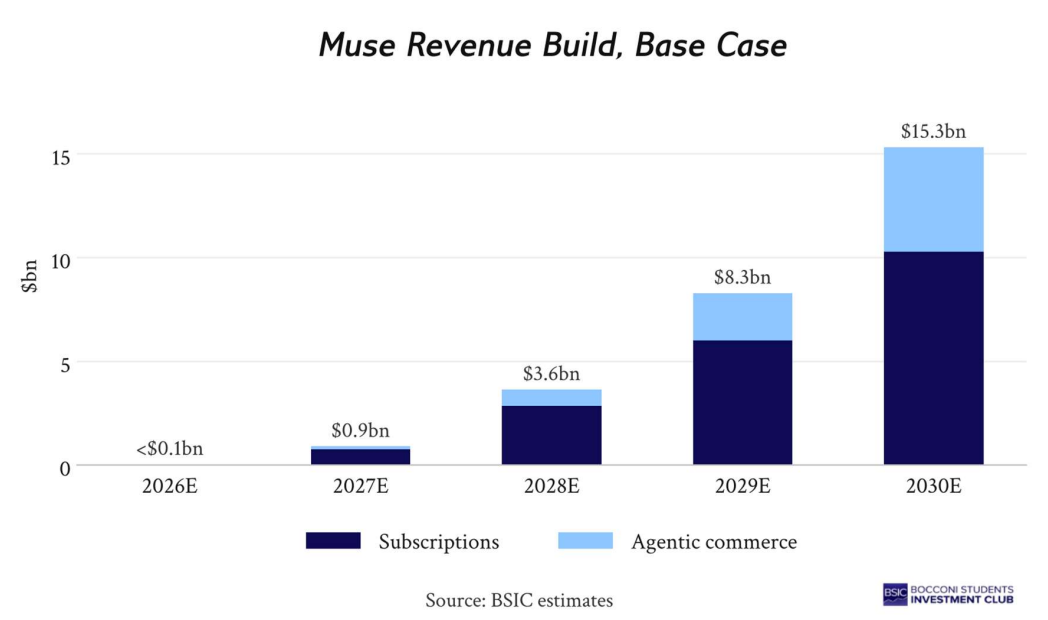
Muse subscriptions are the smaller and more predictable of the two agent lines. We model average monthly Muse users rising from 30m at the end of 2026 to 175m in 2027 and 750m by 2030, which keeps the agent below 19% of Family DAP at its peak, and assume paid conversion rises from 3% to 7% as the free tier’s usage limits begin to bind on heavier users. At a blended $20 a month, the Power plan, that produces subscription revenue of $0.8bn in 2027 and $10.3bn in 2030. Conversion is the sensitive assumption: Meta has deliberately kept the free allowance generous, and the $100 Maximum plan is unlikely to shift a blended price dominated by the cheaper tier.
Commerce is where the larger number sits and it is the hardest to project. Meta has said it will charge a fee on transactions the agent completes but has not published a rate, and Shopify’s documentation currently lists no additional selling fee for Meta’s direct checkout. We model the share of Muse users who shop rising from 25% to 37%, purchases per shopper from four to twelve a year, and an average order value of $50, giving gross merchandise value, or GMV, of $6.3bn in 2027 and $131.2bn in 2030. A take rate rising from 2% to 4% then gives commerce revenue of $0.2bn in 2027 and $5.0bn in 2030. We set that range deliberately below the fees charged elsewhere in e-commerce, where Amazon’s referral fees run from 8% to 17% and OpenAI’s checkout fee was 4% before it was withdrawn, because Meta is competing for merchant participation from a standing start and has said it intends to take a small fee; Meta’s strength in e-commerce is its large user base, which creates a massive TAM for this new market.
Coatue sizes agentic commerce at $2.5tn of sales by 2031, producing roughly $250bn of revenue at a 10% take rate. Independent estimates are considerably smaller: Morgan Stanley puts US agentic GMV at $190-385bn by 2030 and Bain at $300-500bn. Against the Coatue path our 2030 GMV is 6.6% of the market; against a more conservative path built from the independent estimates it is 21.9%. The first looks undemanding and the second is a substantial share for a product two years old and not yet available outside North America, and the second is the figure we would have to defend.
Adding the parts gives total revenue of $256.3bn in 2026 and $483.3bn in 2030, a compound rate of 17%. Muse contributes $0.9bn in 2027, rising to $15.3bn in 2030, or 3.2% of revenue, so the agent changes the growth rate at the margin rather than replacing the advertising business within our forecast period.
Our pitch
Meta Platforms [NASDAQ: META], closed at $628.96 on 27 November, giving market cap of $1,608bn. With $42bn of net debt including lease liabilities, current debt and the unpaid settlement, that gives an enterprise value of $1,650bn, and leaves the shares ~19% below the $777.59 high reached in September. On our estimates Meta trades at 13.2x 2026 EBITDA, 10.6x 2027 EBITDA and 17.9x 2027 adjusted earnings on a pre-split basis.
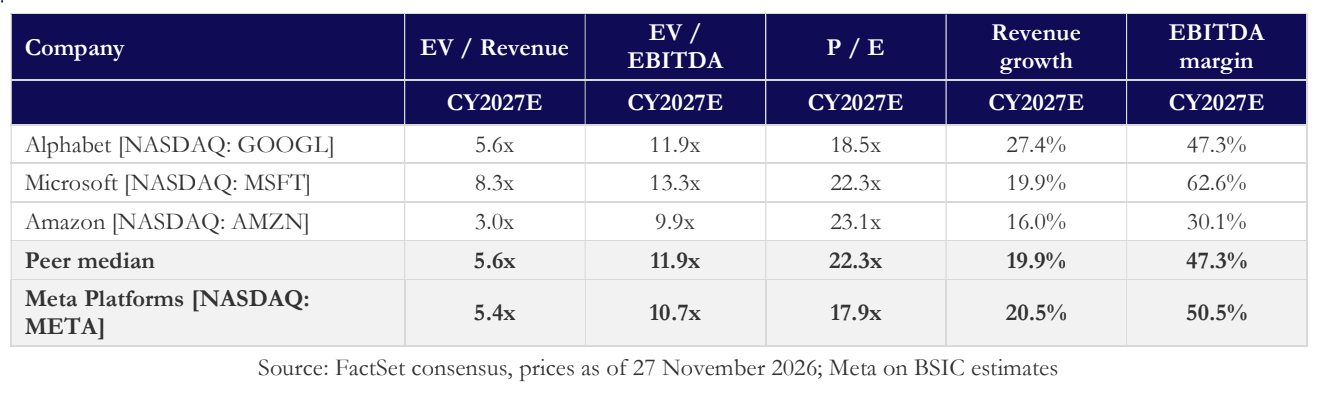
Those multiples sit below Meta’s large platform peers. Alphabet, Microsoft, and Amazon trade at a median of 11.9x 2027 EBITDA, 5.6x 2027 revenue and 22.3x 2027 earnings. Meta is cheaper on all three despite faster forecast revenue growth and a higher EBITDA margin than the peer median, not to mention one of the most promising infant AI businesses. The discount is modest on enterprise value to EBITDA and wide on earnings, which is consistent with a market pricing Meta’s depreciation and the absence of a third-party cloud business to carry some of the spending. We treat the smaller advertising companies as reference points rather than comparables: Reddit, Snap, Pinterest and The Trade Desk are each between 1% and 3% of Meta’s revenue, and Intel is a different business altogether.
We value Meta on 2027 estimates at 13x EBITDA and 22x earnings. Those are a modest premium to where the shares trade now and broadly in line with the peer median on earnings, which we think is the right place for a business still growing at around 20% but with falling returns on capital. They give $771 and $774, blending to $773. Applying the peer median EV/EBITDA and EV/revenue multiples to the same forecasts gives $695. Weighting our complete 3-statement reconstruction model at 70% and the comparables valuation at 30% produces a target price of $749, 19% above the current price.
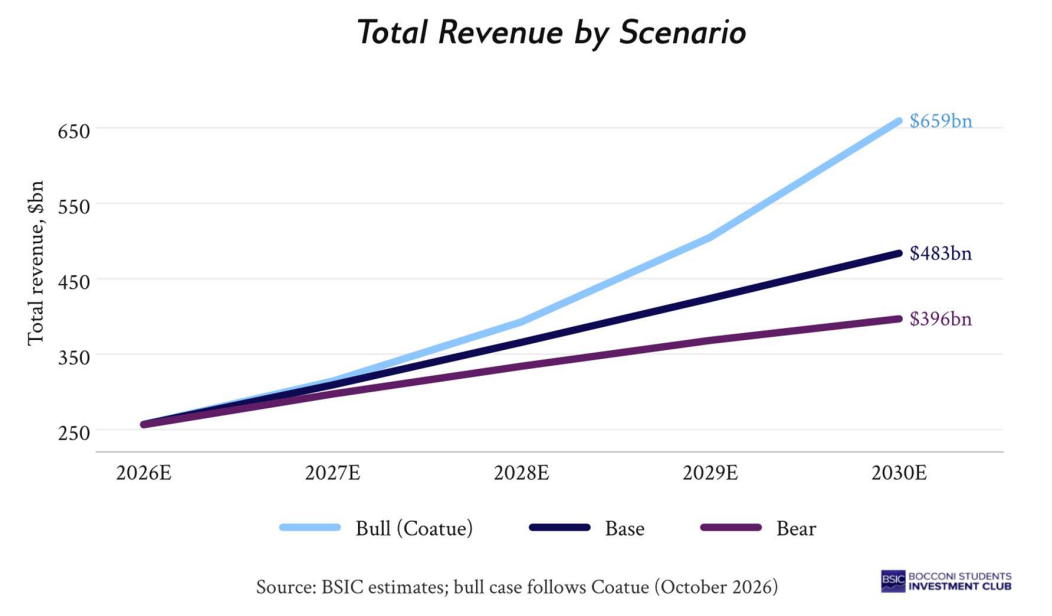
Running each scenario through the model gives a narrower range of prices than the revenue spread suggests. Applying the same 13x EBITDA and 22x earnings multiples to 2027 estimates, and the same 70/30 blend with the comparables valuation, gives $716 in the bear case, 14% above the current price, $749 in the base case, 19% above, and $763 in the bull case, 21% above. The range is tight because the scenarios barely diverge in 2027, when revenue differs by only $17bn between bear and bull; most of the gap opens from 2028 onwards. Even the bear case leaves the shares above today’s price, which suggests the market is discounting the cost of the build more than any particular view of how far Muse goes.
 The valuation moves more with the multiple than with the forecast. At 12x our 2027 EBITDA the shares are worth $711, 13% above the current price; at 16x they are worth $953, 52% above it. Rolling forward to 2028 EBITDA at 13x gives $915. Since the EBITDA estimate itself moves with the scenario, we would treat 12-14x on 2027 as the realistic band and the target as a point inside it rather than a precise figure.

The uncomfortable part of the position is cash. On our forecasts free cash flow falls to $2.1bn in 2026 and to negative $1.9bn in 2027 before recovering to $76.6bn by 2030. Net debt including leases rises from $3.5bn at the end of 2025 to a peak of $94.6bn in 2028, we assume no buybacks between 2027 and 2029, and return on invested capital falls from 32% in 2026 to 16% in 2030. An investor buying Meta today accepts three years in which the company funds its build from the balance sheet and returns almost nothing, in exchange for a business that on our numbers yields 4.8% on free cash flow against today’s market capitalisation by 2030. That exchange is the thesis, and an investor who does not want to own it for three years should not own it at all.
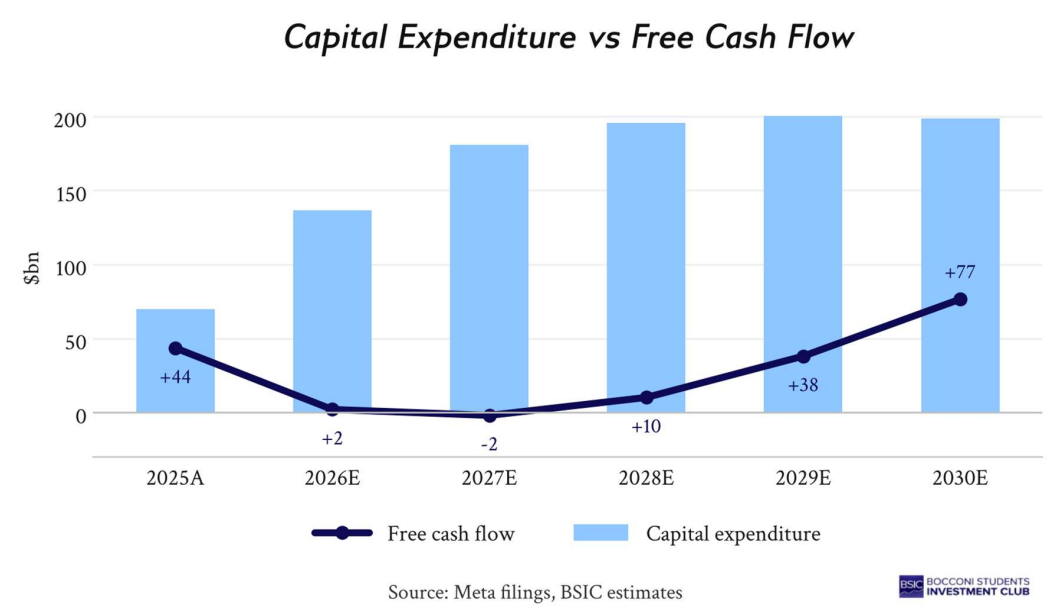
We are not alone in the framing. Pershing Square disclosed a Meta position in February 2026 at roughly 10% of its capital, arguing that the market was focused on near-term capital expenditure at the expense of the longer-term benefit from AI. That is close to our own reasoning, and it is also a reminder that the argument has been available for a year without the share price agreeing with it.
Four things would break the thesis. First, capital expenditure: Meta has not guided to 2027 and will do so with its fourth-quarter results, and our $180.8bn assumption is already 32% above 2026, so a larger number would push the free cash flow trough deeper and later. Second, distribution: Amazon blocked Muse from completing purchases in September and the two are reported to be negotiating access, while Walmart and Shopify already participate, so commerce revenue depends on where the agent is allowed to transact. Third, cost: Meta has not disclosed a cost per Muse user, and the tenfold efficiency improvement is a target rather than a result. Fourth, trust: Reuters reported in November that Muse had mixed up conversations between accounts, and an agent holding payment and calendar access has less tolerance for error than a feed does. Regulation belongs on the same list, since the August settlement resolved one case rather than the category.
Conclusion
Meta is being priced as a company whose spending is certain and whose returns are not. That is a fair description of the position. Capital expenditure roughly doubles this year, free cash flow goes to approximately nothing, and the product meant to justify the build has not yet charged a transaction fee. What the price appears to miss is that Meta’s advertising business funding all of this is still growing at ~20%, it has been very capital efficient, and has current users of more than 3.5bn.
At 10.6x 2027 EBITDA, a discount to the median of three peers carrying the same spending problem and with less engagement to monetise, the market is asking to be paid for uncertainty it is partly creating. While this article serves as research, rather than professional valuation, we believe that this discount with its peers is not entirely justified, especially given the promising growth Meta is showing in its new AI related business segments.



0 Comments