Introduction
Luxury has long been regarded as one of the safest bets in European equities, as an industry that could raise prices almost at will and customers will follow, however this assumption is unravelling. Shares of LVMH [EPA: MC], Hermès [EPA: RMS] and Kering [EPA: KER] have each fallen by ~40% this year, wiping around €250bn off the value of Europe’s largest luxury groups, as Chinese demand falls and aspirational buyer step back. Yet Swiss watch exports have now risen for five consecutive months. This article discusses if luxury is struggling, why are watches recovering, and whether that recovery is real.
Both luxury goods and watches are sold to similar clientele, often by the same groups and have been exposed to the same forces that ended the post-pandemic boom. But watchmaking faces pressures of its own, with costs heavily tied to gold and the Swiss franc, and its production impacted by US tariffs on Switzerland. We believe the recovery is genuine but narrow. Export growth is flattered by a distorted comparison base and driven largely by entry-level watches, while margins and employment are under pressure. Watches do not contradict the luxury slowdown, in fact they offer the clearest view of how the industry is diverging.
Context: Why the Luxury Slowdown Matters for Watches
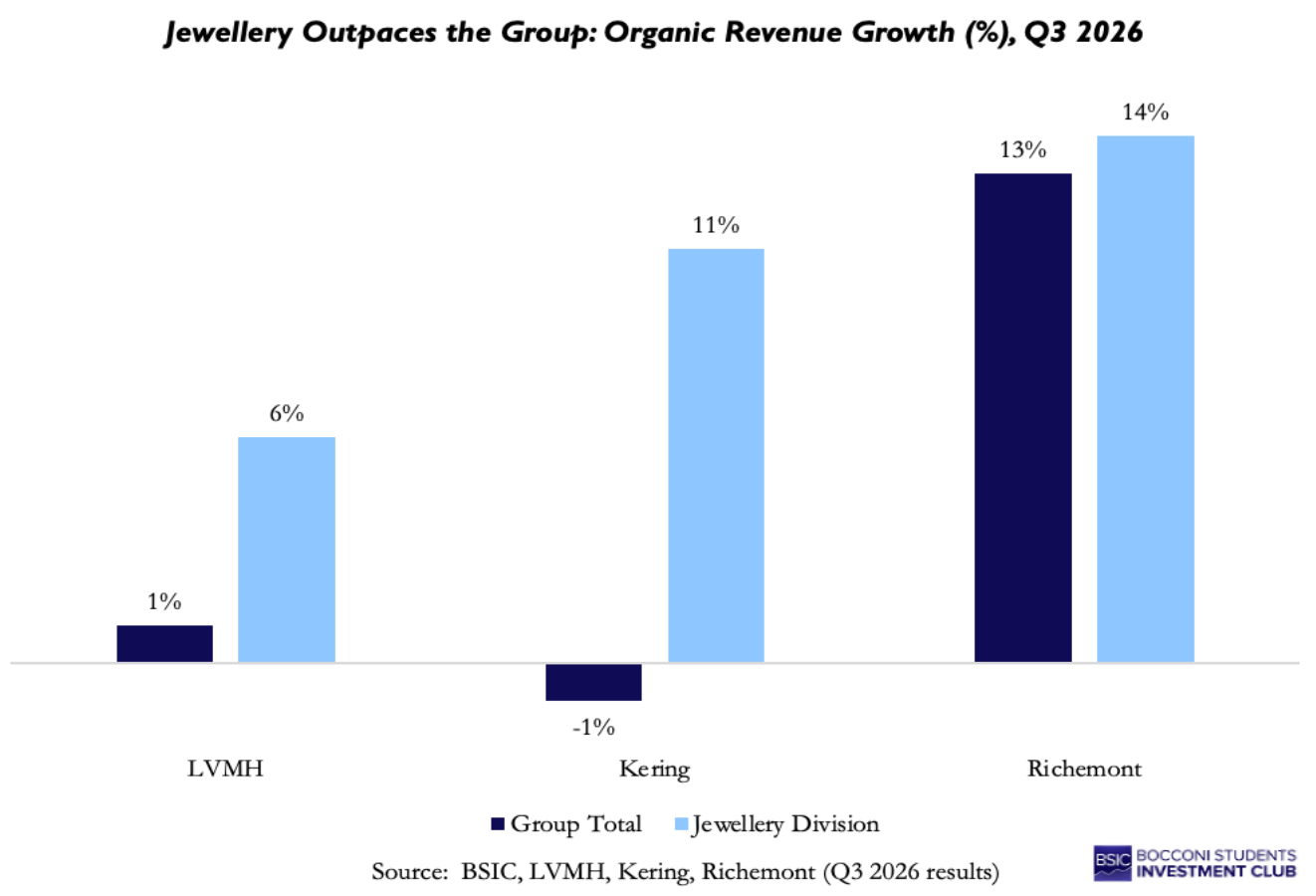
The third quarter showed how uneven the luxury slowdown has become. LVMH [EPA: MC] grew organic revenue by just 1%, and its Fashion & Leather Goods division, the engine of group profits, fell 5% as demand in China slowed. Kering [EPA: KER] slipped 1% on a comparable basis, while Gucci dropped 6%, its retail sales down 9% on thinner store traffic in mainland China and Japan. Hermès [EPA: RMS] was again the exception, up 4.3% at constant exchange rates with leather goods up 10.8%, although even its Asian business outside Japan stopped growing. What the three had in common was jewellery. LVMH’s Watches & Jewelry division grew 6% and Kering’s jewellery brands 11%, and Bain expects jewellery to be the strongest category this year at 8-10%, with watches some way behind at 3-5%.
Behind these numbers sit forces that matter as much to a watchmaker as to a handbag house. Price comes first. Around 80% of the sector’s growth between 2023 and 2025 came from price increases rather than volume, according to McKinsey and The Business of Fashion, and Prada’s Cleo bag now costs 62% more than it did in 2021. That worked until the aspirational buyer, the client who stretches for one piece a year, stopped coming. Bain puts the number of personal luxury consumers at about 315 million this year, against roughly 400m in 2022, yet still expects the market to grow by 2-4% at constant exchange rates. Fewer clients are spending more each, which keeps revenue afloat while footfall falls. China makes it worse. Bain expects mainland spending on personal luxury goods to shrink by 1-3% in 2026, with watches and fashion weakening while jewellery and beauty hold up, and Hermès points to a falling property market and fragile confidence.
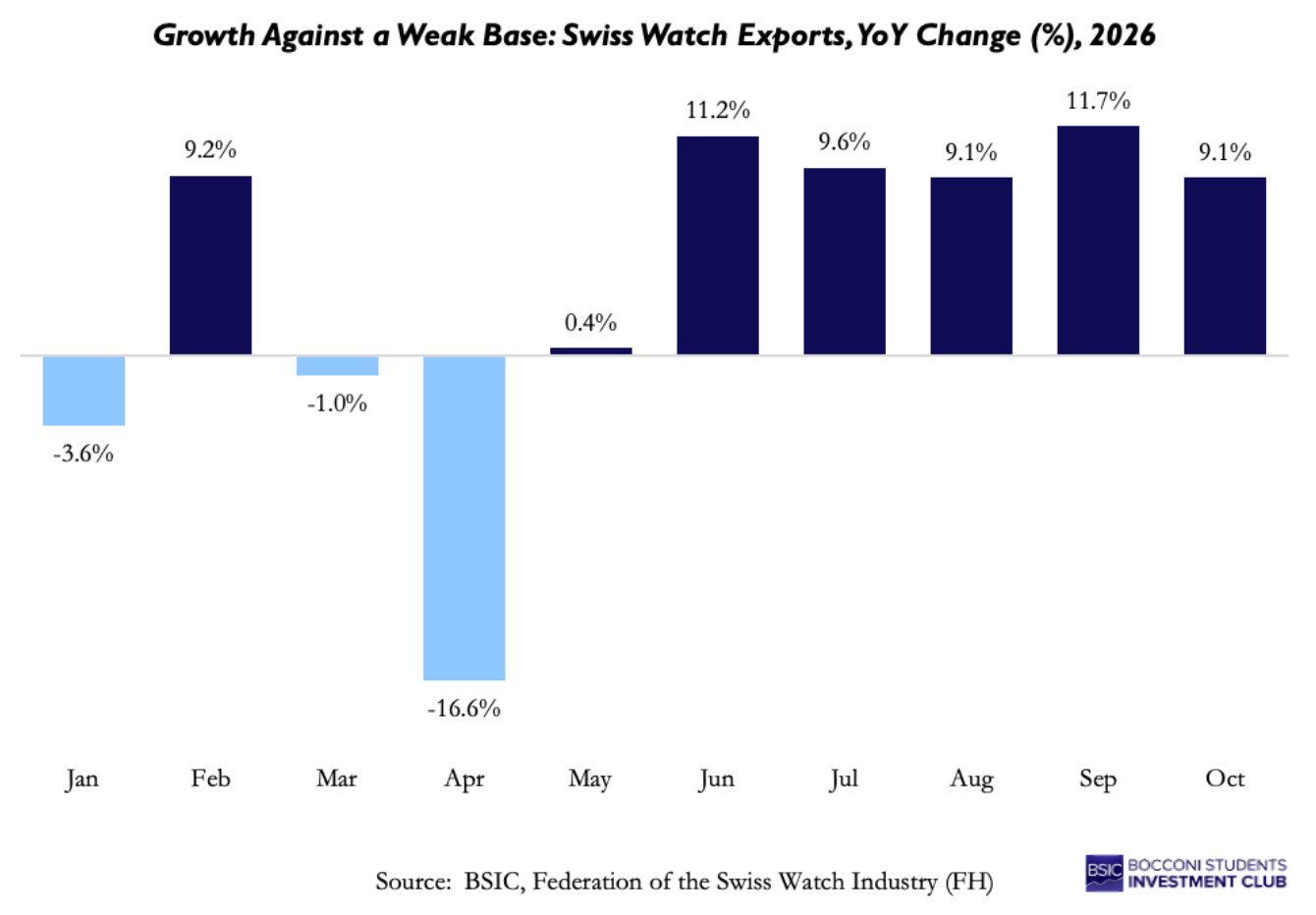
On that evidence, Swiss watch exports should be falling. They are not. Shipments rose 9.1% in October to CHF 2.46bn, according to the Federation of the Swiss Watch Industry, and are up 3.4% over the first ten months at CHF 21.9bn, even though exports to China dropped 12% in the month. Exports to the United States jumped 61%, a comparison flattered by a year earlier, when the 39% tariff imposed in August 2025 had choked off shipments. A luxury market that is losing customers and a watch industry that is shipping more watches cannot both be telling the full story, and the next section asks which one is.
Is the Watch Recovery Real? Better Exports, Worse Margins
On the surface, watch recovery is real, but headline numbers make the recovery seem stronger than it is. Five straight months of growth have lifted exports by 3.4% over the first ten months of 2026, after two years of decline, yet we need to look at these figures with care. The Federation of the Swiss Watch Industry (FH) measures watches shipped to retailers and subsidiaries, not the actual watches bought by end customers. This in addition to gold prices, exchange rates and tariffs, makes the underlying trend difficult to judge. The comparison base is also badly distorted by US tariffs, where in April 2025, brands hurried watches into the US before tariffs took effect, and shipments rose 149%. Against this figure, total Swiss watch exports fell 16.6% in April 2026, while shipments to the US fell 56%.
The opposite effect then followed. After the 39% tariff in August 2025, exports fell for roughly four months, meaning the gains from June to October 2026 were measured against a depressed base. These changes have made planning difficult: the US rate moved from 39% to a 15% framework, then to a flat 10% after the Supreme Court struck down the emergency power tariffs and finally move to 12.5% from 24th of July 2026. This adds up to ~5 rates in about fifteen months, in a market where duties had been close to zero before 2025. Vontobel’s analysts describe US shipments as a “seesaw” driven by tariffs and changes in stock levels, and excluding the US, Swiss watch exports grew just 1.7% in the first four months of 2026.
There are different types of watches that are acting differently. In the first half, mechanical watches with an export price below CHF 500 rose 23.8% in volume, while the CHF 500-3000 segment fell 5.7% in value. Over the long term, the industry is shipping fewer watches: annual exports fell from 17 million units in 2023 to 14.6 million in 2025. Higher-priced watches have recovered since the summer, partly on the US base effect, and October was the first month when mid-range watches turned clearly positive, up 6.6%. Even so, exports of precious metal-watches were down 6.5% by value.
Making and selling Swiss watches has also become more expensive. Coming back to the factor of gold, it reached a record of about $5,590 an ounce in January. By August, it was 20% lower than the peak, however the retail watch prices had not followed it down. The franc gained roughly 14% against the dollar over the year in late 2025. Swiss watch manufacturers pay their costs in francs, while a large share of their revenue comes in dollars. A strong franc makes that dollar revenue worth less at home.
Company results show how difficult it is turning rising sales into higher profits. Swatch Group’s first-half sales grew 8.5% excluding exchange rate changes, but operating profit was only CHF 52m, well below the CHF 120m analysts expected. Richemont’s Specialist Watchmakers on the other hand offers a different picture, with sales rising 10% excluding exchange-rate changes and operating profit tripled to €150m. After excluding one-off tariff effects, its margin was still only 7.7%, quite low for a luxury business. Elsewhere, conditions remain difficult. Breitling’s annual sales fell 11% in one year, and its EBITDA fell 21%. Zenith is reducing its workforce in Le Locle by about half, and employment across the sector fell 1.3%, its first decline since Covid.
Overall, the recovery is real in the narrow sense of the word, in the sense that more watches are leaving Switzerland and that tariffs shocks seem to have passes. But looking at it from a different angle, growth is affected by a distorted base, concentrated in entry-level volume, and eroded by higher costs.
Winners and Losers
The gains from the recovery are going to very few players. According to Morgan Stanley and LuxeConsult’s 2026 report, Patek Philippe, Rolex, Audemars Piguet and Richard Mille together held 49.1% of the Swiss watch market in 2025, up 12.4 percentage points since 2019. Rolex alone accounted for CHF 11bn, roughly a third of the industry. Watches above CHF 50,000 now make up 37% of export value and LuxeConsult found that watches representing 1.3% of volume produced account for 75% of value growth.
The leading private brands can grow without selling more watches. Keeping supply limited can increase the company’s prestige and exclusivity and protect demand and prices. Rolex made fewer watches in 2025 while increasing its market share. However, listed groups need volume to absorb fixed costs as Swatch’s 1.7% margin on deliberately maintained capacity shows.
The stronger brands also have greater control over how their watches are sold. Rolex’s certified pre-owned program is worth close to CHF 500m a year, and the brand has the pricing power to raise prices, which it did twice this year. The result is a profit pool that Morgan Stanley estimates at CHF 7.9bn, of which the largest four companies capture about 76% at a margin near 33%, against 18% for the three listed groups with margins of 10%.
But even the stronger businesses face pressure: Richemont’s first-half sales rose 17% and jewellery sales rose 19%, excluding exchange rate changes, as Cartier continued to gain market share. Yet shares fell about 8% on results day because jewelry growth slows from 24 to 14% between quarters and higher gold prices are expected to weigh on second-half margins. Brands in the middle are struggling the most: exports with prices between CHF 500 and CHF 3,000 fell 5.7% by value in the first half. TAG Heuer’s sales fell 2%, Hublot’s 7%, Zenith’s 15% and Omega’s 8%. Swatch Group has lost roughly 10.3 percentage points of market share since 2019. They don’t have neither the scarcity at the top, which lets them limit supply and charge more, nor the price point of Longines, Tissot and Hamilton, which are driving growth in the number of watches sold. Even in accessible luxury, established names dominate.
The resale market acts the same. The WatchCharts index rose 7.5% in the twelve months to October, led by Patek Philippe at 15.6%. Only Rolex, Patek and Audemars consistently trade above retail, with other brands selling at a discount. The resale premiums have decreased, and prices remain below the 2022 peak. The ability to sustain high prices still belongs to a small group of brands whose watches remain hard to obtain.
Our View: What Watches Tell Us About Luxury
Despite more watches leaving Switzerland, the growth is concentrated at the accessible end of the market, while value accrues to a handful of private brands at the top. This trend is seen in the luxury industry as a whole, which is not collapsing, but instead polarising, and watches expose that divide more starkly than other categories.
The same pattern runs across the wider sector. Bain estimates the number of personal luxury consumers fell to 315m this year, down from 330m in 2025, yet the top clients are commanding ~48% of personal luxury spending. Revenues are being sustained by an even smaller, wealthier clientele, while the aspirational middle is drifting away. Thus, at both extremes, the winners either have scarce products, or products which are affordable. The most instructive lesson behind this trend concerns pricing. Much of the industry’s growth in recent years was built on price hikes rather than volume, and watches show when this strategy works or when it fails. Rolex raised prices while producing fewer watches, and demand held. Mid-tier brands raised prices without that underlying scarcity, and demand fell as customers chose to walk away. Pricing power is therefore earned by keeping supply below demand.
The question is whether these brands can win back the aspirational buyer without eroding the exclusivity that defines them. The first potential strategy to do this is cutting prices. Brands like Gucci have cut prices on one of its handbags, which may lure some buyers back. However, it signals to loyal clients that they overpaid and undermines resale values, the very opposite of the approach that built strong brands in watchmaking. The second would be to offer a cheap entry point under someone else’s name. The Royal Pop allows AP to reach a mass audience through a $400 Swatch pocket watch. This enables AP to put its name in front of millions of buyers without producing more of its own watches or lowering their prices. This strategy rests on a “halo effect”, hoping someone who buys a $400 Royal Pop today will one day buy a real AP. The evidence that this works is weak, with Swatch selling the MoonSwatch, a collaboration with Omega, which did not yield strong results for Omega. Thus, collaborations may attract attention, but there is little sign that they turn that attraction into buyers of the brand’s main watches.
The third strategy, and maybe the most compelling, is certified pre-owned. Under this, the brand itself checks, services and guarantees used watches, which are then resold through its official retailers. For the buyer, this is a cheaper way into the brand, while keeping the aspect of reassurance you obtain when buying new. For the brand, it brings in new customers without cutting prices and takes back control of a resale market that used to be run entirely by independent dealers. A limitation to this solution, is it only works for brands whose watches hold their value. If used watches sell far below the retail price, a certified pre-owned programme simply tempts customers away from buying new ones. Therefore, polarisation reinforces itself, with the strongest brands having the greatest available solutions to protect their exclusivity while widening access.
For the rest of the industry, the uncomfortable truth is that the middle has become the hardest tier to be placed in. Mid-tier brands charge luxury prices, but their watches lose value far easier, so they offer neither the exclusivity of the top nor the value for money of the bottom. One solution for such brands could be to cut supply, create more expensive pieces and let scarcity build, however this takes years of brand-building, so they would have to absorb short-term losses. The second is to move downmarket, by competing on prices and collaborating with cheaper brands, which will ultimately bring volume back but at thinner margins. This same dilemma is what the rest of luxury is facing, where brands are caught between rebuilding exclusivity and cutting prices.
Conclusion
The recovery in Swiss watch exports is real, but it rests on narrower foundations than the headline figures imply. Months of growth owe much to a depressed comparison base, a shift in mix towards entry-level volume and the gradual unwinding of the tariff shock. The gains are also unevenly distributed. A small group of privately owned houses, insulated from earnings pressure and able to control supply is capturing a large share of value. This trend extends beyond watchmaking to the luxury sector as a whole. Growth depends increasingly on a shrinking base of wealthy clients and pricing power, that rests on scarcity rather than on the ability to raise prices. The aspirational customer who underpinned the post-pandemic boom has not disappeared but has become more price-conscious and thus selective. Re-engaging this customer base without diluting brand equity is now the central strategic challenge for much of the sector. Therefore, the Swiss watch industry is better understood not as recovering, but as diverging.



0 Comments