Introduction
Demand for protein-rich foods and drinks has grown as society increasingly associates protein with a healthy lifestyle and fitness culture. GLP-1 weight-loss drugs represent another source of demand, as some of their users cannot reach their daily intake requirements when eating smaller meals and thus rely on protein supplements.
Some of this demand is met with whey, a liquid co-product of cheese production that can be processed into concentrated protein ingredients. This is why whey has become more appealing to dairy processors, encouraging many to increase investments in protein production. However, while higher whey prices can improve processors’ returns, they also raise costs for manufacturers of protein products. In November 2026, for example, Glanbia [LSE: GLB] reported that it had raised Optimum Nutrition prices in response to significant whey inflation, showing how cost pressures are being passed down the supply chain.
Companies are thus trying to benefit from this demand by investing in their processing capacity or by acquiring businesses that would provide access to ingredients and customers. Arla, for example, is investing in the processing site acquired with Volac’s whey nutrition business, and Fonterra [NZX: FCG] is investing in its protein processing capacity, while Danone [EPA: BN] expanded its consumer business through the acquisition of Huel in September 2026. Whether this spending pays off will depend on how demand develops and whether companies can protect their margins as more production capacity becomes available.
Corporate Investment and Capital Allocation
For dairy producers, the protein boom has led to an unusual split: milk supply is abundant, yet one of its components has rarely been worth more. Milk supply increased significantly across Europe with production rising by 7.7% in the UK and 3.6% in Denmark in 2025, while the EU farm-gate price of milk fell almost 20% year on year by May 2026. Protein, however, has been moving in the opposite direction. The price of whey protein concentrate 80% (WPC80) rose from £4,302 to £23,751 per tonne between June 2023 and June 2026, an increase of 452%. This may initially seem counterintuitive since a cheaper raw material should mean a cheaper by-product.
The main reason for this is that whey is largely derived from cheese production, and its supply fluctuates with the volume of cheese produced rather than with that of milk. With EU cheese prices also down nearly a fifth on the year, producers have little reason to make more cheese, so the production of whey is unable to expand to meet its demand. The whey produced from cheese-making is not WPC80. In fact it is 94% water and less than 1% protein, so over 100 tonnes of liquid whey must be filtered and dried to make 1 tonne of WPC80. Turning liquid whey into WPC80 requires filtration and drying capacity, which has now become the constraint, with some suppliers reportedly sold out by June for the rest of 2026.
More milk has therefore not translated into more protein. In a market now paying for protein rather than milk, dairy groups have begun treating whey as a co-product of cheesemaking rather than a by-product, and have started to redirect their capital into processing capacity to match demand.
This capital expenditure has taken four forms, which differ less in purpose than in cost, speed, and exposure to price fluctuations. The cheapest option has been upgrading existing equipment. Across the industry, dryers that made lower-value whey products such as sweet whey powder or lower-concentration WPC are being modified to produce more protein-rich derivatives of whey such as WPC80 and isolate. FrieslandCampina has done exactly this, investing over €90m across three of its Dutch sites, which are expected to reach full capacity by 2028. The company has already doubled its whey protein isolate production capacity at its Borculo plant.
A costlier option is adding a new production line to an existing whey-processing site. DMK is set to spend €26m on a new WPC80 facility at its existing Edewecht site which would lead to a capacity increase of 7,000 tonnes, reflecting an upfront investment of €3,700 per tonne of capacity. Leprino, a US dairy group, spent $35m on an expansion of its Texan plant, quadrupling its capacity. This approach, while slightly more costly, suggests the firms expect protein demand to remain high.
A third option is to repurpose an existing plant, as Arla is doing by converting a drying tower at its Danish ARINCO site from infant formula to protein ingredients. At the highest cost are multi-year site programmes and joint ventures, which take longer and carry the most price risk with their outputs arriving later. Glanbia, the company behind Optimum Nutrition, sits on the purchasing side of the protein boom, and is now set to add 4,500 tonnes of isolate capacity through Southwest Cheese, its joint venture with US dairy co-ops, which supply the milk while Glanbia runs the plant and sells the whey products.
Brownfield spending has dominated protein investment across the dairy industry because existing sites, permits and equipment can be upgraded rather than built from scratch. This approach keeps costs per tonne low and commissioning fast, which helps recover the capital expenditure used for the investments.
Despite the demand boom, protein remains a minority of dairy capex, but it is the part with the clearest return. Out of Arla’s €731m in capex in 2025, only €39m (5%) was directed towards increases in protein capacity. FrieslandCampina’s €90m programme works out at roughly €30m a year, around 8% of its 2025 capex of €380m. Fonterra has been an outlier, with protein-related investment taking up roughly a quarter of its planned capex for the next three years. Having sold its consumer brands, Fonterra is free to bet more heavily on its core ingredients business and is therefore the most committed to protein growth.
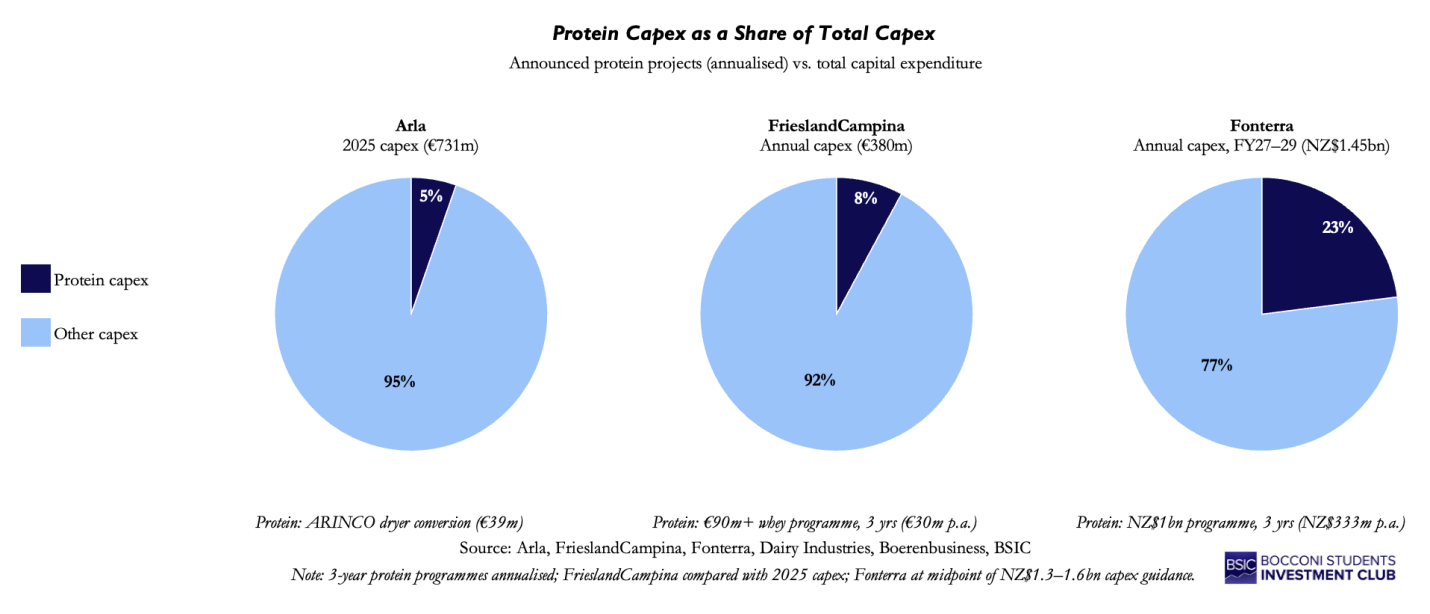
The capex allocation towards protein is surprisingly small, showing that these businesses may value allocating capital elsewhere, either internally through UHT, cheese and decarbonisation projects or externally through member payouts. All three businesses are farmer-owned cooperatives, therefore every euro of capex competes with euros to be paid out to their farmer members. Not only must protein spending beat the cost of capital, but it must beat the cash farmers would receive otherwise.
The return from the investment in WPC80 production depends on the spread relative to the whey’s next best use. Each tonne of WPC80 uses whey that could have otherwise been used to make roughly 8 tonnes of whey powder while yielding 6.8 tonnes of permeate (lactose and mineral by-products of WPC80 production). The spread versus producing whey powder is the revenue obtained from WPC80 and permeate, minus the value of the whey powder forgone and the extra running costs of membrane filtration. The price of whey powder rose from €850 per tonne in 2023 to €1,650 per tonne in 2026, a 94% increase. While substantial, over the same period WPC80 rose more than fivefold, so the spread widened sharply.
Considering a brownfield expansion such as DMK’s, it is possible to estimate how long it will take for such an investment to pay back under June 2023 and June 2026 prices. Permeate traded at around 63% of the price of lactose in 2026, so we value 2023 permeate at the same 63% of the lactose price and add €500 per tonne of extra running costs to cover membrane filtration, a step that producing whey powder does not require.
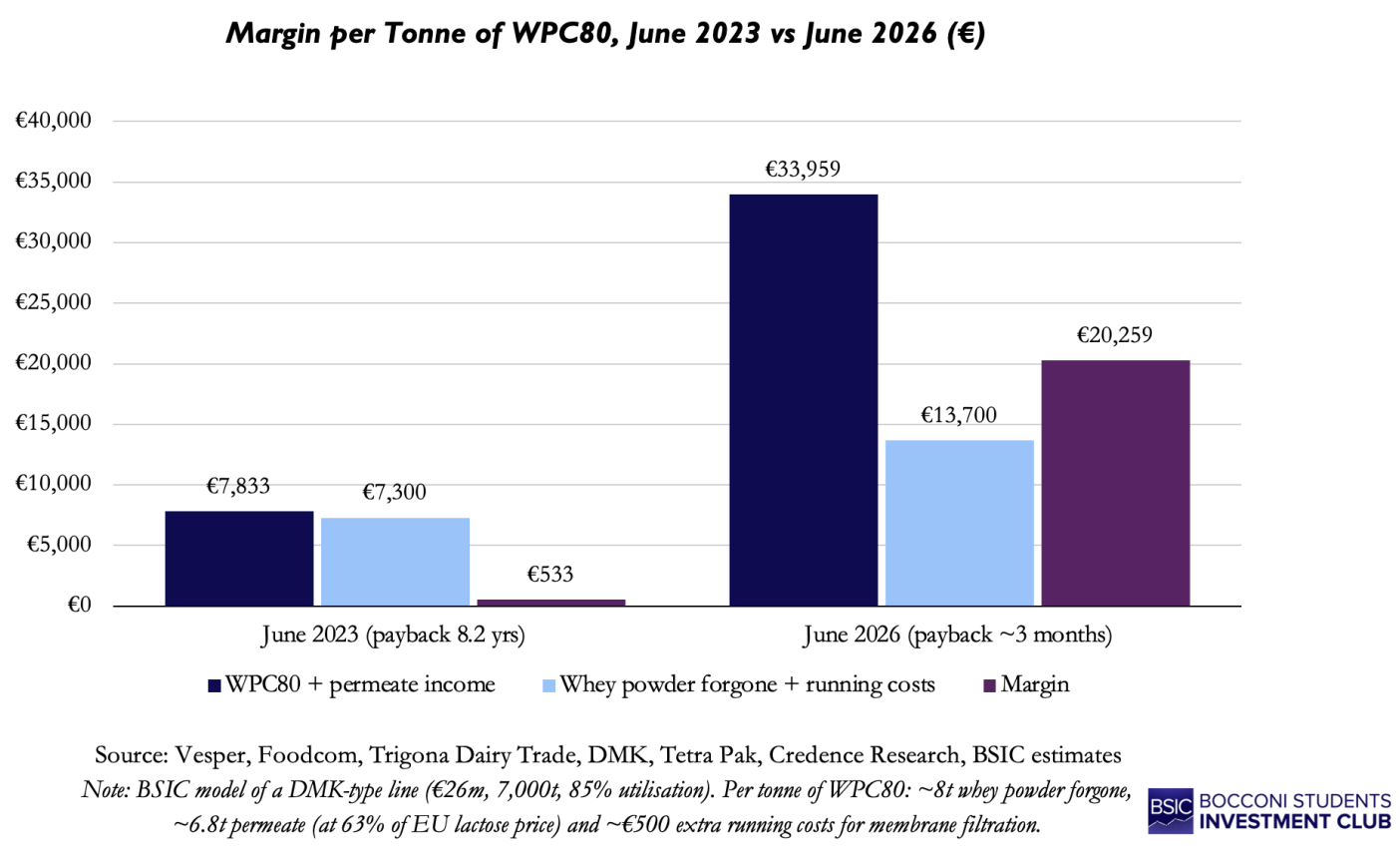
Based on our estimates, in June 2023, the spread per tonne of producing WPC80 instead of whey powder was only around €530, a small return for the large investment needed to produce WPC80, which would pay back after roughly eight years. This modest return would struggle to justify lower payouts to members. However, by June 2026 the spread had increased to around €20,000 per tonne, making WPC80 production much more attractive than that of whey powder, explaining the recent push for investment in protein capacity. Assuming 85% capacity utilisation, the investment would pay back after only three months. At June 2026 prices the spread is very large, allowing for the price of WPC80 to decrease by almost 75% and still break even. This cushion, however, is the same for every producer, and it relies on prices that are already easing, with European WPC80 back to around €21,000 in October. The risk in protein capex is therefore not the individual project’s capex, but the spread beneath it, and every major cooperative is betting on the same spread at once.
Arla and Fonterra represent two different ends of this strategy: one converting an asset it already owns, and the other reshaping its portfolio to fund capacity. Arla Foods Ingredients, a subsidiary of Arla Foods, is investing almost DKK300m in rebuilding an existing drying tower at its ARINCO site to go from producing infant formula to milk and whey protein ingredients. The rationale behind the decision was that the ingredients unit was expected to outgrow its sites, and Arla decided to outsource the production of its early life nutrition to Sodiaal and repurpose its capacity to accommodate increased ingredients production.
Fonterra opted to double down on the protein market and sold its consumer brands to Lactalis for NZ$4.22bn, returning NZ$3.2bn of divestment proceeds to farmer shareholders via a NZ$2.00 per share capital return. It is investing an incremental NZ$1bn over three years in South Island protein manufacturing, funded by retained sale proceeds and operating cash flow. Since operations are expected from 2029 onwards, this investment depends much more on the previously mentioned spread holding into the future. Arla’s investment is smaller and expected to come online sooner, while Fonterra has committed more capital over a longer period.
Building and repurposing capacity can take years and still requires an established whey supply stream. While these projects may be more affordable, the construction time may eliminate some of the short-term gains currently available during the protein boom. Dairy groups must therefore consider whether it makes more sense to build capacity for the future or acquire capacity for short-term gains.
M&A Activity and Industry Consolidation
Growing protein demand is changing the businesses that food companies seek to acquire. Ingredient producers are targeting specialised processing operations and established supply relationships, while consumer groups are buying brands with a recognised position in nutrition with an existing customer base. Both approaches can shorten the time required to enter the growing protein food industry. Recent transactions in the market reveal different ways to grab the same demand, as the selection of the acquisition target depends on the respective capabilities of the buyer.
Dairy ingredients vary greatly in terms of the types of proteins that can be produced and the degree of processing required. Whey protein isolate, for example, requires additional filtration and membrane treatment steps. A clear isolate for a protein drink also requires additional processing and related expertise. There are significant differences between the processing of ordinary whey for the food industry and that for the specialized protein market. An existing producer can bring sufficient resources as well as relevant manufacturer relations to a company. These manufacturer relations can be of great commercial value to customers, as they assess suppliers not only on price but also on the supplied quality and reliability.
Arla Foods Ingredients secures new production capacity and supply of whey ingredients with the acquisition of Volac’s whey nutrition business in a single transaction. The core asset is the Felinfach, Wales-based producer of high quality whey protein isolate which will sit alongside existing production and be supplemented by additional volumes of whey protein isolate. Arla also gained access to additional whey volumes and Volac’s network of supply partners. The deal was done for the whey nutrition division of Volac, not the whole group. From Arla’s point of view it was a combination of an operating plant with the appropriate relationships to supply the plant and to sell the output from it. This is becoming an increasingly common industry model: connecting up specialist businesses with a larger customer base through its own sales function. Research can also be shared between different customer groups. Moreover, The cost of technically reformulating ingredients to add to new products is further reduced by the joining together of technical teams from the two businesses.
For consumer-oriented industry segments, such as ready-to-eat food, factors such as demand and distribution will be of greater significance than for other industry segments when considering an acquisition. A food group may have the necessary production facilities and access to required raw materials but lack a brand that consumers associate with convenient, protein-rich nutrition. Building this position on the market requires product launches on the market, marketing and building customer loyalty. An acquisition, however, brings an existing customer base and sales history which reduces the commercial uncertainty for the buyer. The buyer then has to determine whether its resources can expand the business more effectively than the target could on its own.
Danone’s acquisition of Huel follows this logic. Completed on September 4th, the transaction added a direct-to-consumer business selling nutritionally complete meals in formats including powders and ready-to-drink shakes. Danone did not disclose the consideration, although Reuters reported a value close to €1bn. Huel’s products are plant-based and address broader nutritional needs alongside protein. The acquisition therefore expands Danone’s position in convenient nutrition and consumer distribution. Danone gains Huel’s online selling capabilities and established customer relationships in the UK, Europe and the US. Huel gains access to Danone’s research infrastructure and international distribution. Huel’s growing retail business can also benefit from the experience of its parent in supplying a wide variety of other markets. Its direct online sales also give it a further unique relationship with customers, enabling it to manage repeat purchases. The potential return comes from expanding those relationships and reaching new consumers, while preserving the reasons existing customers chose the brand.
The choice between acquiring a brand and developing a competing product remains relevant even when manufacturing is readily available. The CMA’s Huel review identified low entry barriers to the ready-to-drink meal replacement market, with companies able to outsource production or use existing drinks manufacturing facilities. However, the responses to the investigation from businesses identified brand, consumer trust and retail listing as key barriers to growth. This distinction helps explain why a food group might pay for an established business despite being technically able to manufacture a similar product. Danone itself launched Alpro Meal-to-Go in UK retail in April 2026, while the Huel transaction was underway. Acquisition and internal product development were therefore proceeding alongside each other.
The integration of the assets to be purchased has to be suitable. The combination of the ingredient operations can lead to a better coordination of production and development. Preserving brand identity and ensuring the continuity of customer experience is just as important as in consumer acquisitions. Huel announced that, upon the transaction, the brand would retain its name and management and that Huel subscribers would continue to receive their normal subscriptions of existing products. By preserving the relationships the buyer acquired, the established brand can avoid losing value during the integration process. Procurement and distribution savings can offset some of the costs of product development and customer retention. However, preserving the acquired brand and its customer relationships may require continued spending that outweighs those back-office efficiencies.
In addition to the reported growth, also the operating development needs to be distinguished from the consolidation effect. Arla’s value-added ingredients segment grew by 29.3% in 2025, compared with 12.8% excluding M&A. The acquisition of an existing company can therefore be used to accelerate expansion of operations. The purchase price itself does not determine the return on acquisition. Rather, return on acquisition is measured as the profitability and cash of the combined company over time, after integration of operations and additional investment. Across the industry, the acquisition decision therefore depends on the cost and time required to reproduce what the target already has. Specialist processing expertise and dependable supply relationships may justify buying an ingredients business, or a consumer brand can be attractive because it brings repeat customers and distribution that would be expensive to establish through new launches. When evaluating potential targets, buyers need to determine how ownership of that target will improve its operations or increase its commercial reach. The return on the acquisition will be based on specific improvements made by the buyer above and beyond the purchase price, and all additional expenditures required to achieve growth in protein demand and expand the business.
Conclusion
There has been significant growth in the demand for protein in recent years, resulting in many dairy processors and food companies expanding their businesses. However, so far, it is unclear how much capacity companies should add or what they should be willing to pay for an acquisition. Arla’s and Fonterra’s processing investments, for example, aim to increase profitability, while the Volac and Huel acquisitions help the buyers expand more quickly. But in both cases, whether these approaches create value depends on the additional profit and cash flow they generate compared with initial investment.
The time it will take for the new processing capacity to be fully developed and implemented also poses a risk for companies. This could take several years, during which other processors might increase production too. If supply then grows faster than demand, this could reduce the additional profit processors earn from making concentrated protein instead of lower-value whey products. Acquisitions can also carry greater risk if the price paid already assumes strong growth. Although companies can benefit from the growing demand for protein products, they thus still have to consider what they could earn if prices fall.



0 Comments