Salzgitter AG (SZG GR): BUY
Target Price EUR 70, 26% Upside, 12 to 18 Month Horizon
Note: this piece was written in September 2026 with the shares trading at EUR 55.65, which is the reference price behind every multiple and every per share figure below. Sell side estimates cited are Deutsche Bank. The scenario probabilities, the Aurubis bridge and the target derivation are ours.
Introduction
Salzgitter is a German steel and industrial group with a market capitalisation of roughly EUR 3.3 billion and revenue of about EUR 9 billion. Around 70% of that revenue is European and Germany alone accounts for roughly 40%. The group spans steel production, downstream processing, trading and a technology division built around KHS, which makes filling and packaging machinery for beverage producers.
Two assets sit at the centre of this report. The first is HKM, Huettenwerke Krupp Mannesmann, a large Duisburg steelworks producing crude steel and slabs, which Salzgitter took to 100% ownership in July after buying out thyssenkrupp Steel and Vallourec. The second is a 29.99% stake in Aurubis, the largest copper producer in Europe and the largest copper recycler in the world. That stake is listed, liquid and worth about EUR 2.1 billion against a parent company worth EUR 3.3 billion.
We are long Salzgitter for three reasons, and they are worth stating flatly before any of the detail. The market has not yet seen a single reported quarter under the European steel trade regime that took effect on 1 July. It has read the HKM acquisition as a EUR 900 million capex bill when the company guided net cash cost is about EUR 100 million. And it is crediting the Aurubis stake with EUR 642 million of value when the screen says EUR 2.1 billion. The three legs fail in three different ways, which is the point. This is one position with three uncorrelated sources of return, not one argument repeated three times.
That matters for how the position behaves. JP Morgan attributes roughly 60% of this stock’s return to idiosyncratic factors rather than to the steel complex, so a thesis built on company specific items is the right shape for the name. All three of ours are company specific.
What we are not claiming
We are not betting on a rise in steel prices. Our base case is simply that European mills gradually fill part of the gap left by lower imports over the next twelve to eighteen months, with hot rolled coil settling somewhere between EUR 720 and EUR 780 per tonne. Deutsche Bank assumes EUR 750 for both 2027 and 2028, which is broadly in line with our range. We don’t need a particular edge in forecasting steel prices for the investment case to work.
We are also not claiming this is an undiscovered name. The shares have roughly tripled off their low and the twelve month range is EUR 20.76 to EUR 66.55. The sector has already moved. What it has not done is report under the new rules.
Leg one: the ceiling moved
The price of imported steel is the ceiling on the domestic price. A European customer chooses between a domestic mill such as Salzgitter and an imported tonne, so the landed cost of that imported tonne sets the level above which the domestic producer cannot price.
On 1 July the European Union replaced the previous safeguard system. Tariff free import quotas were cut by roughly 47%, about 13 million tonnes, to approximately 18 million tonnes annually. The duty on volumes above quota went from 25% to 50%. CBAM, the Carbon Border Adjustment Mechanism, was switched on at the same time and adds a carbon cost to carbon intensive imports.
The arithmetic of the ceiling is what carries this leg.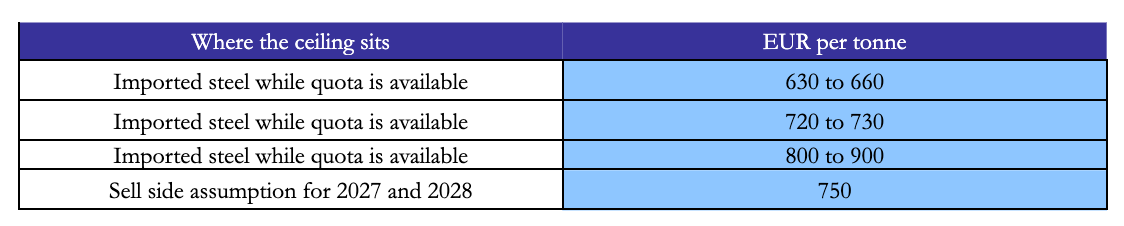 Inside the quota, the relevant import cost is the foreign steel price plus freight, logistics and CBAM, which lands at EUR 630 to 660 per tonne. Once the quota is exhausted, the marginal imported tonne carries the 50% duty and the ceiling jumps to EUR 800 to 900. Quotas were roughly half filled after two months and several exporting countries have already burned through their individual allocations. Spot at EUR 725 is pricing a fraction of that shift.
The obvious objection is that Deutsche Bank models EUR 750 rather than parity at EUR 800 to 900. We agree with them. They assume a soft demand environment in which European mills partially refill the gap, and so do we. The thesis does not require import parity. It requires EUR 750 to hold, which is EUR 25 above spot.
The second objection is that this is already in the stock because the sector has doubled. The sector move priced the announcement. What has not been reported is a single full quarter under the regime. First half EBITDA of EUR 278 million predates the rules entirely, because they went live on the first day of the second half.
We care about the steel spread rather than the headline price. Realised price less iron ore, coking coal, energy and conversion cost is the earnings variable being underwritten here. A higher hot rolled coil price that is fully absorbed by input inflation is worth nothing. This is also why we prefer Salzgitter to ArcelorMittal as the expression. ArcelorMittal carries substantial operations in North America, Brazil and mining. Salzgitter is concentrated in Europe, which is where the protection applies.
Leg two: HKM is being read as a cost
This is where we disagree with the street most directly. In July Salzgitter acquired the remaining stake in HKM from thyssenkrupp Steel and Vallourec and moved to full ownership. The market saw the capex headline attached to the new electric arc furnace and stopped reading.
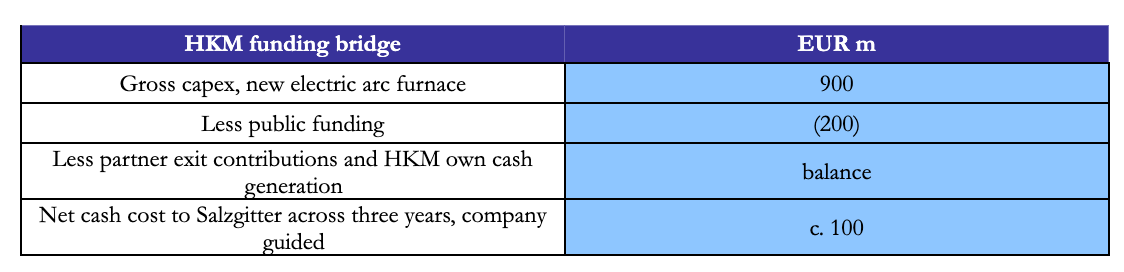 Gross capex for the new furnace is about EUR 900 million. Public funding covers EUR 200 million. The former shareholders are making substantial exit contributions, and HKM continues to generate operating cash flow supported by a slab offtake agreement with thyssenkrupp that runs to 2028. After maintenance capex and restructuring, management guides to roughly EUR 100 million of net additional cash from Salzgitter across three years. Nine hundred becomes one hundred. That is a factor of nine, it is company guided, and it is checkable against the disclosure rather than a matter of opinion.
There is a second element that the headline reading misses entirely. HKM makes slabs and rolls nothing, and a slab is the thinnest margin product in steel. Most of that output currently leaves the gate under the inherited thyssenkrupp contract. When that contract ends in 2028, Salzgitter can route those tonnes into its own Mannesmann tube business, where the same tonne is worth several times more. We are not paying for that today and we do not need it. The 2027 thesis works on the ceiling alone, and the 2028 margin capture sits on top as free optionality.
There is also a supply point that ties back to leg one. HKM capacity comes down to 2.5 million tonnes and headcount falls from around three thousand to about one thousand. European supply is being cut in the same year that Europe removed thirteen million tonnes of import access.
Leg three: Aurubis is priced at a third of its value
The Aurubis stake is the largest single number in this report and the one the market appears not to have modelled. Because Aurubis is listed, the value of the holding is directly observable rather than a matter of estimation. Salzgitter accounts for it under the equity method, recording its share of Aurubis earnings rather than consolidating the business line by line, which is precisely why it disappears in a casual look at group multiples.
The bridge below strips the enterprise value back to what is left for Aurubis once the industrial business is valued at a sector multiple.
 At EUR 55.65 a share you cannot simultaneously give the steel business a sector multiple and give the Aurubis stake its market value. One of the two is being handed to you. The gap is EUR 1.46 billion, or EUR 24.3 a share, and the cleanest path to closing it is a sale. We put a 40% probability on that.
Four facts make a sale plausible rather than hopeful. Salzgitter already has a EUR 500 million bond outstanding that is exchangeable into Aurubis shares, and a company does not issue paper convertible into an asset it intends to hold forever. German participation exemption means corporate gains on the sale of shareholdings are 95% exempt, so proceeds would arrive close to tax free. The three year capital programme, SALCOS and HKM together, costs about EUR 1.87 billion, and a EUR 2.1 billion stake funds the entire build with money left over, which removes the only real balance sheet question in the story. And 29.99% sits one basis point below the German mandatory offer threshold while remaining comfortably above the 25% blocking minority, so nobody acquires Aurubis without dealing with Salzgitter first. The stake may be worth more than screen value, not less.
Two of those paths require no board decision at all. The exchangeable converts by itself if Aurubis keeps rising, and a bidder for Aurubis has to deal with a blocking stake whether Salzgitter wants to sell or not.
The honest objection is that nothing has been announced and that Aurubis is up 62% over twelve months, so we may be marking the top. That is why this is a leg rather than the base case. We hold the stake at market in every scenario and the 40% sits on top of that. Copper is the stated break condition here. If copper halves, this leg is gone and we own the other two.
A related point on the reported numbers. As Aurubis shares appreciate, the exchange right embedded in the bond becomes more valuable, the fair value of the liability rises, and Salzgitter books a mark to market loss with no deterioration in any operating business. In the first half this produced roughly EUR 180 million of negative valuation effects, which is the difference between about EUR 460 million of EBITDA excluding valuation effects, which the company reports as EBITDA VX, and roughly EUR 280 million of reported EBITDA. EBITDA VX is the cleaner read on the operating businesses and the one we underwrite.
Catalysts
The primary catalyst is mechanical rather than event driven, which we prefer. The tightened quotas are already in force and become progressively more binding through the remainder of 2026 as tariff free volume is consumed. That should push realised European steel spreads higher without requiring any demand recovery, and it should appear in the coming quarterly results as improving steel segment margins. The market gets a reported data point rather than a forward promise.
The second catalyst is the 2028 expiry of the HKM slab offtake agreement, which converts the thinnest margin product in the group into feedstock for higher value downstream processing. That is a scheduled step change in margin capture rather than a speculative option.
The third is further monetisation of the Aurubis stake. The EUR 500 million exchangeable already demonstrates willingness to extract financial value from the holding. Any additional structure of that kind, or continued appreciation in Aurubis feeding through to a narrower sum of the parts discount, crystallises value the market currently gives almost no credit for.
Where no single catalyst applies, the size of the discount is sufficient on its own to justify the position.
Valuation and scenarios
We value the company as the Aurubis position plus the industrial business on a multiple of 2027 EBITDA, less approximately EUR 448 million of net obligations, across 60.1 million shares. The matrix below places the operating outcome on the rows and the treatment of Aurubis in the columns, weighted 40% sold and 60% held.
 Blending the two columns gives approximately EUR 70 a share, which is 26% above the entry price. The shape of the distribution matters more than the point estimate. Three quarters of the probability weighted outcomes sit above where we are buying, and the ratio of weighted upside to weighted downside is roughly six to one. Even in the case where hot rolled coil returns to EUR 650, the loss is around 10%, because a third of the market capitalisation does not move with steel.
We would rather stress the framework ourselves than have it stressed for us. Doubling the probability that the regime breaks from 10% to 20% takes expected value from EUR 70 to EUR 66.5 and the ratio from about six to one down to roughly three to one. The idea survives its own bear case, and since the six to one figure is flattered by the Aurubis asset floor, three to one is the number we would quote.
For completeness, on the 2027 estimates the group trades at 5.9x earnings and 3.3x EV/EBITDA on EUR 1,148 million of EBITDA. We do not lead with those multiples. A low multiple is the symptom here, not the argument.
Investment risks and what breaks the thesis
Each leg is falsifiable and each has a different break condition. We would state the three plainly.
- Steel. The leg breaks if the trade regime fails to translate into higher realised spreads. That happens if European demand stays too weak for mills to push price, if imports remain competitive despite the duty, or if iron ore, coking coal and energy costs rise enough to absorb the price gain. A materially stronger euro would also make dollar denominated imports cheaper in euro terms and partially offset the protection.
- HKM. The leg breaks if the roughly EUR 100 million net cash framework proves too optimistic, or if the electric arc furnace transformation is delayed or runs over budget. We have used the most favourable capex line available to us, so this is where our own framework breaks first.
- Aurubis. The leg weakens if copper rolls over and the stake itself loses value, or if Salzgitter draws on the financial flexibility the stake provides without ever crystallising value for shareholders.
Three further points belong in the open rather than in a footnote. Free cash flow is negative in 2026 and 2027, so this business burns cash for two more years and only turns in 2028. The shares have already tripled off the low. And operating leverage cuts in both directions, as the Steel Production division demonstrated by swinging from a EUR 56 million loss to a EUR 50 million profit on broadly flat revenue.
On monitoring, the quota fill rates published by the Commission are the weekly early read on whether the ceiling moves when we think it does. Quarterly capex and the SALCOS subsidy drawdown are the second. Brussels is the exit. Any quota loosening, exemption carve out or dilution of CBAM and we are out rather than trading around it, because the policy is the thesis.
Conclusion
This is not a low multiple call. There are three separate mispricings here: an inflection in European steel spreads that has not yet touched a reported quarter, an HKM cash burden overstated by a factor of nine, and a listed, liquid and increasingly monetisable copper stake carried at a third of its market value. None of the three needs the other two to work.
We would hold this as a core position rather than a maximum one, with liquidity setting the size rather than conviction. On a stressed case we are paid roughly three to one to own a policy change that has not yet reached the reported numbers, with a third of the downside sitting in a listed asset the market is valuing at a third of its price.
References
[1] Deutsche Bank, European Steel, 3 September 2026
[2] JP Morgan, Salzgitter AG, 12 August 2026
[3] UBS, Salzgitter AG, 11 August 2026
[4] Salzgitter AG, Half Year Financial Report 2026 and associated press releases
[5] Salzgitter AG, announcement on the acquisition of the remaining shares in Huettenwerke Krupp Mannesmann, July 2026
[6] European Commission, steel safeguard replacement measures and quota fill rate publications, July 2026
[7] Aurubis AG, company reports and market data


0 Comments